
Bespoke Brunch Reads: 9/19/21
Welcome to Bespoke Brunch Reads — a linkfest of the favorite things we read over the past week. The links are mostly market related, but there are some other interesting subjects covered as well. We hope you enjoy the food for thought as a supplement to the research we provide you during the week.
While you’re here, join Bespoke Premium with a 30-day free trial!
COVID
The unvaccinated and the orphans they leave behind by Renée Graham (Boston Globe)
With hundreds of thousands of Americans dying from the COVID pandemic, more than 100,000 children have been orphaned or lost at least one caregiver. [Link; soft paywall]
New Orleans Saints Covid-19 Cases Will Test NFL’s Pandemic Strategy by Andrew Beaton (WSJ)
Hoping that widespread vaccinations would reduce spread risk, NFL teams are required to test personnel weekly rather than daily. But that allows clusters of breakthrough cases (like the New Orleans Saints saw this week) to create a mess if they gain momentum. [Link; paywall]
College
Colleges Have a Guy Problem by Derek Thompson (The Atlantic)
Men dramatically outnumber women on college campuses…but why? This effort to dig into the causes, and concludes that it’s unlikely down to a single factor but a mix of cultural, historical, and economic forces. [Link; soft paywall]
College students reported record-high marijuana use and record-low drinking in 2020, study says by María Luisa Paúl (WaPo)
Time was that college meant binge drinking, and a lot of it. But many college kids are pivoting towards marijuana use instead, with nearly half of college-aged Americans reporting use last year. That’s about twice as large a share as those reporting binge drinking. [Link; soft paywall]
Real Estate
Rust Belt City’s Pitch for a Hot Housing Market: Free Homes by Ben Eisen (WSJ)
A struggling small town in Pennsylvania is hoping desperation among home buyers will make a pretty good deal seem irresistible: agree to fix up a house, and you get it for free. [Link; paywall]
Newsom signs long-awaited bills to increase housing density in California by Alexei Koseff (San Francisco Chronicle)
In addition to staving off a recall attempt this week, Governor Newsom also made it legal to build a duplex on any property zoned for single family housing statewide. The hope is that modest increases in density will free up housing supply in the famously challenged state. [Link; soft paywall]
Politics
Polling error: How one survey changed the Newsom recall campaign by Ben Christopher (CalMatters)
In late July, Democrats in one of the country’s bluest states started to worry their reasonably popular governor would get recalled. One poll specifically spurred a frantic effort to turn out voters, and appears to have led almost directly to the strong results for Newsom in the race, a fascinating example of electoral reflexivity. [Link]
Pests
Die, Beautiful Spotted Lanternfly, Die by Ginia Bellafante (NYT)
The northeast is facing an invasion from gorgeous bugs called spotted lanternflies, putting at risk grape crops and trees across the region. The solution? Put the boot to them. [Link; soft paywall]
Personal Finance
How You Feel About Money by Michael Batnick (The Irrelevant Investor)
A thoughtful review of how our personal experience drives us to think about money, both for good and ill, but in ways that need to be acknowledged and understood. [Link]
Taxes
ETF Taxation In The Crosshairs (NASDAQ)
Democrats are considering removing some of the tax benefits of ETFs, making the funds less likely to track their benchmark and creating tax liabilities for some investors. We note that this is only at the proposal stage and formal language has not even been circulated. [Link]
Fast Food
Taco Bell tests 30-day taco subscription to drive more frequent visits by Amelia Lucas (CNBC)
YUM is testing a program that would let users pick up a daily taco every day for 30 days at a cost of $5 to $10 per month, hoping that the loss leader will drive more frequent visits and purchases of other items. [Link]
Oil
Beijing to release state crude reserves by auctions to ease feedstock costs (S&P Global/Platts)
In an effort to alleviate tight crude supplies, China’s strategic oil reserve will release tens of millions of barrels and cap imports, in a major shift for short-term global crude demand. [Link]
Labor Markets
Spillover Effects from Voluntary Employer Minimum Wages by Ellora Derenoncourt, Clemens Noelke, and David Weil (SSRN)
When Amazon raises wages for its distribution centers, other local employers are forced to bump up pay as well to continue attracting workers. [Link]
Read Bespoke’s most actionable market research by joining Bespoke Premium today! Get started here.
Have a great weekend!
Daily Sector Snapshot — 9/17/21
The Bespoke Report Newsletter – 9/17/21 – Too Cute?
This week’s Bespoke Report newsletter is now available for members.
It hasn’t happened very often this year but early Friday afternoon the S&P 500 was on pace to close below its 50-day moving average. A close below the 50-DMA is not something that market technicians like to see.

To read this week’s full Bespoke Report newsletter and access everything else Bespoke’s research platform has to offer, start a two-week trial to one of our three membership levels.

Bespoke Growth Basket: Update & Commentary, September 2021
Bespoke’s Morning Lineup – 9/17/21 – Slow Going into the Weekend
See what’s driving market performance around the world in today’s Morning Lineup. Bespoke’s Morning Lineup is the best way to start your trading day. Read it now by starting a two-week trial to Bespoke Premium. CLICK HERE to learn more and start your trial.
“If you buy things you do not need, soon you will have to sell things you need.” – Warren Buffett
Futures are pointing to a modestly lower open this morning, and they’re right near the lows of the morning as European stocks opened the day higher and have steadily sold off throughout the morning session there. Two culprits are behind the weakness in Europe. The first is a hot CPI report which showed y/y increases of 3.0% versus 2.2% last month. The second is technical; after opening back up above its 50-DMA this morning, the STOXX 600 couldn’t hold on to that level after closing below it in each of the last two trading days.
The economic calendar is light today with the only report on the calendar being Michigan Sentiment, and economists are expecting a modest rebound following last month’s plunge.
Read today’s Morning Lineup for a recap of all the major market news and events from around the world, including the latest US and international COVID trends.
With the S&P 500 on pace for its eighth down day in the last 10 trading days, there’s a good degree of trepidation on the part of investors lately. Look no further than this week’s sentiment survey from the American Association of Individual Investors (AAII) where bullish sentiment plunged as an example. One encouraging aspect of trading the last several days is the performance of semiconductors, a sector we consider to be a good barometer of the market’s direction. Yesterday, for example, the VanEck Semiconductor ETF hit a new record high and finished in positive territory for the sixth day in a row. Not only that, but in the last 20 trading days, the ETF has finished the day lower only four times.

Start a two-week trial to Bespoke Premium and read today’s full Morning Lineup.
Bespoke’s Weekly Sector Snapshot — 9/16/21
The Bespoke 50 Top Growth Stocks – 9/16/21
B.I.G. Tips – Large Drops in Bullish Sentiment
The S&P 500 is down under 2% from its record closing high on September 2nd and has been hovering right above its 50-DMA this week. While neither of those may sound dramatic, it seems to have sent shivers down the spines of individual investors given the results of this week’s sentiment survey from AAII. Bullish sentiment has made a turn lower since its high of 43.4% two weeks ago, but this week, the reading plummeted down to 22.4%. That is the lowest level in bullish sentiment since the last week of July 2020 and is in the bottom 5% of readings since the start of the survey in 1987. The 16.5 percentage point drop is even more notable ranking in the 1.9th percentile of all week over week moves. It was the largest decline since August 2019 when bullish sentiment dropped 16.78 percentage points in a single week.


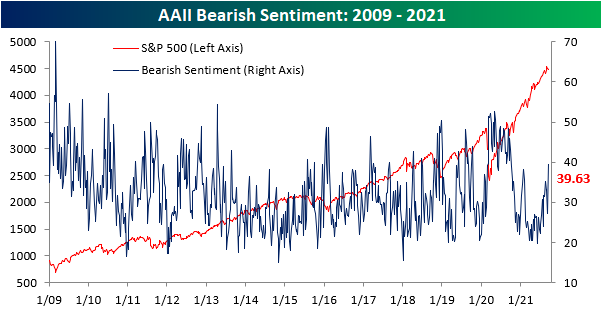
Given that massive decline in bullish sentiment, bearish sentiment obviously picked up substantially. The percentage of respondents reporting as bearish spiked 12.1 percentage points to 39.3%. That is the highest reading on pessimism since early October of last year, and it was the largest one-week uptick in bearish sentiment since the 24.14 percentage point spike in August 2019.
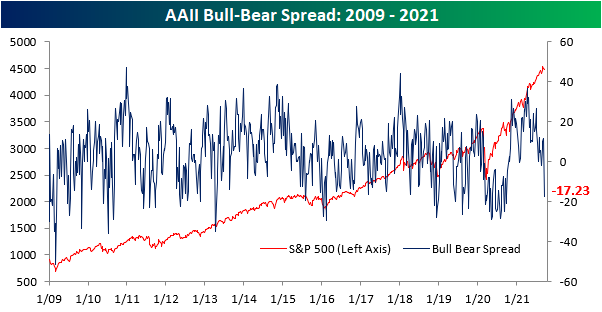
As a result of those big inverse moves in bulls and bears, the spread between the two crashed back into negative territory meaning bears now outnumber bulls for the first time since the week of August 19th. While it has not been too long since bears outnumbered bulls, the degree to which that is the case is significant. The last time that the bull-bear spread was as negative as it is now was in August 2019.
That is not to say all the losses to bullish sentiment went to the bearish camp. Neutral sentiment rose for a second week in a row adding over 15 percentage points in that time. Currently, 38.3% of respondents are neutral. That is an elevated reading but only the highest since the end of July.

To see how the S&P 500 has performed following similar types of sentiment readings, make sure to log in. If you aren’t currently a subscriber, sign up for a two-week trial to Bespoke Premium to view the rest of this report.
S&P Dividend and Treasury Yields Are Nearly Identical
On February 25th of this year, the 10-Year Treasury yield surpassed the dividend yield of the S&P 500 for the first time since January 17th, 2020. Currently, the S&P 500’s dividend yield stands at 1.33% vs. the 10-Year’s yield of 1.31%, so they’re essentially right inline with each other at the moment.
Since 1971, the 10-Year yield has been higher than that of the S&P 90.7% of the time, and the median spread between the 10-Year yield and the S&P’s dividend yield has been +3.5 percentage points. Both yields are much lower than their typical level since 1970. The S&P’s dividend yield has been higher than its current level 94.62% of the time. As for the 10-Year Treasury, its yield has been higher 97.55% of the time.

The spread between these two yields generally narrowed between the ’90’s and the mid 2000’s. The first time the S&P’s dividend yield crossed above the 10-Year yield was in November 2008 in the midst of the Financial Crisis. Since then, the spread has never been more than 2 percentage points in either direction, with a range from -1.99 to 1.67. The spread was the largest in September of 1981, when the 10-Year Treasury yield was 10.23 ppts higher than that of the S&P 500’s dividend yield.

The 10-Year yield has also historically been more sensitive to economic change. The average rate of change over a one month period for the yield of the 10 year has been 4.82% to the upside and -4.95% to the downside. The S&P 500 dividend yield’s average rate of change over the same time period has been 3.64% to the upside and -3.23% to the downside. The correlative coefficient between the two yields is .80, signifying that the two figures are strongly correlated. This makes sense, as the two are alternative forms of income. When one yield increases, it becomes more attractive to investors, who will sell off the alternative, thus raising the yield of the alternative as the price decreases.
