Daily Sector Snapshot — 7/11/22
KWEB Gaps Down 4%+
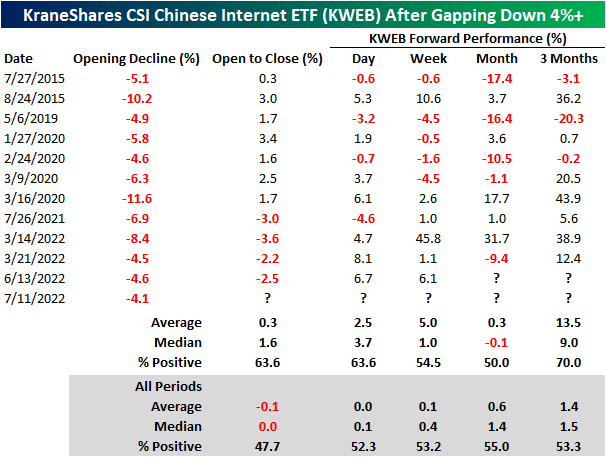
Today, the KraneShares CSI Chinese Internet ETF (KWEB) gapped down by 4.1% due to regulatory pressures from the Chinese Communist Party and an uptick of COVID cases in a few Chinese cities. Since KWEB’s inception in August 2013, the ETF has only gapped down by 4%+ 12 times, the largest of which was an 11.6% drop in March of 2020 during the height of the COVID crash. Following these weak opening gaps, KWEB has tended to partially recover throughout the day, booking a median gain of 1.6% between the open and the close. However, today the stock bucked that pattern and continued to decline from the open to close falling an additional 2%, resulting in a total loss of over 6%.

Following prior downside gaps of 4%+, KWEB has bounced back by a median of 3.7% the next day, with positive returns nearly two-thirds of the time. Over the course of the next week, KWEB has posted a median gain of 1.0%, which is 0.6 percentage points better than the average of all periods. For all the time periods that we looked at, KWEB’s median performance following these occurrences has outperformed the median of all periods, apart from the following month. Three months later, KWEB has booked a median gain of 9.0%, which is 7.5 percentage points higher than the 1.5% average for all periods. Click here to learn more about Bespoke’s premium stock market research service.
Elon Musk: The 2022 Twitter (TWTR) Catalyst
On the front page of most news sites today is the headline that Elon Musk has officially sent notice terminating his deal to acquire Twitter (TWTR). Similar to the way other celebrities have appeared to be major catalysts for a stock in the past year, like Joe Rogan and Spotify (SPOT), Musk’s interest in one of the cornerstones of social media has played a major role in the movements of TWTR’s stock this year. Below, we show a timeline of the saga overlaid on the charts of TWTR’s stock price and the daily percent change since the start of the year.
Back in early April—only a little more than a week after Musk tweeted a poll regarding the platform and free speech then following up with a tweet mentioning the “consequences of this poll will be important”—markets got confirmation that one of history’s wealthiest people had become the company’s largest single owner of Twitter with a 9.2% passive stake. That sent the stock surging 27.12% in a single day. The following day, TWTR rose another 2% when the company extended an offer for him to join the Board of Directors. That was an offer that would be rejected only a few days later as the stock began to reverse some of the massive gains. TWTR would not go on to turn around until Musk officially offered to buy the company at $54.20 per share (4/14), his financing was confirmed (4/21), and finally, when a deal was reached (4/25).
We always say how the market is forward-looking, and it appears as though Mr. Market knew the deal was fake news the entire time. On the day the deal was announced, TWTR peaked a few dollars short of Musk’s proposed price and has been on the decline ever since. The worst of the reversal occurred in mid-May as Musk expressed a hold-up regarding the company’s tracking and reporting on fake/bot accounts. A lack of resolution to Musk’s reservation has been the justification for the undoing of the deal which was confirmed last Friday, resulting in Twitter shares to fall 13.74% since last Thursday’s close.

Finally, we would also note that even though Twitter (TWTR) is a major player in the social media space, it is way down the list in terms of the S&P 500’s largest stocks; especially after the recent drop. Conversely, Musk’s Tesla (TSLA) is currently the fifth-largest stock in the index based on market cap indicating it has an outsized impact on the moves of the S&P. Given all the recent events and Musk’s involvement, Twitter and Tesla have been trading increasingly in sync with one another over the past few months implying these moves in Twitter to some extent actually have ripple effects for the broader market via sympathetic moves in TSLA. For example, while Twitter is down 9.5% today as of this writing, TSLA is falling 6.5%.
Below we show the correlation between the daily moves in TWTR and TSLA on a rolling 2-month basis which would roughly cover the period when the Twitter deal came into question and shares began to roll over. Historically, the two stocks have had a modest positive correlation with a handful of stints in which that relationship became very strong like late 2018, the COVID Crash, and the first quarter of this year when growth stocks broadly fell together. This year, that correlation weakened a bit as the Twitter acquisition news began to develop, but since the deal began to fall apart, it has started to rip higher once again with the current level entering the top decile of historical readings. Click here to learn more about Bespoke’s premium stock market research service.

Consumers Run From Stocks
The New York Fed runs a monthly survey of consumer expectations (SCE) which covers topics ranging from inflation, the labor market, and household finances, and while its history is limited (starts in 2013), it provides a great look at where US consumers see the state of the economy and financial markets. The latest update for the month of June was released earlier today and provided some really interesting insights regarding different trends, but one we wanted to focus on here is how Americans view the prospects for stock prices.
As the equity market has weakened this year amid higher inflation and the Fed’s rate hike cycle, consumer sentiment towards the stock market has been declining, but the pace has really picked up in the last two months taking the total percentage of consumers expecting higher stock prices to its lowest level (33.8%) in the history of the survey. Put another way, just about two-thirds of US consumers expect stock prices to remain flat or decline over the next 12 months. Add this to the long litany of other sentiment surveys showing investors and consumers alike have little confidence in the stock market. Click here to learn more about Bespoke’s premium stock market research service.

Chart of the Day – What About That Yield Curve?
Bespoke’s Morning Lineup – 7/11/22 – Slow Start to a Busy Week
See what’s driving market performance around the world in today’s Morning Lineup. Bespoke’s Morning Lineup is the best way to start your trading day. Read it now by starting a two-week trial to Bespoke Premium. CLICK HERE to learn more and start your trial.
“I have thought it my duty to exhibit things as they are, not as they ought to be.” – Alexander Hamilton

Below is a snippet of content from today’s Morning Lineup for Bespoke Premium members. Start a two-week trial to Bespoke Premium now to access the full report.
After a nice week to kick off the quarter, we are seeing some giveback this morning as all of the major US averages are indicated to open lower. Along with weaker stock prices, crude oil, gold, and crypto are joining the downward bias. Treasuries, however, have bucked the trend with the 10-year yield trading down near 3%.
This week will be an important one for the markets with some key economic data (CPI, PPI, and Retail Sales) as well as the start of earnings season, but it’s starting off slow as there are no significant economic reports and the only earnings report of note is from Pepsi (PEP) after the close.
In today’s Morning Lineup, we discuss moves in Asian and European markets and economic data from around the world.
Last week was a pretty good one for US equities with the S&P 500 up nearly 2% and the Nasdaq up over 4%. Even after the gains, both the Nasdaq and the S&P 500 failed to close above their 50-day moving averages (DMA). The Nasdaq is just fractionally below that level, and the S&P 500 is over 1.5% below its 50-DMA. While the Nasdaq wasn’t able to re-take its 50-DMA, it does appear to have broken a downtrend that has been in place since the Spring. The S&P 500, on the other hand, also remains below its downtrend from the Spring, so it still has more work to do on the upside. Just as the 50-DMA tends to act as support in uptrends, it tends to act as a headwind during downtrends, so this week should prove to be a critical one as we get deeper into Q3. A failure on the part of the indices to break above their respective downtrends or reclaim their short-term moving averages could set the market up for a long earnings season.

Last week’s rally was dominated by the ‘trash’ as the year’s three worst performing sectors were the leaders last week. Consumer Discretionary rallied 6.5% over the last five trading days (July 1st through last Friday), while Technology and Communication Services both surged 4%. Even after these gains, all three sectors are still down well over 20% YTD. On the downside, it was generally the year’s winners that lagged last week as Energy and Utilities both experienced fractional declines. One outlier to the trend was Materials. It was the worst-performing sector over the last five trading days and it is also the fifth worst-performing sector YTD, and one of just two oversold sectors.

Start a two-week trial to Bespoke Premium to read today’s full Morning Lineup.
Bespoke Brunch Reads: 7/10/22
Welcome to Bespoke Brunch Reads — a linkfest of the favorite things we read over the past week. The links are mostly market related, but there are some other interesting subjects covered as well. We hope you enjoy the food for thought as a supplement to the research we provide you during the week.
While you’re here, join Bespoke Premium with a 30-day free trial!
Autos
Registrations for electric vehicles soar, signaling increasing mainstream acceptance by Jayme Deerwester (USA Today)
Electric vehicle sales industry-wide were up 60% YoY in Q1 despite an 18% drop in overall registrations. Fully electric vehicles in the US are just below 5% of total passenger sales in the US with roughly 60% of sales driven by Tesla. [Link; auto-playing paywall]
Monthly car payments have crossed a record $700. What that means by Brittany Cronin (NPR)
The combination of car price inflation and more feature-laded vehicles along with soaring interest rates are driving a surge in the monthly payment required to cover a car purchase. [Link]
New York Waterways
Give Me Your Tired, Your Poor, Your Pods of Dolphins—New York Welcomes New Immigrants by Alyssa Lukpat (WSJ)
As the rivers around New York have gotten cleaner, dolphins have returned to New York harbor in pursuit of a snack. Fins have been spotted from Brooklyn to Harlem, delighting residents. [Link; paywall]
She died in a Manhattan penthouse but was buried on an island for the poor by Mary Jordan (WaPo)
A tiny one mile slice of Long Island Sound is the largest public cemetery in America, serving as the final resting place for more than 1 million souls interred since 1869. [Link; soft paywall]
Real Estate
Roaring US Rental Market Shows Early Signs of Slowing Down by Paulina Cachero (Bloomberg)
High frequency indicators suggest that rents are starting to fall in a range of markets that were absurdly hot during 2020 and 2021, with large drops for 1- and 2-bedroom apartments alike. [Link; soft paywall, auto-playing video]
The Suburban Lawn Will Never Be the Same by Brian Eckhouse and Siobhan Wagner (Bloomberg)
As drought wracks the American West, homeowners have started to replace dead, dried out grass with artificial turf which doesn’t have the same thirst for scarce water that real blades would soak up. [Link]
Crypto
‘It’s Ruined Me’: Voyager Customers Fear Life Savings Gone After Crypto Firm’s Bankruptcy by Maxwell Strachan (Vice)
A crypto brokerage that promised huge yields for deposits of fiat currency has suspended withdrawals and declared bankruptcy, leaving customers holding the bag. [Link]
Sports
World Cup stadiums in Qatar to be alcohol-free – source (i24)
Thirsty footy fans are going to be totally out of luck at the World Cup this fall, with host country Qatar banning alcohol consumption in public…including the stands of matches at the iconic sporting event. [Link]
Fiscal Policy
Was the Paycheck Protection Program Effective? by William R. Emmons and Drew Dahl (FRB St Louis)
As COVID smashed the US economy in 2020, Congress traded off speed for precision. The consequence is that Paycheck Protection Program loan/grants were much less useful in supporting workers than unemployment insurance or economic impact payments. [Link]
Energy Shortage
Germany dims the lights to cope with Russia gas supply crunch by Guy Chazan (FT)
Russia is cutting off natural gas supplies to Germany, and the result is a nationwide energy crisis that is forcing rationing and massive price inflation onto households used to cheap and reliable gas supplies. [Link; paywall]
That’ll Leave A Mark
Markets Had a Terrible First Half of 2022. It Can Get Worse. by James Mackintosh (WSJ)
Stocks collapsed in the first half of the year, but the pessimist’s perspective offers little hope of a major rebound in the second half given how much risk still remains. [Link; paywall]
Read Bespoke’s most actionable market research by joining Bespoke Premium today! Get started here.
Have a great weekend!
The Bespoke Report — 7/8/22
This week’s Bespoke Report newsletter is now available for members.
In this week’s Bespoke Report, we’ve recapped today’s nonfarm payrolls report, provided an update on inflation trends, taken a look at sector breadth and internals, previewed the upcoming earnings season, and highlighted the recent price action in mega-caps and uber-growth stocks. To read this week’s full Bespoke Report newsletter and access everything else Bespoke’s research platform offers, start a two-week trial to one of our three membership levels.