
Daily Sector Snapshot — 2/1/23
Bespoke’s Consumer Pulse Report — February 2023
Bespoke’s Consumer Pulse Report is an analysis of a huge consumer survey that we run each month. Our goal with this survey is to track trends across the economic and financial landscape in the US. Using the results from our proprietary monthly survey, we dissect and analyze all of the data and publish the Consumer Pulse Report, which we sell access to on a subscription basis. Sign up for a 30-day free trial to our Bespoke Consumer Pulse subscription service. With a trial, you’ll get coverage of consumer electronics, social media, streaming media, retail, autos, and much more. The report also has numerous proprietary US economic data points that are extremely timely and useful for investors.
We’ve just released our most recent monthly report to Pulse subscribers, and it’s definitely worth the read if you’re curious about the health of the consumer in the current market environment. Start a 30-day free trial for a full breakdown of all of our proprietary Pulse economic indicators.
Bespoke’s Matrix of Economic Indicators – 2/1/23
Our Matrix of Economic Indicators provides a concise summary analysis of the US economy’s momentum. We combine trends across the dozens and dozens of economic indicators in various categories like manufacturing, employment, housing, the consumer, and inflation to provide a directional overview of the economy.
To access our newest Matrix of Economic Indicators, start a two-week free trial to either Bespoke Premium or Bespoke Institutional now!

Bespoke Market Calendar — February 2023
Please click the image below to view our February 2023 market calendar. This calendar includes the S&P 500’s historical average percentage change and average intraday chart pattern for each trading day during the upcoming month. It also includes market holidays and options expiration dates plus the dates of key economic indicator releases. Click here to view Bespoke’s premium membership options.

10 Names For Half the Move
Taking tabs on the strong first month of the year, at multiple points in the past day we highlighted (see here, here, and here) which areas were the best performing parts of the market. In January, sectors like Tech, Communication Services, and Consumer Discretionary saw massive outperformance following the opposite playing out throughout 2022. Another significant point to these sectors is that they are home to some of the largest stocks in the S&P 500 by market cap; meaning those largest stocks have outsized impacts on the moves in the market cap-weighted S&P 500. As such, a massive portion of the S&P 500’s gains in January came from only a handful of names.
In the table below, we show the ten stocks which had the largest impacts on the S&P 500 index level moves. With double-digit percentage rallies during the month, the largest stocks in the index with market caps of more than $1 trillion like Apple (AAPL) and Amazon (AMZN) top the list. Those two alone accounted for over a fifth of the S&P’s gains in January. Impressively, adding in the rest of the top ten largest contributors (which account for roughly a third of the S&P 500’s total market cap) shows that those ten names combined had nearly the same impact as the hundreds of other stocks that make up the index.


Although mega caps, and thus a handful of sectors, have provided an outsized boost to the S&P 500 to start out the year, the market’s rally has still been broad-based as breadth has been quite positive. As shown below, the S&P 500’s cumulative advance-decline (A/D) line has been grinding higher and making new highs even as price has not been as strong. In other words, a large number of stocks are moving higher even if a small number of stocks are pulling more than their fair share of the load. Click here to learn more about Bespoke’s premium stock market research service.

Home Prices Coming Down from the Summit
November home price data from S&P CoreLogic Case Shiller was released earlier this week, and below is an updated look at recent changes in prices across the country.
The composite and national indices all fell month-over-month (m/m) for the fifth month in a row, but the year-over-year (y/y) change in prices is still running at +6% or more. Unless prices plummet at an even faster pace over the next couple of months, we likely won’t see a negative y/y number until the March or April 2023 data is released (which won’t be until May/June since the data is released on a two-month lag).

Looking at different parts of the country, cities in the West fell the most m/m with declines of more than 1% in San Francisco, Seattle, San Diego, Phoenix, and Las Vegas. Dallas and Tampa also fell 1%+ m/m, although Miami only fell 20 bps. New York saw prices fall the least of any city at just -0.06% m/m.
Notably, while the national indices are still up 6%+ y/y, San Francisco is the first city to fall into the red on a y/y basis with a decline of 1.57% in prices from November 2021 to November 2022. Tampa and Miami home prices are still up the most y/y with gains of 16.85% and 18.41%, respectively.
We also show how much prices are up since February 2020 just before COVID began as well as how much prices have now fallen from their post-COVID peaks. The national indices are all still up more than 30% from pre-COVID levels, and so far they’ve fallen around 5% from their highs. San Francisco and Seattle have seen the biggest drops in prices with declines of more than 13%, while New York, Chicago, Miami, and Atlanta have seen prices fall the least.


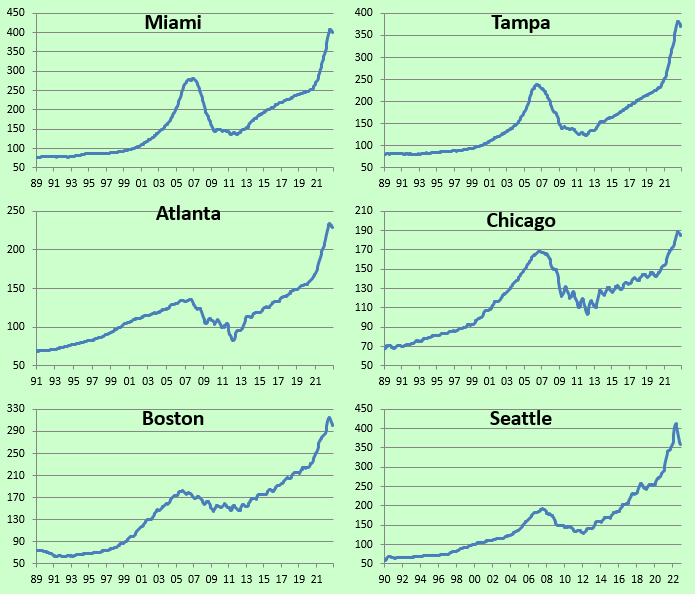
Below are historical price charts of the Case Shiller home price indices for all of the cities covered. While prices look to have peaked, you can see that they’re still extremely elevated relative to any point over the last 30+ years, including the prior housing bubble highs seen in the mid-2000s before the housing crash that occurred alongside the Financial Crisis of 2008/2009. If the peak was the summit of Mt. Everest, we’re still a long way from base camp. Click here to learn more about Bespoke’s premium stock market research service.



Bespoke’s Morning Lineup – 2/1/23 – Starting the Month on a Down Note
See what’s driving market performance around the world in today’s Morning Lineup. Bespoke’s Morning Lineup is the best way to start your trading day. Read it now by starting a two-week trial to Bespoke Premium. CLICK HERE to learn more and start your trial.
“Money is the MC-mansion in Sarasota that starts falling apart after 10 years. Power is the old stone building that stands for centuries.” – Frank Underwood, House of Cards

Below is a snippet of content from today’s Morning Lineup for Bespoke Premium members. Start a two-week trial to Bespoke Premium now to access the full report.
What a January that was! After closing out an already bad year on a down note, the Nasdaq stormed into 2023 rallying 10.7% in January. Never mind the fact that it’s still only 1% higher than where it was when it closed November, the strong start to the year has a lot of bulls newly emboldened, although there’s more than a small minority of investors saying they won’t get fooled again.
So how common is it to see the Nasdaq rally 10% or more in a month? Since 2000, there have been 33 prior months where the Nasdaq rallied at least 10%, and if you narrow that down to 10% monthly rallies that followed a twelve-month period where the index was down, the list gets cut in half to just 16 prior occurrences. In the table below, we list each of those prior months since 2000 along with the Nasdaq’s forward performance over the next one, three, and twelve months. Since 2002, these 10%+ rallies after a decline in the prior twelve months have been followed by positive returns in the next year. During the year 2001, though, there were four separate occurrences, and each one was followed by declines over the next year. For a longer-term and more detailed look at the Nasdaq’s performance after 10+ monthly gains, check out today’s Morning Lineup.

Our Morning Lineup keeps readers on top of earnings data, economic news, global headlines, and market internals. We’re biased (of course!), but we think it’s the best and most helpful pre-market report in existence!
Start a two-week trial to Bespoke Premium to read today’s full Morning Lineup.
January 2023 Asset Class and Stock/Sector Performance
It was a January to remember for investors (who went through one of the worst years in recent history in 2022). Below is a look at the recent performance of various asset classes using our ETF matrix. Performance in January (YTD 2023), over the last six months, and over the last year is shown for each ETF (or exchange traded product).
Looking specifically at January, the Nasdaq 100 (QQQ) was the best performing US index ETF with a gain of 10.6%. The small-cap Russell 2,000 (IWM) wasn’t far behind with a gain of 9.8%. The Dow 30 (DIA) — the index that held up the best in 2022 — was up the least in January with a gain of 2.95%.
At the sector level, Communication Services (XLC) was up the most with a gain of 15.1% followed closely by Consumer Discretionary (XLY) at 14.8%. While these two sectors were up double-digit percentage points, three sectors actually fell in January: Consumer Staples (XLP), Health Care (XLV), and Utilities (XLU).
Outside of the US, the bulls were running with a number of country ETFs up 10%+, including Australia (EWA), China (ASHR), France (EWQ), Germany (EWG), Italy (EWI), Mexico (EWW), and Spain (EWP). India (PIN) was the only country in our matrix that was down with a decline of just 5 basis points.
Commodity ETFs/ETNs were mostly flat with one exception — natural gas. As shown, UNG was down 33.9% in January, and it’s now down 67.4% over the last six months.
Finally, Treasury ETFs continued to bounce back after a horrific 2022, with the longer the duration, the better the performance. The 20+ year Treasury ETF (TLT) was up the most with a huge monthly gain of more than 7%.

Below is a look at the average performance of stocks in the large-cap Russell 1,000 by sector during this past January. We also show the average distance from 52-week high and the average total return in 2022. As you can see, the areas that got hit the hardest in 2022 are the ones that bounced back the most in January. The average stock in the Communication Services sector gained 16% in January, but these stocks are still 32% below their 52-week highs after falling 32.6% in 2022. Energy and Utilities stocks averaged minimal gains in January, but they’re also the only two sectors that averaged gains in 2022.

Finally, below is a list of the 35 best-performing individual stocks in the Russell 1,000 in January. Topping the list is Carvana (CVNA) — which is still in the Russell 1,000 for now — with a gain of 114.6% during the month. Even after more than doubling in January, CVNA remains 94% below its 52-week high.
Aside from National Instruments (NATI), this list of big winners in January is a who’s who of stocks that got crushed in 2022. Not one stock was up last year, and they were down an average of 61.6% in 2022! After averaging a gain of 49.6% this month, they’re still close to 50% below their 52-week highs. The two biggest stocks on the list are Tesla (TSLA) and NVIDIA (NVDA). Tesla ended up gaining 40.6% in January after falling 65% in 2022, while NVIDIA gained 33.7% after getting cut in half in 2022. Some other recognizable names include Lucid (LCID), Peloton (PTON), Warner Bros Discovery (WBD), Lyft (LYFT), Spotify (SPOT), Roku (ROKU), Zillow (ZG), Paramount (PARA), and Carnival (CCL).

On the flip side, below are the 35 worst-performing stocks in the Russell 1,000 in January. Whereas the best-performing stocks this month were the ones that got hit hardest last year, the worst-performing stocks this month were mostly names that actually posted gains in 2022. On average, these 35 stocks fell 8.5% this month, but they were up 11.4% last year and are only 24% from 52-week highs. The three worst-performing stocks in January were Northrop Grumman (NOC), Enphase Energy (ENPH), and Texas Pacific (TPL). All three were up huge last year, with NOC up 43%, ENPH up 44.8%, and TPL up 91.2%. Click here to learn more about Bespoke’s premium stock market research service.

As always, past performance is no guarantee of future results.