
The Closer – 7/5/16: Just a Mirage in the Fog?
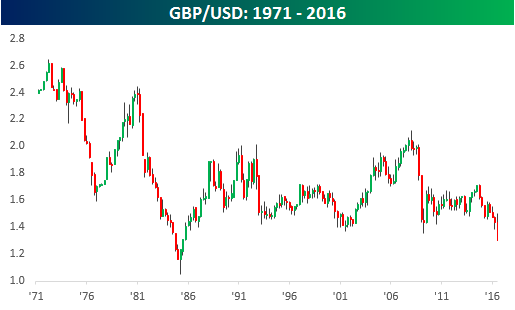
Looking for deeper insight on global markets and economics? In tonight’s Closer sent to Bespoke clients, we discuss the fall in the pound and long-term interest rates, we quantify the record level of policy uncertainty in the UK, and the trend for what we consider the two biggest drivers of equity prices this year. Regarding the pound, after today’s decline the pound has only been lower than its current level in less than 2% of all trading days in nearly the last 50 years!
The Closer is one of our most popular reports, and you can sign up for a trial below to see it and everything else Bespoke publishes free for the next two weeks!
Click here to start your no-obligation free Bespoke research trial now!
UK Equity Markets Dip Below 5%
Below is a chart (using Bloomberg data) showing the percentage of total world stock market capitalization that UK stocks make up. Ten years ago, the UK made up roughly 8% of global market cap, but after a steady trend lower over the years, that number has dipped below 5% following the Brexit debacle. For actionable market analysis, start a 14-day free trial to Bespoke’s premium research today!
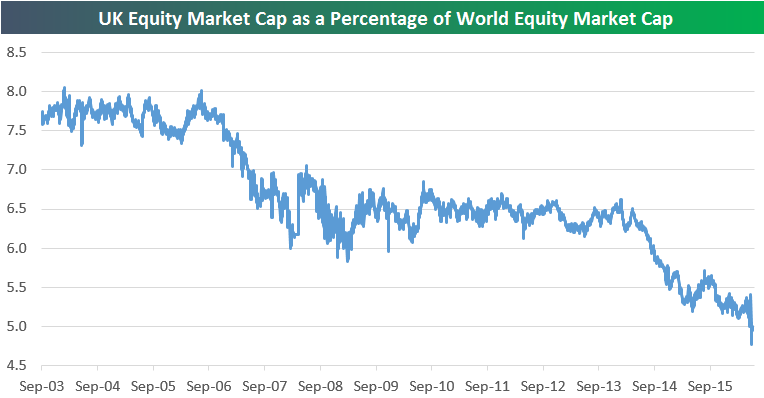
Chart of the Day: TLT Hits High Earth Orbit
As long-dated Treasury yields continue to plummet, their prices have gotten extremely overbought. The ETF that tracks 20+Year Treasuries — TLT — is currently trading above $140/share, which is a new all-time high. At its current price, TLT is just under 3 standard deviations above its 50-day moving average. As shown below, that’s the most overbought it has been in at least a year:
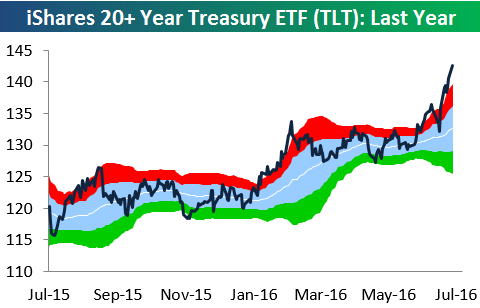
In today’s Chart of the Day sent to paid subscribers, we highlight the near-term forward returns for TLT when it has gotten this overbought in the past. To view the report, please start a 14-day free trial below.
ETF Trends – Hedge: 7/5/16
Below is our daily list of the twenty best and twenty worst performing ETFs over the last five trading days. Gold stocks continue to rise, although silver has claimed the top spot today. After a hiatus for much of June, the biotech ETF (IBB) has returned to the list of best performers. Coffee also remains a strong performer. The British pound is the only ETF that has declined more than 1% over the past five days, as all but 5 of the 259 ETFs we include are positive over the last week.

Bespoke provides Bespoke Premium and Bespoke Institutional members with a daily ETF Trends report that highlights proprietary trend and timing scores for more than 200 widely followed ETFs across all asset classes. If you’re an ETF investor, this daily report is perfect. Sign up below to access today’s ETF Trends report.
See Bespoke’s full daily ETF Trends report by starting a no-obligation free trial to our premium research. Click here to sign up with just your name and email address.
Bespoke Stock Seasonality Report: 7/5/16
More Lower Highs
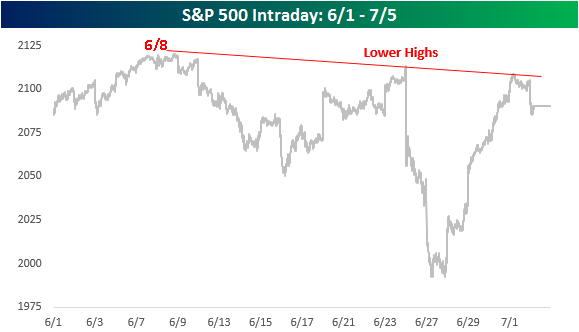
After its all-time high in May of last year, the S&P 500 essentially went range-bound for 13 months with a series of lower highs around the 2,100 level. While there were numerous attempts to break through to the upside, bulls just couldn’t push the market up through that downtrend, and failed rallies were followed with steep selling. On June 8th, though, there looked to finally be some light at the end of the tunnel when the S&P 500 closed at 2,119 and above its prior lower high of 2,102. While all-time highs were still more than 10 points away, there was finally some optimism regarding a break-out.
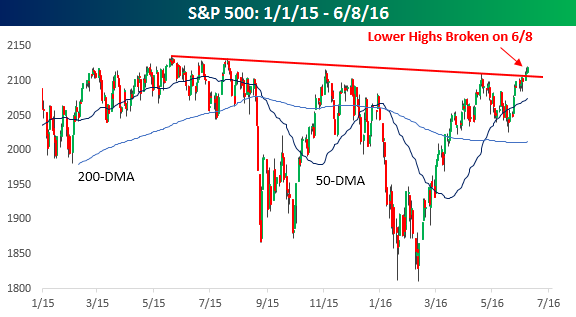
So what happened after that June 8th higher high in the S&P 500? Well, not much. Below we show an intraday chart of the S&P 500 since the start of June. From that June 8th peak, the S&P 500 pulled back about 3% and rallied back but peaked out on June 23rd just ahead of the Brexit vote. Then, the post-Brexit sell-off quickly knocked about 5% off the S&P 500, and while equities quickly snapped back, through Friday’s close the rally has once again fallen short of the prior peak.
Stock Volatility on Earnings by Sector
In our prior post, we highlighted the sectors that have historically seen stocks beat earnings estimates the most and least often using our Interactive Earnings Report Database. Below we highlight how volatile stocks are on their earnings reaction days by sector. Before proceeding, though, we just want to explain what an “earnings reaction day” is. For a stock that reports earnings pre-market before the open of trading, its earnings reaction day is that trading day. For a stock that reports earnings post-market after the close, its earnings reaction day is the next trading day.
Using earnings reaction day price change data for more than 130,000 individual quarterly earnings reports going back to 2001, the average stock that reports earnings experiences a one-day change of +/-5.3% in response to that report.
Unsurprisingly, Technology stocks are the most volatile in response to earnings with an average earnings reaction day change of +/-7.3%. The second most volatile sector is Consumer Discretionary, whose stocks average a move of +/-6.1% on their earnings reaction days. Health Care stocks rank third at +/-6.0%, followed by Industrials at +/-5.4%.
Six sectors are less volatile than average — Consumer Staples, Telecom, Materials, Energy, Financials and Utilities. As you would expect, Utilities stocks are the least volatile in response to earnings reports with an average one-day change of just +/-2.2%. The Financial sector is the second least volatile with an average earnings reaction day change of +/-3.2%. For actionable earnings-season analysis, start a 14-day free trial to Bespoke’s premium research today!

Historical Earnings Beat Rates by Sector
The Q2 reporting period is set to begin next Monday, July 11th when Alcoa (AA) reports earnings after the close. Between now and next Monday, Bespoke will be publishing a good amount of earnings related-content. We’re able to do this because we have a gigantic database of quarterly earnings reports for individual stocks going back 15 years to 2001. This database — the Bespoke Interactive Earnings Report Database — is available to Bespoke Institutional subscribers right on our website. If you’re interested in gaining access, you can learn more about it here.
We have more than 130,000 quarterly earnings reports for individual stocks in our database, and we can combine and filter these reports in a number of ways. One way is to analyze earnings trends by sector. Below we provide a chart showing the historical earnings beat rate by sector. The “earnings beat rate” is the percentage of time a company reports actual earnings that are stronger than consensus analyst earnings estimates. Before looking at sector stats, we want to point out that for all quarterly earnings reports over the last 15 years, the average stock has beaten earnings estimates 61% of the time.
Notably, just three sectors have earnings beat rates that are stronger than the average beat rate of 61% for all stocks across all sectors. These three are Technology, Consumer Discretionary, and Industrials. The Technology sector has far and away the strongest earnings beat rate at 70%. That’s important because Tech has the largest weighting in the S&P 500 at 20%. Consumer Discretionary has the second strongest beat rate at 63%, and Industrials ranks third at 61%.
Health Care, Consumer Staples, and Financials have beat rates just under 61%, while Telecom, Energy, Utilities, and Materials have the lowest beat rates in the market.

Bespoke Brunch Reads: 7/3/16
Welcome to Bespoke Brunch Reads — a linkfest of the favorite things we read over the past week. The links are mostly market related, but there are some other interesting subjects covered as well. We hope you enjoy the food for thought as a supplement to the research we provide you during the week.
After Brexit
UK existential moment: thinking about the economy, sovereignty and Article 50 by George Magnus
An excellent overview of Brexit’s economic impact and the overall damage done to the UK’s position following the last week or so of events. [Link]
Economic implications of Brexit by Ben S. Bernanke (Brookings)
Another excellent view on what Brexit means for the UK and the rest of the global economy following the vote and subsequent political mess, this time by the thoughtful former Fed Chair. [Link]
Don’t Panic, it’s just like EU 2012. by Polemic Paine (Polemics Pains)
A breath of relaxation over the tumultuous week’s long-term implications from pseudonymous blogger and market old-hand Polemic. [Link]
UK Politics
Here’s How The Internet Reacted To The Most Ridiculous Morning British Politics Has Ever Seen by Alan White (Buzzfeed)
The last day of June was probably the peak – though almost certainly not the end – of post-Brexit shakeouts in the political establishment of the UK. This guide provides a helpful overview for all the zany goings-on. [Link]
Geopolitics
Russia is harassing U.S. diplomats all over Europe by Josh Rogin (WaPo)
Suspected Russian agents have done all sorts of strange things to US diplomats recently, with some incidents quite serious despite their strange headlines, including an unfortunate incident involving a carpet. [Link, soft paywall]
So you want to secede from the U.S.: A four-step guide by Phillip Bump (WaPo)
Amusing discussion of the secession process for US states, which doesn’t exist. Our favorite quote: “Asking the U.S. if you can secede from it is a bit like asking your iPhone if you can use it as an iron lung. It’s not built to do that, and also: No.” [Link]
China
Exclusive: China to tolerate weaker yuan, wary of trade partners’ reaction – sources by Kevin Yao, Nathaniel Taplin, and Lu Jianxin (Reuters)
Sources close to the PBoC are suggesting that a further rise in USDCNY would be tolerated by authorities, so long as the depreciation remained controlled. This would likely follow the pattern we’ve seen over the last quarter or so: rallies in the broad dollar lead to declines in USDCNY, while selloffs keep USDCNY stable, pushing the CFETS index of yuan strength lower over time. [Link]
Writing China: The Compromise of China’s Millennials by Te-Ping Chen (WSJ)
One-third of China’s population are Millennials, and the group is often misunderstood – a condition which seems to be true in quite literally every country. This interview with Alec Ash, author of “Wish Lantern: Young Lives In New China” offers some interesting insights. [Link, paywall]
Ex-Lehman Trader Loads Up on Bad Chinese Debt (Bloomberg)
Bad loans are a way of life within the Chinese financial system and squeezing what value can be had from them requires a special approach (as it does anywhere else). The results are, for now, big returns. [Link]
Wealth Distribution
Not Just the 1%: The Upper Middle Class Is Larger and Richer Than Ever by Josh Zumbrun (WSJ Real Time Economics)
While much attention goes to the share of income that is taken in by the richest 1% of Americans, there’s been less attention paid to the fact that millions of people have transitioned up out of lower incomes and into the booming ranks of the upper middle class. [Link]
Capital Accumulation, Production and Employment: Can We Bend the Arc of Global Capital Toward Justice? by Richard C. Koo (WEA Conference Papers)
Koo’s work has broadly focused on the concept of the balance sheet recession, but this stab attempts to get a handle on the distribution of wealth and its importance for the global economy. [Link, 92 pg PDF]
Language
The World’s Most Efficient Languages by John McWorther (The Atlantic)
A lovely overview of linguistics and efficiency, featuring phrases like “sǝq’ayǝƛaaɣwǝaɣhaś” and “Ayam makan”. [Link]
Climate
Why the sun going blank means a ‘Game of Thrones’-like winter is coming (New York Post)
Solar activity is an often under-appreciated driver of terrestrial climate conditions, and the current lack of sunspots suggests that the sun is going to provide a lot less warmth in coming winters. [Link]
Crime
Welcome to Miami, the WORST city in America: Study claims Florida’s party hotspot has worse crime, income, and poverty levels than anywhere else in the US (Daily Mail)
Extreme inequality, wide-spread poverty, and high crime rates are key driver’s of Miami’s claim to the “worst” (an admittedly subjective) term city in America. [Link]
The Longform Guide To Manhunts (Longform)
This excellent collection of long reads about searches for the baddies will keep you busy for quite a while. [Link]
Investing
Millennials Are Pretty Cocky About Their Investing Skills by Ben Steverman
We’re shocked, just shocked to learn that young people in general are confident in their ability to do well in markets. [Link]
NYC
How 6 Bodega Owners Make An Honest Living In NYC by Steffanee Wang and Amos Barshad (The Fader)
Bodega culture is a uniquely New York phenomenon: the little shops stocking staple household goods and limited food selections along with a deli counter and tobacco or lottery ticket sales are an institution across most of the Five Burroughs. They’re also a way upwards in society for many recent immigrants. [Link]
Birth Rates
Japan and its birth rate: the beginning of the end or just a new beginning? by Olga Garnova (Japan Times)
While much is made of falling headline birth rates in Japan, the aging population is by far the largest driver; the elderly are never going to start having more children. However, there’s good reason to suspect that Japan is in the midst of a new mini-boom in fertility rates for younger women. [Link]
Modern Medicine
Chili Peppers Could Free Us From Opioids by Cynthia Koons (Bloomberg)
A new series of drugs that target pain directly instead of washing over it with chemical scrubbing as opiods do could lead to a revolution in how we treat pain. [Link]
Replacing Drivers and Workers
How Amazon Triggered a Robot Arms Race by Kim Bhasin and Patrick Clark (Bloomberg)
The story behind the 30,000 robots that Amazon and its founder Jeff Bezos employ to maximize warehouse efficiency around the world. [Link]
The End of Traffic: How the Smartest People in the World Are Fixing Your Commute by Sam Grobart (Bloomberg)
The effort to end gridlock, in video form. [Link, auto-playing video]
The First Fatal Crash In A Self-Driving Car Has Happened; NHTSA Investigating Tesla by Raphael Orlove (Jalopnik)
An unlikely series of events led to the death of driver using Tesla’s Autopilot mode in Florida during the month of May. Here’s what happened. [Link]
The BESPOKE REPORT – 7/1/16
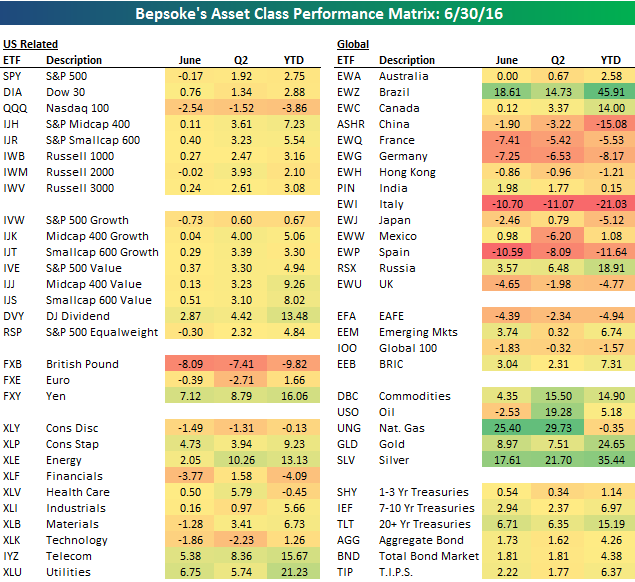
Below is a recap of financial market performance using our ETF Matrix which measures performance (in terms of price) of various ETFs. The version below contains performance figures for various ETFs (USD Price Changes) in the month of June, during the second quarter, and YTD. Focusing on Q2 (middle column), it was a modestly positive quarter for US equities as the only major index that was down during the quarter was the Nasdaq (-1.52%). All of the other indices featured were up anywhere from just over 1% (Dow Jones–DIA) to nearly 4% (Russell 2000-IWM). On a sector basis, Energy (XLE) contributed the most to the gains with a gain of 10.26%. Other sectors that were up more than 5% include Health Care (XLV), Telecom (IYZ), and Utilities (XLU).
In international markets, Brazil (EWZ) outdid every other country with its 14.7% gain. The only other country up over 5% was Russia (RSX), which was up 6.48%. On the downside, nearly all of the weakness was focused in Europe where Italy (EWI) dropped 11.1%, Spain (EWP) fell 8.1%, Germany (EWG) fell 6.53%, and France (EWQ) lost 5.42%. Closer to home, Mexico (EWW) was also weak with its decline of 6.2%.
In currencies, our ETFs were all over the place. The British Pound (FXB) fell 7.41%; it was actually up on the quarter heading into the Brexit vote. In the flight to safety trade that followed last week’s vote, investors also flocked to the Yen (FXY) as the ETF that tracks Japan’s currency was up 8.8%.
Finally, in commodities, all the ETFs shown were up sharply with DBC, USO (Oil), Nat Gas (UNG), and Silver (XLV) all up over 15%. Long term treasuries (TLT) also had a strong showing rallying 6.35%.
Each week, Bespoke sends clients across all of its subscription levels the Bespoke Report newsletter. If you’re looking for Bespoke’s analysis of current market internals, economic data, earnings beats and misses, individual stock ideas, and more, the Bespoke Report has it all.
Continue reading this week’s Bespoke Report by starting a 14-day free trial to our paid content below.
Have a great weekend and Happy 4th!