
Can the Fun Last for ACIA and TWLO?
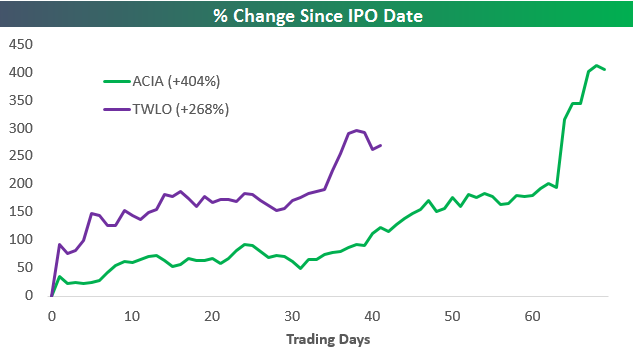
In last Friday’s Bespoke Report newsletter — which you can view by starting a two-week free trial to our premium research — we looked at the amazingly strong performance of two relatively recent cloud-related IPOs — Acacia (ACIA) and Twilio (TWLO). As shown in the chart below, Twilio (TWLO) is up 268% from its IPO price 41 trading days ago on June 22nd. Acacia (ACIA) is up even more at +404% since its IPOd 69 trading days ago on May 12th.
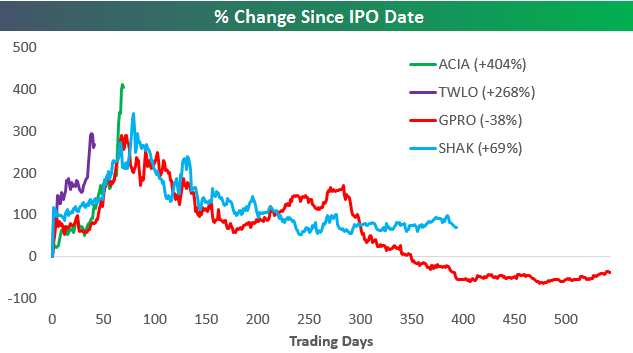
Two other relatively recent IPOs that come to mind when thinking about stocks that surged right out of the gate are Shake Shack (SHAK) and GoPro (GPRO). GoPro (GPRO) went public on June 25th, 2014, and within 67 trading days it was up 290%. Shake Shack (SHAK) IPOd on January 29th, 2015, and it gained 342% within 79 trading days. For Shake Shack and GoPro, though, the bloom came off the rose quickly. Below is a chart showing the percentage change for all four IPOs — ACIA, TWLO, GPRO, SHAK — from their respective IPO prices. Notably, both GPRO and SHAK hit their peaks after roughly 75 trading days. GPRO peaked after 72 trading days, while SHAK peaked on day 79. Today marks trading day 70 for ACIA, while TWLO is still just 42 trading days into its life as a public company.
Two things that can slow down hot IPOs are lock-up period expirations and the trading of options. Employees that own shares in IPOs typically have a lock-up period of 180 days where they can’t sell their shares. Once those lock-ups expire, it puts more supply of shares on the market. Options don’t typically begin trading for IPOs right away either. Once they do, it gives investors an additional way to make negative bets on a stock, whereas prior to the options trading, shorting the stock was the only way to take a negative bet. It’s usually very difficult to find shares to borrow short for high-flying IPOs right out of the gate. Both ACIA and TWLO already have options trading, but lock-ups are still in place. ACIA’s lock-up period expires in early November, while TWLO’s lock-up period expires in mid-December.
Just because GoPro (GPRO) and Shake Shack (SHAK) peaked at roughly the same time following their IPOs doesn’t mean that TWLO and ACIA are doomed to the same fate. The companies are in completely different industries in a completely different market environment. We think it does warrant a bit of caution, though, if you’re thinking about getting long here.
Dynamic Upgrades/Downgrades: 8/22/16
Bespoke Brunch Reads: 8/21/16
Welcome to Bespoke Brunch Reads — a linkfest of the favorite things we read over the past week. The links are mostly market related, but there are some other interesting subjects covered as well. We hope you enjoy the food for thought as a supplement to the research we provide you during the week.
Olympics
NBC’s $12 Billion Olympics Bet Stumbles, Thanks to Millennials by Gerry Smith (Bloomberg)
The rise of online media have sapped viewership for the Rio Olympics by 17% since versus the London Games four years ago. [Link; auto-playing video]
Could Rio’s Olympic pool have given some swimmers an unfair edge? By Jackie Bamberger (Yahoo!)
A researcher claims that almost half the improvement from one heat to the next amongst 50 meter freestyle swimmers was due to irregularities in currents. [Link]
Autonomous Vehicles
Ford will have a fully autonomous vehicle on the streets in less than five years by Phil LeBeau (CNBC)
One of the biggest OEMs in the world claims to be five years away from a production commercial vehicle without a steering wheel or pedals. [Link; auto-playing video]
Uber’s First Self-Driving Fleet Arrives in Pittsburgh This Month by Max Chafkin (Bloomberg)
Supervised by humans, Uber’s collaboration with Carnegie Mellon will yield on-street results this month as customized Volvos take to the streets of Pittsburgh. [Link]
The Ride Sharing Business: Is a Bar Mitzvah moment approaching? By Aswath Damodaran (Musings on Markets)
The valuation guru takes another stab at pricing the value of Uber (and ride-sharing more broadly) in the context of the most recent information about the company. [Link]
Affordable Care Act
Just Released: Firms Assess the Effects of the Affordable Care Act by Jason Bram and Richard Deitz (NY Fed Liberty Street Economics)
While businesses in the New York Fed region are seeing higher costs and incentives to raise deductibles, copays, and out-of-pocket maximums, less than one in five is reporting lower employment because of the law. [Link]
Aetna’s Retreat From Obamacare Is More Than It Seems by Megan McArdle (Bloomberg View)
An overview of the complicated dance between regulators and the companies they cover in the context of the recent decision by Aetna to drop out of 11 state exchanges. [Link]
Is Aetna’s withdrawal from the exchanges payback for the Justice Department’s antitrust suit? by Nicholas Bagley (The Incidental Economist)
More on the basic game theory of playing chicken – or poker – with regulators. [Link]
Hacking Civics
Google’s Search Engine Directs Voters To The Ballot Box by Michael Liedtke (AP)
In an effort to stimulate civic engagement, Google will begin directing voters towards registrations and polling information when certain keywords are punched in to the ubiquitous search engine. [Link]
Creator of chatbot that beat 160,000 parking fines now tackling homelessness by Elena Cresci (The Guardian)
A student who wrote a simple program which helps users navigate the formulaic process of parking ticket appeals in New York and London is now trying to do the same for applications to public housing. [Link]
Gonzo
Antlers Hunter S Thompson stole from Hemingway’s home returned to family by Alison Flood (The Guardian)
During a 1964 visit to the home of Earnest Hemmingway in Ketchum, Idaho, Hunter S. Thompson lifted a memento. Now, half a century later, that memento is being returned. [Link]
A Terrifying Journey Through the World’s Most Dangerous Jungle by Jason Motlagh (Outside)
A harrowing trip through the Darién Gap. While the place name bears a modest resemblance to a certain well-heeled suburb of New York City, the frontier-like environment couldn’t be more different. [Link]
Economics
Fifteen Fatal Fallacies of Financial Fundamentalism: A Disquisition on Demand Side Economics by William Vickery (Columbia Working Paper Project)
A sharp critique of the economic school of thought which only looks at one side of the economy to solve the problems of the day, be they inflation, growth, or otherwise. [Link]
U.S. Economy in a Snapshot – August 2016 by The FRBNY Research and Statistics Group (FRBNY)
This monthly update is a great one-stop shop for a sober assessment of the current state of the US economy. [Link; 15 page PDF]
Monetary Policy in a Low R-star World by John C. Williams (FRBSF Economic Letter)
The President of the SF Fed takes a crack at the challenges facing central banks in a world where the natural real rate of interest (R*) is very low. [Link]
Big Thoughts
The Narrative Machine by W. Be Hunt (Epsilon Theory)
The Chief Risk Officer of Salient Partners takes a crack at a complementary theory to the “Economic Machine”, the framework put forward by Ray Dalio of Bridgewater (the world’s largest hedge fund). The results are complicated and thought provoking. [Link]
The Danger of Deconsolidation: The Democratic Disconnect by Roberto Stefan Foa and Yascha Mounk (Journal of Democracy)
In this long article, the authors argue that the democratic institutions and maybe more importantly attitudes which form the bedrock of our current system of capitalist democracy are breaking down. We don’t necessarily agree with their conclusions but the argument is worth considering. [Link; 14 page PDF]
Common Law And The Origin of Shareholder Protection by Graeme Acheson, Gareth Campbell, and John Turner (QUCEH Working Papers)
A fascinating look at the origins of shareholder rights, and the benefits they gave to corporations which went above what was required by law in pursuit of fair outcomes for their shareholders. [Link; 51 page PDF]
Market Signals Just Aren’t What They Used to Be by Conor Sen (Bloomberg View)
More passive investing and a greater reliance on markets to judge the trajectory of monetary policy has created some concerning feedback loops. [Link]
Retailing
Walmart’s Out-of-Control Crime Problem Is Driving Police Crazy by Shannon Pettypiece and David Voreacos (Bloomberg)
Who knew that the nation’s largest retailer was an extraordinary hotbed for crime? A detailed look at the rap sheet for Wal-Mart visitors and the effort to crack down on crime around locations. [Link]
Science
Physicists confirm possible discovery of fifth force of nature (Phys.org)
The physics here is way over our heads (we prefer problems that can be solved using tools like Excel) but the idea of a new fundamental force is exciting. [Link]
Tech
Apple Hits Roadblocks in Cutting Watch Ties to iPhone by Mark Gurman, Alex Webb, and Scott Moritz (Bloomberg)
Itching to free your Apple Watch from the data tether it requires via your iPhone? Bad news. [Link; auto-playing video]
Intel Licenses ARM Technology to Boost Foundry Business by Ian King (Bloomberg)
With an inability to penetrate certain segments of the mobile market, Intel is looking to monetize production lines by licensing others’ tech. [Link]
Journalism
This Is What’s Missing From Journalism Right Now by Monika Bauerlein and Clara Jeffrey (Mother Jones)
In order to delve deep into investigative projects, Mother Jones is forced to take donations, use grants, and makes almost no money at all from advertising. [Link]
Careers
Why making a backup plan may set you up to fail by Ana Swanson (WaPo Wonkblog)
Sometimes the push you need is to get rid of the net underneath your tightrope. [Link]
Hedge Funds
Hedge Fund Investors Stop Paying for Bad Returns by Eric Uhlfelder (Barron’s)
It shouldn’t surprise anyone that low returns lead to outflows, even forgetting the fees involved. [Link; paywall]
Hedge fund manager used terminally ill patients for profit: SEC by Suzanne Barlyn (Reuters)
Eden Arc Capital allegedly used loopholes in brokerage account language to sign up dying patients and sell bonds back to issuers at favorable prices when those terminally ill people died. [Link]
Investing
This Is Radical: Three New ETF Ideas That Actually Make Sense by Jason Zweig (WSJ)
While the proliferation of ETFs is sometimes ridiculous, a few newcomers may result in truly useful financial innovation for investors. [Link; paywall]
This Basically Anonymous Fund Manager Oversees $800 Billion by Ben Steverman (Bloomberg)
The art of managing an index fund is quite different (and quite a bit less reliant on the performance of the market) than any other type of money management. [Link]
The Rise of the Buy Side by Alastair Marsh and Sridhar Natarajan (Bloomberg)
While the vast majority of the bond market still flows through the hands of dealers, customers have gained more transparency and execution has started to slowly drift towards more direct platforms. [Link]
Economic Change
No, Wall Street Journal, Chinese Imports Didn’t Kill My Hometown by Eric Cunningham (The Federalist)
While many blame foreign trade for the shift in many industries over the past 20 years, this writer astutely points out that the creative destruction of capitalism and rising productivity are far more significant, bringing with them both challenges and opportunities. [Link]
Great resource shift leaves investors walking tightrope by Henry Sanderson (FT)
As the world slowly begins to shift away from carbon and towards silicon, there’s a huge investment opportunity and risk to manage. [Link; paywall]
Fixed Income
Hunting for Yield? They’re Handing It Out in the Money Market by Ben Eisen and John Carney (WSJ)
As money market reform pushes AUM out of prime funds and into those buying only government liabilities, yields on commercial paper have risen significantly. [Link; paywall]
Banks’ CoCo Bond Payouts Gain More Protection in EU Proposal by John Glover and Boris Groendahl (Bloomberg)
Contingent convertibles – the source of much hand-wringing if little real financial stress for the markets last winter – may get new, less risky treatment from EU regulators. [Link]
S&P 500 Weekly Chart Book – 8/19/16
The BESPOKE REPORT — 8/19/16
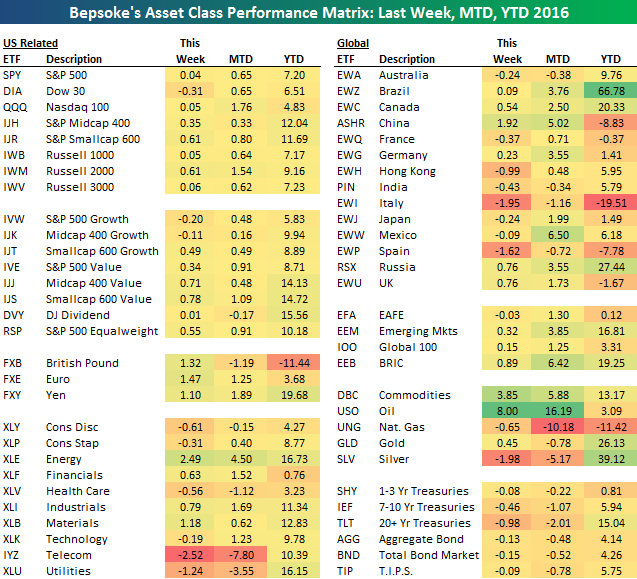
Below is an updated look at our asset class performance matrix using key ETFs traded on US exchanges. For each ETF, we show its performance this past week, month-to-date, and year-to-date. This week was dominated by oil, which rallied 8%. Oil’s gain propelled the S&P 500 Energy sector (XLE) up 2.5% as well, which was the biggest jump for any sector. Utilities (XLU) and Telecom (IYZ) both fell sharply. Outside of the US, China (ASHR) gained the most at +1.92%, while Italy (EWI) and Spain (EWP) both fell more than 1.5%. Treasury ETFs pulled back and are now down solidly month-to-date.
We analyze asset class performance, earnings season, economic indicators, sentiment and more in this week’s Bespoke Report newsletter. We also pack a ton of additional analysis into this week’s 30+ page report. You can read the entire thing by starting a 14-day free trial to our paid content below.
Have a great weekend!
The Closer 8/19/16 – End of Week Charts
Looking for deeper insight on global markets and economics? In tonight’s Closer sent to Bespoke clients, we recap weekly price action in major asset classes, update economic surprise index data for major economies, chart the weekly Commitment of Traders report from the CFTC, and provide our normal nightly update on ETF performance, volume and price movers, and the Bespoke Market Timing Model.
The Closer is one of our most popular reports, and you can sign up for a trial below to see it and everything else Bespoke publishes free for the next two weeks!
Click here to start your no-obligation free Bespoke research trial now!
Earnings Beats and Misses for Q2 2016 Earnings Season
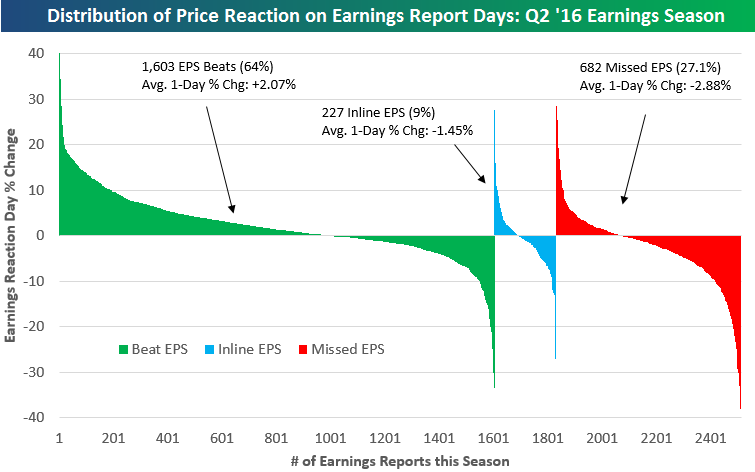
Below is a distribution chart showing the one-day price reaction (%) to earnings reports for the 2,512 stocks that reported this earnings season between July 11th and August 18th. Stocks that beat earnings estimates are in green, stocks that reported inline estimates are in blue, and stocks that missed estimates are in red. As shown, the 1,603 stocks that beat earnings estimates averaged a one-day gain of 2.07% on their earnings reaction days. There were still plenty of beats that saw price declines, however. The 227 companies that reported inline numbers were punished for just meeting estimates. They averaged a one-day decline of 1.45% on their earnings reaction days. Finally, the 682 stocks that missed earnings estimates averaged a one-day decline of 2.88% on their earnings reaction days. Given the negative share price reaction to both misses and inline reports, is it any wonder why companies work so hard to beat numbers on a quarterly basis?
Start a two-week free trial to our premium research to see our full earnings season analysis.
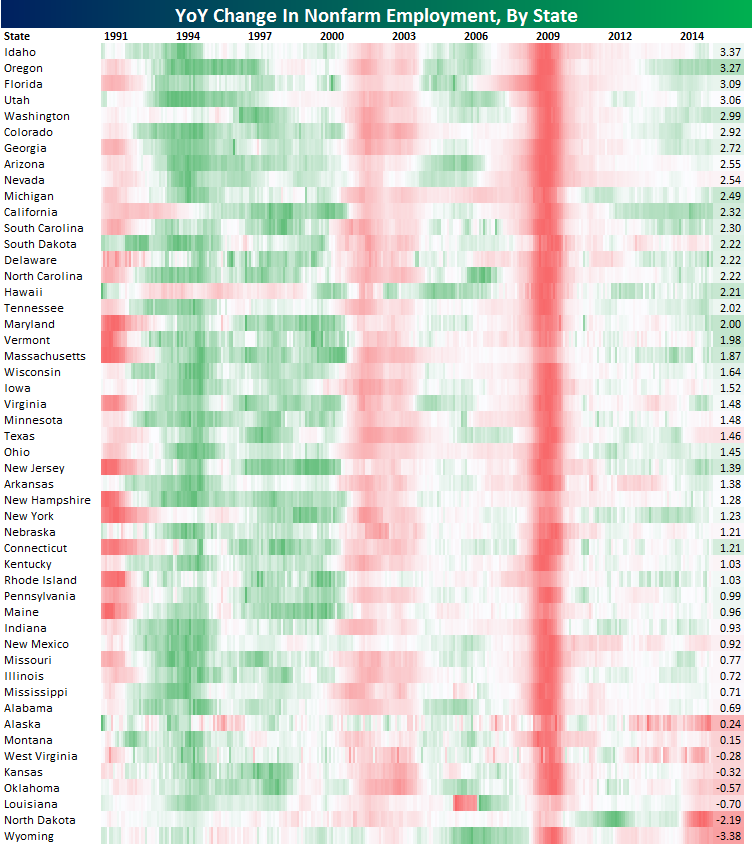
Idaho The Strongest Jobs Market In The Country Over The Past Year
This morning the Bureau of Labor Statistics released July estimates for state payrolls. In terms of YoY growth, a surprising winner emerged: Idaho. The small, mountainous state has seen payrolls rise 3.37% over the past year, besting Oregon for the top job growth in the nation. Florida and Utah also saw jobs added at a greater than 3% clip, while 14 states have seen payrolls rise by more than 2% YoY. Six states have fewer jobs than a year ago: West Virginia, Kansas, Oklahoma, Louisiana, North Dakota, and Wyoming. Five of those states are oil-dependent, and the rollover in oil patch activity that followed oil price declines from 2014 has suppressed jobs growth dramatically. For a number of states, especially those in the 2-2.5% payrolls growth range, job gains appear to be accelerating. We also note that while Texas is seeing poor payrolls growth by its standards, the oil slump has only served to push it down to the middle of the pack in terms of total payroll gains.
ETF Trends: Fixed Income, Currencies, and Commodities – 8/19/16
Oil, Energy, and broad commodity indices continue to trounce the field on the best performers list while other raw commodity plays like Steel Producers also perform well. Despite a weak showing for European banks, the KRE (US regional banks) and KBE (US banks) both rallied significantly versus a weak ago. Dollar, bond, and yield play bulls have all gotten pounded over the past week as REITs, long-term Treasuries, and the USD have all gotten pounded. Utilities are by far the weakest sector within the S&P 500 and we note that high momentum stocks have also underperformed over the past week.
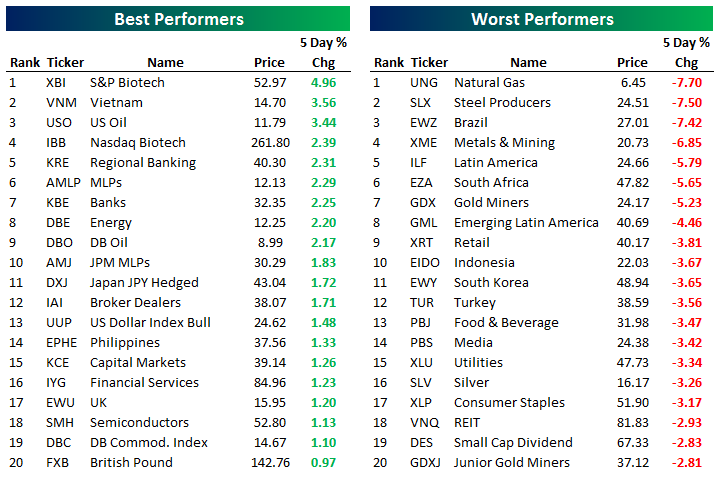
Bespoke provides Bespoke Premium and Bespoke Institutional members with a daily ETF Trends report that highlights proprietary trend and timing scores for more than 200 widely followed ETFs across all asset classes. If you’re an ETF investor, this daily report is perfect. Sign up below to access today’s ETF Trends report.
See Bespoke’s full daily ETF Trends report by starting a no-obligation free trial to our premium research. Click here to sign up with just your name and email address.
Chart of the Day – Volume, Like Paint, Drying Up
 In many ways, the last few weeks for the market have been like watching paint dry, as volatility has been non-existent. Given it’s August, this is the way it normally is, so we aren’t complaining. Along with the lack of volatility, volume has really dried up as well. In fact, the last time that we had an above average volume day in the S&P 500 tracking ETF (SPY) was on July 15th. That’s 25 straight days of below average volume.

In today’s Chart of the Day, which was sent to paid subscribers, we looked at prior periods where volume in SPY was below average for at least 25 trading days and then provided an analysis of the ETF’s returns going forward. To see the report, please start a 14-day free trial to Bespoke’s paid research below.