B.I.G. Tips – September 2016 Seasonality
Netflix (NFLX) Ticking Above Downtrend Channel
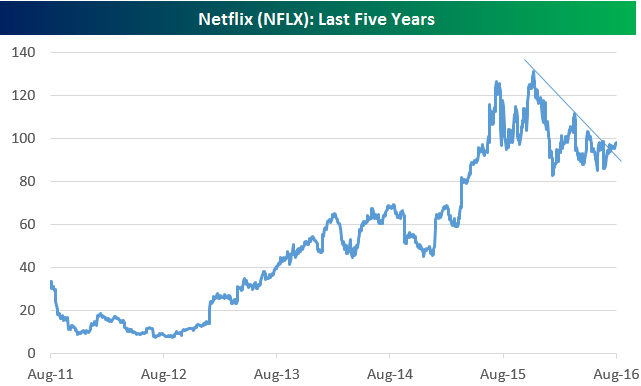
Below is a five-year price chart of Netflix (NFLX). After surging from the high-$40s up to $130 from January 2015 to early December 2015, Netflix formed a new downtrend that has taken it into the mid-$80s multiple times this year. The stock’s most recent bounce, though, has pushed it above the top of its downtrend channel. Look for a series of higher highs and higher lows over the next few months as NFLX attempts to establish a new uptrend. Bulls can continue to treat $82 as a downside stop since that’s its 2016 low point. There’s not a lot of support until the high $60s if the $80-$82 range is broken.
S&P 500 Group Performance: 2016 vs. Bull Market
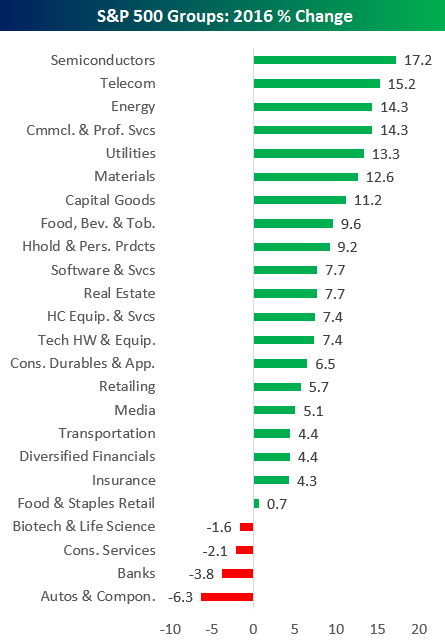
Below is a look at the year-to-date performance of the 24 S&P 500 Industry Groups. As shown, Semis are up the most with a gain of 17.2%, followed by Telecom (15.2%), Energy (14.3%), Commercial & Professional Services (14.3%) and then Utilities (13.3%). Autos are down the most at -6.3%, while Biotech, Consumer Services and Banks are all down as well.
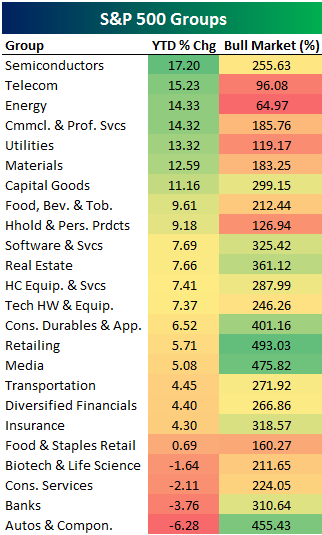
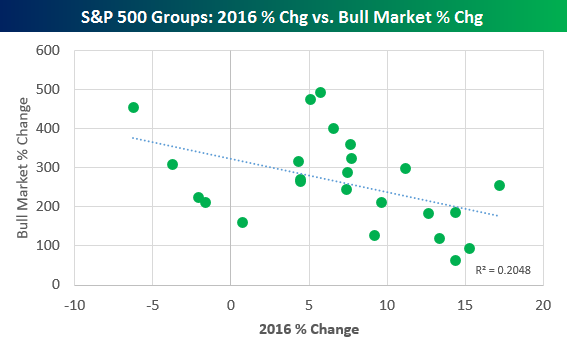
Below is a table highlighting not only 2016 performance, but also performance throughout the entire bull market (since 3/9/09). We also provide a scatter plot of the two performance numbers in the second chart below. The scatter plot shows that while not perfectly correlated, a lot of the groups that have been laggards throughout the entire bull market have been big winners in 2016, while the biggest winners of the bull market are in the middle of the pack this year.
Financials Take Another Step Higher
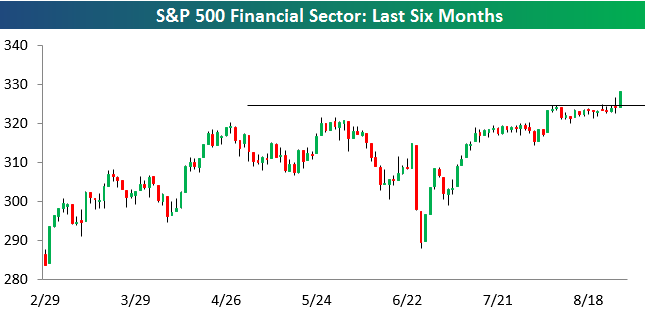
The S&P 500 Financial sector is breaking higher today as shown in our six-month price chart below:
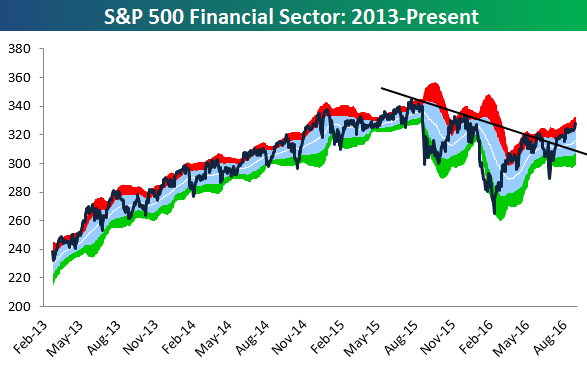
Looking at a longer-term trading range chart of the sector shows that it remains solidly above the top of its now-broken downtrend channel. Things are looking up for the Financial sector.
ETF Trends: US Indices & Styles – 8/29/16
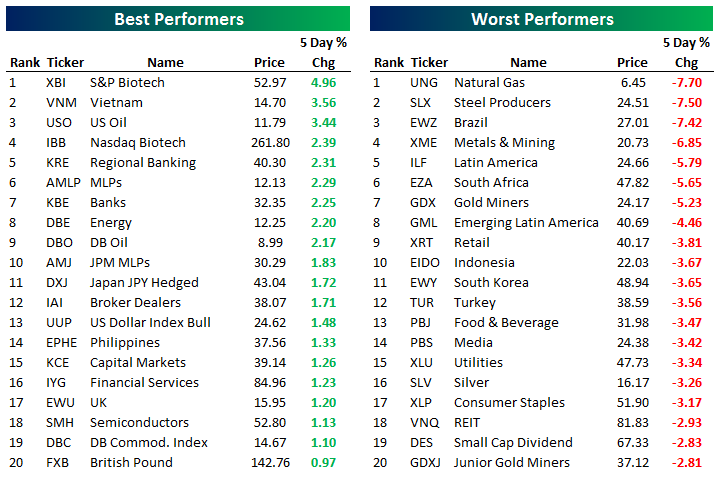
Natural gas continues to deliver an impressive run of outperformance with an 8% gain versus a week ago for UNG. Banks and other financials have also rallied significantly over the past week as the more hawkish tone from the Fed pushed up short-term interest rates. The USD has also performed well, while emerging markets have been hit including South Africa, Mexico, Poland, and Turkey. Gold miners have also continued their recent run of underperformance.
Bespoke provides Bespoke Premium and Bespoke Institutional members with a daily ETF Trends report that highlights proprietary trend and timing scores for more than 200 widely followed ETFs across all asset classes. If you’re an ETF investor, this daily report is perfect. Sign up below to access today’s ETF Trends report.
See Bespoke’s full daily ETF Trends report by starting a no-obligation free trial to our premium research. Click here to sign up with just your name and email address.
Chart of the Day: State Level Stock Performance
Bespoke Brunch Reads: 8/28/16
Welcome to Bespoke Brunch Reads — a linkfest of the favorite things we read over the past week. The links are mostly market related, but there are some other interesting subjects covered as well. We hope you enjoy the food for thought as a supplement to the research we provide you during the week.
Directing Eyeballs
Facebook Reduces Human Involvement in Selection of Trending Topics by Sarah Frier (Bloomberg)
After a minor uproar over the use of human curators who were accused of bias against conservative topics, Facebook is shifting its Trending Topics bar to algorithmic control. Our question: why were humans involved in the first place? [Link]
Europe plans news levy on search engines by Duncan Robinson (FT)
The latest reform proposals from the European Commission are said to include regulations which would force search engines to pay media organizations for using snippets of their stories when displaying search results. [Link; paywall]
Bungling
The Government Has Cheated Legal Immigrants for Decades by David Bier (Cato At Liberty)
In a remarkable legal analysis, Bier argues that the current US visa system is mistakenly counting families against quotas that should only apply to original applicants, reducing totally legal and highly skilled worker inflows into the American economy by as much as half. [Link]
Only in Washington: Have Your Lawyer Tell My Lawyer to Tell Me What You Think by Andrew Ackerman (WSJ)
The combination of Congressional intransigence on appointments and a Nixon-era transparency law mean CFTC commissioners can’t catch up and sound each other’s’ views out over coffee. [Link; paywall]
Why Is The IMF Pushing Fiscal Consolidation in the Eurozone in 2017? by Brad Setser (CFR Follow the Money)
Astoundingly, the implicit result of policy recommendations from the IMF to the four countries which make up 80% of the area’s GDP is for more fiscal tightening. [Link]
Hundreds of Americans wash up illegally in Canada after river party (Reuters)
The story probably misstates the legality of the wash-up (we checked the UN Convention on the Law of the Sea – no, seriously, Article 98) but the river float gone awry is nonetheless quite amusing. [Link]
Gene name errors are widespread in the scientific literature by Mark Ziemann, Yotam Eren, and Assam El-Osta (Genome Biology)
Astoundingly, about one-fifth of papers with gene lists that are provided in Excel contain errors in gene name conversions because of the program. [Link; 3 page PDF]
Sports
Why are Cal and Hawaii opening the college football season in Australia? by Christian D’Andrea (SB Nation)
14 hours to get to your season opener is a bit extreme, but the Australian market may prover fertile for a game that isn’t that dissimilar from Australian Rules Football or rugby. [Link]
To Be a Star College Athlete These Days, Options Including Chopping Wood, Fishing and Broomball by Kelsey Gee and Patrick McGroarty (WSJ)
Obscure sports are getting more interest from students who don’t want to make the massive commitments required of more traditional college athletics. [Link; paywall]
Urban Planning
Should everyone crowd into New York and San Francisco? by Tyler Cowen (Marginal Revolution)
Many modern policy “wonks” argue that there’s no good reason why density should not be drastically increased in populous, popular cities. They might be missing some things; we also highly recommend the piece this post is based off, linked in the first paragraph. [Link]
The ‘Tortured Transit’ of Bus Routes by Linda Poon (The Atlantic Citylab)
For millions of Americans without their own vehicle, the difference between getting to work on time and being fired can be as simple as a straight line. [Link]
Airbnb Probably Isn’t Driving Rents Up Much, At Least Not Yet by Ariel Stulberg (538)
In this excellent quantitative analysis of data from AirBnB, Stulberg deconstructs the composition of listings and shows that there are relatively few permanent listings (the kind that could drive up local rents) in most markets. [Link]
Exclusive interview: Palo Alto mayor Patrick Burt fires back at housing critics by Adam Brinkow (Curbed SF)
It’s not often that you hear a mayor claim that too many jobs are hurting his community. [Link]
Management
We’re Paying CEOs All Wrong by Caleb Melby (Bloomberg)
Despite quite literally billions of dollars at stake, there’s remarkably little attention paid to the behavioral economics and game theory involved with CEO pay. [Link]
At Kimberly-Clark, ‘Dead Wood’ Workers Have Nowhere to Hide by Lauren Weber (WSJ)
Employee turnover is up and efficiency is rising at Kimberly-Clark, part of a broader post-recession push to increase margins across corporate America. [Link; paywall]
Leaky Surveillance
Private lives are exposed as WikiLeaks spills its secrets by Raphael Satter and Maggie Michael (AP)
While feelings on the actions of WikiLeaks and Edward Snowden run the gamut (words like “hero”, and “traitor” are thrown around with equal abandon), there’s been little attention paid to the collateral damage that is an unavoidable consequence of forced government transparency via leaks. [Link]
Commentary: Evidence points to another Snowden at the NSA by James Bamford (Reuters)
The computer science here is over our heads (which, of course, isn’t say much) but the upshot appears to be that there are likely more future leakers of government surveillance data lurking. [Link]
Watch This Surveillance Master Dissect a Murder From the Sky by Drew Beebe (Bloomberg)
An astounding video (part of a larger story, linked to in the text) that shows the power of aerial surveillance in fighting crime. [Link; auto-playing video]
Parenting
Why Vacationing With a Toddler Is No Vacation by Partricia Garcia (Vogue)
In case you were looking for motivation to avoid having kids… [Link]
How to Stay Rich in Europe: Inherit Money for 700 Years by Alessandro Speciale and Chiara Vasarri (Bloomberg)
While Americans occasionally fret about declining economic mobility, we don’t have anything quite like the multi-century empires carefully guarded by the descendants of medieval wealth. [Link]
Economic Data
More and More Economic Datapoints Have Completely Erased the Financial Crisis by Lorcan Roche Kelly (Bloomberg)
An excellent review of data points which have finally recovered to the levels they were at ahead of the economic crisis that struck in 2007 and 2008. [Link]
Black Knight Financial Services’ First Look at July 2016 (Black Knight)
Some good old fashioned number crunching of mortgage data, from delinquencies to foreclosures, prepayments to inventories. [Link]
Investing
How This Hedge Fund Robot Outsmarted Its Human Master by Kathleen Chu and Komaki Ito (Bloomberg)
A fund based on machine learning (if not actual artificial intelligence) tries to take flight in Tokyo. [Link]
Worried About The Election? by Michael Batnick (The Irrelevant Investor)
Using data, Batnick makes the argument that the election doesn’t really matter for investors who are thinking long-term. [Link]
Business Models
Solving The Flight Center Enigma Part 2 (Find The Moat)
Despite a secular shift towards online travel, there is still a company that’s able to maintain impressive profitability doing it the old fashioned way. [Link]
How Lending Club’s Biggest Fanboy Uncovered Shady Loans by Max Chafkin and Noah Buhayar (Bloomberg)
More on the increasingly messy world of platform lending and the missteps that led to the demise of the industry leader. [Link]
Food
For the Colonel, It Was Finger‐Lickin’ Bad by Mimi Sheraton (NYT, September 9, 1976)
As news broke over the past couple of weeks that an heir to the original Colonel Sanders had made public the famed Kentucky Fried Chicken recipe, the Time has dug up an account of his visit to a New York City KFC. The Colonel was not impressed. [Link; paywall]
U.S. Takes a Bite From Cheese Mountain With Stockpile Purchase by Alan Bjerga and Lydia Mulvany (Bloomberg)
With dairy prices plunging 40% in a couple of years and huge inventories of various products stacking up, the US government has been forced to stock food bank shelves buying cheese with tax payer’s cheddar. [Link]
Brexit
Brexit sparks rush for New Zealand as emigration inquiries hit record high (The Guardian)
While the votes are long since counted, the UK hasn’t left the EU yet. That hasn’t stopped a doubling of the number of UK residents registering to live and work in New Zealand. [Link]
Contrarynomics
How Economic Downturns May Be Good for Your Health by Jeffery Sparshot (WSJ Real Time Economics)
While there’s mixed evidence as to the total impact (unemployment tends to reduce life expectancy), curtailed smoking and drinking during recessions do have a positive impact on some peoples’ health. [Link]
Are Index Funds Communist? by Matt Levine (Bloomberg)
For an academically informed take on a weird bit of Wall Street research, there’s really no better destination than Matt Levine’s Bloomberg View column, and his investigation of the odd claim that passive indexing was worse for the economy than communism in a Bernstein piece this week proves that. [Link]
Misallocation, Education Expansion, and Wage Inequality by Theodore Koutmeridis (Conference on Research on Economic Theory and Econometrics)
The economics here are a bit complicated, but the upshot of this paper is that for low-experience workers, education provides a big boost for wages. However, experience premiums don’t rise much for highly educated workers. This suggests that the labor market is highly inefficient, also increasing wage inequality. [Link; 39 page PDF]
Teens
Teens Who Say No to Social Media by Christine Rosen (WSJ)
Some anecdotal evidence that contrary to popular perception, the kids just may be alright. [Link; paywall]
Bespoke Weekly Chart Book — 8/27/16
The Closer 8/26/16 – End of Week Charts
Looking for deeper insight on global markets and economics? In tonight’s Closer sent to Bespoke clients, we recap weekly price action in major asset classes, update economic surprise index data for major economies, chart the weekly Commitment of Traders report from the CFTC, and provide our normal nightly update on ETF performance, volume and price movers, and the Bespoke Market Timing Model.
The Closer is one of our most popular reports, and you can sign up for a trial below to see it and everything else Bespoke publishes free for the next two weeks!
Click here to start your no-obligation free Bespoke research trial now!
The BESPOKE Report — 8/26/16
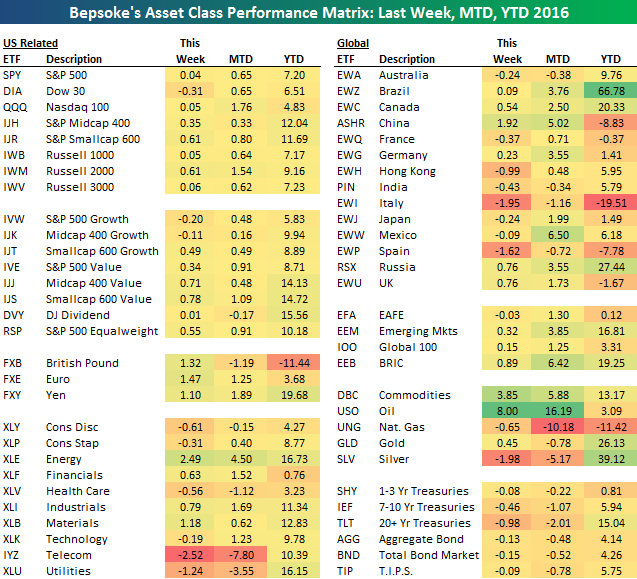
Below is an updated look at our asset class performance matrix using key ETFs traded on US exchanges. For each ETF, we show its performance this past week, month-to-date, and year-to-date. As one might be able to surmise, there really hasn’t been much in the way of major moves this month across the spectrum of our Asset Class Matrix. In fact, just eleven of the 58 ETFs shown are up or down more than 2%. Two of the biggest losers this month have been Telecom Services (-7.6%) and Utilities (-5.7%). These are generally considered ‘safe’ areas of the market, but ironically enough, have been some of the most volatile in a month lacking any volatility at all. On the upside, oil is up over 12%, and along with it, the Energy sector ETF is up just under 3%.
We analyze asset class performance, earnings season, economic indicators, sentiment and more in this week’s Bespoke Report newsletter. We also pack a ton of additional analysis into this week’s 30+ page report. You can read the entire thing by starting a 14-day free trial to our paid content below.
Have a great weekend!