
Chart of the Day: September Intra-Month Pattern
ETF Trends: US Indices & Styles – 9/6/16
Gold-related ETFs have rebounded over the last week. Asian country-related ETFs have also surged with China, Hong Kong, and South Korea up 4% or more in 5 days. Natural gas, which had been a consistent outperformer, is down almost 6% in a week, with oil also getting hit despite a bit of a rebound to start this week. Within the US equity markets, Retail and Construction have done poorly, while no US-specific exposure is in the top 20.
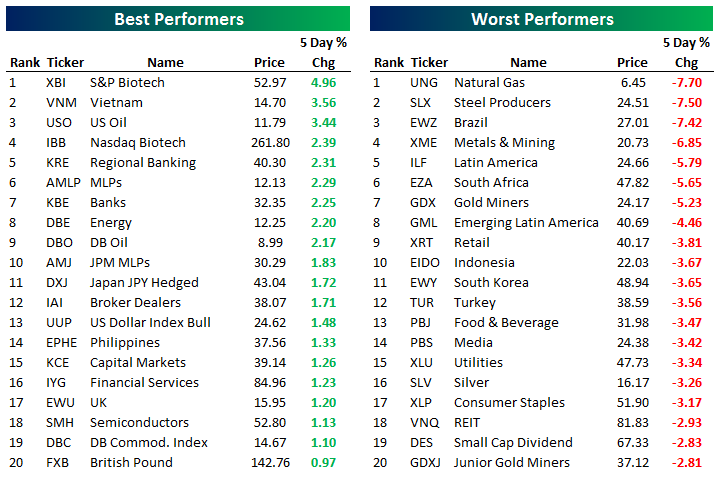
Bespoke provides Bespoke Premium and Bespoke Institutional members with a daily ETF Trends report that highlights proprietary trend and timing scores for more than 200 widely followed ETFs across all asset classes. If you’re an ETF investor, this daily report is perfect. Sign up below to access today’s ETF Trends report.
See Bespoke’s full daily ETF Trends report by starting a no-obligation free trial to our premium research. Click here to sign up with just your name and email address.
Year of Rotation
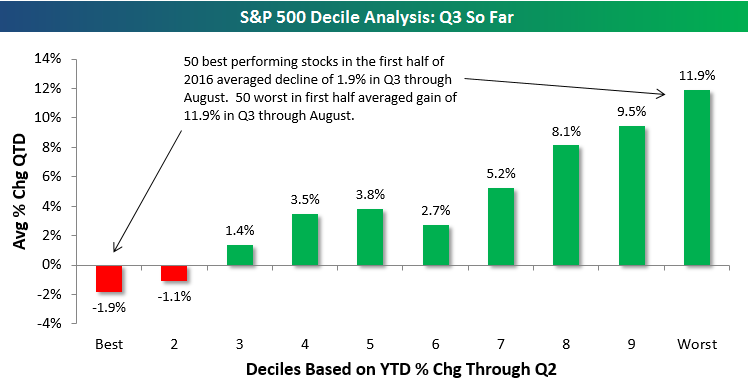
Late last week, we sent paid clients our popular “decile analysis” of third quarter market performance through August. Our decile analysis identifies stock characteristics that are driving performance over any given period. One of the most interesting trends we found is that performance so far in the third quarter is pretty much a mirror image of what we saw in the first half of the year. We highlight this below by breaking up the S&P 500 into deciles (10 groups of 50 stocks each) based on performance in the first half of 2016. Decile 1 in the chart contains the 50 stocks in the S&P 500 that did the best in the first half, while decile 10 in the chart contains the 50 stocks that did the worst. The bars in the chart represent the average change of the 50 stocks in each decile so far in Q3.
As shown, the 50 best-performing stocks in the first half of 2016 were actually down an average of 1.9% in Q3 through August. As you move from left to right on the chart, performance gets better and better, until you get to decile 10 (50 worst stocks in the first half), where the average stock was up a whopping 11.9% in Q3 through August. If you rode the stocks that worked best in Q1 and Q2 into Q3, you likely had a rough July and August compared to the broad market. If you reversed course and rotated into the worst performing stocks in the first half, you likely had a banner two months!
Bespoke Stock Seasonality – 9/6/16
While history never exactly repeats itself in the financial markets, variations of certain patterns tend to repeat themselves over time. Seasonal trends are one area where we often see recurring patterns of strength at certain times of the year and weakness at others, hence the advent of phrases like “Sell in May and Go Away.” To track these seasonal patterns in the equity market, each week we send Bespoke Premium and Bespoke Institutional clients a report that provides an analysis of the historical performance of the S&P 500, its ten sectors and individual stocks over the upcoming two-week period.
In this week’s report (sent out to clients earlier today), we noted that although September has historically been the weakest month of the year for equities, in the last ten years, the middle part of the month hasn’t been that bad. In fact, there were a number of bullish trends which really stand out. Among them was the fact that there are 17 current members of the S&P 500 that have been positive in the upcoming two-week period in each of the last ten years. That’s right, going back to 2006, these seventeen stocks have traded up in the two week period from 9/6 – 9/20. Below we have included a table which gives a sneak peak at some of the names that make up the seventeen on the list. To see the entire analysis and all seventeen names, sign up for a monthly Bespoke Premium membership now!
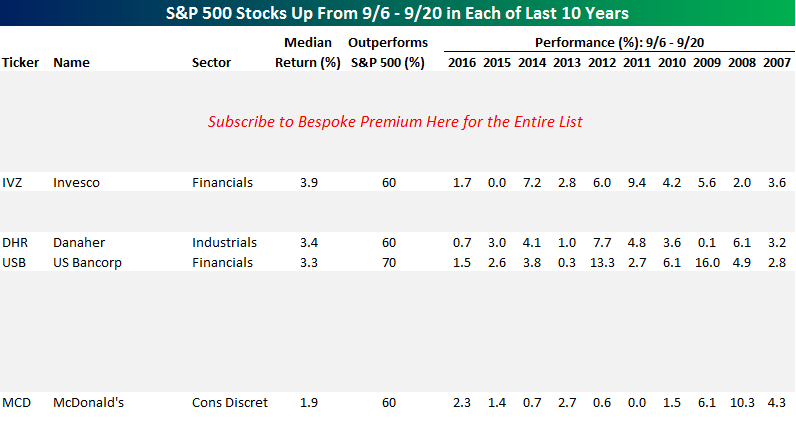
See the full S&P 500 Stock Seasonality report by signing up for a Bespoke Premium membership now.
August ISM: Increase in Commodities Falling
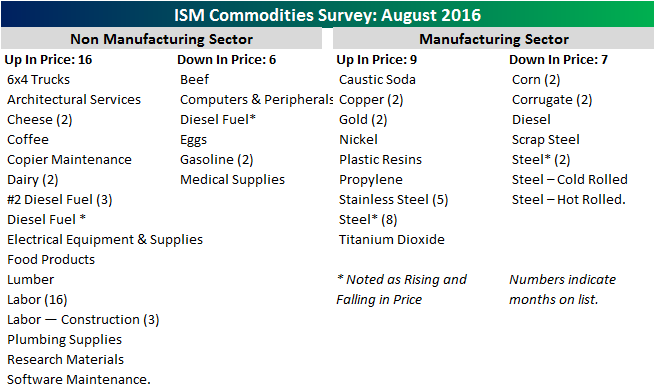
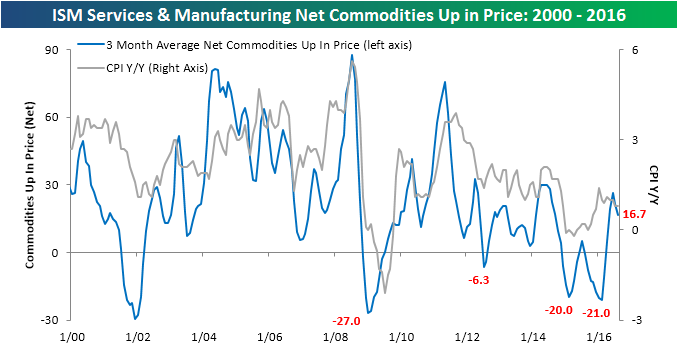
In each month’s ISM reports on the Manufacturing and Non-Manufacturing sectors, respondents are asked whether prices for commodities they deal with are up or down. Over time, we have found that trends in the number of commodities rising in price has tended to coincide with, or even lead, trends in inflation. In this month’s report on the Non-Manufacturing sector (released on 9/6), respondents noted increases in the prices of 16 commodities and declines in 6, for a net reading of +10, which was up from +6 last month and slightly above the six-month average of 8.2. In the Manufacturing sector (released on 9/1), the commodities survey showed increases in the prices of 9 commodities and declines in 7, for a net reading of +2. That was down from +8 last month and is significantly below the six-month average of +9.8.
The chart below compares the combined net number of commodities rising in price (on a three-month moving average basis) to the y/y change in CPI. As shown in the chart, changes in the commodities survey have closely tracked or even led CPI over time. Two months ago, the net reading of the commodities survey hit a multi-year high, but has since declined for two straight months. As shown on the right-hand portion of the chart, that coincides with a short-term peak in the CPI earlier this year.
Bespoke Stock Scores: 9/6/16
ISM Services Falls Victim to the Ugly Stick
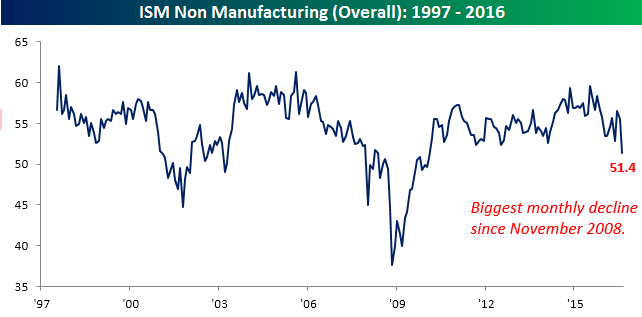
For a lot of investors and traders out there, today marks the beginning of the “back to work” season on Wall St. where the summer is unofficially over, vacations are now wrapped up, and focus shifts back to the daily grind. In terms of economic data, the back to work season certainly isn’t starting off on the right footing as today’s ISM Non-Manufacturing report came in significantly weaker than expected. While economists were forecasting the headline index to come in at a level of 55.0 versus last month’s reading of 55.5, the actual reading came in at 51.4. As shown in the chart below, it was truly an ugly reading. Not only was it the weakest report relative to expectations since April 2011, but it was also the lowest monthly reading since February 2010, and the biggest monthly drop since November 2008.
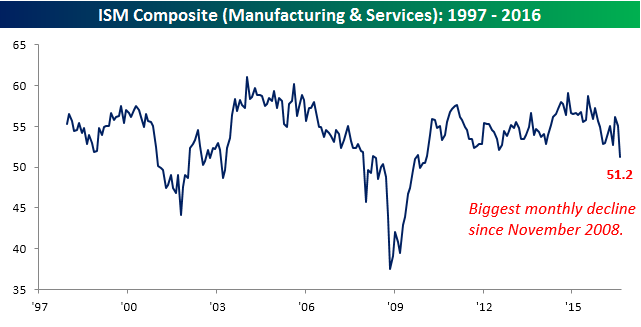
As if the Non-Manufacturing report wasn’t bad enough, remember that it comes on the heels of last week’s ISM Manufacturing report which also missed consensus expectations by a wide margin and dipped back into contraction territory. Taking both of these reports together and weighting them for their share of the economy, the combined ISM report for the month of August dropped from 55.1 down to 51.2. That represents the lowest reading since January 2010 and was also the largest monthly decline since November 2008.
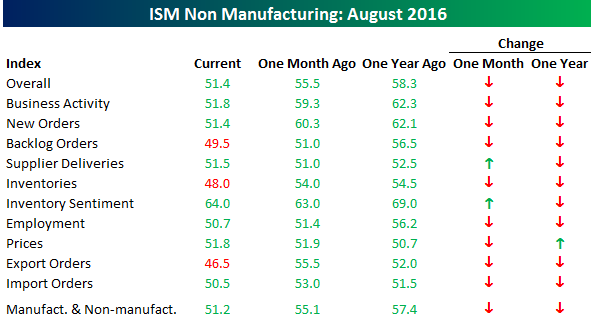
The table below breaks down this month’s ISM Services report by each of the subsectors and shows their changes over the last month and year. As shown, this month’s report was a sea of red. On a month over month basis, the only categories that increased in August were Supplier Deliveries and Inventory Sentiment. The biggest decliners this month were Export Orders (-9.0), New Orders (-8.9), and Business Activity (-7.5). Relative to last year, the changes were even more negative and Prices was the only category to increase, and New Orders and Business Activity saw the largest declines.
Dynamic Upgrades/Downgrades: 9/6/16
Bespoke Brunch Reads: 9/4/16
Welcome to Bespoke Brunch Reads — a linkfest of the favorite things we read over the past week. The links are mostly market related, but there are some other interesting subjects covered as well. We hope you enjoy the food for thought as a supplement to the research we provide you during the week.
Food And Drink
The Most Exclusive Restaurant In America by Nick Paumgarten (The New Yorker)
Locally sourced. Artfully prepared. Creatively plated. But are the numbers legitimate? A review of the upstate New York restaurant that may be the most difficult place to get a table in the world. [Link]
Gatorade Goes Organic as PepsiCo Joins Natural-Product Push by Jennifer Kaplan (Bloomberg)
Strawberry, lemon, and mixed berry organic Gatorade has hit the shelves at Kroher supermarkets, costing only 50 cents more than traditional, non-organic thirst quencher. [Link]
In Search of Ragu by Matt Goulding (Roads And Kingdoms)
There is nothing – nothing – as satisfying as a rich, hearty, flavorful ragu, and this oral journey will definitely stoke your craving for the meaty, melty sauce. [Link]
Media Matters
Wolff: The looming shakeout in digital media by Michael Wolff (USA Today)
Another year, another prediction for the demise of unprofitable and amply funded efforts to crack the code that is making money in digital media. [Link]
Twitter will now share video revenue with individual content creators by Julia Boorstin (CNBC)
So far, social media companies have not had to pay for the content their users generate: tweets, status posts, pictures, links, and the like. But what if competition for user time changes that model? [Link; auto-playing video]
Endorsed on Instagram by a Kardashian, but Is It Love or Just an Ad? by Sapna Maheshwari (NYT)
With sponsored placement of products on celebrities social media feeds becoming increasingly common, questions linger over the ground rules for what can be said in the ads. [Link; paywall]
Baseball Bats
A Bug That Eats Baseball Bats (NYT Sunday Review)
Invasive species are a menace to both ecosystems and economies. While this particular issue isn’t likely to devastate the massive and Manhattan-oriented NY economy, the loss of ash trees to borers is no less painful. [Link; paywall]
Report: Russians buy tons of baseball bats and almost no balls by Ted Berg (USA Today)
What are Russians doing with half a million baseball bats and only one ball and one glove? [Link]
Pestilence
The Race For A Zika Vaccine by Siddhartha Mukherjee (The New Yorker)
A tiny team of scientists took the virus ravaging South America and created a vaccine – through three different methods – in less than half a year. [Link]
Geopolitics
Uzbekistan’s president may be dying. Here is all my research on Uzbekistan. (Sarah Kendizor)
Anthropology PhD and Uzbek expert Kendizor has a timely round-up of stories and research on the country with its only President since the fall of the Soviet Union in the hospital and a power transition looming. [Link]
Politics
Can A Canadian Prime Minister Be An Action Hero? Marvel Comics Thinks So by Jackie Northam (NPR)
Global media and culture have been warmly receptive to recently elected Prime Minister of Canada Justin Trudeau (son of Pierre Elliot Trudeau, one of the country’s most famous Prime Ministers). That now includes, amusingly, the comic book industry. [Link]
Trump’s Top Fundraiser Eyes the Deal of a Lifetime by Max Abelson and Zachary Mider (Bloomberg)
The populist slant to the GOP nominee’s campaign does not include his national finance chairman who is as much a part of the pedigreed Wall Street establishment as any son of a Goldman Sachs partner can possibly be. [Link]
Careers
Should You Get a Money Manager Who Was Born Poor? by Daniel Akst (WSJ)
New research suggests that advisors who hail from a modest background outperform those who grew up amongst the well-off. [Link; paywall]
Employers Find ‘Soft Skills’ Like Critical Thinking in Short Supply by Kate Davidson (WSJ)
Communication, critical thinking, creativity, and coworker cooperation are all in short supply and great demand in the US labor market. [Link; paywall]
Hedge Funds
Ken Griffin’s Citadel Securities Is Muscling Into Credit Derivatives by Katie Linsell (Bloomberg)
With banks reducing the amount of capital they make available to market-making activities, intermediary-intensive products are seeing liquidity provision from hedge funds. [Link]
Bridgewater just released a series of videos that looks like something Facebook or Google would produce by Richard Feloni (Business Insider)
With half of employees not making it through the first year and a half on the job, the world’s largest hedge fund is being forced to cast more light on its secretive operations in the hopes of attracting the talent it needs. [Link]
Corporate Government
The CIA’s Venture-Capital Firm, Like Its Sponsor, Operates in the Shadows by Damian Paletta (WSJ)
CIA funds back In-Q-Tel, a firm that invests in tech start-ups focusing on technology of interest to the agency which may not have commercial appeal; however, conflicts of interest appear rampant amongst the company’s investments and board. [Link; paywall]
Obama Finds an Ally in Wal-Mart, Whose Stores He Once Shunned by Toluse Olorunnipa and Shannon Pettypiece (Bloomberg)
Despite hostility towards the retailer as a Senator, President Obama has found a very close ally in Bentonville, Arkansas, an arrangement which benefits both in terms of both PR and policy choice. [Link]
The Dark Side
Why They Did It: Madoff and Enron’s Fastow Explain the Biggest Frauds in U.S. History by Paul Barrett (Bloomberg)
An investigation of what drives white collar criminals to commit the crimes which seem to offer so little yet cost so much. [Link]
Aurora massacre survivors sued. How did some end up owing the theater $700,000? by Nigel Duara (LA Times)
Survivors and the families of victims from the Aurora, Colorado theater shooting were stymied in court; that puts them on the hook for the theater company’s massive legal bill. As a happy note, this story was later updated to note Cinemark would not pursue the families for the costs of its defense. That’s a welcome outcome given the extremely unfortunate circumstances. [Link]
Economics
Looking beyond GDP when measuring welfare by Nick Bunker (Equitable Growth)
It’s often forgotten that GDP is simply an accounting system, and one that very intentionally overlooks certain kinds of activity. There may be downsides to that approach. [Link]
Is Fischer ‘Stan the Man’ or the ‘Odd Stan Out’ on Rate Hikes? by Luke Kawa (Bloomberg)
How much attention should we be paying to the Vice Chair of the Federal Reserve? [Link; auto-playing video]
Regional Whimsy
Techies Priced Out of Palo Alto as Studios List for $1.3 Million by Alison Vekshin (Bloomberg)
With housing costs exploding across the Bay Area, a small but growing number of families are hanging up their artisanal toast spurs in favor of Midwestern mortgage payments. [Link]
Massachusetts Could Swap Time Zones for Later Winter Sunsets by Tom Moroney and Anne Mostue (Bloomberg)
Locals worry prospective college students will head for sunnier latitudes, so why not ensure that Boston’s sun doesn’t set only 22 minutes before the last daylight in the Yukon? [Link]
Consumer Tech
Nintendo’s New NX Console to Go Retro With Videogame Cartridges by Takashi Mochizuki (WSJ)
With Nintendo working away on its newest generation of video console, the company is reportedly considering a very retro storage medium. [Link]
RBC: This Survey Data Makes Netflix a ‘#1 Buy’ by Julie Verhage (Bloomberg)
Increasing subscriber penetration and less focus on 2016 price hikes appear to be boosting user growth for Netflix. [Link]
Will Amazon Kill FedEx? by David Leonard (Bloomberg)
Amazon has steamrolled almost every industry it’s touched, and as the massive operation’s logistics continue to grow it’s now exploring an in-sourcing of the delivery and routing services it currently purchases from UPS, FedEx, and the USPS. [Link]
Oops
SolarCity adviser Lazard made mistake in Tesla deal analysis by Liana B. Baker (Reuters)
Double-counting of indebtedness reduced the fair value estimate for SolarCity shares when the company was bought out by Tesla; that said, the mistake probably wasn’t material to the final offer for the company. [Link]