Consumers See Noticeable Uptick in Healthcare Costs
Each month, Bespoke runs a survey of 1,500 US consumers balanced to census. In the survey, we cover everything you can think of regarding the economy, personal finances, and consumer spending habits. We’ve been running the monthly survey for more than two years now, so we have historical trend data that is extremely valuable, and it only gets more valuable as time passes. All of this data gets packaged into our monthly Bespoke Consumer Pulse Report, which is included as part of our Pulse subscription package that is available for either $39/month or $365/year. We highly recommend trying out the service, as it includes access to model portfolios and additional consumer reports as well. If you’re not yet a Pulse member, click here to start a 30-day free trial now! Below we highlight the results of two questions we ask each month regarding health insurance and healthcare costs. This is one of essentially hundreds of data points included in each monthly report.
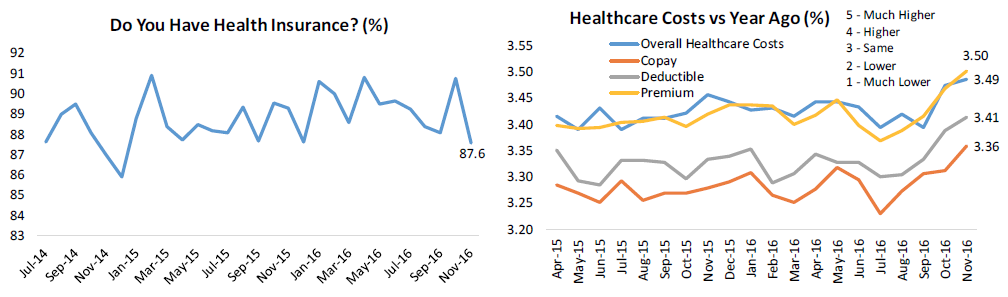
In our latest November Consumer Pulse Report, we saw a noticeable drop in the percentage of consumers who have health insurance. We also ask survey participants how current healthcare costs compare to costs one year ago. As shown in the chart below at right, consumers have been noticing big increases in healthcare costs across the board recently. Premiums, deductibles, copays, and overall costs had been trending lower up until mid-2016, but over the last five months they’ve been going up and up. This cost data suggests to us that the new administration shouldn’t get much pushback from the public when dealing with healthcare reform.
Bespoke Brunch Reads: 12/4/16
Welcome to Bespoke Brunch Reads — a linkfest of the favorite things we read over the past week. The links are mostly market related, but there are some other interesting subjects covered as well. We hope you enjoy the food for thought as a supplement to the research we provide you during the week.
Trump
GOP Eyes Lightning Strike on Obamacare to Kick Off Trump Era by Steven T. Dennis and Billy House (Bloomberg)
A look at the likely repeal of the Affordable Care Act, with appropriate focus on the political risks of the policy vacuum that would follow. [Link; auto-playing video]
Donald Trump, the First President of Our Post-Literate Age by Joe Weisenthal (Bloomberg)
In a world where mass communication is no longer linked to prose, how do we think about the approach that Trump took to being elected? [Link]
How a $60 Billion Fund With Four-Decade Alpha Prepares for Trump by Adam Haigh and Tom Redmond (Bloomberg)
Capital Group runs its mountain of capital very quietly and very effectively, and some of their thinking about the Trump Presidency struck us as both very conventional while remaining contrary in important ways. [Link]
An interview with the editor of Snopes: ‘Technology changes, but human nature doesn’t’ by Glenn Kessler and Michelle Ye Hee Lee (WaPo)
With the fake news narrative taking on new heights (and new share/like counts) daily, this conversation with the dean of debunking is informative. [Link; soft paywall]
Economic Arcana
The paradox of Cuban GDP (Nintil)
An excellent investigation of conflicting economic data related to the size of Cuba’s economy. Widely-cited statistics that show it as one of the better performers in Latin America are likely wrong as this post convincingly demonstrates. [Link]
Some thoughts on reforming the American Transfer Union by Raja Korman (tumblr)
A meandering look at what’s wrong with the structure of our federal transfer system, and some interesting (if wildly implausible) ideas about how to fix it. [Link]
Sharing Economy
Customers in the digital economy have the whip hand by Sarah O’Connor (FT)
Perhaps the biggest impact of the digital revolution is its tendency to take the “customer first” mentality of many businesses and turbo-charge it to the point of absurdity. [Link; paywall]
The taxi unicorn’s new clothes by Izabella Kaminska (FT Alphaville)
A rundown on the complete lack of demonstrated profitability shown by Uber, and the small likelihood that it will be able to do so in the long haul. [Link; registration required]
Derivatives
Citi Said to Weigh Derivative Desk Move to Frankfurt on Brexit by Gavin Finch and Nicholas Comfort (Bloomberg)
With the “Brexit means Brexit” rhetoric of the ruling Conservatives in the UK, the financial industry is starting to look at ways to mitigate London’s probable lack of access to sections of the European financial markets via the “passporting” feature of its current regulatory regime. [Link]
Get Thee to a Brokerage! Low Rates Turn Nuns Into Traders by Georgi Kantchev (WSJ)
“I started by googling what a swap is,” has to be our favorite nun-related line ever. A fascinating look at the behavior of nontraditional investors in a low rate environment. [Link; paywall]
Food
Here’s What Happens After Guy Fieri Visits A Restaurant by Wil Fulton (Thrillist)
The frosted tips, doughy physique, and array of garish shirts are a harbinger of massive increases in foot traffic for small purveyors of chow across the country. [Link]
Municipal Finance
Dallas Stares Down a Texas-Size Threat of Bankruptcy by Mary Williams Walsh (NYT)
While the economy in Dallas is humming, past promises to retirees are creating huge problems despite ample revenue fundamentals. [Link; soft paywall]
Words Fail Us
Highland Capital seeks to unmask author of ‘defamatory’ post on Dealbreaker by Jonathan Stempel (Yahoo Finance/Reuters)
A fund with over $15 billion in AUM has decided to sue Dealbreaker in order to unmask a pseudonymous commenter who once said a mean thing in the comments section. [Link]
The Cloud
Amazon Broadens Cloud Services as Big Companies Sign On by Jay Greene (WSJ)
AWS started as a bare-bones commodity product: raw processing power and data storage, accessed remotely, and very cheap. In a bid to increase market share and total revenues, the service is now adding more complexity and usability via services layered on top of that core offering. [Link; paywall]
Video Games
“Gosh, It’s Beautiful.” By Justin Heckert (ESPN)
The incredible and strange story behind the world’s most valuable video game. [Link]
Some Good News
Ten Good Pieces of Economic Data From All Around the World by Sid Verma (Bloomberg)
China PPI, ISM Manufacturing, Bloomberg Consumer Comfort, Eurozone Unemployment, Eurozone PPI, Canadian GDP, South Korean exports, Japanese profits, [Link; auto-playing video]
The Bespoke Report — 12/2/16
The Closer 12/2/16 – End of Week Charts
Looking for deeper insight on global markets and economics? In tonight’s Closer sent to Bespoke clients, we recap weekly price action in major asset classes, update economic surprise index data for major economies, chart the weekly Commitment of Traders report from the CFTC, and provide our normal nightly update on ETF performance, volume and price movers, and the Bespoke Market Timing Model.
The Closer is one of our most popular reports, and you can sign up for a trial below to see it and everything else Bespoke publishes free for the next two weeks!
Click here to start your no-obligation free Bespoke research trial now!
Quick View Chart Book – 12/2/16
Low Jobless Rate: Is This As Good As It Gets?
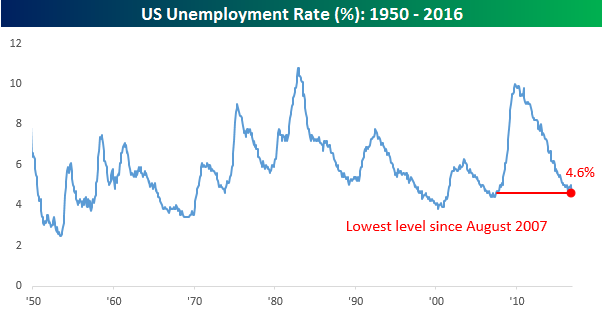
This morning’s jobs report showed an unexpected drop in the unemployment rate, falling from 4.9% to 4.6%, putting the jobless rate at its lowest level since August 2007. Thinking back to that period, most of us remember all too well what happened going forward as the S&P 500 peaked in October and ultimately fell more than 50% over the next year and a half. This has led some to question, is today’s jobs report as good as it gets?
To help answer that question, we looked back at the S&P 500’s historical performance during prior periods where we saw a similar trend in the jobless rate as today. To see the report, sign up for a monthly Bespoke Premium membership and get 10% off for life ($89/month).
the Bespoke 50 — 12/2/16
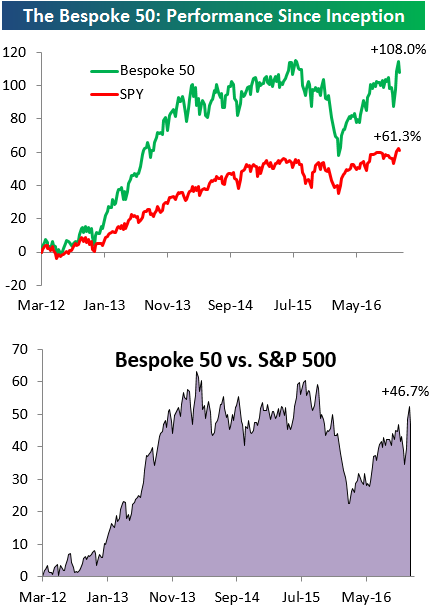
Every Thursday, Bespoke publishes its “Bespoke 50” list of top growth stocks in the Russell 3,000. Our “Bespoke 50” portfolio is made up of the 50 stocks that fit a proprietary growth screen that we created a number of years ago. Since inception in early 2012, the “Bespoke 50” has nearly doubled the performance of the S&P 500. Through today, the “Bespoke 50” was up 108% since inception versus the S&P 500’s gain of 61.3%.
To view our “Bespoke 50” list of top growth stocks, sign up for Bespoke Premium ($99/month) at this checkout page and get your first month free. This is a great deal!
JC Penney, Nordstrom Website Visits Ticking Higher
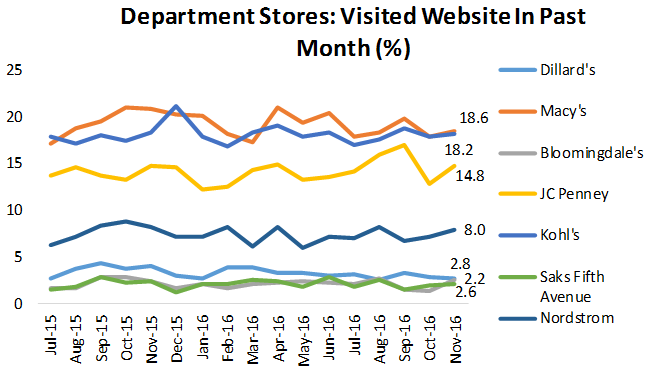
Each month, Bespoke runs a survey of 1,500 US consumers balanced to census. In the survey, we cover everything you can think of regarding the economy, personal finances, and consumer spending habits. We’ve now been running the monthly survey for more than two years now, so we have historical trend data that is extremely valuable, and it only gets more valuable as time passes. All of this data gets packaged into our monthly Bespoke Consumer Pulse Report, which is included as part of our Pulse subscription package that is available for either $39/month or $365/year. We highly recommend trying out the service, as it includes access to model portfolios and additional consumer reports as well. If you’re not yet a Pulse member, click here to start a 30-day free trial now! Below we highlight the results of a question we ask regarding department store website visits. This is one of essentially hundreds of data points included in each monthly report.
As the holiday shopping season moves full steam ahead, we continue to track which department stores are gaining or losing popularity in a few different ways, one of which is by monitoring website traffic. Although this most recent survey does not include annual Black Friday/Cyber Monday promotions (our surveys take place during the week of the 12th every month), we did see the beginnings of holiday shopping with slight ticks up in all retailers but one, Dillard’s, which remained flat. Macy’s and Kohl’s remain dominant in the space as both recovered slightly after seeing weaker online traffic in October. Interestingly, JC Penney recovered materially from its drop in October. We have seen a steady trend higher for JC Penney since the beginning of this year, so it will be interesting to see how it performs around the holidays. Nordstrom is another name that has begun to trend higher in terms of website visits.
ETF Trends: Hedge – 12/2/16
Oil is the best-performing global asset class over the last week, up over 10% using ETFs USO and DBO as proxies. Energy stocks, especially high-beta oil service ETFs, have also benefited significantly. Broad commodity indices have also done well with natural gas, gold, and other energy performing well. Over the last week, coffee is the worst performer while Biotech, Semis, and other Nasdaq components have underperformed. Big-cap tech in general has been weak, as have momentum stocks.
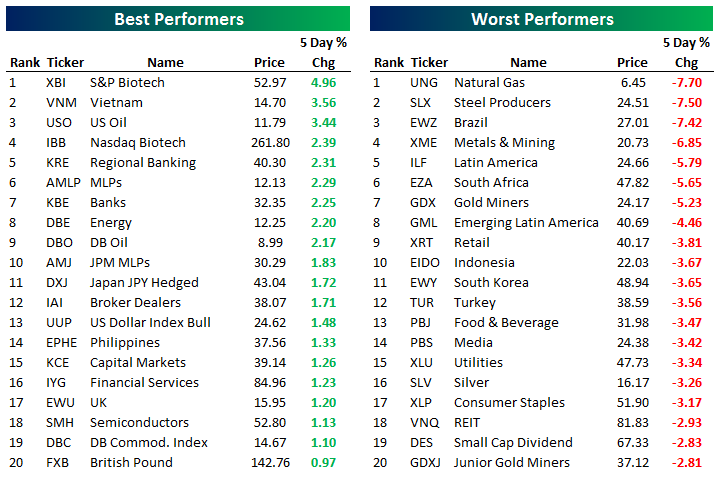
Bespoke provides Bespoke Premium and Bespoke Institutional members with a daily ETF Trends report that highlights proprietary trend and timing scores for more than 200 widely followed ETFs across all asset classes. If you’re an ETF investor, this daily report is perfect. Sign up below to access today’s ETF Trends report.
See Bespoke’s full daily ETF Trends report by starting a no-obligation free trial to our premium research. Click here to sign up with just your name and email address.
Tech Sector Falls Behind
Like our free content? You’ll like Bespoke Premium even more! Click here to start a no-obligation 14-day free trial now.
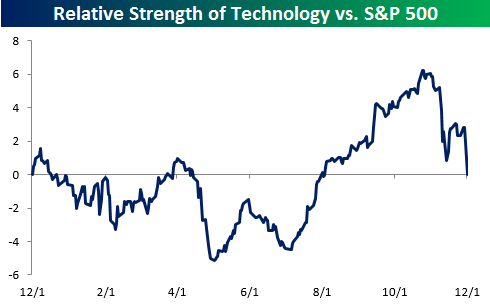
While Technology was a market leader for much of the Summer and into the Fall, in the post-election world the sector has done a complete 180 and fallen off a cliff. The chart below shows the relative strength of the Technology sector versus the S&P 500 over the last year. When the line is rising, it indicates outperformance on the part of the Tech sector, while a falling line indicates underperformance. Following yesterday’s steep sell-off, the sector is now underperforming the S&P 500 over the last year! While the sector is just barely underperforming, it’s a far cry from where things stood just one month ago.
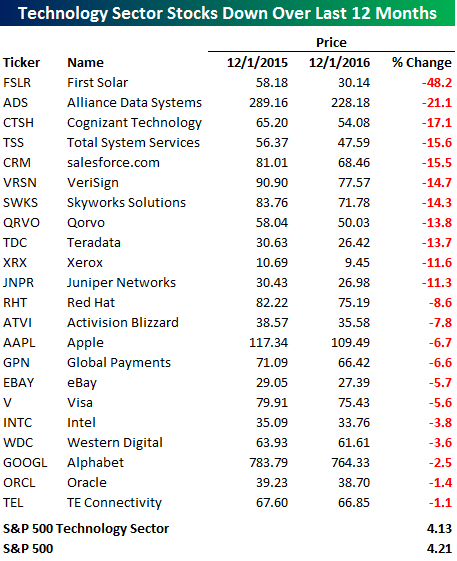
So which tech stocks have been pulling the index lower? The table below lists the 22 stocks in the S&P 500 Technology sector that are now down over the last 12 months. It wasn’t long ago that a list like this would have been considered a perfect list of stocks to own, but now holders of these stocks are having a hard time finding bids. First Solar (FSLR) has been the worst performer, losing nearly half of its market cap in the last year, while salesforce.com (CRM) has declined over 15%. It isn’t just high multiple tech that has fallen out of favor either. Apple (AAPL) is down over 6% over the last 12 months, while Intel (INTC) and Western Digital (WDC) are both down over 3%. To say that this turnaround in Tech has been swift would be an understatement.