
Bespoke CNBC Appearance (2/14/17)
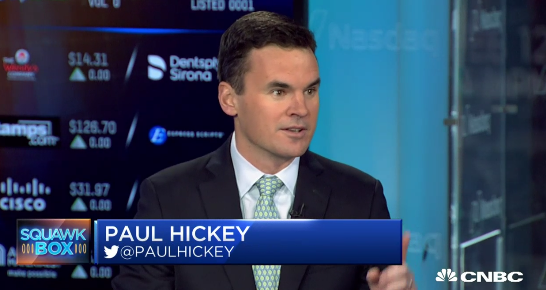
Bespoke Co-Founder Paul Hickey appeared on CNBC’s Squawk Box this morning to discuss the market set up with the major averages trading at or right near all-time highs. To view today’s segment, please click on the image below. Want to see more of our market research? Start a 14-day free trial today.
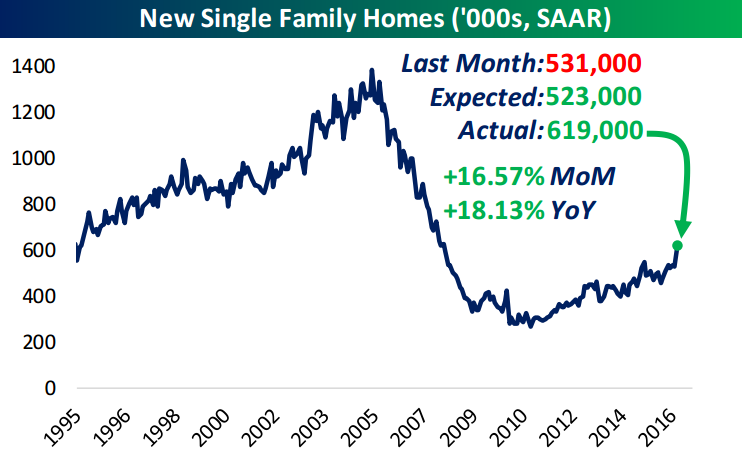
The Closer — The Buck Versus Prices — 2/13/17
Log-in here if you’re a member with access to the Closer.
Looking for deeper insight on global markets and economics? In tonight’s Closer sent to Bespoke Institutional clients, we discuss the valuation of the USD relative to the terms of trade index for the United States.
The Closer is one of our most popular reports, and you can see it and everything else Bespoke publishes by starting a no-obligation 14-day free trial to our research!
36 New S&P 500 All-Time Highs
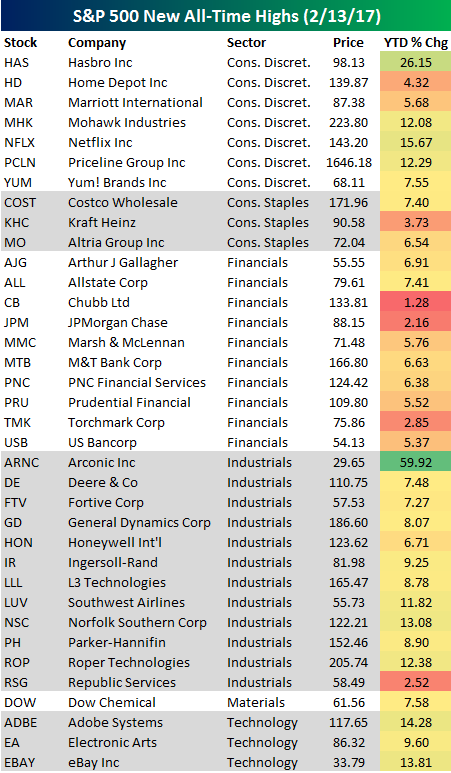
Investors like to track the number of new 52-week highs in the S&P 500 (or any index for that matter) to measure underlying breadth of the index. With the S&P making another new all-time high today, we looked to see how many individual stocks in the index also made new all-time highs today. In total there were 36, or 7.2% of the index.
Below is a list of the 36 stocks that made new all-time highs today sorted by sector. Some of the key names on the list include Home Depot (HD), Netflix (NFLX), Costco (COST), Altria (MO), JP Morgan (JPM), Deere (DE), Dow Chemical (DOW), Adobe (ADBE), and even eBay (EBAY). Talk about a diversified basket of names.
Start a 14-day free trial to see more of our earnings season research.
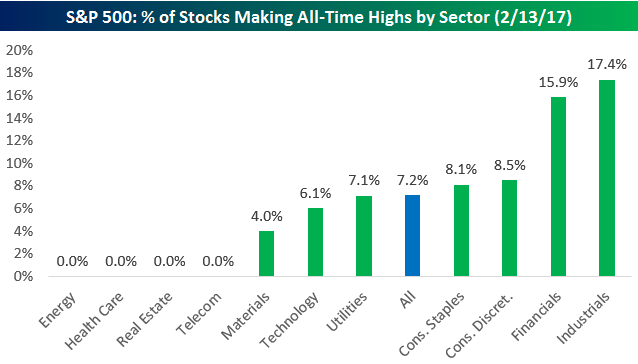
The Industrials sector saw the highest percentage of new all-time highs today at 17.4%, followed by Financials at 15.9%. No stocks in the Energy, Health Care, Real Estate, or Telecom sectors made new all-time highs today.
Interesting Trends in Yale Investor Confidence Surveys
Two of the most widely followed stock market sentiment indicators come from Investors Intelligence and the American Association of Individual Investors. The Yale “Stock Market Confidence” indices are much lesser known, but they provide key insights into investor sentiment trends nonetheless.
The Yale School of Management has been surveying both individual and institutional investors for nearly two decades now, and below we provide historical charts that track the four survey questions they ask investors each month.
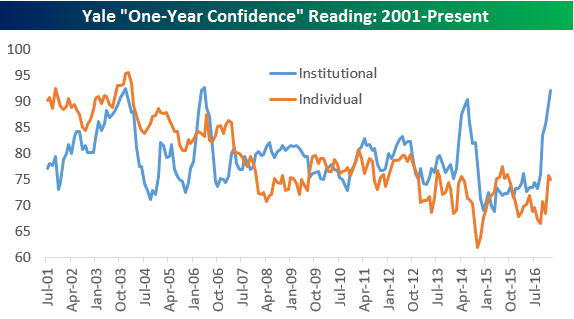
The first survey highlighted below is Yale’s “one-year confidence” reading which asks investors if they think the stock market will be up one year from now. As shown, for institutional investors this reading had been trending lower for years now, but we’ve recently seen a massive spike in expectations. At the same time, sentiment on the part of individuals has only seen a minor pickup. In this regards, it appears that institutional investors have turned significantly more bullish since the election, while individual investors simply aren’t sold.
Start a 14-day free trial to see more of our investor sentiment research.
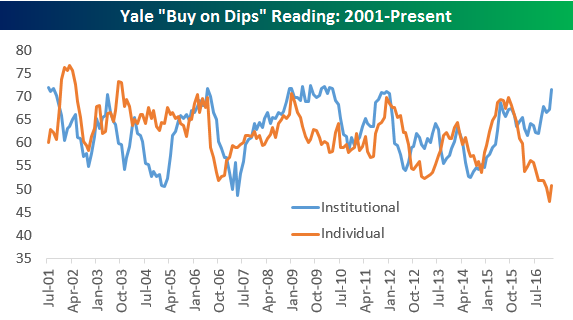
The second survey question asks investors how confident they are that the market will rise the day after a sharp fall. Yale calls it the “Buy on Dips” measure. Similar to the “One-Year Confidence” reading, we’ve seen a big divergence between institutional and individual investors for the “Buy on Dips” measure. Institutional investors have gotten very confident to buy on dips, while the reading for individual investors just recently hit new lows.
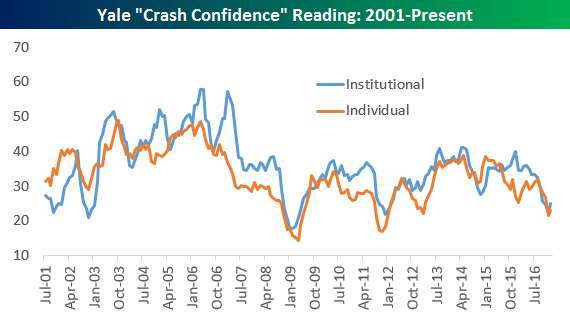
The third survey question asks investors how confident investors are that there will not be a stock market crash in the next six months. For this reading, the lower the number, the more concerned investors are about a crash, and vice versa. Interestingly, both individual and institutional investors have become less confident that there won’t be a stock market crash in the coming months. It’s not surprising to see the reading where it is for individual investors, but it is surprising to see that institutional investors are just as concerned about a stock market crash even though they’re much more bullish on the stock market based on the readings above.
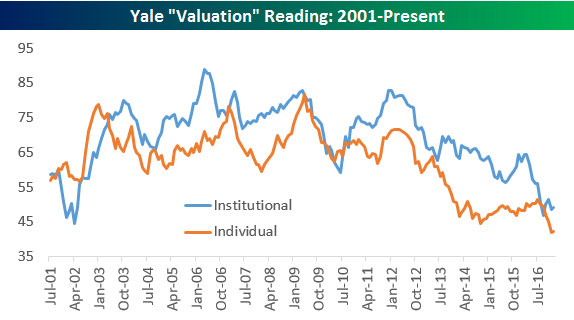
The final question asks investors how confident they are in the valuation of the market. Here, low readings mean investors don’t think the market is attractively valued, and vice versa for high readings.
As shown below, both individual and institutional investors have become less and less confident in the valuation of the market over the years, and the reading keeps hitting new lows for individual investors. The reading for institutional investors is extremely low as well.
Based on all four readings, individual investors seem less than enthusiastic about stocks, even after the election. For institutional investors, they’re bullish on the market, but at the same time, they don’t think it’s attractively valued and they’re relatively concerned about a crash. To us, it seems like institutional investors are basing their bullishness on hope.
As highlighted above, institutional investors are much more optimistic about the stock market than individual investors. Remarkably, this is a trend that has been in place for more than ten years now!
In the chart below, we show the spread between the average institutional investor reading (based on all four of Yale’s survey questions) and the average individual investor reading. When the spread (blue line) is in positive territory, it means institutional investors are more bullish than individual investors. As you can see, the spread has essentially been in positive territory since 2005, and it just recently hit an all-time high. Over the years we’ve written a lot about the plight of the individual investor and the impact that two 50%+ drawdowns for the S&P 500 over the last 20 years have had on individual investor sentiment. It’s the old “fool me once, shame on you…fool me twice, shame on me” saying, and they don’t want to be burned again.
The current bull market is about to enter its 8th year, and we still haven’t seen individuals turn bullish on stocks. If a 200% rally over 8 years isn’t enough to draw them back in, we don’t know what will. At this point it looks as if the only remedy is going to be time — and it’s not going to be months or years, but maybe decades.
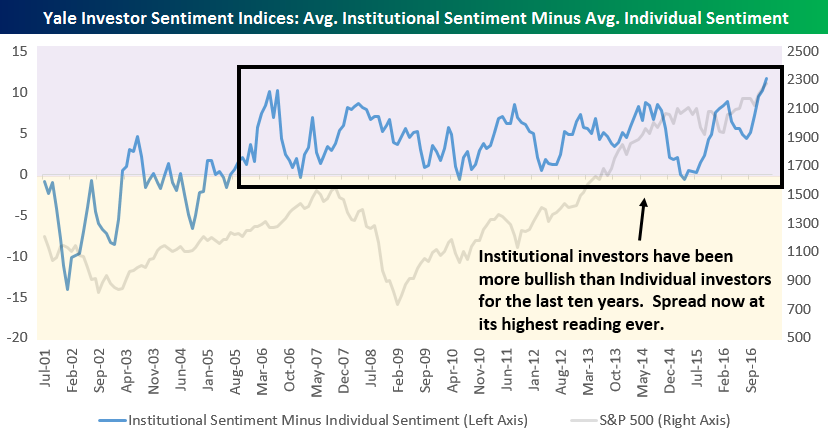
Chart of the Day: No Slowdown in Intraday Buying
Bespoke Stock Seasonality Report – 2/13/17
ETF Trends: US Indices & Styles – 2/13/16
Steel, industrial metals, and Chinese equities have gained the most over the past week with Solar an unlikely but notable addition to the best-performers among ETFs we track over the past week. Decliners include gold miners (which had rallied quite significantly in recent weeks), natural gas, and a variety of foreign currencies.
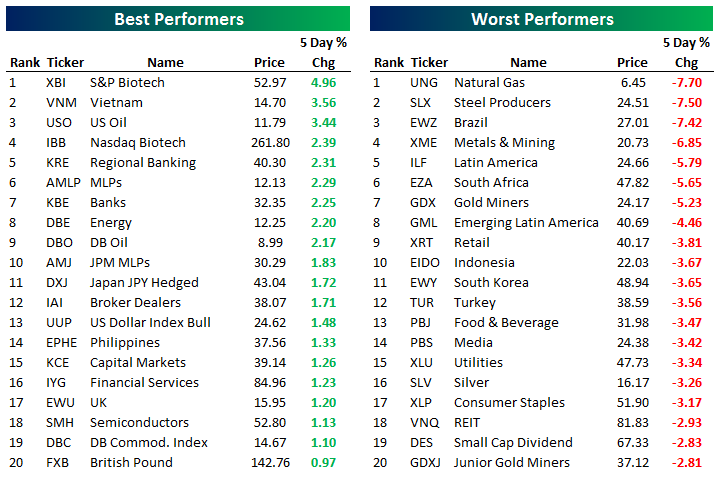
Bespoke provides Bespoke Premium and Bespoke Institutional members with a daily ETF Trends report that highlights proprietary trend and timing scores for more than 200 widely followed ETFs across all asset classes. If you’re an ETF investor, this daily report is perfect. Sign up below to access today’s ETF Trends report.
See Bespoke’s full daily ETF Trends report by starting a no-obligation free trial to our premium research. Click here to sign up with just your name and email address.
Broken Record Breakouts
While not all of the indices got there on an intraday basis last week, the S&P 500, Nasdaq, Dow Jones Industrial Average, and Russell 2000 all closed at new all-time highs last Friday for the first time this year. These days, it’s getting to the point where everything is hitting new highs.
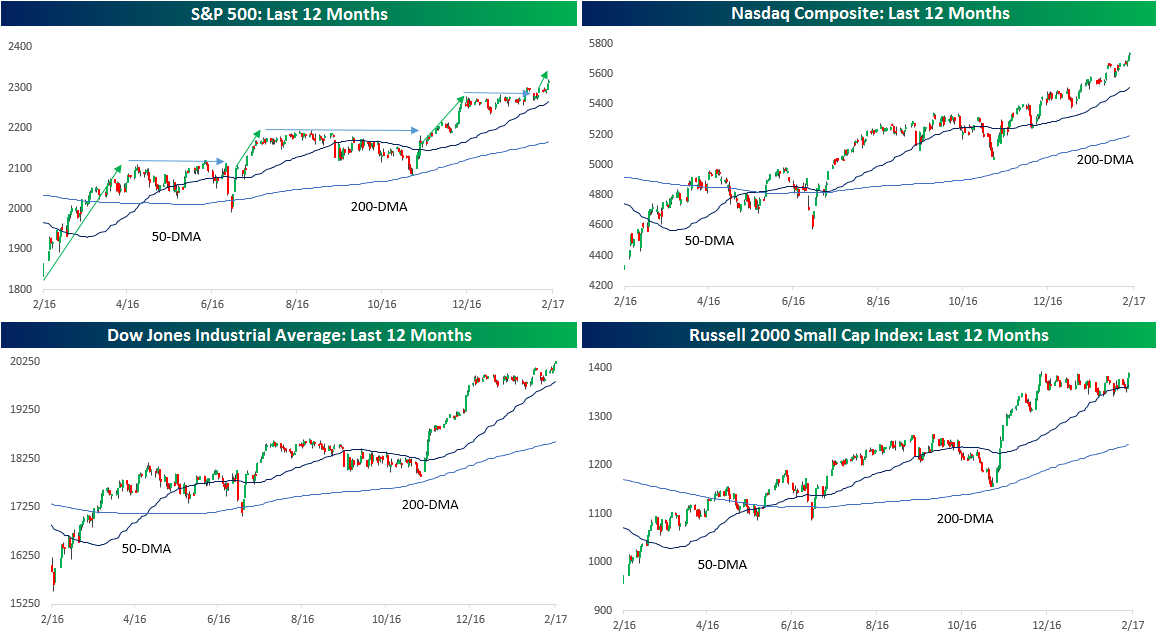
It’s not just the major US averages hitting new highs either. While still off its all-time highs, in dollar terms, the MSCI Emerging Market index also hit a new 52-week high in last Friday’s trading.

OK, not everything hit new highs last week. Digging down a little deeper, the Dow Jones Transports have been stymied at resistance at around the 9,500 level twice now in the last two months.
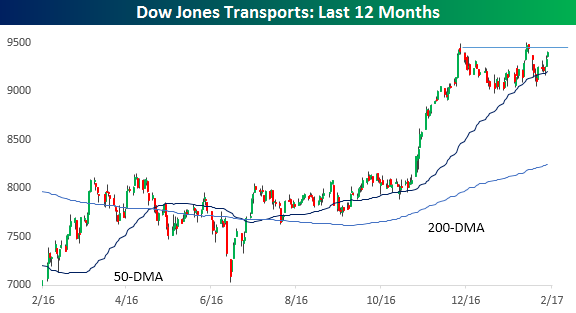
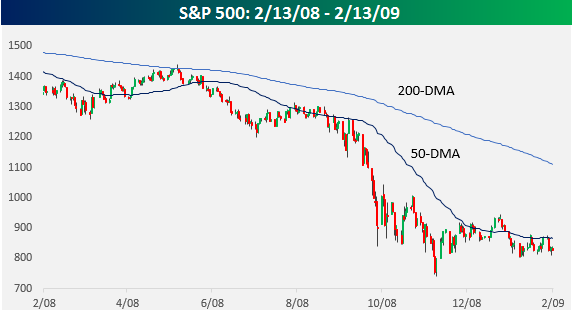
If you’re a bull, you have to love the way the market is trading, but enjoy it while it lasts. Nothing lasts forever. Just as the chart below from eight years ago eventually reversed itself, this too will eventually go the other way. Stay on your toes.
Bespoke Brunch Reads: 2/12/17
Welcome to Bespoke Brunch Reads — a linkfest of the favorite things we read over the past week. The links are mostly market related, but there are some other interesting subjects covered as well. We hope you enjoy the food for thought as a supplement to the research we provide you during the week.
Corporate News
Amazon.com Takes Aim at Victoria’s Secret With Its Own $10 Bras by Khadeeja Safdar and Laura Stevens (WSJ)
The latest market eyed by Amazon is one we wouldn’t have predicted: intimate apparel for women, a space that seems much less amenable to ruthless logistics than other areas the company has focused on. [Link; paywall]
Samsung battery factory bursts into flame in touching Note 7 tribute by Shaun Nichols (The Register)
Not content to be declared a civil aviation hazard, Samsung’s now setting fires at the recycling facility that is processing the batteries after they’ve been turned in. [Link]
Channeling Steve Jobs, Apple seeks design perfection at new ‘spaceship’ campus by Julia Love (Yahoo!/Reuters)
A look inside the giant corporate headquarters Apple has built itself in Silicon Valley, complete with seamless door frames and the feel of a landed alien spacecraft. [Link]
Economic Whimsy
Economics: An Illustrated Timeline by Heske van Doornen (The Minskys)
A one-stop shop for quick summaries of economic thinkers over time. [Link]
Karthik Sankaran’s guide to macroeconomics, in verse by Karthik Sankaran (FTAV)
Eurasia Group’s director of global strategy rolls out his hilarious version of economic thinking, properly metered. If you can’t get through this without at least one snort of amusement, you’re probably not an economics nerd! [Link; registration required]
Science
Here’s why golf balls have dimples by Mike Nudelman and Elena Holodny (Business Insider)
This may be common knowledge for those who avidly roam the links but we hadn’t heard it before: dimples are key to stabilizing the spinning white balls and reducing drag. [Link]
Injection could permanently lower cholesterol by changing DNA by Michael Le Page (New Scientist)
This therapy is probably years from widespread adoption but it’s a good example of the rapid progress being made in gene editing and just a hint of what may be to come in the space. [Link]
Economic Updates
Lawler on Household Projections by Tom Lawler (Calculated Risk)
Recent changes to estimates of net migration by the US Census which have nothing to do with recent political events (though could be exacerbated by them) suggest that current estimates for households occupied in the United States are much too high. [Link]
U.S. Firms Slash Interest Tab in $100 Billion Refinancing Blitz by Matt Wirz (WSJ)
In the month of January alone, firms refinanced an astound 12 figures worth of debt, reducing coupon payments in enormous chunks. [Link; paywall]
Here Comes the Economic Growth That Confidence Data’s Predicting by Luke Kawa (Bloomberg)
A round-up of “hard” economic data that’s starting to put some backbone in the “soft” survey improvements seen since the election. [Link]
Brexit
Local voting figures shed new light on EU referendum by Martin Rosenblaum (BBC)
A summary of new data which reveals key drivers of voting decisions to remain or leave in last summer’s referendum on the EU. [Link]
Money Managers
Hedge Fund Investor Letters Show Managers Are Stumped by Trump by Simone Foxman (Bloomberg)
A nice round up of the diverse perspectives held by hedge fund managers with respect to the new administration and what it means. [Link; auto-playing video]
A Quiet Giant of Investing Weighs In on Trump by Andrew Ross Sorkin (NYT)
This piece was probably the one we saw shared the most this week in our Twitter feeds; some perspective on what the new President means for his portfolio from Seth Klarman. [Link; soft paywall]
Tiger Hedge Funds Become Wall Street Prey by Juliet Chung (WSJ)
Stock pickers in general had a tough showing in 2016 but some of the hardest hit may have been the investors who trace their “family” tree back to the legendary Julian Robertson. [Link; paywall]
Pursuits
They Came to Ski Idaho Slopes. Now They’re Saving the Ski Resort. by Conor Dougherty (NYT)
An oral history of a community effort to make the first new US ski hill in a generation work. The best anecdote involves repo men in helicopters. [Link; soft paywall]
NLRB rules football players at private FBS schools are employees by Lester Munson (ESPN)
Big-time college football may be poised to change significantly as the National Labor Relations Board has ruled that private schools must treat their football players as employees. [Link]
Patriots Love ‘Heads’ in Coin Toss; Super Bowl Bettors Bank On It by Victor Mather (WSJ)
A European bookmaker is a taking a bath after taking prop bets without doing its due diligence. [Link; paywall]
Long Reads
Serial Killers Should Fear This Algorithm by Robert Kolker (Bloomberg)
A deep dive on murder data, clearance rates, and the uses of big data sets in helping police identify serial killers (as well as other murderers). [Link]
The New Face of American Unemployment by Jeanna Smialek and Patricia Laya (Bloomberg)
A portrait of Americans who are not employed and can’t find work, despite tighter labor markets and an expanded economy. [Link]
Youths
China’s Middle Class Anger at its Education System Is Growing by Lauren Teixeira (Foreign Policy)
Admissions quotas, regional rivalries, and parents desperate to make sure their children are given the opportunity to succeed. Welcome to China’s educational system. [Link]
Millennials across the rich world are failing to vote (The Economist)
A summary of voter turnout trends and their implications as the old start to outnumber the young significantly for the first time ever. [Link]
Trade
One Tiny Widget’s Dizzying Journey Shows Just How Critical Nafta Has Become by Thomas Black, Jeremy Scott Diamond and Dave Merrill (Bloomberg)
An illustrated example of how complex modern supply chains are; efforts to erect protectionist schemes around the world are playing with a very delicate system. [Link]
Infrastructure
As Trump Vows Building Splurge, Famed Traffic Choke Point Offers Warning by Charlie Savage (NYT)
An admittedly extreme but nonetheless informative study of behavior organizing itself around fixed assets, and the resulting creation of interest groups that can get in the way of broader efficiency. [Link; soft paywall]
Have a great Sunday!