
Alibaba (BABA) Catching Back Up to Amazon.com (AMZN)
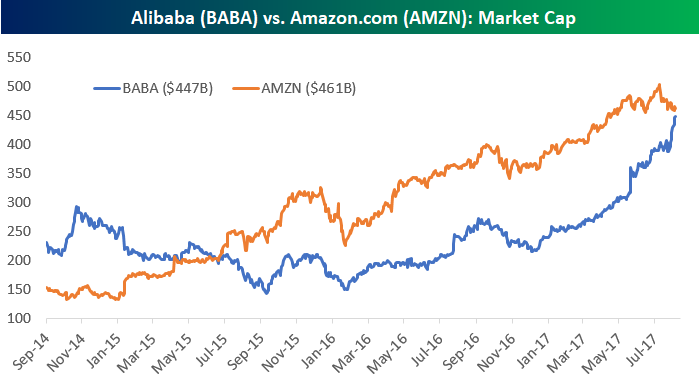
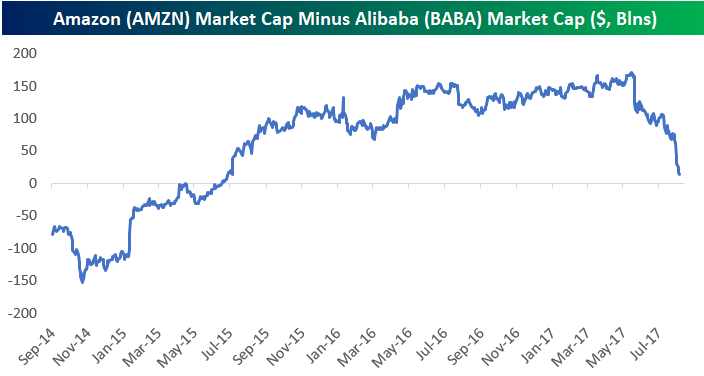
Below is a chart of the historical market caps for Alibaba (the Chinese version of Amazon) and Amazon.com (AMZN). As shown, Alibaba (BABA) actually had a higher market cap that Amazon.com (AMZN) for quite some time just after BABA IPOd back in late 2014. Once AMZN’s market cap crossed above BABA’s in mid-2015, however, AMZN opened up a wide lead for a two-year period.
BABA has been on an absolute tear lately, though, and its market cap has ballooned from $220 billion up to $447 billion since the start of the year. While AMZN’s market cap has risen more than $100 billion this year as well, BABA has pulled to within $14 billion of AMZN at this point. Another decent-sized down day for AMZN accompanied by a gain in BABA would see these market caps cross yet again.
Fixed Income Weekly – 8/23/17
Searching for ways to better understand the fixed income space or looking for actionable ideals in this asset class? Bespoke’s Fixed Income Weekly provides an update on rates and credit every Wednesday. We start off with a fresh piece of analysis driven by what’s in the headlines or driving the market in a given week. We then provide charts of how US Treasury futures and rates are trading, before moving on to a summary of recent fixed income ETF performance, short-term interest rates including money market funds, and a trade idea. We summarize changes and recent developments for a variety of yield curves (UST, bund, Eurodollar, US breakeven inflation and Bespoke’s Global Yield Curve) before finishing with a review of recent UST yield curve changes, spread changes for major credit products and international bonds, and 1 year return profiles for a cross section of the fixed income world.
In this week’s note, we take a look at Energy’s impact on the high yield market.
Our Fixed Income Weekly helps investors stay on top of fixed income markets and gain new perspective on the developments in interest rates. You can sign up for a Bespoke research trial below to see this week’s report and everything else Bespoke publishes free for the next two weeks!
Click here to start your no-obligation free Bespoke research trial now!
Bespoke’s Global Macro Dashboard — 8/23/17
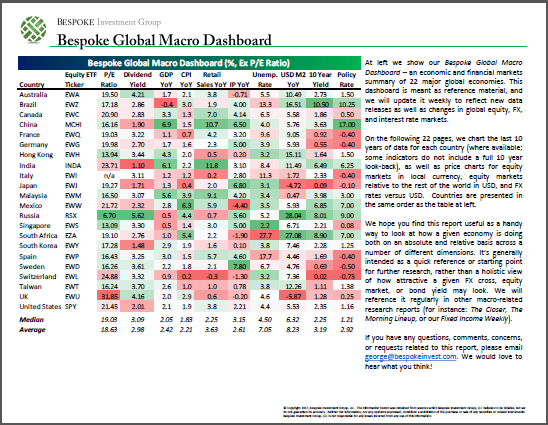
Bespoke’s Global Macro Dashboard is a high-level summary of 22 major economies from around the world. For each country, we provide charts of local equity market prices, relative performance versus global equities, price to earnings ratios, dividend yields, economic growth, unemployment, retail sales and industrial production growth, inflation, money supply, spot FX performance versus the dollar, policy rate, and ten year local government bond yield interest rates. The report is intended as a tool for both reference and idea generation. It’s clients’ first stop for basic background info on how a given economy is performing, and what issues are driving the narrative for that economy. The dashboard helps you get up to speed on and keep track of the basics for the most important economies around the world, informing starting points for further research and risk management. It’s published weekly every Wednesday at the Bespoke Institutional membership level.
Click here to start a no-obligation two-week free trial to Bespoke Institutional!
Breadth Still Not Great
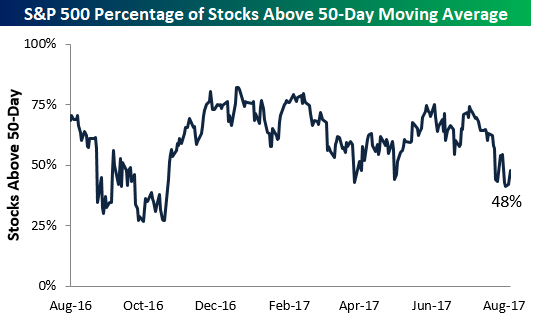
The S&P 500 re-took its 50-day moving average yesterday, but unfortunately it did so without more than half of its index members closing above their 50-days as well. As shown below, only 48% of stocks in the S&P are currently above their 50-day moving averages. Bulls would like to see a much stronger reading than that based on where the S&P is currently trading.
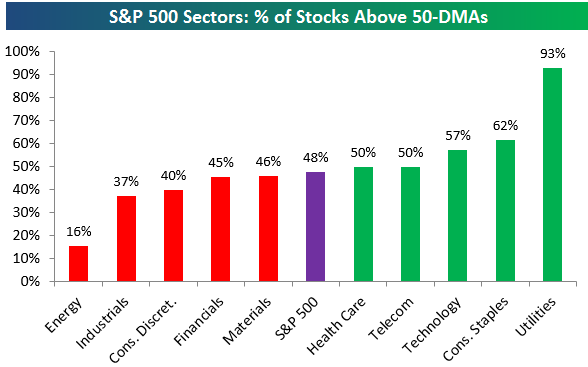
Below is a look at the percentage of stocks above their 50-day moving averages by sector. As shown, five cyclical sectors have breadth readings that are weaker than the 48% reading for the broad S&P 500. Energy is all the way down at 16%, while Industrials and Consumer Discretionary are at 40% or less. The two sectors with the strongest breadth levels are both defensive in nature — Utilities and Consumer Staples. We’d prefer to see the script flipped with cyclicals leading and defensives lagging.
The Closer — Large Cap Technicals, Mexican Growth, and Canadian Retail — 8/22/17
Log-in here if you’re a member with access to the Closer.
Looking for deeper insight on global markets and economics? In tonight’s Closer sent to Bespoke Institutional clients, we review the technical picture for the S&P 500, recap major North American data releases today, and preview tomorrow’s data schedule.
The Closer is one of our most popular reports, and you can sign up for a free trial below to see it!
See today’s post-market Closer and everything else Bespoke publishes by starting a no-obligation 14-day free trial to our research platform!
Chart of the Day: Introducing The “Amazon Survivors” Index
Back in February of 2014, we introduced the Bespoke “Death By Amazon” Index (DBA), a portfolio of companies culled from retailer indices that we judged as being extremely exposed to Amazon’s assault on the traditional retailing business model. The “Death By Amazon” Index has become pretty well-known over the past few years — especially over the last year since it has underperformed the rest of the stock market quite dramatically.
While the “Death By Amazon” Index is made up of retail stocks that are most threatened by Amazon.com, what about the rest of the retail sector? We wanted to know how the retailers that aren’t in the “Death By Amazon” Index are doing compared to the DBA, AMZN, and the broad market. In this regards, we’ve created the Bespoke “Amazon Survivors” Index (ASI), which is composed of companies not included in the “Death By Amazon” Index but still included in the retailing indices we use as our source list for companies. Below, we chart the performance of Amazon, the S&P 1500, and our two indices. All charts of our indices in this post are the equal weight versions.
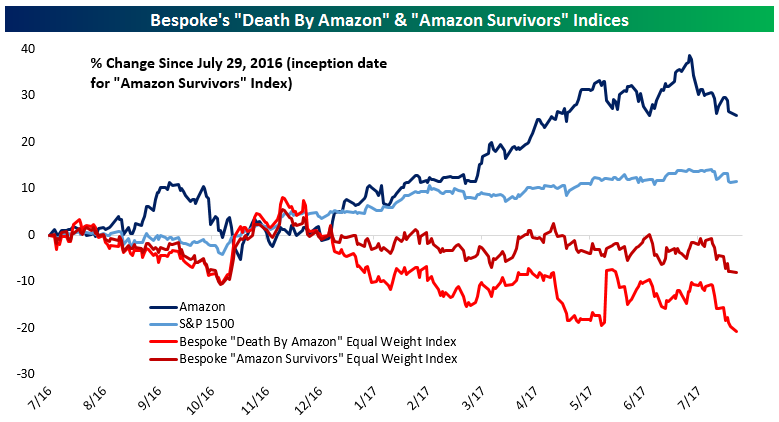
Subscribe to one of our three membership levels to continue reading today’s Chart of the Day. We provide additional performance metrics as well a list of index members of our “Death By Amazon” and “Amazon Survivors” indices.
Bespoke Stock Scores: 8/22/17
ETF Trends: Fixed Income, Currencies, and Commodities – 8/22/17
S&P 500 Breadth Streak Could End
At one point during the day yesterday, the percentage of stocks in the S&P 500 trading above their 50-day moving averages dipped down to 39%. Had this breadth measure closed at 39%, it would have been the first time the reading closed below 40% in 198 trading days dating back to November 4th, 2016. A small late-day rally into the close saved the streak yesterday, but entering today the reading is sitting right at 40%. The streak will most likely end with a decline of any magnitude for the S&P today.
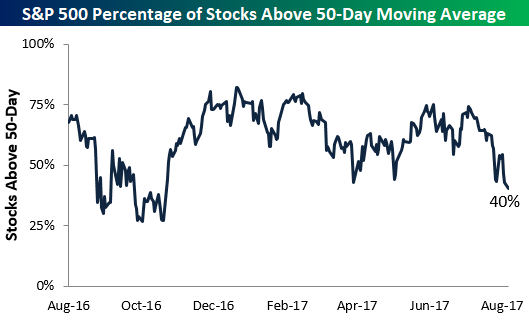
Below is a chart showing historical streaks of trading days with 40%+ of S&P 500 stocks closing above their 50-day moving averages. The length of the streak is just another data point showing just how long it has been since we’ve had any kind of market pullback.
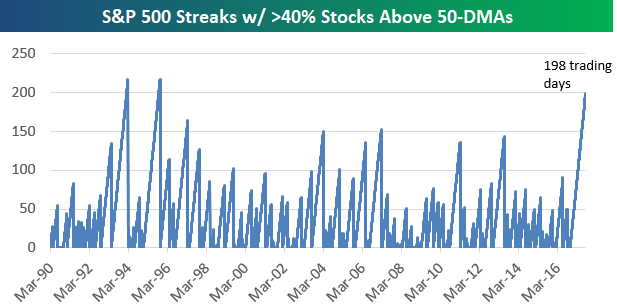
There have only been two longer streaks in the S&P’s history dating back to 1990 when this breadth data begins. In 1994 there was a 216-trading day streak of consecutive 40%+ breadth readings, and in 1995 there was a 217-trading day streak.
Once these long streaks of positive breadth come to an end, there’s a question of what it means. Does the breakdown in breadth finally signal that a more prolonged market pullback has begun, or is it actually a good time to buy?
The table below shows all streaks of 100+ trading days where 40%+ of stocks in the S&P 500 closed above their 50-day moving averages. The date shown is the day the streak came to an end, and next to each date we show how the S&P 500 performed over the next week, month, and three months.
As shown at the bottom of the table, when these streaks have come to an end, the market has performed very well in the near term the large majority of the time. Over the next week, the S&P has averaged a gain of 1.10% with gains 9 out of 13 times (69%). Over the next month, the S&P has averaged a gain of 2.45% with positive returns 10 out of 13 times (77%). And over the next three months, the S&P has averaged a big gain of 4.65% with positive returns 11 out of 13 times (85%). The biggest three-month drawdown seen after these streaks have ended was just -2.67% following the 101-trading day streak that ended on January 13th, 2005.

Gold: Third Time the Charm or Third Strike?
It was less than two weeks ago that we were watching one of the cable news networks, and the panel was discussing what viewers should expect in a war with North Korea since so many of them considered it a sure thing. The next week, the same panel had moved on from North Korea and was discussing the process by which President Trump will leave office. For all this reported chaos in the world right now, one would think that the price of gold would be seeing at least a little action, but over the last four months or so, it has merely been bouncing around between $1,200 and $1,300, or a range of less than 8%. In the most recent leg higher, gold has once again tested the top end of its range and for now, at least, it has been stopped in its tracks. Will the third time be the charm for gold or are we in for just more of the range?
