Shorts Piling Into Equifax (EFX)
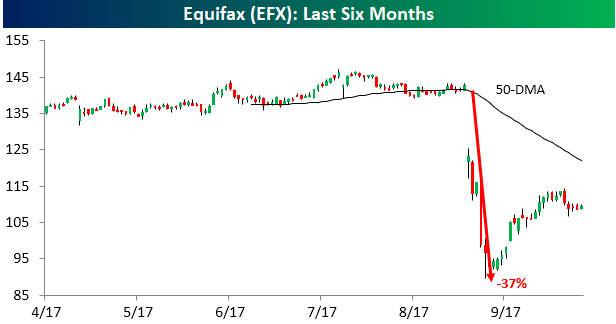
What happens when a company entrusted with the personal information of US consumers gets hacked and exposes the names, addresses, Social Security numbers, birth dates, and even drivers license numbers of just about every American who has a credit report? Well, for starters, your stock price goes down, and that’s exactly what happened to the price of Equifax after news of the massive security breach first broke in early September. From the close on 9/7 to its intraday low on 9/14, shares of EFX plunged more than 37%.
Gain access to 1 month of any of Bespoke’s premium membership levels for $1!
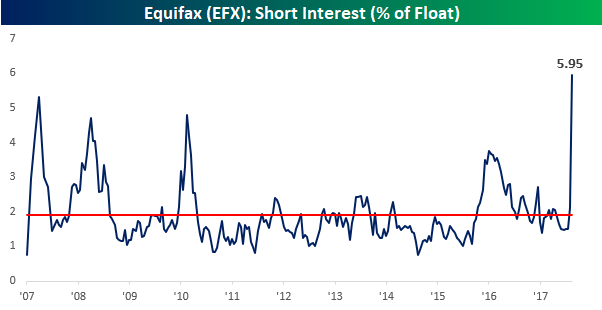
While they have recovered a bit of that decline in the last month, short-sellers have been piling into the stock, sending its short interest as a percentage of float up to just under 6%. While 6% may not sound like a lot when there are other stocks that have more than half of their float sold short, with its historically stable business, EFX is not the type of stock that typically attracts short-sellers. For EFX, 6% short interest is a extremely high. Looking back over the last decade, short interest levels for EFX have never been as high as they are now after the security breach. Not even during the financial crisis. One could easily argue that for Equifax at least, the latest security breach is a much more negative event than the financial crisis, so the high level of short interest may very well be warranted. The company is far from out of the woods. What the high short interest level does provide, though, is some degree of cushion against further weakness. With the stock already down over 25% and 6% of its outstanding shares sold short, eventually, those shares will have to be covered.
Gain access to 1 month of any of Bespoke’s premium membership levels for $1!
Bespoke Stock Scores: 10/17/17
19K, 20K, 21K, 22K, 23K…
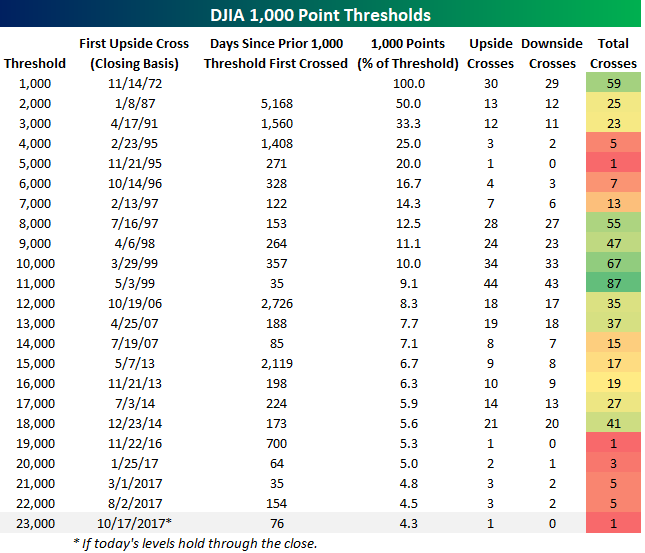
The thousand point thresholds continue to drop like flies these days. With the caveat that a thousand points becomes an increasingly small percentage of the overall index as prices rise, the DJIA just crossed its fifth 1,000 point threshold since Trump’s election last November. The table below shows the date that the DJIA has first crossed each 1,000 point threshold on a closing basis since it first closed above 1,000 back on 11/14/72. For each 1,000-point threshold, we also show how many days transpired between that cross and the prior 1,000 point threshold, the percentage that each 1,000-point threshold represents of the index’s price, and then how many upside and downside crosses the DJIA has had with each level.
Since the election, the DJIA has crossed five 1,000-point thresholds, and with each one, there has been very little in the way of looking back. For instance, once the DJIA crossed 19,000, it never closed back below that level. Once 20,000 was crossed, it only closed below it again once, while 21,000 only saw two subsequent closes below. In looking for comparable periods, the current period is somewhat similar to the late 1990s, when the DJIA crossed several 1,000-point thresholds in very short order. In the current period, these levels have been coming and going a lot faster, but again, it’s important to remember that they represent a much smaller percentage of the overall index’s value than the levels that were crossed in the 1990s. Finally, while it may seem as though the move from 22K to 23K was quick, at 76 calendar days (if that level holds between now and the closing bell), it was longer than the time that elapsed between 20K and 21K (35 days) as well as the time it took to get from 19K to 20K (64 days).
Gain access to 1 month of any of Bespoke’s premium membership levels for $1!
Homebuilder Sentiment Back on the Upswing
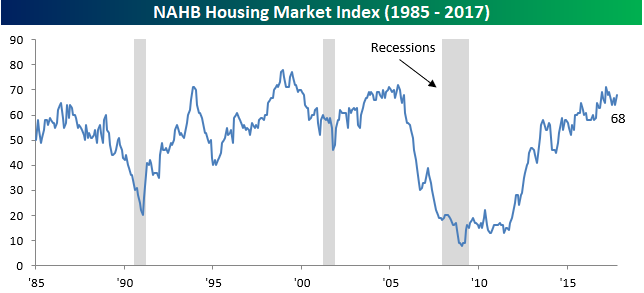
Homebuilder sentiment took a sharp turn higher this month, rising from 64 up to 68 and well ahead of consensus expectations for a reading of 64. While the magnitude of the beat seems large, there have been three other reports in the last year where sentiment saw as big or a bigger improvement relative to expectations.
Gain access to 1 month of any of Bespoke’s premium membership levels for $1!
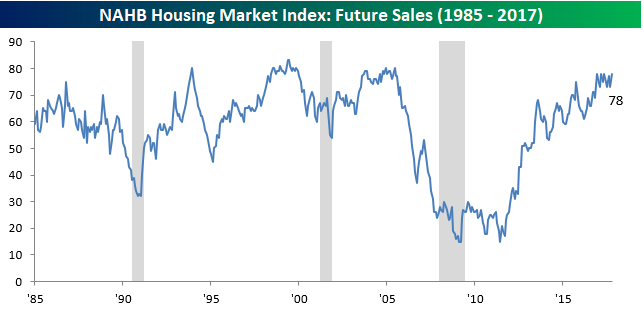
As shown in the table below, Present and Future Sales as well as Traffic all increased this month. Future Sales was a big standout to the upside, as it rebounded back to its highest level since 1999 (chart below).
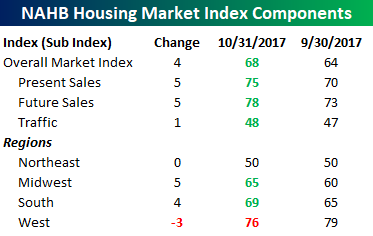
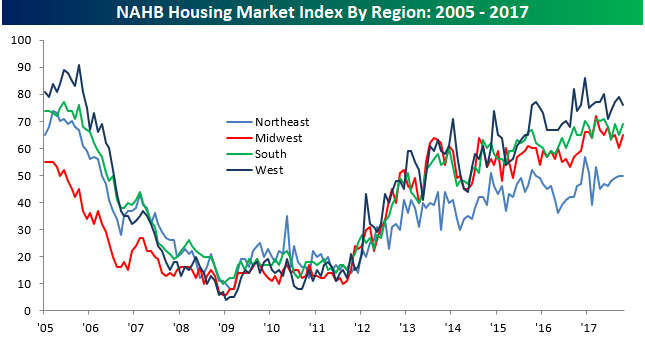
On a regional basis, the only region of the country where sentiment declined was out West. Sentiment in the Northeast was unchanged, while sentiment in the Midwest and South saw big improvements. While overall sentiment was stronger this month, no single area or aspect of the report hit a new high for the cycle.
The Closer — Analogues, Taylor, Pesos — 10/16/17
Log-in here if you’re a member with access to the Closer.
Looking for deeper insight on global markets and economics? In tonight’s Closer sent to Bespoke Institutional clients, we talk about recent price analogues for the S&P 500 and why 1987 isn’t one of them. We also give our thoughts on the Mexican peso and the possible replacement of FOMC Chair Yellen.
The Closer is one of our most popular reports, and you can sign up for a free trial below to see it!
See today’s post-market Closer and everything else Bespoke publishes by starting a no-obligation 14-day free trial to our research platform!
ETF Trends: Fixed Income, Currencies, and Commodities – 10/16/17
The Most Hated Stocks in the Market
Short interest figures for the end of September were released last week, and we just recently sent out our regular update of overall and stock specific trends in short interest levels to clients. In the table below, though, we wanted to provide a quick look at which stocks in the S&P 1500 have the highest levels of short interest (as a percentage of float). All 25 names shown have at least 30% of their free-floating shares sold short, but amazingly, eight of those stocks have more than half of their float sold short. The most shorted stock in the S&P 1500 is Applied Optoelectronics (AAOI), which has more than 70% of its float sold short. It’s not very often that you see a stock with this high a level of short interest, but given the stock is down by a third this month alone, the high short interest looks justified.
Other notable names with high levels of short interest include retail-related names like Dillard’s (DDS), Shake Shack (SHAK), Fred’s (FRED), RH (formerly Restoration Hardware), JC Penney (JCP), and Big Lots (BIG). Outside of SHAK and RH, these retail names are all down MTD. Overall, the 25 names listed below have seen an average decline of 2.91% (median: 3.19%) this month, compared to a gain of 1.47% for the S&P 1500. Normally, stocks with high short interest rally during periods when the market is strong, but these days, investors generally want nothing to do with them.
Gain access to 1 month of any of Bespoke’s premium membership levels for $1!
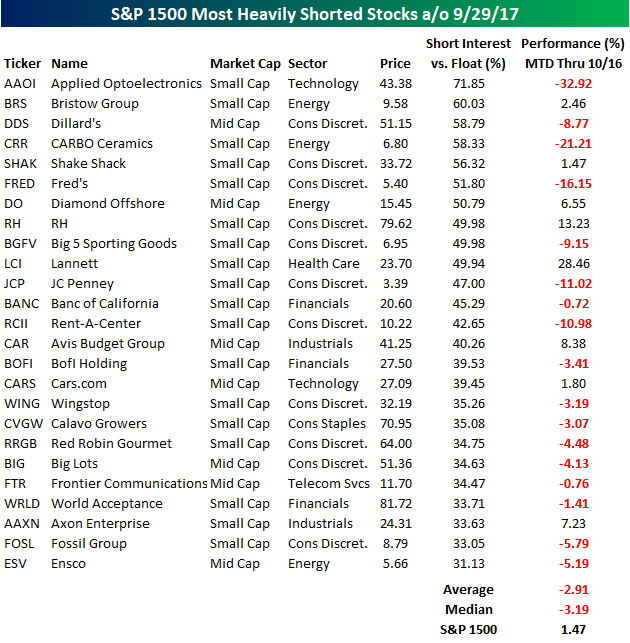
Bespoke Short Interest Report – 10/16/17
Key Earnings Reports to Watch (10/16-10/20)
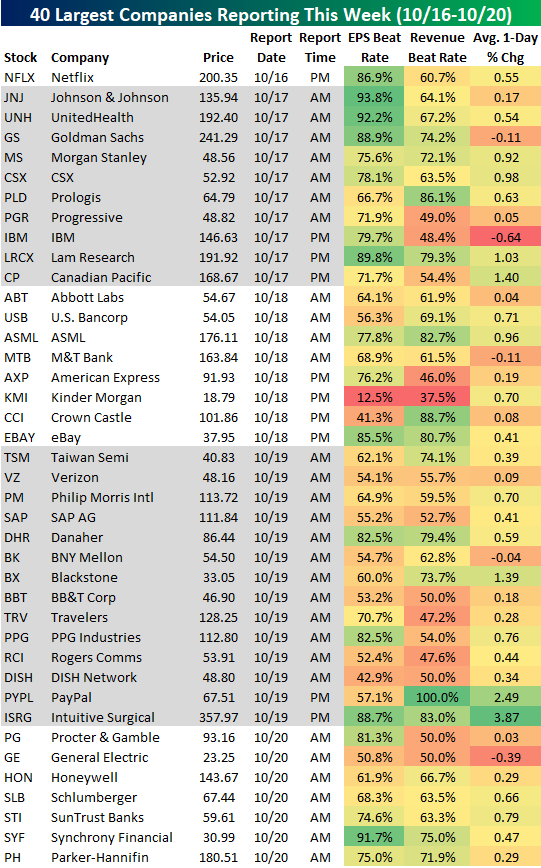
Our Interactive Earnings Calendar is a useful tool for Bespoke subscribers during earnings season. From our calendar, we’ve pulled the table below which shows the 40 largest companies set to report earnings this week. For each stock, we show its historical earnings and revenue beat rate (% of time it beat consensus analyst estimates) along with its average one-day change in reaction to its earnings report.
Netflix (NFLX) kicks things off this week with earnings after the close today. The stock has historically beaten EPS estimates at an 86.9% clip, while its revenue beat rate is a little lower at 60.7%. NFLX is an extremely volatile stock on earnings, but throughout its history, it has averaged a gain of 0.55% on its earnings reaction days.
Tomorrow morning we’ll hear from big Dow 30 stocks like JNJ, UNH, and GS, and then IBM will report after the close. JNJ, UNH, and GS beat EPS estimates at a very high clip compared to the rest of the key stocks set to report this week. IBM beats EPS often, but it has a low revenue beat rate and it typically averages a decline on its earnings reaction day.
Wednesday is relatively quiet, but key companies reporting include American Express (AXP) and eBay (EBAY) after the close. Thursday picks up again with Verizon (VZ), Blackstone (BX), and Travelers (TRV) in the morning followed by PayPal (PYPL) and Intuitive Surgical (ISRG) after the close. Both PYPL and ISRG have seen big gains historically on their earnings reaction days.
On Friday we’ll close out the week with reports from General Electric (GE), Procter & Gamble (PG), Honeywell (HON), and Schlumberger (SLB). GE has only beaten EPS and revenues half the time over the last 15+ years, and it has averaged a decline of 0.39% on its earnings reaction day.
Use Bespoke throughout earnings season with this great membership offer!