
Morning Lineup – Growth Makes a Comeback
The phrase of the day around the world heading into 8:30 was weak economic data, as a bevy of weaker than expected economic data points flooded the headlines. The just-released November Retail Sales report, however, tried to buck that trend as it not only came in higher than expected, but last month’s report was also revised higher! There’s still more to come, though, with Industrial Production and Capacity Utilization at 9:15 and Flash PMI from Markit at 9:45, so hopefully that trend can continue (but not too strong!). Read today’s Bespoke Morning Lineup below for major macro and stock-specific news events, updated market internals, and detailed analysis and commentary:
Bespoke Morning Lineup – 12/14/18
Back in late September when the S&P 500 peaked and started to correct, growth stocks were hit hard reversing their trend of outperformance from earlier in the year. The culprit? Concerns over tighter FOMC policy. By mid-November, the S&P 500 Growth Index had given up about half of its YTD outperformance relative to the S&P 500 Value since the start of the year. Over the last three to four weeks, though, growth stocks have regained some steam with a strong three weeks of relative outperformance. This latest leg lower for the group has come as concerns over broader economic growth have increased causing the market to rethink expectations for the pace of rate hikes going forward.

Start a two-week free trial to Bespoke Premium to see today’s full Morning Lineup report. You’ll receive it in your inbox each morning an hour before the open to get your trading day started.

Tariff Trouble: Treasury’s Tales
Today, the US Treasury reported monthly budget numbers for November. In addition to data about aggregate outlays, revenues, and the deficit, there’s also some interesting data under the hood. Since the US started down a more protectionist policy path following the 2016 Presidential election, we’ve kept a close eye on the line item for customs duties, where the Treasury reports the collection of tariffs (import taxes). This series didn’t start moving much until Q1 of this year, when new taxes on steel, aluminum, and Chinese goods started to really kick in. In the three months ended February, average customs duty revenues ran at a pace of about $3bn (after seasonal adjustment), or $36bn SAAR. By August that number was nearly $4bn, and in November it was nearly $6bn. On a 3m average basis, September-November saw customs duties collected at a pace of 30 bps of GDP. Historically (since this data series begins in 1998) that number typically runs between 15 and 20 bps of GDP, so relative to the size of the economy import tariffs are nearly twice their historic range. Of course, these are still small numbers relative to the total economy. They’re also small relative to US imports, with the September-November period showing customs duties running a bit over 2.3% of total goods import values. Over the last 20 years or so, that number has typically been more around 1.5%. In other words, the tax rate on imports has risen very sharply, but it’s still very small relative to, for example, sales taxes in most states.

Chart of the Day: European Equities Underperform
Jobless Claims Beat Estimates By 20K
After nearly two months of trending upwards, initial jobless claims fell dramatically this week to 206K versus last week’s 231K on a seasonally adjusted basis. This low reading is only 4K off of the multi-decade low of 202K from mid-September, and at 40 year lows for all but three readings from the last week of August and first two weeks of September. Claims were expected to decline this week, but the actual reading blew the 226K forecast out of the water; this was the largest beat since April. This week’s release has of course held onto a number impressive streaks. They have now spent 62 weeks below 250K, the best streak since January 1970 when the streak ended at 89 weeks. Claims have also held below 300K for a record 197 weeks. Given population and employment trends since the previous records, these current streaks are arguably a lot more impressive. Following the previous several weeks’ elevated levels, this week’s low reading helps to reaffirm the health of these streaks.
Taking a look at the four-week moving average, this week’s data point is still unconcernedly elevated but below levels last week. The four-week moving average comes in at 224.75K, down from last week’s 231K. While it is still at very low levels in the grand scheme of things and should be no cause for concern, it has now been 13 weeks since the last time it made a cycle low.

On a non-seasonally adjusted basis, initial claims fell off of last week’s highs down to 260.5K. This drop is in line with seasonal patterns that have been previously observed. Important to note, this week of the year typically comes before a major spike in claims and this dip off highs has happened in prior instances (can be seen in the past two years in the chart below). In other words, while this week was remarkably strong, it could come in part from seasonal factors and in upcoming releases, especially on a non-seasonally adjusted basis, there could be a higher reading due to seasonal effects. Regardless, today’s data maintains a healthy labor market and came in well below the average for the current week in the past 18 years of 439.7K and since 2005 there has not been a better week for initial jobless claims.

Individual Investor Sentiment Hits Multi-Year Records
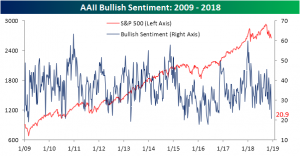
As we made note of last week, the survey of individual investor sentiment from AAII saw a surprising divergence from the market’s price action due to timing issues of the survey. Last week saw a jump in bullish sentiment despite major declines on Tuesday. This week’s survey was much weaker, with bullish sentiment plunging. It’s now down to 20.9% from 37.9%. As shown in the chart below, this reading of 20.9% collapsed well below lows of the year and is at the lowest point since May 26, 2016. This was also the third largest WoW drop of the current cycle and the largest since mid-November of 2010 when bullish sentiment fell by only half a percentage point more.
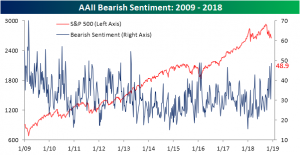
Obviously, if bullish sentiment collapses as it did this week, bearish sentiment sees the inverse effect. Bearish sentiment rose to the highest level in over 5 years to 48.9%; up 18.7% from last week. That is the largest uptick and the highest reading since April 11, 2013! Bearish sentiment is also into a region from early 2016 that saw a major global equity market bottom.
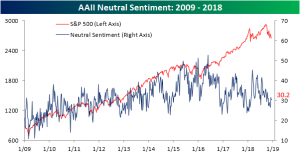
Neutral sentiment actually saw a slight decline this week meaning neutral and bullish investors likely all went into bearish sentiment.
Morning Lineup – Boxed In
Futures have been all over the place this morning on headlines coming out of China (what else is new) and the latest ECB rate decision. In the US, jobless claims are due out shortly, and investors are hoping the recent string of increases reverses. Read today’s Bespoke Morning Lineup below for major macro and stock-specific news events, updated market internals, and detailed analysis and commentary:
Bespoke Morning Lineup – 12/13/18
With all the wild swings we have seen, the US equity market has essentially been trapped in a box over the last several weeks, albeit a relatively large one ranging from 2,600 to 2,800. Until stocks break out of that range in either direction, it’s hard to read these day to day moves as anything more than noise. Right now, the S&P 500 is trading a lot closer to the bottom end of that range than the lower end, so at this point, there’s less room for error.

Perhaps one clue of which way the market will break is to watch the semis. They led the broader market lower, and they too have been pretty much boxed into a range for the last several weeks. Like the S&P 500, the semis are also trading a lot closer to the bottom end of the range than the top.

Start a two-week free trial to Bespoke Premium to see today’s full Morning Lineup report. You’ll receive it in your inbox each morning an hour before the open to get your trading day started.
Chart of the Day: Reversals of Reversals
Twitter (TWTR) Takes Out Resistance
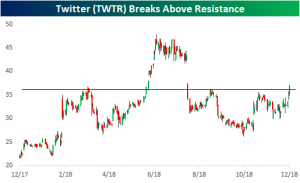
Social media giant Twitter (TWTR) has been on an absolute tear this week. Since Monday’s open, the stock has risen over 12% as of this writing. Half of this comes from today alone as the stock broke out above a key resistance level of $35/$36. This has been an important level for the stock throughout the past year. In March, TWTR failed to break above this resistance, but over the course of the next few months, the stock surged over 20% from there, only to give up all of those gains on a poorly received earnings report in July. From these new lows, the stock would come to once again retest the $35/$36 level twice before today’s breakout. If the past year’s price action is any indication, this breakout could provide a technical base for a solid run back into the $40s.
Long-Term Price Charts of Key Country Equity Indices
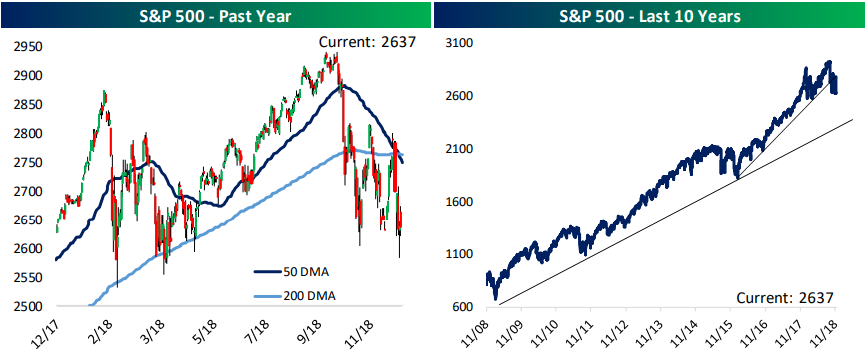
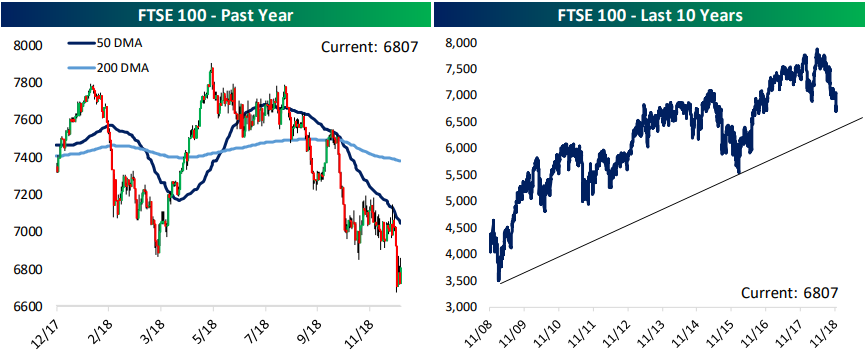
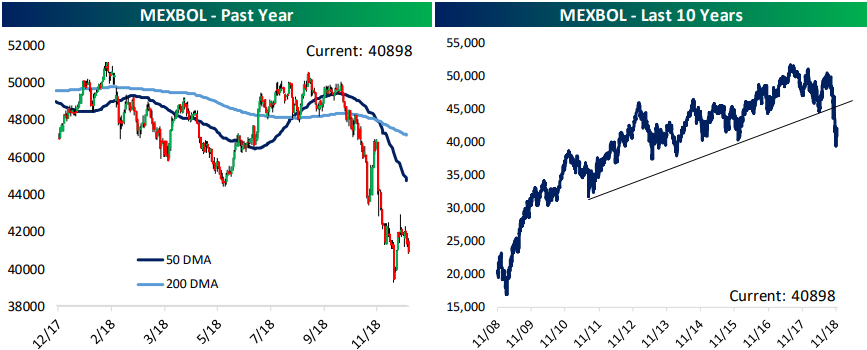
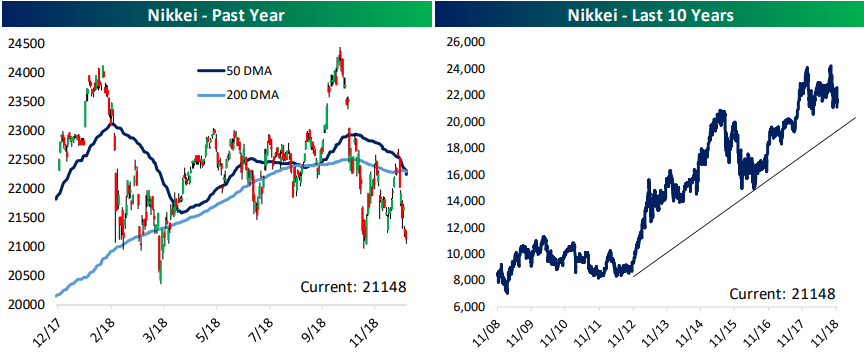
Each week we publish our Bespoke Macro Dashboard, which is a high-level summary of 22 major economies from around the world. Below we provide two charts from the Dashboard covering a short-term and long-term look at selected country stock markets.
While the one-year charts look bearish for all seven countries, some of the countries remain within their long-term uptrend channels, while others have broken down.
The S&P 500 (U.S.) has so far managed to hold above support at 2,600, while its 10-year chart still looks relatively bullish.
The FTSE 100 (UK) is in a nasty multi-month downtrend with a recent break to new 52-week lows, but price has still yet to test the bottom of its 10-year uptrend channel.
Mexico’s Bolsa index has plummeted 20% from its recent highs, and this drop also broke a key support level on its 10-year chart as well.
Japan’s Nikkei 225 looks somewhat similar to the chart for the S&P 500. The index has been choppy over the last year but hasn’t made a new 52-week low, and it remains well within its 10-year uptrend channel.
The German DAX index looks very negative on both a short-term and long-term technical basis. As shown, the index is a falling knife on the one-year chart, and it just broke below its long-term uptrend channel on the 10-year chart.
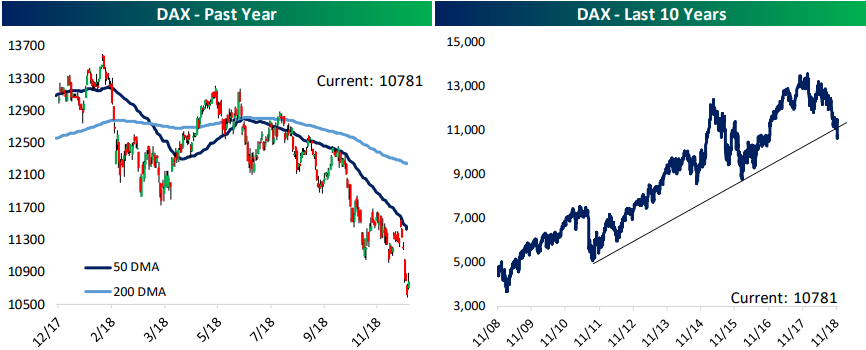
While Germany’s DAX has broken down on a 10-year chart, France’s CAC 40 remains slightly above the bottom of its long-term uptrend channel.
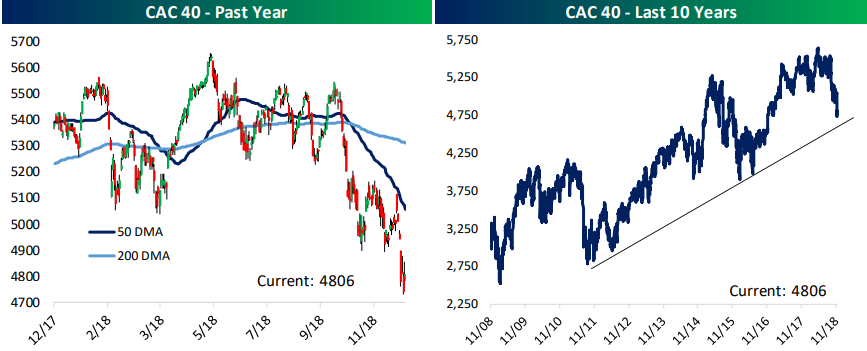
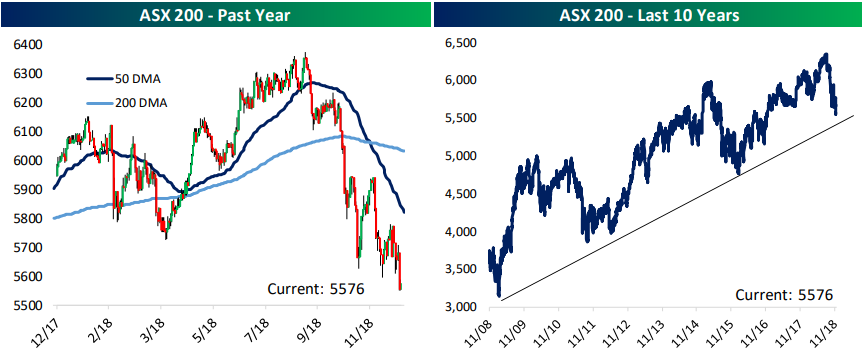
Like the French CAC 40, Australia’s ASX 200 has recently made a 52-week low, but it remains above the bottom of its 10-year uptrend channel.
For a weekly look at these global equity market charts plus much more, start a two-week free trial to our Bespoke Institutional service.
Fixed Income Weekly – 12/12/18
Searching for ways to better understand the fixed income space or looking for actionable ideals in this asset class? Bespoke’s Fixed Income Weekly provides an update on rates and credit every Wednesday. We start off with a fresh piece of analysis driven by what’s in the headlines or driving the market in a given week. We then provide charts of how US Treasury futures and rates are trading, before moving on to a summary of recent fixed income ETF performance, short-term interest rates including money market funds, and a trade idea. We summarize changes and recent developments for a variety of yield curves (UST, bund, Eurodollar, US breakeven inflation and Bespoke’s Global Yield Curve) before finishing with a review of recent UST yield curve changes, spread changes for major credit products and international bonds, and 1 year return profiles for a cross section of the fixed income world.
This week we look at the decline in Treasury yields from a term premium perspective.
Our Fixed Income Weekly helps investors stay on top of fixed income markets and gain new perspective on the developments in interest rates. You can sign up for a Bespoke research trial below to see this week’s report and everything else Bespoke publishes free for the next two weeks!
Click here and start a 14-day free trial to Bespoke Institutional to see our newest Fixed Income Weekly now!