Last Hour Strength – Welcome Back!
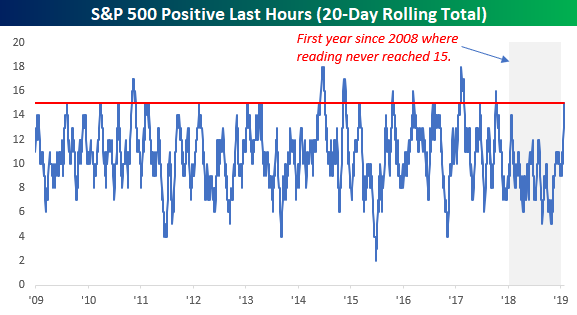
We’ve been discussing the market’s recent tendency to rally in the last hour of trading numerous times in the last few weeks. To summarize, in the 21 trading days since Christmas, the S&P 500 has been up in the last hour of trading 15 times! With a slight decline in the last hour of trading last Friday, the 20-day rolling total of positive last hours as of Thursday’s close was even stronger as the S&P 500 was up in the final hour of trading 75% of the time. Strength in the last hour of trading is generally considered a bullish trend as it signals that investors aren’t worried about the overnight risk of being long equities while the market is closed.
The fact that we have seen such consistent strength in the last hour has been a change of pace for the market based on recent trends. From a longer-term perspective, though, such strength is not uncommon. The chart below shows the rolling 20-day total of the number of days where the S&P 500 saw positive returns in the last hour of trading. Before the most recent occurrence, the last time the percentage of days with positive last hours reached 75% or more over a 20-trading period was in October 2017. That’s a pretty long gap without any occurrences, but when you look back over time, this long of a gap was more of the exception than the rule. In fact, before 2018 the last time that the 20-day rolling total of positive last hours never reached 15 in a calendar year was in 2008.
This Week’s Economic Indicators – 1/28/19
Economic data was light last week with just 10 releases (Durable Goods and New Home Sales did not release due to the shutdown); half of which came in worse while the rest came in at or above forecasts. After the MLK Jr. holiday Monday, we came back Tuesday to a poor reading in existing home sales which missed by the widest margin since November of 2015. More in housing data, alongside an uptick in FHFA House Prices was a decline in mortgage applications, although they were still strong. Wednesday’s Richmond Fed improved versus December but was still negative. Markit released their preliminary January PMIs on Thursday with a stronger reading, especially relative to weak global numbers released that same morning. Thursday’s report on Leading Indicators showed a slight decline (-0.1%) but was right inline with expectations.
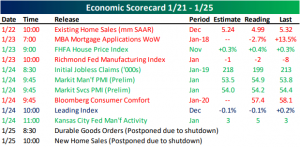
This week activity picks up in a big way with over 30 indicators scheduled for release. Of note, today we get regional Fed activity indices. The Chicago Fed printed its first back to back monthly increase since October 2017. Meanwhile, the Dallas Fed came in stronger at +1 vs -2.1 forecasts. Those activity numbers will be followed up with the first release of Q4 GDP data and an FOMC rate decision (no change is expected) on Wednesday. After Chicago PMI and weekly jobless claims are released on Thursday, the nonfarm payrolls report for January will hit the tape at 8:30 AM ET on Friday.

Last week added two releases to the long list of 26 data points that have been postponed due to the closure of the government organizations responsible for the releases. Thankfully, we should return back to normal next week (no releases have yet to be rescheduled for this week) after lawmakers in Washington agreed to re-open the government last Friday afternoon. With the government re-opened, it is not as though all of the reports listed below will be released immediately. Depending on the department that collects the data, the schedule for release will vary. In some cases, the missed reports will be released on the same day of the next release, while preliminary will not be released at all.
At 34 days long, this shutdown far surpassed the previous record for longest shutdown (21 days) in 2013. The December readings on preliminary Durable Goods Orders and New Home Sales both were scheduled to be released Friday. For these two indicators, we are now missing their November and December data which is why there is no entry for the estimate and last reading of these indicators. These are not the only indicators to have missed two releases. Wholesale Inventories and the Trade Balance, for example, have missed preliminary and final outputs.

FAANG Chart Scanner Snapshot
Bespoke recently launched a new interactive research portal for subscribers. Along with an amazing new search feature that lets investors easily look up individual stocks and ETFs, we also have a revamped reports section, a brand new interactive tools section, and a custom portfolios section!
Our original and timely research reports continue to make up the backbone of Bespoke’s service, but as we grow, our goal has been to give subscribers access to more of the unique investment tools that we use internally.
If a subscriber wants to monitor charts for a basket of stocks or ETFs, it’s now simple to set up a custom portfolio that updates chart patterns for these specific tickers on a daily basis. You can view all of these charts on one page for quick and easy viewing.
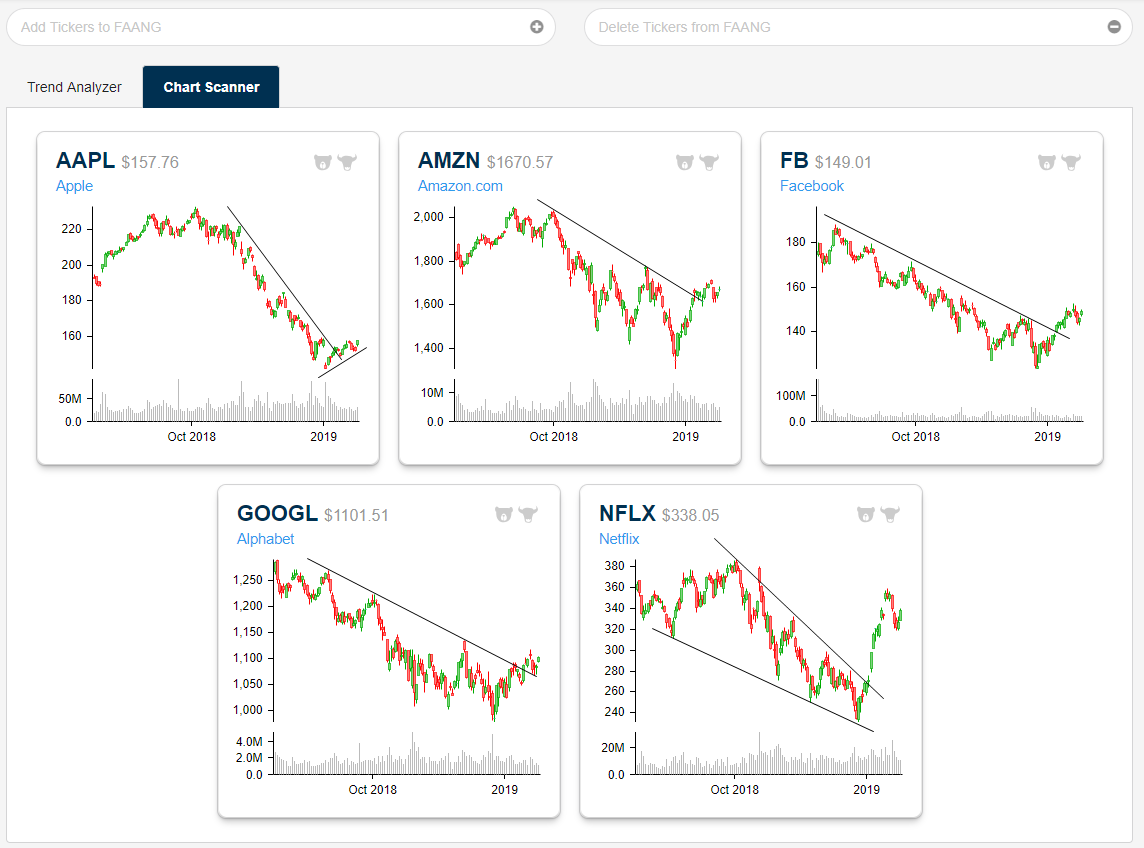
Below we’ve taken a snapshot from our new portal of a FAANG custom portfolio we created. (Subscribers — go to the “Custom Portfolios” section to do this.)
As you can see, the FAANG stocks have all recently made strides in breaking the long-term downtrends that formed in Q4 2018. This is a bullish first step, but they still have a lot of work to do if they’re going to form new uptrends.
To try out Bespoke’s new interactive research portal, start a two-week free trial to either our Bespoke Premium or Bespoke Institutional membership levels.
Trend Analyzer – 1/28/19 – Almost Overbought
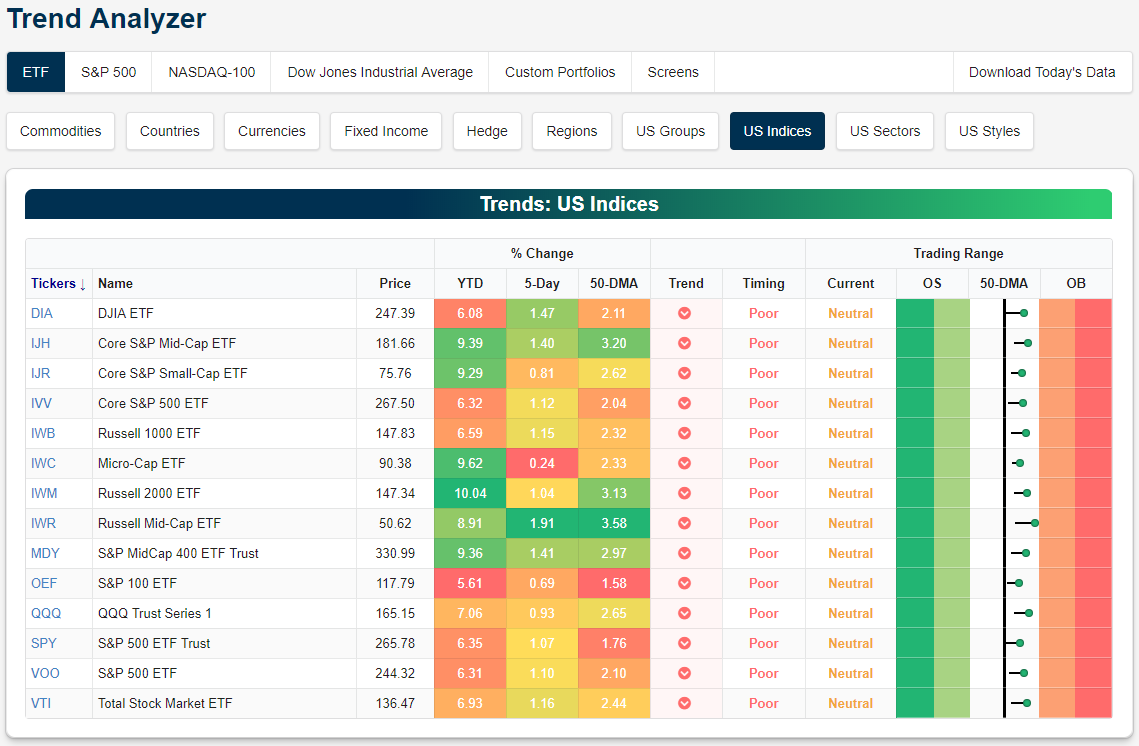
Every major US index ETF is starting the trading week in neutral territory just above its 50-day moving average. With equity futures pointed lower, however, the week may be setting up for a number of tests of support at the 50-day, especially for large-cap indices like the S&P 500 (SPY) and the Dow 30 (DIA).
Note that every ETF listed in the snapshot from our Trend Analyzer tool below is now up more than 5% on the year. The small-cap Russell 2,000 (IWM) is up the most YTD at 10.04%, while the large-cap S&P 100 (OEF) is up the least at 5.61%.
While the small-cap Russell 2,000 (IWM) is up the most year-to-date, the Russell Mid-Cap ETF (IWR) is the most extended above its 50-day moving average at +3.58%.
Morning Lineup – CAT Bites
Equities aren’t kicking off the week on a positive note, and if this morning’s earnings report from Caterpillar (CAT) is any indication, the busiest week of earnings season could be a long one. CAT had its biggest earnings miss in ten years this morning. It was also the first time that the company missed EPS and revenue forecasts as well as lowered guidance in the same report for the first time since October 2013. Read today’s Bespoke Morning Lineup for more on what’s driving the markets this morning.
Bespoke Morning Lineup – 1/28/19
While equities are poised to open the week on a negative note, this year it all comes down to the actual trading day. As shown in our updated chart comparing the S&P 500’s intraday pattern in the period from 9/20 through 12/24 to the days since then, the last 21 trading days have been characterized by steady buying throughout the trading day, especially during the last hour of trading. Can the last hour bail out the bulls again today?

Start a two-week free trial to Bespoke Premium to see today’s full Morning Lineup report. You’ll receive it in your inbox each morning an hour before the open to get your trading day started.

Bespoke Brunch Reads: 1/27/19
Welcome to Bespoke Brunch Reads — a linkfest of the favorite things we read over the past week. The links are mostly market related, but there are some other interesting subjects covered as well. We hope you enjoy the food for thought as a supplement to the research we provide you during the week.
While you’re here, join Bespoke Premium for 3 months for just $95 with our 2019 Annual Outlook special offer.
Trade
Agent Orange: Trump, Soft Power, and Exports by Andrew Kenan Rose (SSRN)
Using panel data for 157 countries from 2006 – 2017 combined with Gallup data for 5 major economies, the author identifies a two-thirds percent increase in exports for every 1 point increase in other countries’ approval ratings for a leader. [Link]
China Resists U.S., EU Talks on Global Digital Trade Deal, Sources Say by Bryce Baschuk and Shawn Donnan (Bloomberg)
In the background behind bilateral trade disputes, multilateral efforts to agree on a framework for digital trade are not engaging China. [Link; soft paywall]
Retail
Inside The Strange Yet Profitable World Of Retail Arbitrage by Ian Lecklitner (Mel Magazine)
Buying goods at your local Amazon or Target then re-selling them on Amazon can net you a tidy profit; in one case, more than $2500 in a day for a board game trade. [Link]
Real Estate
Hamptons Listings Surge 82% in a Year, Pushing Home Prices Lower by Sydney Maki (Bloomberg)
In December, almost 2200 homes were for sale in the Hamptons, an 82% YoY advance that is a record. Softening demand driven by stock prices, very strong appreciation over the last decade, and tax law changes are all to blame. [Link; soft paywall]
Billionaire Ken Griffin Buys America’s Most Expensive Home for $238 Million by Katherine Clarke (WSJ)
The United States has a new record real estate transaction thanks to the purchase of a New York City penthouse by Citadel co-founder Ken Griffin. [Link; paywall]
Airport Noise NIMBYism by Eli Dourado (Mercatus Center)
Opposition to nuisance airport noise tends to be very concentrated; in one example, 78% of calls to complain about aircraft noise at Reagan International Airport came from one residence (an average of 19 per day). [Link]
Medicine
We may finally know what causes Alzheimer’s – and how to stop it by Debora MacKenzie (New Scientist)
New research suggests that the bacteria which causes common chronic gum disease is the culprit for Alzheimer’s, with the proteins thrown off by the bacteria potentially playing a key role in the evolution of the disease. [Link]
Company sells $80 used tissues, claims to help prepare people for flu season (Fox 5 WTTG)
Vaev is offering used tissues as a method for boosting your immune system, a surprising twist on the usual approach of vaccines. [Link]
CBS Rejects Super Bowl Ad for Medical Marijuana by Craig Giammona (Bloomberg)
A medical marijuana company backed by John Boehner tried to buy ad space during the Super Bowl, but was turned down. [Link; soft paywall]
Stories of the South
Lightning, Struck by Max Blau (Bitter Southerner)
The modern Mercedes-Benz stadium that will host the Super Bowl replaced the Georgia Dome, but the neighborhood that occupied the land prior to the Georgia Dome is mostly forgotten. [Link]
After a casino boom, a Mississippi county deals with a reversal of fortune by Jenny Jarvie (San Diego Tribune)
As gambling development has spread from a few concentrated meccas, traditional temples to gambling have fallen on some very hard times. [Link]
Civil Rights Unionism by Robert Korstad (Jacobin)
The recent history of the South has seen the rise of non-union manufacturing, but the longer history is fascinating, including a Communist-led union of tobacco workers fighting for Civil Rights in the wake of World War Two in the Jim Crow South. [Link]
Industry
Wind Installation Bottleneck Threatens 23% of US Projects by Mary B. Powers (Engineering News-Record)
The unique challenge of moving very large components is creating big headaches for the turbine industry, which is facing a phase-out of tax credits. [Link]
U.S. Oil Production Is 23 Years Ahead of Schedule by David Marino and Stephen Cunningham (Bloomberg)
Last year, the EIA forecasted 2042 oil production in the US would come in around 11.95mm bbl/day, but the industry is on pace to break that high water mark this year alone. [Link; soft paywall]
Vows & Vocations
As If by Design, Their Connection Was Inevitable by Vincent M. Mallozzi (NYT)
Accomplished professor at the M.I.T. Media Lab, former Israeli Air Force first lieutenant, and PhD in computational design Neri Oxman wed the manager of a hedge fund in a January 19th ceremony. [Link; soft paywall]
Norman Goodman, 95, Dies; Summoned Manhattanites to Jury Duty, Like It or Not by Margalit Fox (NYT)
The man who instructed generations of Manhattan residents to appear for jury duty has passed away, leaving behind a colorful career of public service. [Link; soft paywall]
Davos
Remarks delivered at the World Economic Forum by George Soros (georgesoros.com)
Americans often hear the name George Soros as some sort of left wing puppeteer, but the investor’s speech at the World Economic Forum doesn’t read anything like that. It’s acutely focused on the dangerous authoritarianism of China under Xi Jinping, very consistent with his long-term focus on protecting free and open society. [Link]
Chilling Davos: A Bleak Warning on Global Division and Debt by Andrew Ross Sorkin (NYT)
During the World Economic Forum in Davos, Switzerland, a hedge fund manager’s bleak outlook over a global social and political divide is par for the course. [Link; soft paywall]
Polling
A big portion of Trump’s base is breaking from him and would want to end the shutdown without a border wall, new poll shows by Eliza Relmon (Business Insider)
The government shutdown ended (at least temporarily) Friday, but polling released earlier in the week suggests that the President’s base was not sticking with him as he sought wall funding in exchange for re-opening the government. [Link]
Global Warming Concerns Rise Among Americans in New Poll by John Schwartz (NYT)
73 percent of Americans polled at the end of 2018 agreed that global warming was happening, 10 percentage points higher than in 2015; 72 percent say the issue is important to them. [Link; soft paywall]
Gold
Venezuela Wants $1.2 Billion in Gold Back From Bank of England by Patricia Laya, Ethan Bronner, and Tim Ross (Bloomberg)
In order to prevent access to funds for the Venezuelan regime, the Bank of England has denied a request to repatriate the country’s gold reserves from London. [Link; soft paywall]
Crime
I’m Still Around by Samuel Kerr (Medium)
The fascinating and disturbing story of the mid-nineties gang war in Vancouver, including media mistakes, blown prosecutions, vicious murders, and more. [Link]
The Rich
Super Rich Americans Are Getting Younger and Multiplying by Ben Steverman (Bloomberg Quint)
As Baby Boomers age, the largest wealth transfer in history has started, with the average age of those with $25mm or more in assets falling to 47 from 58 in 2014. [Link; soft paywall]
Social Media
Twitter suspends account that helped ignite controversy over viral encounter by Donie O’Sullivan (CNN)
The confrontation in Washington DC last week between a teenaged supporter of Donald Trump and a native American protestor initially caught attention from an account later suspended by Twitter. [Link]
Read Bespoke’s most actionable market research by joining Bespoke Premium today! Get started here.
Have a happy New Year!
Updated Earnings and Revenue Beat Rate Numbers for Q4 2018
The Q4 2018 earnings season continued to pick up steam this week as another 100+ companies reported. Next week things kick into full gear, however, with an estimated 325+ companies set to report.
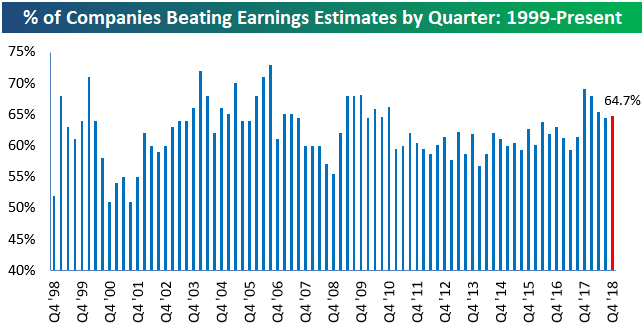
Below we take a look at the numbers we’ve seen so far this season. As shown in the first chart below, the bottom-line earnings per share beat rate now stands at 64.7%. This is roughly inline with the final reading seen last quarter, but it’s also low for where we are in the reporting period. Historically, the earnings beat rate drifts lower as earnings season progresses.
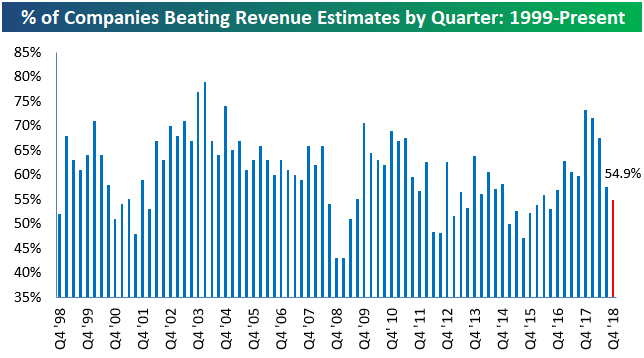
The top-line revenue beat rate actually ticked up a bit this week after finishing last week below 50%. As shown below, 54.9% of companies that have reported this season have beaten consensus revenue estimates. Even after the tick higher this week, top-line beats this season remain weaker than normal.
Xilinx (XLNX) Leads the List of Earnings Season Winners So Far
Roughly 200 companies have reported Q4 earnings results since the current reporting period began earlier this month. So how have stock prices been reacting to earnings reports so far this season? Very well.
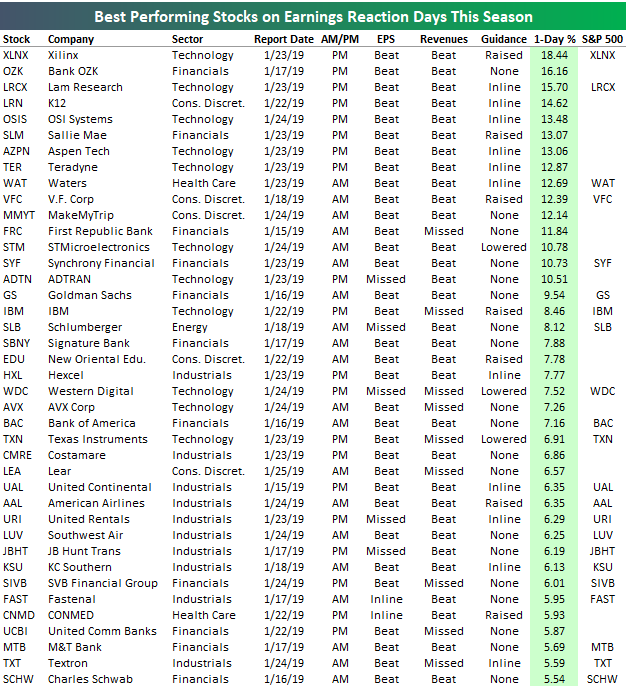
The average stock that has reported Q4 numbers has gained 1.2% on its earnings reaction day. (The earnings reaction day is the first trading day following a company’s quarterly report. For companies that report before the open, its earnings reaction day is that trading day. For companies that report after the close, its earnings reaction day is the next trading day.) That’s an impressive reading suggesting investors came into the reporting period too bearish.
Below is a list of the 40 best performing stocks on earnings so far this season. Of the 40 stocks listed, 15 gained more than 10% on their earnings reaction days, with semiconductor company Xilinx (XLNX) on top at +18.44%. On January 23rd, XLNX reported an earnings triple play after the close by beating EPS estimates, beating revenue estimates, and raising guidance. Shareholders were rewarded with a one-day gain of nearly 20%.
Bank OZK (OZK) ranks second on the list with a one-day gain of 16.16% following its report on January 17th. Lam Research (LRCX) ranks 3rd at +15.7%, followed by K12 (LRN) and OSI Systems (OSIS). Other notables on the list of big winners this earnings season include Goldman Sachs (GS) with a gain of more than 9%, IBM with a gain of 8.5%, and Bank of America (BAC) with a gain of more than 7%. GS, IBM, and BAC are three blue-chip financials that had been beaten down in the months leading up to their recent reports, and they’re great examples of the newfound strength that many previously struggling financials have shown in recent weeks.
For more in-depth earnings season analysis, start a two-week free trial to Bespoke Institutional. We’ve got an amazing Earnings Explorer tool that you’ll love.
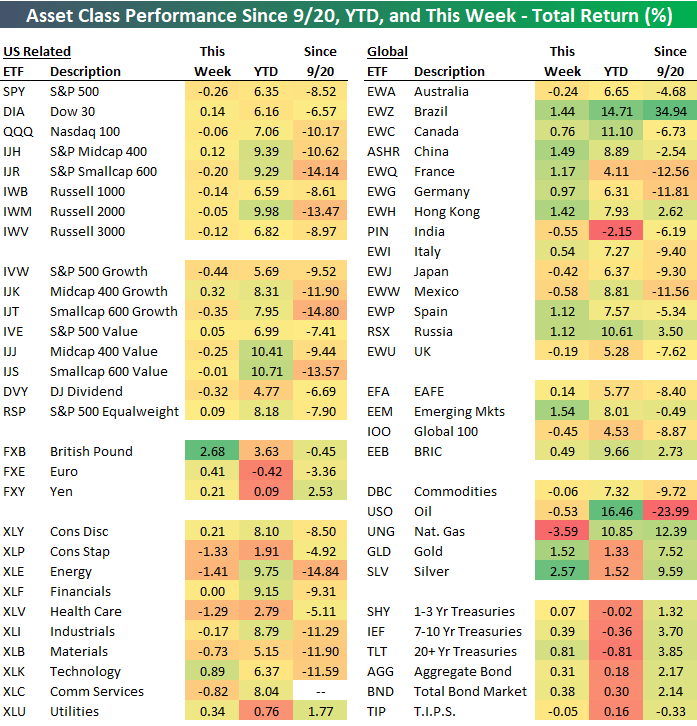
Asset Class Performance YTD Through 1/25 (ETF Matrix)
Below is a look at the recent performance (total returns) of various asset classes using our key ETF matrix. For the week, the S&P 500 (SPY) was down 26 basis points, but it’s still up 6.35% YTD. Since the 9/20/18 peak for SPY, the ETF is now down 8.52%.
While SPY is down 8.52% from its 9/20 high, the Dow 30 (DIA) is down just 6.57%, while the Nasdaq 100 (QQQ) is down 10.17%. Small-caps are down the most from their highs at -14.14% (IJR).
Looking at sectors, it really wasn’t a great week outside of strength in Tech (XLK). Health Care (XLV), Energy (XLE), and Consumer Staples (XLP) were all down more than 1% on the week, while Materials (XLB) and Communication Services (XLC) were down more than 70 basis points. For the year, Energy (XLE) is still up the most, but it’s also down the most of any sector since the 9/20 peak.
International equity markets performed much better than the US this week, and most countries are outperforming the US on a year-to-date basis as well. Brazil (EWZ) continues to post massive gains, returning 1.44% on the week at +14.71% on the year. While SPY is down 8.52% from its 9/20 high, EWZ is up 34.94% over the same time period. The only country struggling this year is India (PIN) with a decline of 2.15%.
Commodities are performing well in 2019, with DBC up 7.32% on the year. Oil (USO) and natural gas (UNG) took a breather this week, but they’re still both up 10%+ on the year. And while gold (GLD) and silver (SLV) are lagging energy commodities so far in 2019, these two precious metals posted nice gains this week. Here’s a closer look at gold’s price chart if you’re interested.
Be sure to read our newest Bespoke Report newsletter, which covers everything you need to know about equities, the economy, and more. You can read it by starting a two-week free trial to any of our three membership levels.
The Bespoke Report – And Then There Was One
US equities took a bit of a breather this week from their torrid rally off the Christmas Eve lows. While anyone long equities would like to see the market trade consistently higher, nothing moves in a straight line. At this point, the sideways trading this week can still be considered nothing more than a pause as the market looks to catch its breath. Next week, though, we should get a lot more clarity on which way this market wants to move as the FOMC will announce its latest views on monetary policy Wednesday, followed by a Jerome Powell Press conference. Just as important, the pace of earnings reports for Q4 will pick up even more steam as nearly a quarter of the S&P 500 (122 companies) will report numbers.
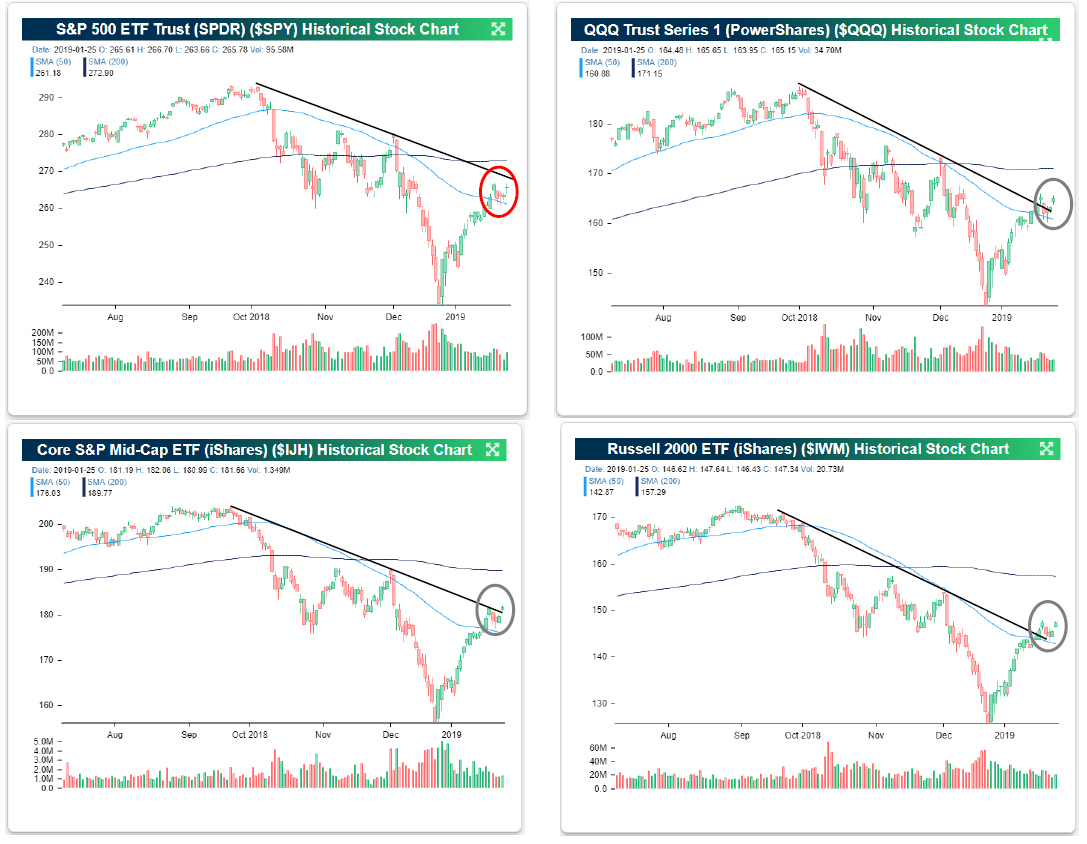
Looking at where some of the major US averages closed out the week, one of these pictures doesn’t look like the others. As shown in the four charts below, in this week’s trading, the Nasdaq 100, the S&P 400 Mid Cap Index, and the Russell 2000 all appear to have broken their downtrends from the October highs. The lone holdout at this point is the S&P 500, which finished the week just shy. Breadth for the S&P 500 has been very strong lately (page 30), so now all we need is price to confirm it. Something tells us that next week we’ll have a good idea either way!
For in-depth analysis of recent price action, sector technicals, earnings season, the economy, and more, start a two-week free trial to one of our three membership levels and read this week’s Bespoke Report newsletter. You won’t be disappointed!