
Dow Adds Another 1,000 Point Notch to Its Belt
While back below that level now, Friday’s close marked the 28th 1,000-point threshold that the DJIA crossed on a closing basis for the first time, and it was the first such cross of one of these thresholds in more than four months. While the financial media used to (and to a degree still does) make a big fuss about the DJIA crossing a 1,000 point level for the first time, these days it just isn’t what it used to be. The table below lists each 1,000 point threshold that the DJIA has crossed in its history. For each level, we also list the date the DJIA first crossed the 1,000 point level, how many days passed since the prior 1,000 point threshold, what percentage that threshold was of the index’s total level, and then how many times the DJIA has crossed above and below that level (on a closing basis).
When we said 1,000 points isn’t what it used to be, we meant it. As shown in the table, these days 1,000 points on the DJIA is only a 3.6% move, and the path from 28K up to 29K will be less than 3.5%. With the DJIA at much higher levels now, the 127-day rally from 27,000 to 28,000 is much less impressive than the 1997 move where the DJIA rallied from 6,000 to 7,000 (a 14% rally) in just 122 days. Additionally, while it took 540 days for the DJIA to go from 26,000 up to 27,000, it only took 421 days for the index to cross the prior eight 1,000 point levels!
Another interesting aspect of the DJIA’s path through 1,000 point thresholds is how many times it crossed each one of them. 10,000 and 11,000 were especially difficult levels for the DJIA to put through the rearview mirror. The index crossed above or below 11,000 on 87 different occasions and 10,000 67 times. While those were extreme levels of congestion for the DJIA, two levels it glided right through were 5,000 and 19,000. These are the only two 1,000 point levels from which the index has never looked back after first crossing above them. Sign up for Bespoke’s “2020” special and get our upcoming Bespoke Report 2020 Market Outlook and Investor Toolkit.

Bespoke’s Morning Lineup – 11/18/19 – Southbound
See what’s driving market performance around the world in today’s Morning Lineup. Bespoke’s Morning Lineup is the best way to start your trading day. Read it now by starting a two-week free trial to Bespoke Premium. CLICK HERE to learn more and start your free trial.

Bespoke Brunch Reads: 11/17/19
Welcome to Bespoke Brunch Reads — a linkfest of the favorite things we read over the past week. The links are mostly market related, but there are some other interesting subjects covered as well. We hope you enjoy the food for thought as a supplement to the research we provide you during the week.
While you’re here, join Bespoke Premium for 3 months for just $95 with our 2019 Annual Outlook special offer.
Florida
Florida’s Sunshine and Tax Benefits Beckon Billionaires by Juliet Chung and Joseph de Avila (WSJ)
The wealthiest are trading New York winters for endless summer, but low taxes are almost certainly a bigger impetus for the zip code shifting. [Link; paywall]
Fuel-theft rings fill South Florida roads with ‘moving bombs’ by Mario Ariza (South Florida Sun Sentinel)
The weather is good but the crews stealing fuel and transporting the proceeds in SUVs are a much less wonderful feature of life in South Florida. [Link; auto-playing video]
Economics
Do Ridesharing Services Increase Alcohol Consumption? by Jacob Burgdorf, Conor Lennon, and Keith Teltser (SSRN)
Increasing access to on-demand transportation has led people to imbibe more aggressively as concerns about the need to drive home have disappeared. UberX entry to a market led to a 9% increase in the prevalence of heavy drinking. [Link]
From Plantations to Prisons: The Legacy of Slavery on Black Incarceration in the US by Melissa Rubio (Dropbox)
In her job market paper, the author identifies a link between counties’ dependence on slavery and the black male incarceration rate immediately after the abolition of slavery and through to contemporary times. [Link; 58 page PDF]
The Effect of District Attorneys on Local Criminal Justice Outcomes by Sam Krumholz (SSRN)
Electing nonwhite district attorneys leads to a 10% decline in incarceration, without any significant impact on local crime or arrest rates. In other words, the choice of district attorney has a big impact on how many people are in jail, but little effect on crime rates. [Link]
Legal Drama
Customer: Wine spill on Hermès bag was $30k mistake. Country club: Our waiter should pay by Rodrigo Torrejon (USA Today)
A New Jersey country club is trying to fob off a ridiculous lawsuit from a customer on one of its employers, the latest in a long string of ridiculous workplace suits. [Link; auto-playing video]
He told a kid to slide. Then he got sued. by Steve Politi (NJ.com)
Instructing a player to slide into third base is now grounds for years of lawsuits. It’s hard to imagine it could get more ridiculous than this most recent litigious lunacy from New Jersey. [Link]
How to Conduct Business with Chinese Companies That See a Dark Future by Dan Harris (China Law Blog)
An extremely interesting rundown on the current legal backdrop in China, where the trade war and a slowing economy are provoking a variety of legal activities that can catch customers abroad by surprise. [Link]
Football
Notre Dame Football Sellout Streak Set to End After 46 Years by Sara Marley (Bloomberg)
It’s been a disappointing run for the Fighting Irish, who may fail to sell out a game for the first time since 1973 in a fight against ranked opponent Navy this weekend. [Link; soft paywall]
The Line of Fire by Natalie Weiner (SBNation)
With gun violence reaching into schools, it should be no surprise that football coaches are on the front lines in trying to keep young people safe. [Link]
Algos Gone Wild
IBM hopes to change weather forecasting around the globe using big data and a new supercomputer by Steve Liesman (CNBC)
Weather models are getting an upgrade, with a new model that uses its new supercomputer DYEUS to model weather in 2-mile blocks (one-third to twenty percent of the smallest units in more traditional models). [Link]
AI can predict if you’ll die soon – but we’ve no idea how it works by Donna Lu (New Scientist)
An interesting example of a machine learning technique picking up on something that a traditional evaluation of data can’t: risk of death based on to electrocardiogram data. [Link]
Goldman faces probe after entrepreneur slams Apple Card algorithm in tweets (Reuters)
A widely-followed VC helped spark outrage over the credit limit assignment process for the new Apple credit card that Goldman Sachs issues. [Link]
Hidden Costs, Hidden Benefits
New Report Examines the Impact of Instagram’s Hidden Likes Experiment on Influencer Engagement by Andrew Hutchinson (Social Media Today)
A study found that hiding likes reduced the number of likes for posts across a range of account sizes, consistent with the thesis that removing like totals reduces engagement. [Link]
The move to free stock trading led to a big jump in new accounts for Charles Schwab by Maggie Fitzgerlad (CNBC)
Removing commissions in response to Robinhood, Charles Schwab reported 142,000 accounts opened in October, up 31% MoM as free trading gains traction. [Link]
Investing
Strategists Foresee ‘Boiling Point’. Investors Risk Up. by Christine Idzelis (Institutional Investor)
Investors have pivoted to a very positive outlook that has investors all sorts of nervous. While fund managers are optimistic, their allocations to equities are only at one-year highs. [Link]
Mars
The Curiosity rover detects oxygen behaving strangely on Mars by Ashley Strickland (CNN)
A strange seasonal pattern of oxygen levels has been picked up by the Curiosity rover on Mas, which may point to a variety of new geological possibilities. [Link]
Renewables
Wind Turbines Are Getting Wild by Caroline Delbert (Popular Mechanics)
A new superconducting material is offering possibilities for wind turbines that would result in dramatic efficiency gains and lowered costs. [Link]
Read Bespoke’s most actionable market research by joining Bespoke Premium today! Get started here.
Have a great weekend!
The Closer: End of Week Charts — 11/15/19
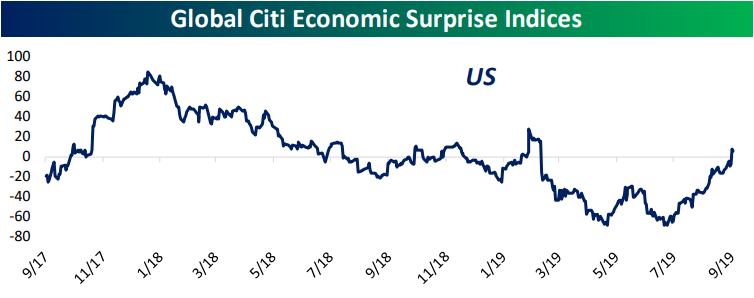
Looking for deeper insight on global markets and economics? In tonight’s Closer sent to Bespoke clients, we recap weekly price action in major asset classes, update economic surprise index data for major economies, chart the weekly Commitment of Traders report from the CFTC, and provide our normal nightly update on ETF performance, volume and price movers, and the Bespoke Market Timing Model. We also take a look at the trend in various developed market FX markets.
The Closer is one of our most popular reports, and you can sign up for a free trial below to see it!
See tonight’s Closer by starting a two-week free trial to Bespoke Institutional now!
The Bespoke Report Newsletter — 11/15/19
This week’s Bespoke Report newsletter is now available for members.
A persistent rally in US equity indices has continued this week, with equity markets at all-time highs in the US and confirming price action from other global indices. We take a look at economic data, technicals, and the earnings backdrop in the US and Europe. We also review commodity and credit markets as well as many other topics in this week’s Bespoke Report newsletter. To read the report and access everything else Bespoke’s research platform has to offer, start a two-week free trial to one of our three membership levels. You won’t be disappointed!

Sluggish Manufacturing in the New York Region
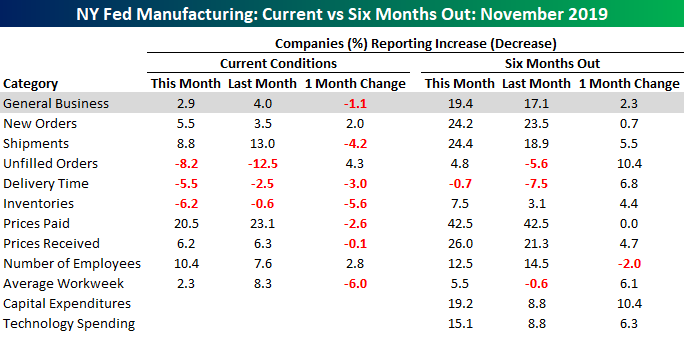
This morning saw one of the first looks at November activity with the NY Fed Empire Manufacturing report. Economists weren’t expecting much of a strong report to begin with as the consensus forecast for the headline General Business Conditions index was for a reading of 6.0 vs last month’s reading of 4.0. The actual reading actually showed a slight decline from last month, though, falling to 2.9. While the current conditions index declined, expectations actually saw a small boost rising from 17.1 up to 19.4.
One interesting thing to note is how little Empire Manufacturing has changed in recent months. With monthly readings of 4.3, 4.8, 2.0, 4.0, and now 2.9, the index has had a five-month range of just 2.8 points. In the history of the survey dating back to 2001, the only five-month window with a narrower range was in late 2011!

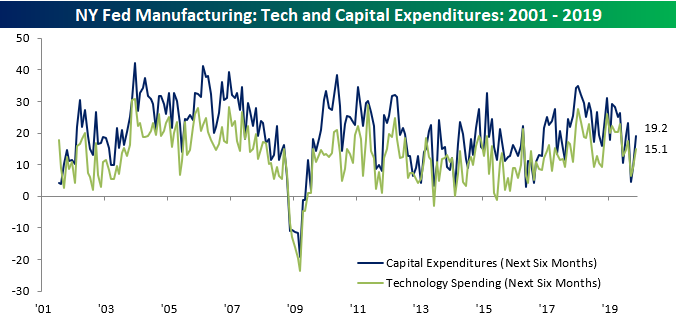
In terms of plans for Capital Expenditures and Technology Spending over the next six months, it was encouraging to see both of these readings rebound after falling sharply in recent months.
Finally, the table below shows the month/month change for each category of the Empire Manufacturing report in terms of both current conditions and expectations. What’s interesting to note about this month’s data is that while there was broad-based weakness in terms of current conditions, expectations rebounded, suggesting that manufacturers are expecting an upturn from current conditions. Sign up for Bespoke’s “2020” special and get our upcoming Bespoke Report 2020 Market Outlook and Investor Toolkit.
Bespoke’s Morning Lineup – 11/15/19 – Retail Sales Friday
See what’s driving market performance around the world in today’s Morning Lineup. Bespoke’s Morning Lineup is the best way to start your trading day. Read it now by starting a two-week free trial to Bespoke Premium. CLICK HERE to learn more and start your free trial.
The Closer – Wal-Mart Reversal, Volatile Fed, Transportation, Iron, Fund Flows – 11/14/19
Log-in here if you’re a member with access to the Closer.
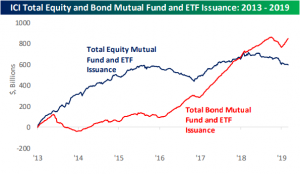
Looking for deeper insight on markets? In tonight’s Closer sent to Bespoke Institutional clients, we begin with a look at what Wal-Mart’s (WMT) intraday reversal means for the stock as well as how consumer staples and other defensives have lagged recently. Next, we look into the relationship between the Fed’s balance sheet and volatility before moving onto today’s economic data including freight volumes, EIA data, and ICI Fund Flows.
See today’s post-market Closer and everything else Bespoke publishes by starting a 14-day free trial to Bespoke Institutional today!
Cisco (CSCO) Deja Vu
Call it deja vu, but Cisco (CSCO) is seeing a repeat of its August earnings report. Back in the summer, CSCO beat on the top and bottom line but lowered guidance leading the stock to fall 8.61% the following day. Fast-forwarding to today, CSCO reported after yesterday’s close with the same results. The company once again lowered guidance while beating EPS by 3 cents and revenues by $69.4 million. Although the stock’s performance in response has not been quite as bad as last time around, CSCO fell over 7% on Thursday. That is the worst single-day performance for the stock since its last earnings report. Two quarters in a row now, CSCO has fallen substantially on earnings. That is quite the difference from the previous four quarters when the stock rose each time.
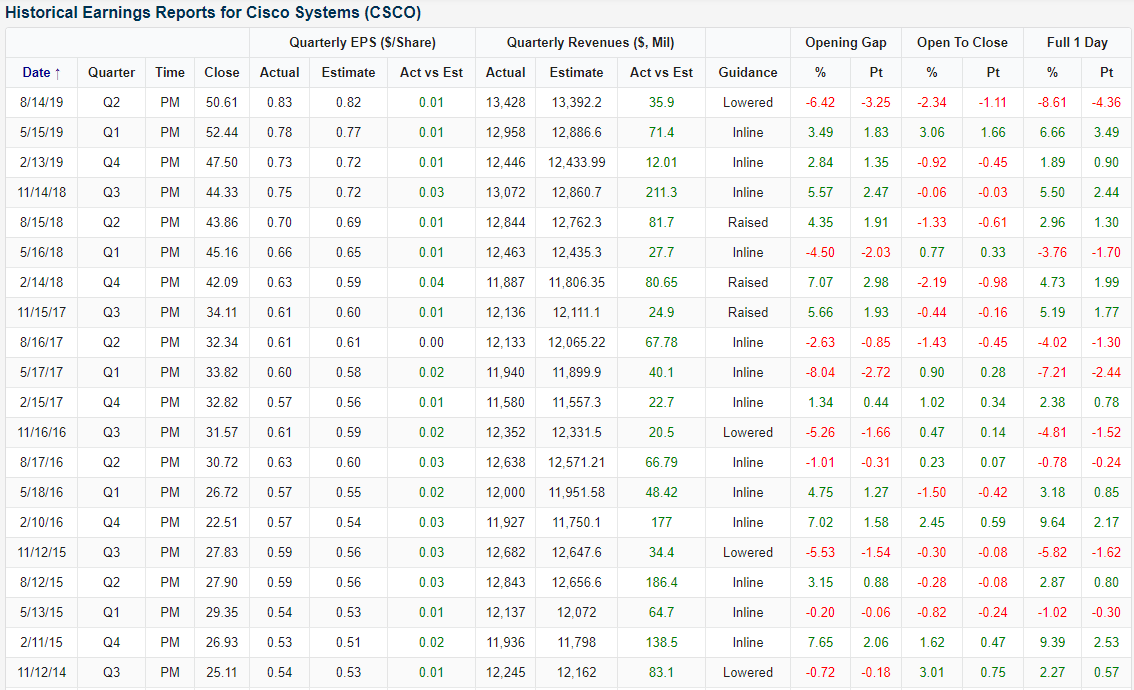
Last Monday, we highlighted Cisco (CSCO) in a Dividend Stock Spotlight noting that although it has an attractive dividend, the technical picture was mixed with the stock at a bit of a crossroads at the bottom of a longer-term uptrend thanks to a rough-looking shorter term. The past few months’ declines have come following the aforementioned earnings report in August and a weak quarter from competitor Arista Networks (ANET) further dampening the outlook for CSCO. These catalysts since the summer in conjunction with today’s declines have brought the stock under support between $45-46 and also broken the longer-term uptrend that had been in place over the past few years. Since it’s high on July 15th, CSCO has declines more than 22% and shed $42.8 billion in market cap. To put that into perspective, that decline is within $1 bn of the current market caps of Advanced Micro Devices (AMD), Humana (HUM), Progressive (PGR), and Marriott Hotels (MAR). Start a two-week free trial to Bespoke Institutional to gain full access to our research and interactive tools.

Shrinking Ranges
In the S&P 500’s run to new highs over the last few weeks, overall volatility has really become subdued. For example, the S&P 500 hasn’t had an intraday swing of even 1% in more than a month now. The chart below shows streaks over the last ten years where the S&P 500 didn’t see a 1% spread between its intraday high and low and allows us to compare how the current streak stacks up to prior periods.
While the current 24 trading day streak without a 1% intraday move is far from the longest over the last ten years, there haven’t been a lot of streaks that were longer. Ironically enough, the three streaks that were the longest of the last ten years all occurred in the two years after the 2016 election. For all the turmoil that seems to surround this Administration, market turmoil hasn’t been one of them. Sign up for Bespoke’s “2020” special and get our upcoming Bespoke Report 2020 Market Outlook and Investor Toolkit.
