Lumber Squeezed, But Savings Super A Few Months Out
Today is the last day of trading for the September 2020 lumber future. Unlike the constant front-month, which now references November delivery futures, September lumber settled at $984.50 yesterday. The physical lumber market remains extremely tight, fueled by booming demand from construction, COVID’s impact on production eating into inventories, and now the forest fires in the West. Buyers who can wait a couple of months for delivery save 32% off the price of the current front-month contract; going out to next May that number is an impressive 48%; the futures market is pushing off construction into later quarters via price. Click here to start a free trial to Bespoke Institutional and receive our nightly Closer for the next two weeks, featuring more commentary and data on macro markets.

Chart of the Day – CAT Sales Slow
Chart of the Day: One Nasdaq 100 Streak Ends, Another One Begins?
Gold and Bitcoin Bounce Off Support
With all the liquidity that has been put into the system, the number of Americans concerned about the dollar’s purchasing power has seen a great deal of inflation. Just last week, legendary investor Stanley Druckenmiller became the latest person to publicly worry about the possibility of double-digit inflation in the coming years. With those types of concerns becoming increasingly mainstream, it’s no wonder that the price of gold remains right near record highs. Despite the recent 5% pullback in prices, gold remains just under $2,000 per ounce after bouncing off support just above $1,900 which is a level that also coincides with its 50-day moving average. Since its high in early August, each bounce off the $1,900 level has been met with a lower high, so until this consolidation phase either breaks above $2,000 or below $1,900, it’s probably best to just sit tight.

Bitcoin has also been trading in somewhat of a consolidation pattern after breaking above resistance at $10,000 in late July. While bitcoin’s price rallied above $12,000 just as gold was peaking, its price pulled back in early September as risk assets corrected. However, just as $10,000 provided stiff resistance on the way up for the past year, the first test of $10,000 to the downside has held up so far. Investors increasingly view bitcoin as the digital version of gold, so by that logic, any bullish argument for gold should apply to bitcoin as well. Like what you see? Make sure to sign up for a free trial to unlock all of Bespoke’s analysis and interactive tools.

No New Highs For High Yield
The S&P 500 may have broken out above its February highs back in late August and still remains above February’s highs after today’s advance, but performance in the high yield market hasn’t been quite as strong. The chart below shows the B of A High Yield Master Index on a total return basis over the last 12 months. The index saw its peak back on 2/20 just a day after the S&P 500’s first-half high. Those gains quickly turned into a decline of nearly 20% before the markets started to recover. On September 2nd, just as the S&P 500 was getting off to a strong September start, the total return of the High Yield Master Index came just shy of topping its 2/20 high, but as markets started to swoon, the high yield market also suffered and prices pulled back.

While total return levels in the high yield market are important to track, spreads in high yield debt relative to treasuries provide a more useful barometer. In this respect, the high yield market has still come up short. The chart below compares spreads in the high yield market relative to treasuries over the last year. Remember, high yield spreads tend to move in the opposite direction as equities. When stocks rise, spreads tend to fall and vice versa. Back in January, high yield spreads bottomed out at 339 basis points (bps) nearly a full month before the S&P 500 peaked. They subsequently widened out to 1,087 bps on 3/23 which was the same day the S&P 500 bottomed. Since then, spreads have been more than cut in half to the current level of 521 bps. That’s an impressive move, but spreads are still nowhere near their prior lows. Like what you see? Make sure to sign up for a free trial to unlock all of Bespoke’s analysis and interactive tools.

Bespoke Brunch Reads: 9/13/20
Welcome to Bespoke Brunch Reads — a linkfest of the favorite things we read over the past week. The links are mostly market related, but there are some other interesting subjects covered as well. We hope you enjoy the food for thought as a supplement to the research we provide you during the week.
While you’re here, join Bespoke Premium with a 30-day free trial!
Pandemic Payoffs
Golf sees huge upswing with women and young adults: ‘You can take your bag full of White Claws’ by Melody Hahm (Yahoo! Finance)
Left for dead by shifting demographics and no taste for the links among younger folks, golf is suddenly getting a massive boon from COVID, with low disease risk and spare capacity for folks to head out and hit some balls. [Link; auto-playing video]
Locked Down in the Ritz-Carlton: Winning the Quarantine Hotel Lottery by Chong Koh Ping (WSJ)
Folks arriving in Singapore must pass a mandatory 14 day quarantine, but the hotel they spend their time at is assigned by lottery. For some, that lottery is a big payoff. [Link; paywall]
Battery Power
Pandemic e-commerce surge spurs race for ‘Tesla-like’ electric delivery vans by Nick Carey (Reuters)
In addition to targeting zero-emissions, last mile logistics companies are also looking for capabilities like autonomous driving and analytics which are already a part of basic Tesla capabilities. [Link]
Why Tesla’s Battery Day Will Actually Live Up to the Hype by Steve LeVine (Medium)
In a couple of weeks, Tesla will host a live webcast “battery day” alongside the company’s shareholders meeting; reading the tea leaves, it’s possible that CEO Elon Musk will announce its battery technology efficiency has improved to cost-parity with gasoline cars. [Link]
Alternative Approaches
To Manage Wildfire, California Looks To What Tribes Have Known All Along by Lauren Sommer (NPR)
Historically, Indigenous people around North America actively used wildfires as a way to manage the biosphere; returning to managed burns could reduce the scale and intensity of fires which have wracked California in recent summers. [Link]
Call police for a woman who is changing clothes in an alley? A new program in Denver sends mental health professionals instead. by Elise Schmelzer (The Denver Post)
A pilot program in Denver that focuses on mental health and social service intervention instead of police presence has led to a successful series of de-escalations rather than arrests and confrontation. [Link]
A $12 Billion Trust Fund Is About to Crack Open for U.K. Teens by Edward Robinson (Bloomberg)
15 years ago the Blair government created a trust fund that included government contributions, market gains, and family contributions to accounts. The first generation of recipients is set to start receiving the money this year, providing a firmer financial footing for all UK young adults. [Link]
Doomed Enterprises
Those boats in Texas paraded at the wrong speed by Brendan Greeley (FTAV)
You might think a boat parade would be a pretty straightforward enterprise, but the physics can get very complicated and very dangerous in a hurry, as was the case in Texas this week. [Link; registration required]
A Gender-Reveal Celebration Is Blamed for a Wildfire. It Isn’t the First Time. by Christina Morales and Allyson Waller (NYT)
A “smoke-generating pyrotechnic device” designed to spew the gender of a baby ignited a fire that consumed thousands of acres near Los Angeles, one of a number of similar incidents in recent years as the trend of over-the-top gender reveals and extreme wildfire conditions have coalesced. [Link; soft paywall]
Social Media
WeChat and TikTok Taking China Censorship Global, Study Says by Jamie Tarabay (Bloomberg)
Chinese social media apps used in the US often censor content deemed sensitive by the Chinese government, one among many reasons that Chinese tech is decoupling from the rest of the world. [Link; soft paywall]
Trading
NYSE Exchanges to Prepare for Potential Move From New Jersey by Stacie Sherman (Bloomberg)
In response to New Jersey’s discussion of a financial transaction tax, NYSE is preparing to move its digital infrastructure across state lines to dodge the tax. [Link; soft paywall]
Read Bespoke’s most actionable market research by joining Bespoke Premium today! Get started here.
Have a great weekend!
The Bespoke Report — Momentum Matters Most
It was a rough week to own stocks as the Nasdaq 100 dragged down the broader US equity market. While the failure to introduce a new bill to continue easing fiscal policy has been ignored by markets for the most part, the breakdown of upward momentum coupled with that policy flop clouds the outlook…even as the economy is improving and the spread of COVID also eases. Broken moving averages and weak technical set-ups don’t mean markets are poised to crash, but the backdrop has gotten worse over the past week. We discuss all these items in detail along with economic data in the US and around the world, low rates in the US, and how the COVID pandemic has impacted Americans in this week’s Bespoke Report.
This week’s Bespoke Report newsletter is now available for members.

To read the report and access everything else Bespoke’s research platform has to offer, start a two-week free trial to one of our three membership levels. You won’t be disappointed!

Active Managers Do an About Face
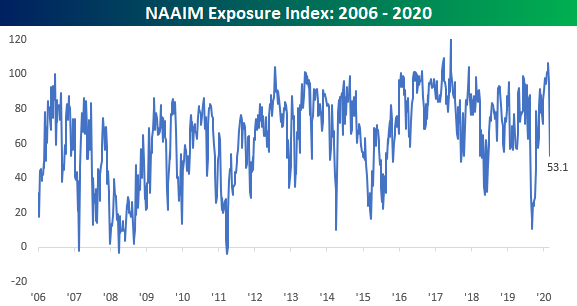
The National Association of Active Investment Managers (NAAIM) has an index which tracks the exposure of its members to US equity markets. Each week, members are asked to provide a number that represents their exposure to markets. A reading of -200 means they are leveraged short, -100 indicates fully short, 0 is neutral, 100% is fully invested, and 200% indicates leveraged long. Two weeks ago, in our Bespoke Report, we highlighted the fact that the exposure index had moved to one of the highest levels in its 15-year history. Now, just two weeks later, these same active managers have reigned in their exposure considerably as this week’s reading dropped from just under 100 to 53.1.
This week’s drop was the second-largest one week decline in the index’s history and just the 10th time that the index lost more than a third (33 points) in a single week. The most recent occurrence was back in early March in the middle of the Covid crash, and every other prior period where the index saw a similar drop, the S&P 500 was also down every time by an average of 2.3%. Therefore, it’s not much of a surprise to see the big drop this week given the big declines in the market. But what about going forward? Do big drops in the NAAIM Index mean a bounce back for markets or further declines? Find out in this weekend’s Bespoke Report newsletter where we cover this much more in depth. If you aren’t currently a client of any of Bespoke’s research services, make sure to sign up for a free trial today in order to unlock access to this week’s report.
Mean Reversion Shows up in Trend Analyzer
Our popular Trend Analyzer tool is a very helpful way for Bespoke members to monitor overbought and oversold levels for large baskets of stocks or ETFs across asset classes. Below is a snapshot of major US index ETFs from our Trend Analyzer tool as of this morning.
When looking at the Trend Analyzer’s “Trading Range” section (far right of snapshot), the dot for each stock or ETF represents where its share price is currently trading relative to its 50-day moving average (DMA). In the snapshot below, the 50-DMA for each ticker is represented by the vertical black line in the middle of the trading range. Price is below the 50-DMA when it is to the left of the 50-DMA line and above the 50-DMA when it is to the right of the black line. Additionally, the tail for each ticker in the Trading Range section shows where the stock or ETF was relative to its range one week ago. So when the dot is to the left of the tail, it means price moved lower within its trading range over the last week. When the dot is to the right of the tail, it means price moved higher within its trading range over the last week.
Long tails mean price moved a lot over the last week on a relative basis, while short tails indicate little price movement. In today’s snapshot of US index ETFs, you can see that all of them have long tails with price moving lower over the last week. This highlights the significant downside mean reversion that US equities have experienced recently. In early September, pretty much everywhere you looked, prices were very overbought (extended well above their 50-day moving average). Over the last week or so, however, as equities have sold off they’re now trading at more neutral levels within their trading ranges.
When looking for an entry point or exit point on a position, it’s useful to take overbought or oversold levels into account. We use our “Timing” score within the Trend Analyzer to help members identify attractive (or unattractive) set ups. Members looking to add a new position or add to an existing position like to do so when price is trading at neutral or oversold levels as opposed to placing a bid when price is extremely overbought.

Looking at US sector ETFs, our Trend Analyzer shows that all of them have moved lower within their trading ranges over the past week, which gives them “Good” timing scores as opposed to the “Poor” timing scores these same ETFs had when they were trading at extreme overbought levels a few weeks ago.
The Energy sector (XLE) is the main outlier here with an extreme oversold reading. While every other sector is either neutral or overbought (Materials), Energy just can’t seem to get out of its own way this year. The sector entered today down 7.5% over the last week, 10.84% below its 50-day moving average, and down 43.7% year-to-date.

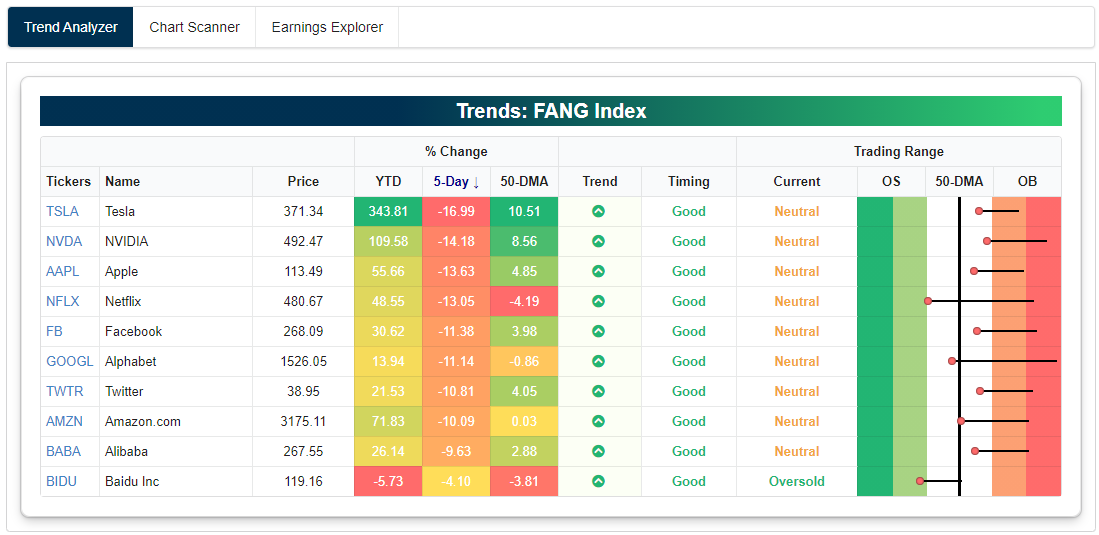
Finally, below is a snapshot of the stocks that make of the NYSE FANG+ index run through our Trend Analyzer. Similar to what we’ve seen around the rest of the US equity space recently, all of the FANG+ stocks are down significantly over the last week (8 of 10 down 10%+), and this has caused most of them to move out of overbought territory and back into neutral territory. For those that have been waiting for a pullback in these names to add exposure, now you’ve gotten it. Click here to start a free trial to Bespoke Premium and immediately gain access to our Trend Analyzer tool.
Gap Between Market Cap and Equalweight Shrinks a Bit
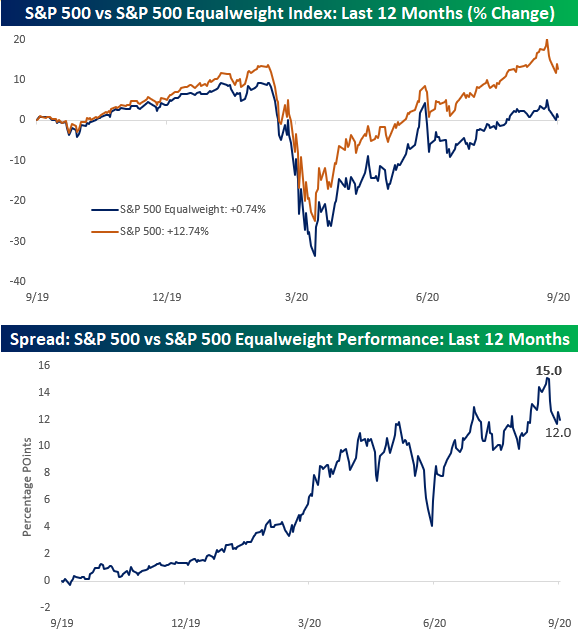
From the lows in March right up to now, one of the number one preoccupations of investors has been the widening gap between the market-cap-weighted S&P 500 and the equal-weighted index. When the market-cap-weighted index outperforms the equal-weight index, it indicates that stocks with the largest market caps are outperforming their relatively smaller peers and vice versa when the equal-weight index outperforms. As shown in the top chart below, through this afternoon, the S&P 500 has rallied more than 12.74% over the last year compared to a gain of just 0.74% for the equal-weight index for a gap of 12 percentage points.
The second chart below shows the performance spread between the S&P 500 and the equal-weighted index over the last 12 months. While the spread is wide now, just over a week ago it was even wider at 15 percentage points. The sell-off of the last few days has certainly narrowed the gap a bit, but there is still a lot of space between the two indices where they sit now. If the recovery from the pandemic recession continues, we would expect to see some broadening out of performance across market caps, but if the recovery derails or hits a roadblock, then the largest of the largest stocks could see their lead start to widen again. Click here to view Bespoke’s premium membership options for the best market analysis available.