The Closer — Worrying and Wondering — 3/19/19
Log-in here if you’re a member with access to the Closer.
Looking for deeper insight on markets? In tonight’s Closer sent to Bespoke Institutional clients, ahead of tomorrow’s rate decision out of the Fed, we begin tonight’s Closer with a look at interest rates as seen through the 3 month LIBOR and overnight index swaps. We also take a brief look at the movement in industrial metals to see what this could say about the global economy. Next, we provide an update of our Beige Book index which has collapsed recently. We then turn to Europe which has seen credit markets lagging versus their US counterparts. With the banking sector being in part to blame for this, we finish with a look at the status of Non-performing loans in the Eurozone.
See today’s post-market Closer and everything else Bespoke publishes by starting a 14-day free trial to Bespoke Institutional today!
Chart of the Day: Investors Back Into Invesco (IVZ)
B.I.G. Tips – Fed Days March 2019
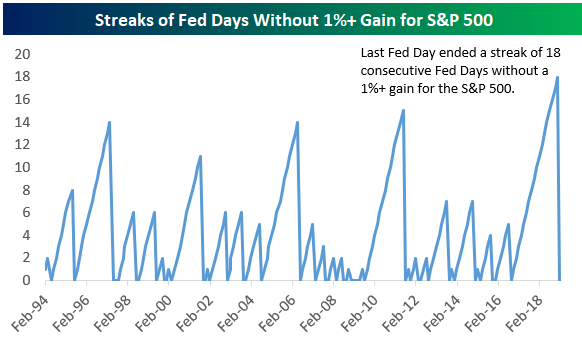
The S&P 500’s gain of 1.55% on the January 30th Fed Day ended a streak of 18 consecutive Fed Days without a 1%+ gain for the index. The gain also ended a 7 Fed Day streak of declines for the S&P 500 dating back to the start of Chair Powell’s tenure. Both streaks were the longest on record dating back to 1994 when the Fed began announcing its policy decisions on the same day as its meeting. We’ve just published a B.I.G. Tips report covering the topics you need to know ahead of tomorrow’s Fed meeting. To gain access to the full report, please start a two-week free trial to our Bespoke Premium package now. Here’s a breakdown of the products you’ll receive.
Bespoke Stock Scores — 3/19/19
Morning Lineup – Rising Tide on Both Sides of the Atlantic
Please click the link below to read today’s Bespoke Morning Lineup.
Bespoke Morning Lineup – 3/19/19
With the S&P 500 down just over 3% from its all-time high and tomorrow marking the six-month anniversary since the last time the index closed at an all-time high, the current period is just the fifth time since the March 2009 low that the index has gone six months or more without closing at post-financial crisis high. It also marks just the sixth time that the index has gone more than 100 trading days without hitting a new high.
In the chart below, we highlight the S&P 500’s path since the March 2009 lows and show each of the 100+ trading day droughts without a new high in red. The current period, which will extend to 122 trading days today, has been unique as it came just 19 trading days after a 145 trading day drought that spanned late January to August of 2018. When the S&P 500 finally broke out to new highs last August, bulls were probably not expecting such a ‘lame’ breakout as the difference between the September high and the high from earlier in January was barely more than 2%. The only period that was similar was from 2011 through 2012 where a 206 trading day streak without a new high and a 108-day streak were separated by just 22 trading days and a rally of less than 4%.
Those two examples just mentioned are where the S&P 500 saw the smallest rallies following a drought of 100+ trading days without a new high. The other three periods, however, were a lot more palatable for bulls as the S&P 500 rallied an additional 12% through May 2011 after breaking the 135-day drought in November 2010, an additional 50% through May 2015 after breaking the 108-day drought in September 2012, and an additional 33% through January 2018 after breaking the 285 trading day drought in July 2016.

Start a two-week free trial to Bespoke Premium to see today’s full Morning Lineup report. You’ll receive it in your inbox each morning an hour before the open to get your trading day started.

The Closer — Resistance in the Rearview — 3/18/19
Log-in here if you’re a member with access to the Closer.
Looking for deeper insight on markets? In tonight’s Closer sent to Bespoke Institutional clients, with the 2,816 resistance level now behind us we evaluate how much higher the S&P 500 can run given catalysts like overbought/oversold levels, the VIX, and valuations. Next, we look at last week’s release of Chinese credit creation which came in at the slowest pace in years. We then provide a quick update on Brexit before finishing with one of the few US data points today: Cass Freight Volumes and Costs
See today’s post-market Closer and everything else Bespoke publishes by starting a 14-day free trial to Bespoke Institutional today!
Financials Looking Attractive
As we briefly noted in last week’s Sector Snapshot, the Financial sector has been making a series of higher highs and higher lows, making it attractive from a technical perspective. Additionally, it is just barely overbought as of today, and it also has the lowest P/E ratio of all sectors. While the sector ETF (XLF) is still working its way to new highs after recently pulling back in the first weeks of March, a number of stocks within the sector are breaking out to new 2019 highs or above levels last seen before the late 2018 sell-off. Taken from our Chart Scanner, we show the charts of some of these stocks below.
Across the sector, there are several opportunities with a variety of financials from FinTech to Banks. To highlight a few, American International (AIG) has tested resistance near $44 multiple times since falling off a cliff last October. Though not there yet, a push above these levels could pose as a bullish sign for the stock. Discover Financial Services (DFS) and FactSet (FDS) both have similar patterns since the market found a bottom on Christmas Eve. Both stocks have gone on extremely strong runs so far in 2019 and after recently pulling back, the stocks have caught their breath and are once again pushing higher. While FactSet is reaching 52-week highs, DFS still has room to run to highs from 2018. The big banks are also looking constructive. Whereas Citigroup (C), Goldman Sachs (GS), and JP Morgan (JPM) have all been more or less meandering sideways for the past few weeks, today they have managed to distinctively break out above their recent ranges. In the case of Citi and JPM, both have found support at the 50-DMA before moving higher. Even stocks that have been in long term downtrends like KeyCorp (KEY) or Invesco (IVZ) have seen such strength that the downtrends have been broken. To add to the attractive technical setup, these stocks both have come back to retest this downtrend line having since bounced off and moving higher.

Record High But Still Down Over 40%
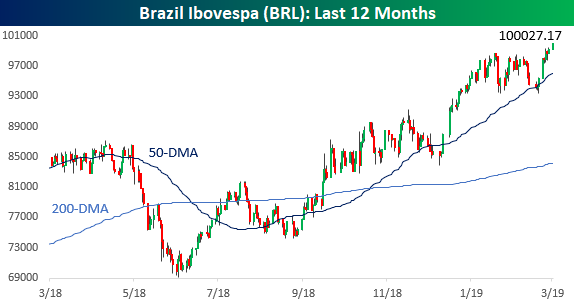
We’re not sure if they’re throwing around “Ibovespa 100K” hats on the floor of the Sao Paulo stock exchange, but Brazil’s benchmark Ibovespa equity index just topped the 100,000 level for the first time in its history. The latest breakout in Brazilian stocks comes after a two-month period of sideways trading that followed a gain of over 40% from the lows last Summer.
The rally in Brazilian stocks and the new high in the Ibovespa are impressive, but at the same time a bit misleading. Brazilian equities may be at record highs, but for a US investor invested in Brazil, things don’t look nearly as impressive. The chart below shows the Ibovespa index going back to 2006 priced in US dollars. From the perspective of a US investor, Brazilian stocks are still up over 40% from their lows last Summer, but even after that move they are still down 41% from their highs way back in May 2008.
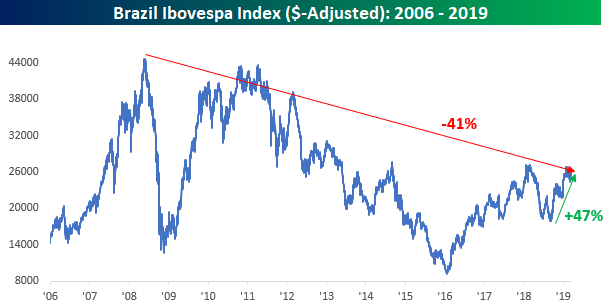
Chart of the Day: Monday Market Mania in China
Homebuilder Sentiment Unchanged
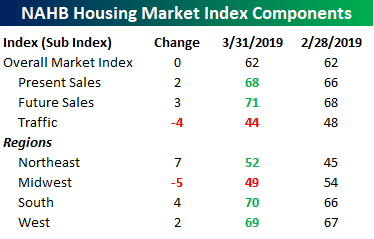
Economic data kicked off the week on a mixed note Monday as Homebuilder Sentiment for the month of March was unchanged versus February, even as expectations were for a small improvement. According to the National Association of Homebuilders (NAHB), the general sentiment index was unchanged at 62 versus consensus forecasts for an increase to 63. While sentiment has been stable after improving in December and January, it remains well off of its highs from late 2017.
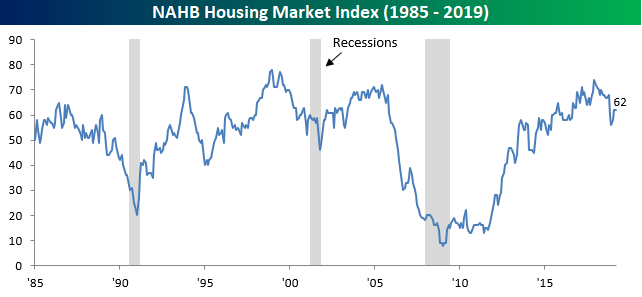
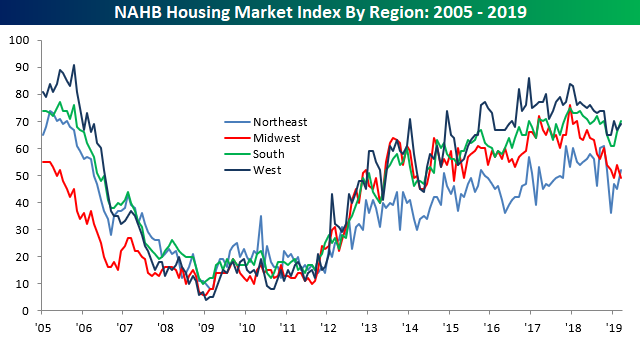
Breaking out the details of the report, most of the report’s subcomponents saw m/m increases. While Traffic was down, both Present and Future Sales showed improvement. On a regional basis, sentiment in the Midwest was down pretty sharply falling from 54 to 49 (indicative of contraction), but homebuilders in every other region of the country were more optimistic. Interestingly, while sentiment in the Northeast was consistently the weakest from 2012 through mid-2018, more recently, the Midwest has been giving the Northeast a run for its money. The Northeast has actually seen a nice pickup in sentiment off of multi-year lows seen a few months ago.