
Bespoke’s Morning Lineup – 6/7/24 – Unchanged into Unemployment
See what’s driving market performance around the world in today’s Morning Lineup. Bespoke’s Morning Lineup is the best way to start your trading day. Read it now by starting a two-week trial to Bespoke Premium. CLICK HERE to learn more and start your trial.
“Tell me a musician who’s got rich off digital sales. Apple’s doing pretty good though, right?” – Prince

Below is a snippet of commentary from today’s Morning Lineup. Start a two-week trial to Bespoke Premium to view the full report.
The recent market trend in non-farm payrolls reports has been positive. Over the last nine months, the headline report came in stronger than expected seven times, and the S&P 500 has been higher eight times on the day of the report. Even including the one day that the S&P 500 was down on a “Payrolls Friday”, its average change on the day of the report was a gain of 0.63%, and the Financial sector has been positive on the day of the report for nine straight months.

We’ve been discussing weak market breadth for a couple of weeks now, including yesterday’s Closer report where we compared the weakness in the cumulative advance/decline (A/D) line to the new high in the S&P 500. Another example is the fact that while yesterday was the only day this week that the S&P 500 was down (and barely at that), the S&P 500’s net A/D line has been negative in three of the last four trading days.
While weak breadth has become especially pronounced in recent days, the trend is not new. Look at the chart below which shows the performance of the S&P 500 market cap-weighted index versus its equalweight counterpart over the last two years. While the S&P 500 has rallied 30.3%, the equalweight index is up by just a little more than a third of that (11.3%).

Below we show the rolling two-year performance spread between the two indices over time. At the current level of 19 percentage points, the spread has reached its widest level in nearly 24 years (6/30/00) putting it in the 95th percentile relative to all other two-year periods since 1992. The last time the spread was this wide, it came just ahead of what ended up being a period of massive long-term underperformance for the cap-weighted index. That being said, the period during which the cap-weighted index had outperformed leading up to that lasted for years.

To continue reading the rest of today’s morning note, where you’ll find much more analysis of global equities and economic readings released this morning, read today’s full Morning Lineup with a two-week Bespoke Premium trial.
Bespoke’s Consumer Pulse Report — June 2024
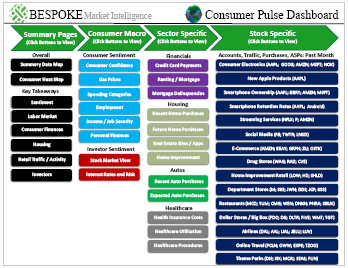
Bespoke’s Consumer Pulse Report is an analysis of a huge consumer survey that we run each month. Our goal with this survey is to track trends across the economic and financial landscape in the US. Using the results from our proprietary monthly survey, we dissect and analyze all of the data and publish the Consumer Pulse Report, which we sell access to on a subscription basis. Sign up for a 30-day free trial to our Bespoke Consumer Pulse subscription service. With a trial, you’ll get coverage of consumer electronics, social media, streaming media, retail, autos, and much more. The report also has numerous proprietary US economic data points that are extremely timely and useful for investors.
We’ve just released our most recent monthly report to Pulse subscribers, and it’s definitely worth the read if you’re curious about the health of the consumer in the current market environment. Start a 30-day free trial for a full breakdown of all of our proprietary Pulse economic indicators.
Bespoke’s Morning Lineup – 6/6/24 – Watch What We Do, Not What We Say
See what’s driving market performance around the world in today’s Morning Lineup. Bespoke’s Morning Lineup is the best way to start your trading day. Read it now by starting a two-week trial to Bespoke Premium. CLICK HERE to learn more and start your trial.
“You get your ass on the beach. I’ll be there waiting for you and I’ll tell you what to do. There ain’t anything in this plan that is going to go right.” – Col. Paul R. Goode, June 1944
Below is a snippet of commentary from today’s Morning Lineup. Start a two-week trial to Bespoke Premium to view the full report.
As expected by everyone, the ECB just cut rates by 25 bps in its latest policy decision. Still, within its statement, it made some hawkish comments noting that “domestic price pressures remain strong as wage growth is elevated, and inflation is likely to stay above target well into next year.” The statement added, “The Governing Council is determined to ensure that inflation returns to its 2% medium-term target in a timely manner. It will keep policy rates sufficiently restrictive for as long as necessary to achieve this aim.” In looking at their words versus actions, there’s the appearance of a wide disconnect, but actions always speak louder than words. We’ll be looking for more color in the 8:45 press conference.
Looking at the moves in financial markets over the last several minutes, you wouldn’t have even noticed there was a major policy decision from a major central bank. Equity futures have seen little reaction and remain modestly higher, while the dollar is little changed, and yields are modestly higher. In the US, Non-Farm Productivity came in higher than expected while Unit Labor Costs were a bit lower. That’s all good news, but jobless claims did come in slightly higher than expected on both an initial and continuing basis.
Even accounting for last Thursday’s 0.6% decline, the last week of trading has seen stocks put in healthy gains as the S&P 500 rallied 1.7% and hit a record high yesterday. The rally has also been broad-based. As shown in the snapshot below, every sector except for Energy has notched gains, and surprisingly, Technology has not been the leader. It’s basically the only other sector that isn’t up 1%. Leading the way higher, Real Estate, Health Care, and Communication Services have rallied more than 2.5%. Five out of eleven sectors finished yesterday at overbought levels while seven are above their 50-day moving average, and only Energy is oversold.

The Energy sector has been in a steady and well-defined downtrend since its high in early April, and if the sector is going to see at least a short-term bounce, now would be the time as the sector closed yesterday right near the bottom end of that channel after bouncing right near its 200-DMA.

Not surprisingly, the Energy sector has been tracking the performance of crude oil which has also been weak. The sector broke its uptrend in early May, and after failing multiple times to get back above that uptrend line in the middle of the month, crude saw extreme weakness to close out the month. While the price decline has been bad for energy stocks, it has been great news for drivers. According to AAA, the national average price of a gallon of gas has dropped below $3.50 for the first time since March 18th and is down over 5% from its April high.

To continue reading the rest of today’s morning note, where you’ll find much more analysis of global equities and economic readings released this morning, read today’s full Morning Lineup with a two-week Bespoke Premium trial.
Bespoke’s Morning Lineup – 6/5/24 – Softening Indeed
See what’s driving market performance around the world in today’s Morning Lineup. Bespoke’s Morning Lineup is the best way to start your trading day. Read it now by starting a two-week trial to Bespoke Premium. CLICK HERE to learn more and start your trial.
“If you put the federal government in charge of the Sahara Desert, in 5 years there’d be a shortage of sand.” – Milton Friedman
Below is a snippet of commentary from today’s Morning Lineup. Start a two-week trial to Bespoke Premium to view the full report.
This morning, we’re seeing a modestly positive tone in equity markets as treasury yields have barely moved. The risk-on mentality can be seen in Bitcoin where prices cracked back above $70K yesterday and now sit right around $71K. Overnight in Asia, India bounced over 3% while Japan and China both traded down nearly 1%. Service sector PMIs for both countries were better than expected. In Europe, the tone is more positive as Services sector PMIs were close to expectations indicating a modest expansion in that sector.
Back here in the US, the ADP Employment report for May just came out, and it came in weaker than expected at 152K versus forecasts for a reading of 175K. As shown below, the monthly reading has been right around these levels for ten months now, but it is well below the four-year average of 308K. With ADP out of the way, the only other report on the calendar is ISM Services at 10 AM.

Investors are closely watching a stream of employment data this week, including the just-released ADP report. But another insightful source often flies under the radar: Indeed’s job posting report.
This report provides valuable details on various employment trends, as we explored in last night’s Closer. One metric we find very useful is the percentage of industries on Indeed with job postings below their pre-pandemic baseline.
In the wake of COVID, job postings plummeted across all industries. However, from summer 2020 to summer 2021, this percentage steadily decreased. Remarkably, from August 2021 to early 2023, no industries fell below their baseline, reflecting an exceptionally tight labor market.
Over the past year, however, the labor market has begun to loosen. In recent weeks, the percentage of industries with below-baseline postings has reached 32%. While that means two-thirds of industries still have above-normal job postings, the trend suggests easing.
This aligns with other labor market indicators – employment remains strong but not strengthening. If the trend in Indeed job postings over the last several months continues, over half of all industries could see fewer job postings by year’s end compared to pre-pandemic levels.

To continue reading the rest of today’s morning note, where you’ll find much more analysis of global equities and economic readings released this morning, read today’s full Morning Lineup with a two-week Bespoke Premium trial.
EM Election Madness
Equities here in the US have gotten off to a weak start this month with the S&P 500 (SPY) down modestly over the past couple of sessions. However, those declines are being overshadowed by emerging markets. As we discussed in yesterday’s Morning Lineup and Closer and expanded on further in today’s Chart of the Day, Mexican equities have gotten massacred following the country’s election of Claudia Sheinbaum as president. The US-traded ETF that tracks Mexican stocks (EWW) is down 8.3% month-to-date and 12.3% year-to-date. After that decline, the ETF closed yesterday at a record 4.19 standard deviations below its 50-day moving average (DMA). That recent weakness is also a 180 from last year when EWW was the best-performing country ETF of the 22 tracked in our Global Macro Dashboard.
Turning forward to today’s news, Indian equities are likewise responding negatively to an election. As we detailed in today’s Morning Lineup, Prime Minister Narendra Modi’s Bharatiya Janata Party (BJP) and its allies won a majority, but by a much smaller margin than was expected just yesterday. Given the results, the India ETF (INDA) is down 6.6% for its worst day since the final day of 2021. Unlike EWW, INDA is still up on the year, though it has swung from deeply overbought to oversold territory in only a day.
As for the rest of the world, we would note that yet another emerging market has fallen on hard times. Brazil (EWZ) has gotten crushed this year with a 16.7% year-to-date decline even outpacing Mexico for the worst performance in 2024. Averaging across countries, EMs have fallen 0.74% year-to-date whereas developed markets are up mid-single digits on average. Relative to prior highs, the gap between emerging and developed markets is even more stark. EM country ETFs currently sit an average of 9.42% below 52-week highs compared to only 3.28% for developed market countries.

Below, we show price charts of a handful of emerging market economies over the past year with 50-DMA trading ranges shown. As noted earlier, Brazil has been weak and trending lower all year consistently trading below its 50-DMA (gray line). It is not only extremely oversold today, but it is also on the verge of 52-week lows. While EWZ has been trending lower, China (MCHI) has been a bright spot. MCHI is in a long-term downtrend dating back to early 2021, but since the start of this year, it has rebounded. This week’s weakness in Mexico (EWW) comes on what has been a period of consolidation. Since the end of last year, EWW has essentially trended sideways, and current levels are in the middle of last fall’s range. As for India, up until today, the country’s equities have been in a steady uptrend throughout the past year. After today’s decline, the uptrend has taken a hit with the first oversold readings since the fall.


Bespoke’s Morning Lineup – 6/4/24 – Bad Week for Elections in Emerging Markets
See what’s driving market performance around the world in today’s Morning Lineup. Bespoke’s Morning Lineup is the best way to start your trading day. Read it now by starting a two-week trial to Bespoke Premium. CLICK HERE to learn more and start your trial.
“Never make excuses. Your friends don’t need them and your foes won’t believe them.” – John Wooden
Below is a snippet of commentary from today’s Morning Lineup. Start a two-week trial to Bespoke Premium to view the full report.
Futures continue to show weakness from Monday as the S&P 500 and Nasdaq are indicated to open down by about 0.25%. Overnight in Asia and this morning in Europe, stocks also traded lower even as CPI in South Korea rose less than expected and employment data in Europe was weaker than expected. While the losses in Mexico on Monday were notable, stocks in India fell over 5.7% for the worst day since May 2020, more than erasing Monday’s gain of nearly 4% as initial optimism over the margin of victory for Prime Mister Modi receded.
We called it the Mexico Massacre in yesterday’s Closer report, which wasn’t an overstatement. Following the landslide victory for Claudia Sheinbaum and big gains for the Morena party, investors sold the peso and Mexican stocks on fears that the ruling party will pass constitutional reforms without any checks from the opposition leading to a less business-friendly environment.
Stocks in Mexico responded as you might expect, posting sharp declines. In local currency terms, the S&P/BMV IPC benchmark index tanked 6.11% for its worst day since the Covid crash and its 12th worst day on record.

After adjusting for the declines in the peso, US investors in Mexico lost 10% in a single day, or at least pretty darn close at 9.99%. That was also the worst day for the index since 3/9/2020 and the 12th worst since 1994.

It may not have been the worst day on record for Mexican stocks, but when the dust settled, Mexican stocks closed 4.43 standard deviations below their 50-day moving average (DMA), which works out to the most oversold level for the index on record!

To continue reading the rest of today’s morning note, where you’ll find much more analysis of global equities and economic readings released this morning, read today’s full Morning Lineup with a two-week Bespoke Premium trial.
Bespoke Market Calendar — June 2024
Please click the image below to view our June 2024 market calendar. This calendar includes the S&P 500’s historical average percentage change and average intraday chart pattern for each trading day during the upcoming month. It also includes market holidays and options expiration dates plus the dates of key economic indicator releases. Click here to view Bespoke’s premium membership options.

Downward Debt
Although the second half of May was weak for US Treasuries, long-term US Treasuries had a positive return in May as the iShares 20+ Year Treasury Bond ETF (TLT) rallied 2.9%. Despite that rally, TLT has been in a steady downtrend for who knows how long. It’s hard to imagine a stock, index, or asset class that has been in a more well-defined downtrend over the last two years. While there have been plenty of times during this period when TLT has rallied above its 50 and 200-DMAs, they haven’t lasted long.

The chart below shows the annualized return of the Bank of America 10+ Year Treasury Index over the last one, two, five, ten, and twenty years. While long-term treasuries have averaged a gain of about 8% per year dating back to the late 1970s, in more recent years, performance hasn’t been anywhere close to those levels. Over the last year, long-term treasuries are down close to 7%, and over the last two years, the annualized return has been a decline of 7.3%. Even over the last five years, annualized returns are still negative 4%. It isn’t until you go out ten years that annualized returns are positive, and at 0.5%, that’s hardly anything!

The last several years could go down as one of the worst periods on record for US Treasuries. The chart below shows the year/year change in the BofA 10+ Year US Treasury Total Return Index. While there have been plenty of months (15) over the last 40 when US Treasuries had a positive return, there has only been one when the index had a positive return on a year/year basis. As shown in the chart below, the only other period where y/y returns were anywhere close to as consistent to the downside was from October 1979 through October 1981, but even then there were three positive y/y readings in what was a shorter 25-month period. Additionally, the magnitude of the y/y decline during that late 1970s/early 1980s period wasn’t anywhere near as deep as the losses during the current period.

Bespoke’s Morning Lineup – 6/3/24 – June Begins
See what’s driving market performance around the world in today’s Morning Lineup. Bespoke’s Morning Lineup is the best way to start your trading day. Read it now by starting a two-week trial to Bespoke Premium. CLICK HERE to learn more and start your trial.
“My father was frightened of his mother; I was frightened of my father, and I am damned well going to see to it that my children are frightened of me.” – King George V
Below is a snippet of commentary from today’s Morning Lineup. Start a two-week trial to Bespoke Premium to view the full report.
After an unusual surge into the close on Friday, futures have seen some follow-through this morning with Nasdaq futures leading the way as Asia and Europe traded higher overnight and this morning. It’s a busy week for economic data, so we should get a good read by the end of the week whether the economy is really starting to see a summer slowdown or starting to reheat after a cooldown. That in turn will greatly impact the thermostat for interest rates.
As mentioned above, Friday’s late-day surge was unusual as the S&P 500 was slightly lower heading into the final half-hour of trading but then surged 0.90% to close the session.

Since 1990, Friday’s last half-hour gain of 0.90% was the 132nd time that that index rallied 0.75% or more in the final 30 minutes of trading which isn’t uncommon. What is unusual, however, is the environment it occurred in. While these types of moves are commonplace during volatile periods like the Financial Crisis or Covid, it was the first time it ever occurred when the VIX was under 15. Including Friday’s move, the average VIX reading on these days was 37.5!

Not only was it the first time there was a rally of 0.75% in the last half hour when the VIX was under 15, but it was only the fifth time a rally of that magnitude occurred when the VIX was under 20. The table below shows the S&P 500’s performance following each of the prior four days. Unfortunately, if you are looking for a pattern following these prior occurrences, there isn’t one. A year later, the S&P 500 was down once, up modestly once, and up by double-digit percentages twice.

To continue reading the rest of today’s morning note, where you’ll find much more analysis of global equities and economic readings released this morning, read today’s full Morning Lineup with a two-week Bespoke Premium trial.
Bespoke’s Brunch Reads – 6/2/24
Welcome to Bespoke Brunch Reads — a linkfest of the favorite things we read over the past week. The links are mostly market-related, but there are some other interesting subjects covered as well. We hope you enjoy the food for thought as a supplement to the research we provide you during the week.
While you’re here, join Bespoke Premium with a 30-day trial!
On This Day in History:

Environmental
Batteries Taking Charge of the California Grid (Grid Status Exports)
Battery storage in California ISO (Independent System Operator) has surged this spring, with batteries discharging over 5GW at peak times, doubling last year’s average. This increase has led to the lowest average hourly gas generation in seven years. Solar generation also set new records, with the top ten instantaneous solar records occurring in late April, working with batteries to manage solar ramps and reduce midday gas usage. Midday exports have declined despite increased solar generation, indicating a cleaner energy mix. [Link]
The incredible, Earth-saving electric bike is having a moment (Business Insider)
E-bikes have surged in popularity, especially during the pandemic, providing a greener alternative to cars for short trips. Research shows that using an e-bike even once a day can dramatically reduce transportation emissions. E-bikes can be convenient, but they can also help overcome barriers like steep hills and long commutes, making biking a viable option for more people who would otherwise avoid them. Sales of e-bikes have skyrocketed, and new legislation may soon offer financial incentives to boost their adoption. [Link]
The Slowdown in US Electric Vehicle Sales Looks More Like a Blip (Bloomberg)
Despite a flat start to the year for US EV sales and setbacks for Ford and Tesla, the EV market is still strong. Many top automakers, including Hyundai-Kia and Ford, saw substantial sales increases, with some brands seeing over 50% growth in Q1. GM expects a massive ramp-up with new models featuring its Ultium batteries. Tesla is navigating a transitional phase by opening its Supercharger network to non-Tesla owners and planning new vehicle launches, including a self-driving “Cybercab” and potentially more affordable models next year. Other manufacturers are introducing affordable, mass-produced EVs. Long-term forecasts remain optimistic for EV sales over the next few years. [Link]
Solar and battery storage to make up 81% of new U.S. electric-generating capacity in 2024 (U.S. Energy Information Administration)
According to the latest data, developers and power plant owners plan to add 62.8 gigawatts (GW) of new utility-scale electric-generating capacity in 2024, a 55% increase from 2023. Solar power will lead the charge, with an expected record addition of 36.4 GW, nearly doubling last year’s 18.4 GW. Key states like Texas, California, and Florida will dominate these new solar installations. Battery storage is also set to see substantial growth, with plans to add 14.3 GW, nearly doubling the current capacity, driven by projects in Texas and California and boosted by investment tax credits from the Inflation Reduction Act. Wind power will add 8.2 GW, including significant offshore projects like Vineyard Wind 1 and South Fork Wind. Natural gas additions will be the lowest in 25 years, with 2.5 GW planned, primarily from simple-cycle gas turbine plants. Lastly, the Vogtle nuclear power plant in Georgia is set to start its fourth reactor in March 2024, contributing an additional 1.1 GW. [Link]
A problematic estimate of warming from low-sulfur marine fuels (The Climate Brink)
Aerosols play a complex role in the climate system by reflecting sunlight and serving as cloud condensation nuclei, which cool the Earth. The main source of these aerosols has been burning sulfur-rich fossil fuels. However, global sulfur dioxide emissions have decreased significantly, particularly due to regulations like the IMO2020, which dramatically cut sulfur emissions from ships. This reduction has likely unmasked some of the warming previously offset by these aerosols. A new study estimates that the IMO2020 regulations have led to an increase in radiative forcing over the oceans, contributing to additional warming. However, their simplified model may overstate the immediate warming impact. [Link]
Economic Trends
Amazon Fresh to cut grocery prices by as much as 30% to bring back inflation-battered customers (New York Post)
Amazon is cutting grocery prices by up to 30% at its Amazon Fresh stores, both online and in physical locations, to attract inflation-weary customers. The discounts will cover 4,000 items, including meat, seafood, frozen food, dairy, snacks, and beverages, and apply to both national brands and Amazon-owned products. Prime members can enjoy an additional 10% off these reduced prices. Amazon is the latest to follow similar actions by Target and Walmart, which have also announced price cuts to help customers cope with rising food costs. [Link]
Investments
How Researchers Cracked an 11-Year-Old Password to a $3 Million Crypto Wallet (WIRED)
Two years ago, a cryptocurrency owner named Michael lost access to his $2 million worth of bitcoin stored in a password-protected digital wallet. After initial rejection, he convinced famed hacker Joe Grand to take on the challenge. Grand and his friend discovered a flaw in the RoboForm password manager that tied password generation to the computer’s date and time. This breakthrough allowed them to recreate Michael’s password from 2013, unlocking his fortune. Now, with his bitcoin valued at $3 million, Michael reflects on how losing access ultimately led to a greater financial gain. [Link]
Education
Are Gaza Protests Happening Mostly at Elite Colleges? (Washington Monthly)
Student protests against Israel’s actions in Gaza have been notably concentrated at elite colleges, like Columbia University, where fewer students come from lower-income families. Using data from Harvard’s Crowd Counting Consortium, it was found that pro-Palestinian protests and encampments were rare at colleges with high percentages of Pell Grant recipients, which indicates a lower-income student body. In contrast, protests were more common at selective, wealthy institutions. Data suggests that poorer students may prioritize other concerns like jobs and family responsibilities over protesting. Additionally, some colleges have a stronger tradition of activism, while others face political pressures to suppress protests. [Link]
War
‘He couldn’t wait to join’: thousands of young Russians die in Ukraine war (The Guardian)
Shortly after turning 18, Daniil Yermolenko joined the Russian armed forces, inspired by patriotic narratives. Following a brief training period, he was deployed to eastern Ukraine, where he tragically died in early April during intense combat. Yermolenko, the youngest known soldier killed in the conflict, was celebrated in his hometown with a military funeral. His death serves as an example of Russia’s push to recruit its youth, illustrated by increased spending on patriotic education and state-run militarized groups. Despite the Kremlin’s efforts, the effectiveness of this ideological campaign remains uncertain, with financial incentives playing an important role in recruitment. Yermolenko’s brother, Maksim, hopes Daniil’s story will motivate other young Russians to enlist. [Link]
Health & Wellness
What to Know About the Roiling Debate Over U.S. Maternal Mortality Rates (ProPublica)
An unusual public dispute has arisen among maternal health experts regarding the accuracy of the rising US maternal mortality rates over the past two decades. A new study claims that the CDC’s maternal death rates are inflated due to misclassified data and argues that the actual rates are lower and stable. The CDC and the American College of Obstetricians and Gynecologists criticized the study, stressing the importance of accurate data to address the maternal mortality crisis. Specifically, the introduction of the pregnancy checkbox on death certificates has improved the data collection process but also complicated it. Despite the differing views, both sides agree on the disproportionate impact on Black women and the need for more precise data to inform public health initiatives. [Link]
THIS IS THE LAST CHANCE TO SIGN UP WITH OUR MEMORIAL DAY SPECIAL!
Memorial Day was nearly a week ago, but there’s still a little time to get either a full year of Bespoke Premium or six months of Bespoke Institutional for just $527. Once the special trial period ends, you’ll get 20% off for life if you stick with the service.
Bespoke Premium Memorial Day Special
Bespoke Institutional Memorial Day Special

Have a great weekend!