
Investing and Politics
The countdown to Election Day continues to tick down. Politics, understandably, can rile up investors’ nerves, so be sure to check out our Investing and Politics report containing eleven simple slides summarizing the impact (or lack thereof) of DC on financial markets.
Start a two-week trial to any of our three membership levels to access this report and start receiving the rest of our daily equity market research as well.

CFO Political Concerns & 40 Days Away
Yesterday, Duke University in partnership with the Atlanta and Richmond Federal Reserve Banks published their CFO Survey results for the third quarter. We discussed the bulk of the findings of the survey in last night’s Closer, including the chart below showing what CFOs reported to be their most pressing concerns. As shown, monetary policy continues to be the most common concern among CFOs albeit that share was the lowest in a year as rate cuts have begun. Sales/Demand was the next most common response having picked up from only 8% the previous quarter to 9.6% in Q3. Meanwhile, labor quality/availability as a concern has fallen steadily down to the lowest level in at least a year at 9.5%. Conversely, the share of respondents saying health of the economy is the most pressing concern more than doubled to 8.7% of responses.
There are not always the same reasons reported quarter to quarter, and Q3 featured a new and timely reason: Political Climate/Election. Any political tensions in the US aside, this reason did rank low, accounting for only 3.8% of responses which is roughly equal with the share reporting non-labor costs and regulation as the biggest problems.

In addition to adding politics to the most pressing concern question, the survey featured a couple of election-specific special questions. In response to the question “Has uncertainty related to the upcoming U.S. Presidential and Congressional elections led your firm to do any of the following to your investment plans?”, roughly two-thirds of firms reported that there has been no change. In other words, a vast majority of firms are pressing ahead with investment plans regardless of the election outcome. As we discussed in our Investing and Politics slides (which is worth checking out given the upcoming election), most of the time, politics is less impactful on business than we may initially think.
With that said, we would be remiss to not mention there are another 36.7% that reported they would either cancel, postpone, delay, or scale down investment plans on account of the election (note: respondents could select more than one option; percentages do not sum to 100). The survey additionally asked what CFO’s most important policy topic is for the election. Predictably, regulatory policy ranked as the highest followed by monetary policy. Fiscal policy and taxes were the next two issues to also account for more than half of responses.

Checking in on the election, today marks 40 days until Americans take to the polls. Using data from ElectionBettingOdds.com which shows aggregate betting market odds for the outcome of the election, Harris is narrowly favored with a 51.5% chance to Trump’s 47.5% chance. Whereas over the summer the election was looking like it could be a landslide for Trump with his odds closing in on a 70% chance of winning, since Biden dropped out with Harris as the replacement, Democrats have seen their odds improve considerably. Over the past couple of months, there has been a decent amount of back and forth in betting markets’ favoritism and in the past several days those odds are again narrowing. As shown in the second chart below, the odds at 40 days until the election are now the narrowest yet for the comparable point in time versus the 2016 and 2020 elections. While the race is close currently, we would note that on the day before Election Day in 2016 and 2020, the odds widened out massively with Democrats heavily favored each time. Ultimately, those odds proved right once (2020) and wrong once (2016). That means while betting markets can be a gauge on what will happen in November, the findings are far from a sure thing.


The Bespoke 50 Growth Stocks — 9/26/24
The “Bespoke 50” is a basket of noteworthy growth stocks in the Russell 3,000. To make the list, a stock must have strong earnings growth prospects along with an attractive price chart based on Bespoke’s analysis. There were 8 changes to the list this week.
The Bespoke 50 is available with a Bespoke Premium subscription or a Bespoke Institutional subscription. With Bespoke Premium, you’ll receive a number of daily market updates from us along with our weekly newsletter and a portion of our investor tools. With Bespoke Institutional, you’ll receive everything that’s included with Premium plus additional daily macro analysis and more stock-specific research.
To see all 50 stocks that currently make up the Bespoke 50, simply start a two-week trial to Bespoke Premium or Bespoke Institutional.

The Bespoke 50 performance chart shown does not represent actual investment results. The Bespoke 50 is updated monthly on Thursdays unless otherwise noted. Performance is based on equally weighting each of the 50 stocks (2% each) and is calculated using each stock’s opening price as of Friday morning after publication. Entry prices and exit prices used for stocks that are added or removed from the Bespoke 50 are based on Friday’s opening price. Any potential commissions, brokerage fees, or dividends are not included in the Bespoke 50 performance calculation, but the performance shown is net of a hypothetical annual advisory fee of 0.85%. Performance tracking for the Bespoke 50 and the Russell 3,000 total return index begins on March 5th, 2012 when the Bespoke 50 was first published. Past performance is not a guarantee of future results. The Bespoke 50 is meant to be an idea generator for investors and not a recommendation to buy or sell any specific securities. It is not personalized advice because it in no way takes into account an investor’s individual needs. As always, investors should conduct their own research when buying or selling individual securities. Click here to read our full disclosure on hypothetical performance tracking. Bespoke representatives or wealth management clients may have positions in securities discussed or mentioned in its published content.
Bespoke’s Morning Lineup – 9/26/24 – China Pulls Out More Stops
See what’s driving market performance around the world in today’s Morning Lineup. Bespoke’s Morning Lineup is the best way to start your trading day. Read it now by starting a two-week trial to Bespoke Premium. CLICK HERE to learn more and start your trial.
“We can no longer afford to be second best. I want people all over the world to look to the United States again” – John F Kennedy
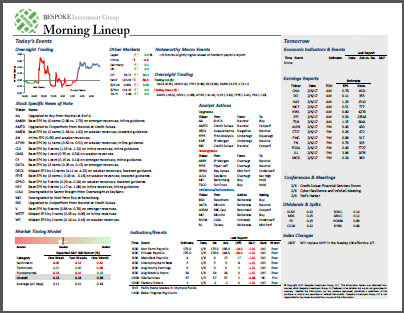
Below is a snippet of commentary from today’s Morning Lineup. Start a two-week trial to Bespoke Premium to view the full report.
Equity futures surged overnight with the Nasdaq indicated to be up nearly 1.5% while the S&P 500 is poised to open higher by 0.75%. The only major catalyst in the US was a strong earnings report from Micron (MU) which surged over 16% after reporting an earnings triple play. The big news once again came out of China where the government said that it would undertake the necessary spending necessary to meet this year’s growth targets. That was also accompanied by reports that the government was prepared to pump $150 bln into the country’s largest banks. All of this news pushed stocks in the country firmly higher for the third straight day of 1%+ gains, and the impact has dispersed out to the rest of the global equity market.
In Europe, stocks have piggybacked on the overnight gains out of China, and the STOXX 600 has rallied over 1%.
Here in the US this morning, it’s a busy day for economic data with revised GDP, Personal Consumption, Core PCE, Durable Goods, and jobless claims all at 8:30. The most notable of these in our view was initial jobless claims, which once again confirmed that the surge earlier this summer may have been more seasonal than anything else. The only other report on the calendar is Pending Home Sales at 10 AM. If all this economic data isn’t enough, there are a ton of Fed speakers scheduled to speak, so many in fact that we couldn’t even fit them all on page one.
After another strong night for Chinese stocks, the Shanghai Composite has now rallied over 9% in the last three trading days with a bulk of the gains coming on Tuesday and today, even as Wednesday’s gain was a not-so-modest 1.2%. As shown in the chart below, the current run ranks as the strongest since July 2020, and before that August 2015. During the financial crisis, there were multiple occurrences, and then before that, there were a handful of occurrences in the years after China entered the WTO at the end of 2001.

The chart below shows each time the Shanghai Composite rallied over 9% in three days with no occurrences in the prior three months. Besides the current period, there were only six other occurrences, and the two that stand out most came right in the middle of major bear markets.

The Closer – Meta, Bankruptcies, CFO Survey – 9/25/24
Log-in here if you’re a member with access to the Closer.
Looking for deeper insight into markets? In tonight’s Closer sent to Bespoke Institutional clients, we lead off with a look into Meta’s new product and news from OpenAI (page 1). WE then dive into business bankruptcies, distressed bonds, the difference between traditional and whole business securitization (pages 2 and 3). We then review today’s CFO survey data (page 4), new home sales (page 5), 5-year note auction (page 6), and EIA data (page 7).

See today’s full post-market Closer and everything else Bespoke publishes by starting a 14-day trial to Bespoke Institutional today!
Bespoke’s Morning Lineup – 9/25/24 – Gold Glitters
See what’s driving market performance around the world in today’s Morning Lineup. Bespoke’s Morning Lineup is the best way to start your trading day. Read it now by starting a two-week trial to Bespoke Premium. CLICK HERE to learn more and start your trial.
“I putt like I did when I was a kid. When you’re a kid, you’re not scared of anything.” – Arnold Palmer
Below is a snippet of commentary from today’s Morning Lineup. Start a two-week trial to Bespoke Premium to view the full report.
It’s a quiet morning in the markets so far as US equity futures are flat to modestly lower while US treasuries are modestly higher as they’ve steadily risen since the Fed cut rates last week. The only economic report remaining on the calendar this morning is New Home Sales, but weekly mortgage applications were released earlier today, and while overall applications were up 11% for the week, nearly all of it was related to refinancing activity which was up 20% compared to a gain of just 1% for purchase applications.
While 10-year yields seemingly rising every day since the Fed cut rates last week, gold is on pace for its sixth straight day of gains and its fifth straight record closing high. Gold surged earlier in the year before trading in a sideways range from April through July. Still, as summer wound down and the current easing cycle became more of a certainty, investors have been piling into the world’s oldest inflation hedge.

Looking at gold from a longer-term perspective, all-time highs in the price of gold have been relatively rare. Since 1976, it has closed at a record high on just 2% of all trading days, and they were generally concentrated into three periods. The first was in the late 1970s to early 1980. Then gold went another quarter century with no record highs. It wasn’t until the financial crisis and the Fed instituted its zero-interest rate policy that gold broke out above its 1980 peak, and those new highs continued until late 2011. During Covid, gold briefly hit another all-time high but traded in a sideways range again through the end of 2023. This year, though, the pace of new highs has been coming in heavy with 36 – or about an average of once a week. Put another way, with 36 new closing highs this year, 14% of all the record closing highs in the price of gold have occurred this year.

Of the 36 record closing highs in the price of gold this year, six have occurred this September (through 9/24), and that has helped to move September into second place for the month with the largest number of new closing all-time highs. That’s nearly the opposite of the S&P 500 where September has been the month with the fewest record closing highs. The only month with more is August, but with just four trading days left this month, August’s lead is safe for this year.

The Closer – Energy Production, 5 Fed, Home Prices – 9/24/24
Log-in here if you’re a member with access to the Closer.
Looking for deeper insight into markets? In tonight’s Closer sent to Bespoke Institutional clients, we start out with a look into monthly energy production figures (page 1) followed by an update of our Five Fed Manufacturing Composite (page 2). Next, we look at the latest update of Case-Shiller home prices (page 3) and finish with a review of today’s 2-year note auction (page 4).

See today’s full post-market Closer and everything else Bespoke publishes by starting a 14-day trial to Bespoke Institutional today!
Record Highs for Gold and Gold Positioning
As we do at the start of each week, in Monday’s Closer we recapped the latest positioning data from the CFTC’s Commitments of Traders report. In essence, this data highlights whether traders are in aggregate positioned long or short in various futures contracts. In the charts below, we show the historical net percentage of open interest net long (short) for gold and silver futures. Higher positive readings indicate that positioning is net long (more longs than shorts), while negative readings indicate that positioning is net short (more shorts than longs).
Last week’s data saw a number of big moves in commodity futures, but some of the most notable were in the precious metal space. For starters, silver rose to 41.5% net long. That makes for the most optimistic positioning since April 2017. As gold continues to trade at record highs, traders have gotten extremely long at 57.7%, which is a record high in this series dating back to 1986!

As shown above, last week’s record high in gold positioning isn’t the first of the year. So far in 2024, there have been five weeks with record highs. As shown below, that is the largest number of record highs since 2009 when there were six.

Again, the new high in gold positioning comes as gold itself is trading at record highs. In the chart below, we show the price of gold during the history of the Commitments of Traders data and plot each time that positioning was also at a record high. Of these occurrences since 2000, gold has usually been trending higher when gold long positioning reaches a record. That was also the case in the 1980s, albeit that was early on in the CFTC data’s history, and as such, back then the net long readings were significantly lower than they are now. The 1990s were a bit different as the strong reads on positioning came at a time when gold was sitting in a downtrend.

The Fed’s Quarterly Review of Household Wealth
The conventional wisdom in investing suggests that individuals should reduce their exposure to equities as they age. This strategy is based on the principle that younger investors have a longer time horizon and can afford to take on more risk, while older investors, nearing or in retirement, should focus on preserving capital and minimizing risk. However, the chart below depicting equity and mutual fund shares as a percentage of financial assets by age group reveals a notable deviation from this traditional approach. Surprisingly, it is the oldest cohort of investors—those aged 70 and above—that maintain the highest levels of equity and mutual fund exposure, with the trend intensifying over time. This data comes from the most recent quarterly Distributional Financial Accounts report from the Fed analyzing household wealth.
The discrepancy in equity market exposure for older and younger age groups can largely be attributed to the dramatic rise in the stock market over the past few decades, which has significantly boosted the wealth of older investors. However, it also underscores a broader trend: younger generations are notably underrepresented in equity markets. This is likely due to a combination of lower net worth, less savings, and perhaps even a more cautious approach to investing. Nevertheless, younger investors, with their longer investment horizon, should ideally have a higher proportion of their financial assets in equities to capitalize on potential long-term growth. We would note, though, that the <40 age group now has a slightly higher share of equity market exposure than the 40-54 age band, and the reading for sub-40 investors has skyrocketed since COVID while the 40-54 age group has merely trended sideways over the last ten years.

In a similar vein, you might expect older investors to have more cash in the form of deposits and money market funds than younger age groups, but it’s the sub-40 group that currently has the highest percentage of cash at 20.2% of financial assets. Back in the 90s, older investors carried much higher cash levels than younger investors, but that trend reversed in the years following the Financial Crisis. The sub-40 group has held the highest cash levels of any age cohort for 12+ years now. All things equal, we view it as bullish for the long-term health of the market that younger investors currently have lower equity exposure than most of their peer age groups and higher cash levels. It suggests there’s plenty of money out there ready to “Get Invested!” at some point.

The charts above were featured in our Closer report sent to Bespoke Institutional subscribers on 9/23. In addition to these two charts, we featured many more from the Fed’s latest quarterly report on household wealth that were quite interesting. If you’d like to read the rest of The Closer from 9/23 and gain access to everything else Bespoke publishes for investors on a daily basis, sign up for a Bespoke Institutional trial today.

Bespoke’s Morning Lineup – 9/24/24 – China Pulls Out a Lot of Stops
See what’s driving market performance around the world in today’s Morning Lineup. Bespoke’s Morning Lineup is the best way to start your trading day. Read it now by starting a two-week trial to Bespoke Premium. CLICK HERE to learn more and start your trial.
“Show me a hero, and I’ll write you a tragedy.” – F. Scott Fitzgerald
Below is a snippet of commentary from today’s Morning Lineup. Start a two-week trial to Bespoke Premium to view the full report.
To see yesterday’s CNBC interview, you can just click on the image below.

Futures in the US are looking at modest gains this morning ahead of Case Shiller housing numbers at 9 AM and Consumer Confidence at 10 but the big news overnight came out of China where the PBoC announced several stimulus measures designed to boost the economy and the stock market. You have to check out the commentary section of today’s report for a full in-depth recap (you won’t find a better one). While the positive response by the equity market to the stimulus measures is more than warranted given the stops pulled overnight and could have some follow-through in the short term, we’re not quite convinced that “all” the necessary stops were pulled to make this the seminal event for a turnaround in the long-languishing Chinese equity market and economy
As mentioned, China’s overnight stimulus measures powered the Shanghai Composite to a rally of 4.15% for its best one-day gain since July 6th, 2020. As impressive as the gain was, it barely got the index above its 200-day moving average and only back to levels it traded at in late August. Since its recent high in May, the Shanghai Composite is still down 10%. You have to start somewhere, but Chinese stocks still have a way to go.

Looking at a longer-term chart, Chinese stocks have had some big bouts of volatility where they more than doubled in just a couple of years and then gave back all of those gains just as fast. What also stands out is how volatility in the country has subsided. Over the last five years, there have been just two one-day gains of 4%+ while in the five before that there were 14. Combining those two most recent five-year periods, there have been 16 one-day gains of 4% in the last ten years which is only slightly more than half as many as there were in the ten years before that (31)!
