Apr 21, 2026
Bespoke’s Conference Call Recaps use AI to summarize lengthy earnings calls. The commentary below is AI-generated and then edited by Bespoke for quality control. As always, none of these summaries should be construed as recommendations to buy or sell any securities, and investors should do their own research and/or consult with a financial professional before making any investment decisions.
Our latest recap available to Bespoke subscribers covers D.R. Horton’s (DHI) Q2 2026 earnings call.

D.R. Horton (DHI) is the largest homebuilder in the US, focused on constructing and selling primarily entry-level and move-up homes. This quarter’s results showed a company navigating a tough affordability backdrop. Orders rose 11% YoY despite cautious consumers, supported by heavy incentives (about 10% of revenue) and widespread mortgage buydowns (used in about 73% of closings). Pricing remains under pressure (Average Selling Price down 3% YoY), but lower construction costs and strong execution kept margins near the high end of guidance. Inventory is being tightly managed, with completed unsold homes down 35% YoY and cycle times improving by nearly a month, allowing faster turns and earlier sales at better margins. Demand trends held up through March and into April despite macro noise (rates, oil, geopolitics), with strength in Texas, Florida, and newer northern markets. Despite the 2.3% YoY revenue dip, EPS and revenue topped estimates, and shares rose 7% on 4/21 as a result…
Continue reading our Conference Call Recap for DHI by becoming a Bespoke Institutional subscriber. You can sign up for Bespoke Institutional now and receive a 14-day trial to read our newest Conference Call Recap. To sign up, choose either the monthly or annual checkout link below:
Bespoke Institutional – Monthly Payment Plan
Bespoke Institutional – Annual Payment Plan
Apr 21, 2026
See what’s driving market performance around the world in today’s Morning Lineup. Bespoke’s Morning Lineup is the best way to start your trading day. Read it now by starting a two-week trial to Bespoke Premium. CLICK HERE to learn more and start your trial.
“Success flourishes only in perseverance — ceaseless, restless perseverance.” – Baron Manfred von Richthofen

Below is a snippet of commentary from today’s Morning Lineup. Start a two-week trial to Bespoke Premium to view the full report.
The Nasdaq may have broken its 13-day winning streak yesterday, but it’s looking to start a new one this morning. Futures on the S&P 500 and Nasdaq are both up nearly 0.5%, while the Dow, powered by a 7% rally in UnitedHealth Group (UNH), has that index on pace to gap up 0.65% at the open. Treasury yields are slightly higher, with the 10-year yield just under 4.26%, while crude oil is fractionally lower at just under $90 per barrel. All in all, it’s been a quiet overnight session as markets await the outcome of the latest on-again, off-again peace talks between the US and Iran. President Trump will also be interviewed on CNBC at 8:30, so investors will be focused on that for any potential headlines. Will he be talking about Iran, Kevin Warsh, or maybe even “Tim Apple’s” retirement?
In international markets overnight, Asian stocks were higher across the board, with South Korea surging 2.7% to a new record high and erasing all its 20%+ decline from late in the first quarter. European stocks are also trading with a positive bias, with the STOXX 600 0.2% higher, led by Germany and Spain, which are up 0.5%.
On the US economic calendar this morning, we’ll get Retail Sales at 8:30, and then Business Inventories and Pending Home Sales at 10 AM. The earnings calendar will also continue to pick up after the close with Capital One (COF), Intuitive Surgical (ISRG), and United Airlines (UAL) all on the calendar.
One of the world’s largest companies marked the end of an era last night when Apple (AAPL) announced that CEO Tim Cook would retire effective September 1st, just over 15 years after taking the helm in August 2011. During Cook’s tenure, AAPL’s stock rallied more than 1,900%, which works out to an annualized gain of 22.8%, or nearly 10 percentage points more than the 13.0% gain for the S&P 500!
As incredible as the stock’s performance has been, it ranks only 38th among current members of the index. Among the current group of trillion-dollar stocks, AAPL trails Alphabet (GOOGL), Amazon (AMZN), Broadcom (AVGO), Nvidia (NVDA), and Tesla (TSLA) but is ahead of Microsoft (MSFT), Berkshire Hathaway (BRK/b), and Walmart (WMT). Meta (META) wasn’t even public when Cook took over as CEO, as its IPO wouldn’t be for another eight to nine months in May 2012.
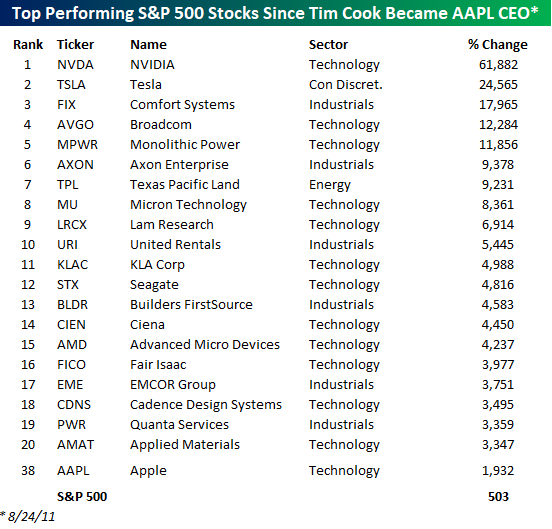
The table below lists the 20 top-performing stocks in the S&P 500 since Cook took the helm at AAPL. NVDA’s 61K% gain is more than double the next closest stock (TSLA) and more than 30 times the gain of AAPL! There are three other stocks – Comfort Systems (FIX), AVGO, and Monolithic Power (MPWR) that have rallied more than 10,000%. While most have become household names, not all have. If you asked the average person to comment on the names listed below, many would probably see names like Comfort Systems (FIX) or Monolithic Power (MPWR) and ask why a mattrass company and utility are on the list, not knowing that the companies provide essential cooling (FIX) and power management systems (MPWR) for the data centers that power AI.
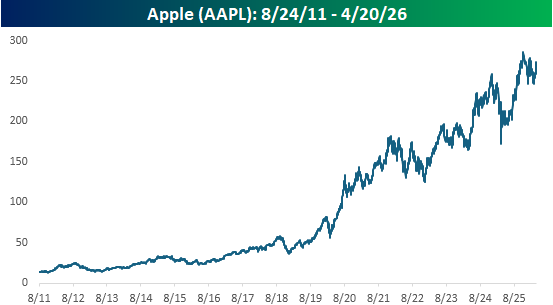
A look at AAPL’s performance under Cook shows what, in retrospect, looks like a steady uptrend with higher highs and higher lows, although there have been plenty of times along the way where the road ahead looked very uncertain. When Cook took the helm, AAPL was trading at a split-adjusted $13 per share. Yesterday, it closed just above $273, off nearly 5% from its all-time high of $286.19.
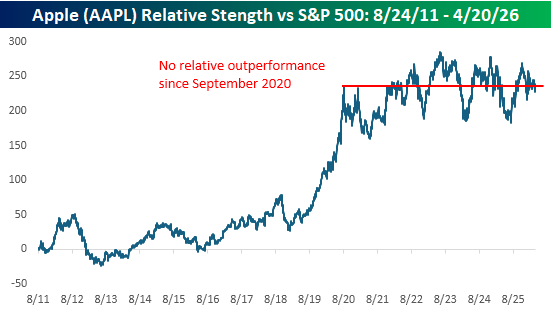
As steady as the rally in AAPL looks, the stock has seen a major shift in at least one respect over the last five years. For more than a decade, from the launch of the iPod through the launch of the iPhone, right up until Covid, AAPL was a steady alpha generator versus the market. A look at its relative strength versus the S&P 500, though, shows a sideways pattern that has been in place for more than five years. Will the new CEO “Ternus” around?
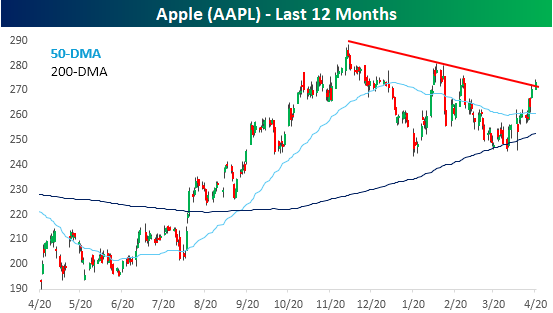
Looking at AAPL’s performance on a short-term basis shows the stock at an important juncture. After trading in a steady downtrend since its high late last year, AAPL tested that downtrend line over the last couple of days and appears to be stalling. While the stock successfully tested its 200-DMA in March and reclaimed its 50-DMA, the next step on the road to new highs and a potential return to outperformance will be a rally above $275.
Start a two-week trial to Bespoke Premium to continue reading today’s full Morning Lineup.
Apr 20, 2026
See what’s driving market performance around the world in today’s Morning Lineup. Bespoke’s Morning Lineup is the best way to start your trading day. Read it now by starting a two-week trial to Bespoke Premium. CLICK HERE to learn more and start your trial.
“If you’re in a good situation, don’t worry it’ll change.” – John A. Simone Sr.
Below is a snippet of commentary from today’s Morning Lineup. Start a two-week trial to Bespoke Premium to view the full report.
After a big rally on Friday on homes that the Iran war was ending, futures are lower to start the week as uncertainty over the progress of the war rekindles itself. The damage isn’t nearly as bad as it was earlier, though, as both S&P 500 and Nasdaq futures are down less than 0.5%. Treasury yields are only slightly higher, and while crude is trading up close to 6%, WTI is still below $89 per barrel. Gold prices are down 1%, and Bitcoin is surprisingly higher as it holds above $75K. In the short term at least, the market has taken a two steps forward, one step back mentality.
Despite the weakness in US futures, Asia had a positive session as it played catch-up to Friday’s rally. The Nikkei rallied 0.6% while South Korea added 0.4%. Europe, however, was still open on Friday when the positive news regarding the Strait came out, so this morning, the STOXX 600 is down over 1.1% with Italy and Germany leading the way lower (-1.4%).
The economic calendar is light in the US today, and there isn’t even a lot in the way of earnings reports for investors to digest, but that will change as the week goes on as we head into the peak of earnings season.
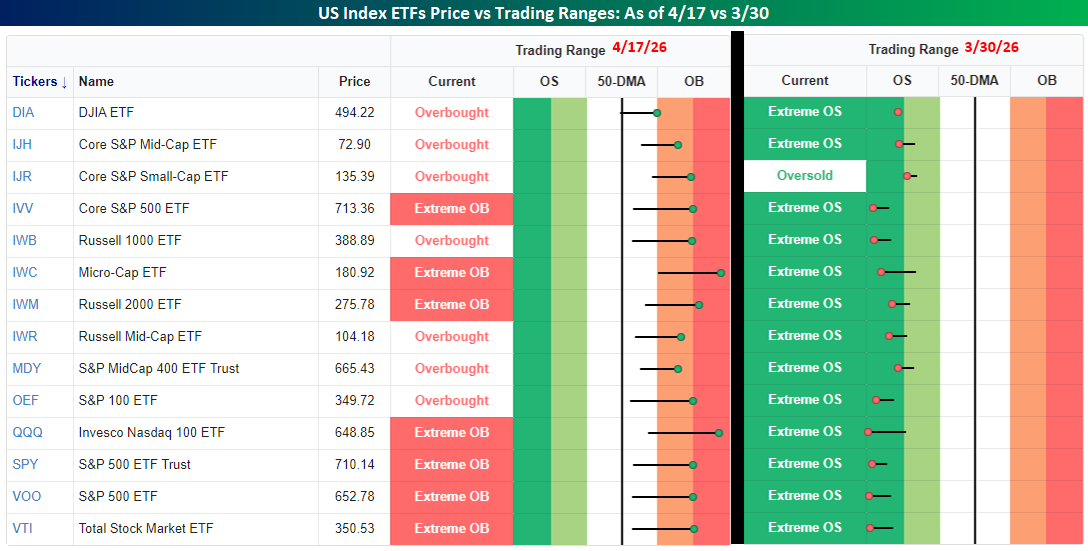
Equities are on pace to start the week lower, but keep in mind how fast it’s recovered. The snapshot below shows where US index ETFs closed out last week relative to their trading ranges compared to where they were as of the close three weeks ago today. As of Friday, every US index ETF in our screen finished off last week at either overbought (1+ standard deviations above the 50-DMA) or extreme overbought (2+ standard deviations above) levels. Three weeks ago, all but one of them were at extreme overbought levels. We’ve come a long way, so some short-term digestion of the moves is only natural.
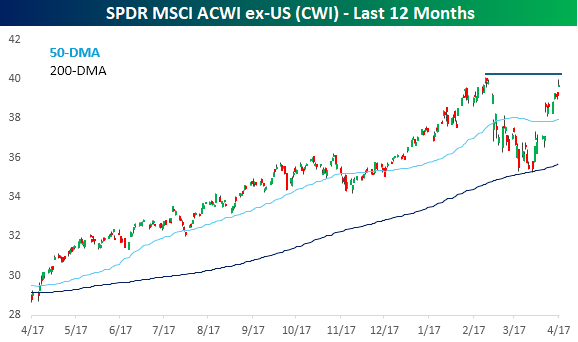
While major US indices closed out the week at record highs last Friday, the same can’t be said for stocks on an international basis. The chart below shows the performance of the SPDR MSCI ACWI Ex US ETF (CWI) over the last year. The sell-off because of the Iran war took the ETF right down to a successful retest of its 200-day moving average, and like the US, the rebound was faster than the decline. Unlike US equities, though, CWI’s rally on Friday stalled out just shy of the all-time highs from late February.
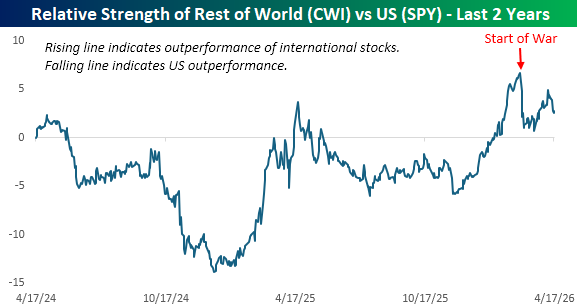
It’s well known by now that the US economy is much more insulated from the issues in the Middle East than the rest of the world, and the chart below illustrates that. On a relative strength basis, international equities bottomed shortly after the 2024 election and reached a short-term peak around Liberation Day last April. Towards the end of last year, as tariff concerns fell off the front page, international stocks started rallying again, hitting a multi-year high right at the end of February.
The start of the war abruptly derailed that outperformance, and while international stocks rebounded in late March into early April, they started to rollover again last week, and look poised ot continue that underperformance today. That weakness was somewhat surprising given it came as tensions in the Persian Gulf started to ease, but if there’s one thing we can all be certain of, the market is always full of surprises.
Start a two-week trial to Bespoke Premium to continue reading today’s full Morning Lineup.
Apr 17, 2026
See what’s driving market performance around the world in today’s Morning Lineup. Bespoke’s Morning Lineup is the best way to start your trading day. Read it now by starting a two-week trial to Bespoke Premium. CLICK HERE to learn more and start your trial.
“Power resides where men believe it resides. It’s a trick. A shadow on the wall.” — Lord Varys, Game of Thrones
Below is a snippet of commentary from today’s Morning Lineup. Start a two-week trial to Bespoke Premium to view the full report.
As if a 12-day rally wasn’t enough for bulls, Nasdaq futures are indicated higher again this morning, putting the index on pace for its 13th day in a row of gains. Both the Nasdaq and S&P 500 are on pace to rally 0.40% while futures on the Dow, which has underperformed recently, indicate a 0.54% gain at the open. The 10-year yield is slightly lower and holding below 4.3% while crude oil flirts with $90 to the downside, falling more than 4%. Gold prices are modestly higher with a gain of 0.34%, while Bitcoin rallies nearly 1% to its highest level since early February.
For much of this year, investors had to put up with weakness heading into the weekend, given all the uncertainty surrounding the war. For the last two weeks, though, investors haven’t been able to resist adding exposure heading into a 48-hour break.
International markets have been more mixed to close out the week, but are still higher for the week. The Nikkei fell 1.8% overnight while Hong Kong, China, and South Korea were all down less than 1%. In Europe, the STOXX 600 is marginally gaining 0.1%, with Italy leading the way (+0.6%) while the UK lags (-0.4%).
Just over two weeks ago, on March 30, the S&P 500 and the Nasdaq closed at their lowest levels since the summer, the Iran war was ongoing, and while Iran’s capabilities were severely damaged, the New York Times warned of a quagmire, saying that “Wounded Iran Is Still Biting: Attacks May Be Fewer But Have Deadly Effect”. Besides all that, it was a Monday too!
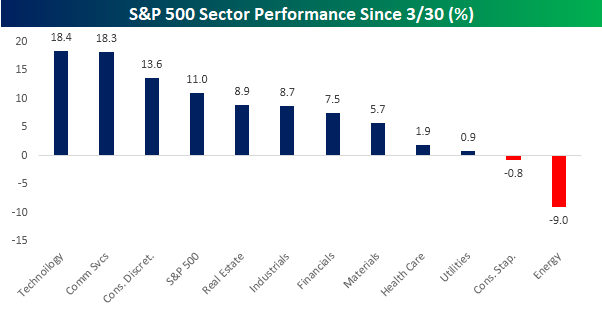
At the time, very few probably anticipated what was in store next for the market. Since that low, the Nasdaq hasn’t closed lower on a single day, and the S&P 500 has rallied in eleven of the last 12 days for a total gain of 11.0%. At the sector level, the rally hasn’t been especially broad, and gains have been concentrated in Technology and Communication Services, which both have surged more than 18%. The only sector that has outperformed the S&P 500 since that low is Consumer Discretionary (+13.6%).
To the downside, Energy has been the main loser with a decline of 9.0%, and the only other sector in the red has been Consumer Staples (-0.8%). As we noted earlier in the week, Consumer Staples is the only sector in the S&P 500 that declined both in the first month of the war from 2/27 to 3/30 and since the 3/30 low.
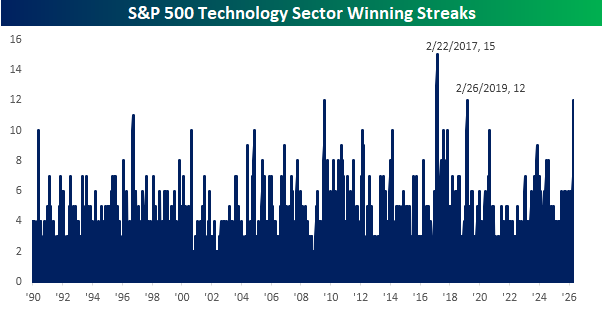
Technology has been the clear leader over the last 12 trading days, and relative to its own history, it’s been an impressive streak. The current streak for the sector is tied with the period ending 2/26/19 for the longest since February 2017. That 15-day winning streak was also the longest in the sector’s history since 1990.
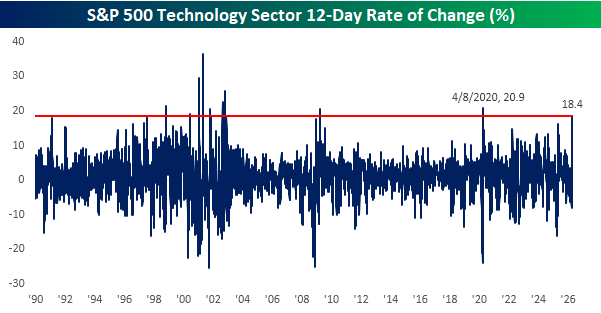
Not only has the sector’s winning streak been among the sector’s best, but the 18.4% rally over the last 12 trading days has been among the strongest since 1990 as well. You have to go back to April 2020, coming out of Covid to find a bigger 12-day rally (+20.9%), and before that, the only larger 12-day gain was in March 2009 coming out of the Financial Crisis. To be sure, not all big 12-day gains for the Technology sector were followed by gains going forward, but the sector’s median gain over the following six and twelve months was 13.8% and 28.1%, respectively.
Start a two-week trial to Bespoke Premium to continue reading today’s full Morning Lineup.
Apr 16, 2026
Bespoke’s Conference Call Recaps use AI to summarize lengthy earnings calls. The commentary below is AI-generated and then edited by Bespoke for quality control. As always, none of these summaries should be construed as recommendations to buy or sell any securities, and investors should do their own research and/or consult with a financial professional before making any investment decisions.
Our latest recap available to Bespoke subscribers covers JPMorgan Chase’s (JPM) Q1 2026 earnings call.

JPMorgan Chase (JPM) is the largest US bank, operating across consumer banking, investment banking, trading, and asset/wealth management. The bank posted $16.5B in net income and 10% revenue growth, driven by strong trading (+21% fixed income, +17% equities) and a rebound in investment banking fees (+28%). Management emphasized that the US consumer remains “resilient,” with spending still growing and credit performance stable, though heavily dependent on a strong labor market. The bank flagged rising geopolitical risks in the Middle East and higher energy prices as key watch points. Jamie Dimon warned that while private credit isn’t systemic, the next credit cycle could produce worse-than-expected losses. A major focus was regulatory pressure, with Basel III and GSIB rules potentially adding roughly $20B in capital and raising borrowing costs. AI remains a double-edged sword, driving fraud prevention and customer tools, but increasing cyber risk. Results were better than expected, but shares were down less that 1% on 4/14…
Continue reading our Conference Call Recap for JPM by becoming a Bespoke Institutional subscriber. You can sign up for Bespoke Institutional now and receive a 14-day trial to read our newest Conference Call Recap. To sign up, choose either the monthly or annual checkout link below:
Bespoke Institutional – Monthly Payment Plan
Bespoke Institutional – Annual Payment Plan
Apr 16, 2026
See what’s driving market performance around the world in today’s Morning Lineup. Bespoke’s Morning Lineup is the best way to start your trading day. Read it now by starting a two-week trial to Bespoke Premium. CLICK HERE to learn more and start your trial.
“Our conviction in the multi-year AI megatrend remains high and we believe the demand for semiconductors will continue to be very fundamental.” – C.C. Wei, President and CEO, Taiwan Semiconductor
Below is a snippet of commentary from today’s Morning Lineup. Start a two-week trial to Bespoke Premium to view the full report.
Before getting to this morning’s note, last night we updated our Bespoke Baskets, where we made two changes to the Growth basket and no changes to the Dividend Income basket. You can view the full update here.
Also, be sure to watch our discussion on markets with Brian Sullivan in a CNBC appearance yesterday.
Futures are indicated higher again this morning as the S&P 500 looks to add to its record highs from yesterday, in what has been one of the most rapid turnarounds in market history. Treasury yields are also lower, while crude oil is just fractionally higher. Both gold and Bitcoin have also shown very modest moves in either direction.
In Asia overnight, most major benchmarks were higher, with the Nikkei up over 2% and China up roughly 1%. In Europe, we’re also seeing gains with the STOXX 600 up 0.4%.
The pace of earnings continues to pick up, but this morning’s focus has been on economic data, and the news was good as both jobless claims and the Philly Fed Manufacturing report exceeded expectations. Lastly, in Fedpseak, NY Fed President John Williams is speaking right now, and he commented that “the No. 1 topic related to the economy is the Middle East conflict, which has introduced substantial risks and heightened uncertainty”.
Since it’s not a US company, Taiwan Semiconductor (TSM) doesn’t get a lot of attention in US stock market coverage, which is a mistake. With a market cap of just under $2 trillion, it’s one of the ten largest publicly traded companies in the world. TSM is the linchpin of the global semiconductor supply chain and the global digital economy for that matter. As much as the Iran war has disrupted energy supplies and threatened to derail the global economy, in a scenario where semiconductor supplies from TSM were cut off for an extended period, it would be an economic calamity.
Thankfully, that’s not the case. Overnight, TSM reported better-than-expected EPS and sales and raised guidance. As highlighted in the quote above, the company sees no signs of a slowdown in demand. Revenues rose 40.6% y/y on incredible gross margins of 66.2%.
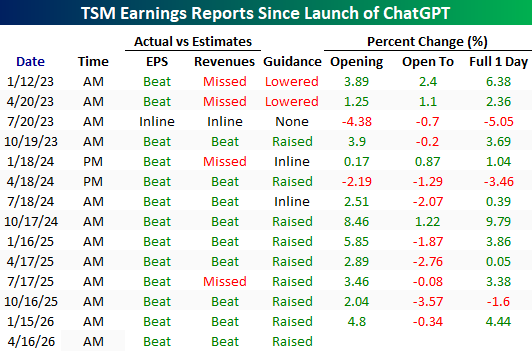
TSM’s results for Q1 were nothing new and continued a trend of strong results since the launch of ChatGPT in late 2022. In the 14 quarters since that launch, the company has reported better-than-expected EPS results 13 times, exceeded sales results nine times, and raised guidance nine times. As shown in the table below, while results relative to expectations were shaky early on in the bull market, more recent results have been consistently strong, with six triple plays in its last seven reports.
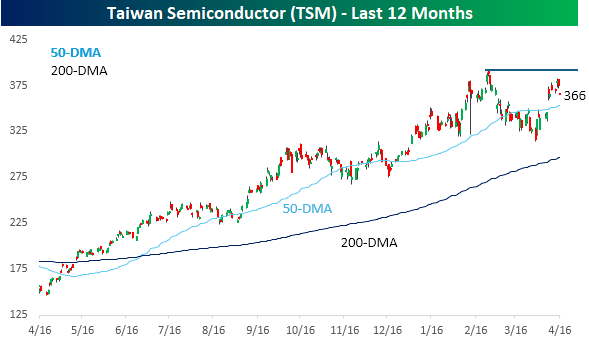
Despite the strong results overnight, shares of TSM are trading modestly lower in the pre-market and failed to make a new high in yesterday’s trading, even as the broader market and the Philadelphia Semiconductor Index (SOX) specifically hit new highs yesterday. That’s not to say that the stock hasn’t been a strong performer, though, more than doubling in the last twelve months.
TSM is the second-largest stock in the SOX on a market cap basis, trailing Nvidia (NVDA) by a wide margin. Like TSM, though, NVDA also didn’t join the SOX or the S&P 500 in hitting a new high yesterday. The fact that the SOX has managed to make new highs without the participation of its two largest members illustrates how broad the underlying strength in the sector has been.
Start a two-week trial to Bespoke Premium to continue reading today’s full Morning Lineup.