Jan 9, 2018
Earnings season kicks off this week as the first of the major companies start to report Q3 numbers. Most of the big names reporting are all Financials like Blackrock (BLK), JP Morgan (JPM), PNC, and Wells Fargo (WFC) on Friday, but we will also hear results from other notables like Lennar (LEN) and KB Home (KBH) on Wednesday and then Delta (DAL) on Thursday.
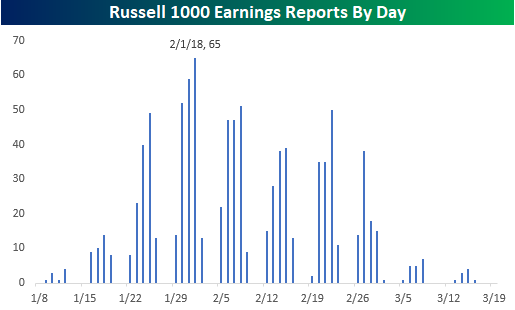
The pace of reports really won’t pick up until the week after next when 133 companies in the Russell 1000 are on the calendar. Then, we get into the peak reporting period in the last week of January/first week of February when 379 companies in the index will report from 1/29 through 2/9. The busiest day in that two-week stretch will be on 2/1 when 65 companies in the Russell 1000 will report. For a more detailed rundown of the earnings schedule for the upcoming season, please see our Interactive Earnings Calendar.
We just published our quarterly look at analyst revisions heading into this earnings season. In this report, we take the current trends and break down how the equity market has performed during prior periods when analyst revisions were at similar levels.
For anyone with more than a passing interest in how equities are impacted by earnings season, this report is a must-read. To see the report, sign up for a Bespoke Premium membership now!
Dec 7, 2017
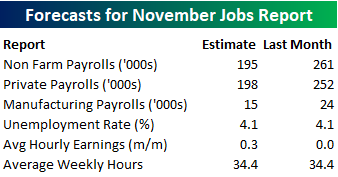
Heading into Friday’s Non-Farm Payrolls (NFP) report for November, economists are expecting an increase in payrolls of 195K, which would be a large decline from October’s reading of 261K. Last month’s big decline was largely due to the rebound effect of last Summer’s hurricanes, so even though total job growth is expected to fall, 195K is still a healthy number. In the private sector, economists are expecting a similar increase of 198K from last month’s level of 252K, and the unemployment rate is expected to remain unchanged at an exceptionally low level of 4.1%. Growth in average hourly earnings is expected to rebound back to 0.3%, while the average workweek should remain at 34.4 hours per week.
Ahead of the report, we just published our eleven-page monthly preview of the November jobs report. This report contains a ton of analysis related to how the equity market has historically reacted to the monthly jobs report, as well as how secondary employment-related indicators we track looked in November. We also include a breakdown of how the initial reading for November typically comes in relative to expectations and how that ranks versus other months.
One topic we cover in each month’s report is the S&P 500 stocks that do best and worst from the open to close on the day of the employment report based on whether or not the report comes in stronger or weaker than expected. In other words, which stocks should you buy, and which should you avoid? The table below highlights the best-performing stocks in the S&P 500 from the open to close on days when the Non-Farm Payrolls report has been better than expected over the last two years. Of the 25 top performing stocks on days when the NFP beats expectations, seven sectors are represented, with Energy leading the way with eight. Leading the way to the upside, Vornado (VNO), has seen an average open to close gain of over 2.5%. In terms of consistency, Urban Outfitters (URBN), Skyworks (SWKS), Autodesk (ADSK), and Cerner (CERN) have been in the black 91% of the time.
For anyone with more than a passing interest in how equities are impacted by economic data, this report is a must-read. To see the report, sign up for a monthly Bespoke Premium membership now!

