Mar 7, 2019
We discuss the trends of the so-called ‘smart’ and ‘dumb’ money quite often. For those unfamiliar with the terms, “dumb money” is considered to be the more reactive traders/investors who trade based on the headlines right at the open. Conversely, the more thoughtful “smart money” waits for things to shake out before acting. To track the sentiment of each group, we consider the dumb money to be the market’s action during the first half hour of the trading day, while the last hour of the trading day is representative of the smart money. The action of the smart and dumb money over the last 12 months has definitely been intriguing, and we analyze these trends in a report that was just published for Premium members. Find out what the “smart money” has been doing recently as the market has stalled out a bit.
To gain access to the report, please start a two-week free trial to our Bespoke Premium package now. Here’s a breakdown of the products you’ll receive.
Mar 6, 2019
Heading into Friday’s Non-Farm Payrolls (NFP) report for February, economists are expecting an increase in payrolls of 181K, which would be a decline from January’s monster report which came in above expectations at 304K. In the private sector, economists are expecting an increase of 180K, which would imply a similar decline versus January as the headline reading. The unemployment rate is expected to tick back down to 3.9% from last month’s reading of 4.0%. Average hourly earnings are expected to grow at a rate of 0.3% versus the 0.1% reading last month. Higher wage growth is probably not something this market wants to see, but given last month’s weaker than expected reading, a move back to 0.3% would likely not be too problematic. Finally, average weekly hours are expected to be unchanged at 34.5.
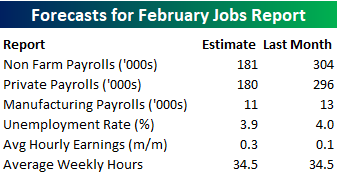
Ahead of the report, we just published our eleven-page preview of the February jobs report. This report contains a ton of analysis related to how the equity market has historically reacted to the monthly jobs report, as well as how secondary employment-related indicators we track looked in February. We also include a breakdown of how the initial reading for February typically comes in relative to expectations and how that ranks versus other months.
One topic we cover in each month’s report is the S&P 500 stocks that do best and worst from the open to close on the day of the employment report based on whether or not the report comes in stronger or weaker than expected. In other words, which stocks should you buy, and which should you avoid? The table below highlights the best-performing stocks in the S&P 500 from the open to close on days when the Non-Farm Payrolls report has been better than expected over the last two years.
Of the top performing stocks on days when NFP beats expectations, nine sectors are represented, but Consumer Discretionary leads the way with eight. Mattel (MAT) has been the best performing stock with an average open to close gain of 2.46%, but another seven have seen average open to close gains of more than 1%. In terms of consistency, Cognizant Technology (CTSH) leads the way with open to close gains 85% of the time.
For anyone with more than a passing interest in how equities are impacted by economic data, this February employment report preview is a must-read. To see the report, sign up for a monthly Bespoke Premium membership now!

