Mar 3, 2026
See what’s driving market performance around the world in today’s Morning Lineup. Bespoke’s Morning Lineup is the best way to start your trading day. Read it now by starting a two-week trial to Bespoke Premium. CLICK HERE to learn more and start your trial.
“The hardest hits are yet to come from the U.S. military,” – Marco Rubio, US Secretary of State

Below is a snippet of commentary from today’s Morning Lineup. Start a two-week trial to Bespoke Premium to view the full report.
Futures are off their overnight lows, but the optimism from the close yesterday evaporated quickly. The S&P 500 is indicated to gap down 1.4% at the open, while the Nasdaq will open down closer to 2%. These are even larger downside moves than at yesterday’s open! Treasury yields continue to move higher as the 10-year yield is back to 4.10%, and oil is on pace for its second day in a row of 6%+ gains. Unlike yesterday, though, there’s been no bid for gold or other precious metals as they’re all sharply lower. Bitcoin is also down 3%.
In Asia, markets are lower again this morning as the Nikkei fell 3.1%, China was down over 1%, and South Korea, after being closed on Monday, tanked 7.2%. It’s the same sea of red in Europe as well. The STOXX 600 is already down 3% on the day, on some of the most negative breadth we have seen in quite some time (24-1 to the downside and every group is down over 1.55%). As bad as US futures look this morning, the losses are a scratch relative to the gash in international markets. From an energy perspective, the US is much more insulated than the rest of the world is to Middle Eastern oil and gas. Therefore, the longer the conflict drags on, the more US assets should catch a bid, at least on a relative basis.
After an impressive turnaround from the morning lows yesterday, the ink was barely dry on the closing prices for the day when US Secretary of State Marco Rubio briefed the press with a statement that included the quote above. That, along with Iranian drone attacks on the US embassy in Riyadh, comments from the IRGC that the Strait of Hormuz was “closed” and any ships that attempted to traverse through it would be set ablaze, and a directive from the State Department for all personnel in Bahrain, Iraq, and Jordan to evacuate those respective countries, has caused a sharp reversal in sentiment as to the scope and duration of the current war situation in the Middle East.
At points yesterday, there was growing confidence that the operation against Iran would be quick, but this morning, we’ve seen some warnings from analysts that it already looks as though the US is getting involved in a prolonged quagmire (even though it hasn’t even been four days to this point). The next several days promise to feature multiple swings in sentiment as the situation unfolds, but remember this: no one knows exactly how this will all play out. The comments from Rubio above and the ones from the IGRC regarding the Strait of Hormuz sound dire, but what else do you expect them to say in the middle of a war?
We’ve only had one day of trading since the war began, and already the market action has been a roller-coaster. After gapping down more than 1% at the open yesterday, the SPDR S&P 500 ETF (SPY) bounced throughout the trading day to finish marginally higher, in what was only the 60th time since its launch 33 years ago that the ETF gapped down at least 1% and finished the day higher. With futures trading sharply lower again this morning, SPY is on pace to gap down more than 1% again today, and of those 59 prior reversals, SPY only gapped down more than 1% the following session six other times
This type of volatility only occurs under one condition – massive uncertainty. As shown by the red dots in the chart, the prior back-and-forth reversals were in December 2002, coming out of the dotcom bust, late 2008 following the collapse of Lehman, January 2022 when inflation started to spike, and last April during the tariff-tantrum. What’s somewhat unique about the current period, however, is the level of the VIX. In the six prior occurrences, the average level of the VIX was 40, and it was never below 30. As of this morning, the VIX is trading just under 26. Also, while the S&P 500 remains close to 52-week highs, all of the others, except the one in January 2022, occurred closer to 52-week lows.

While these types of reversals have been rare for SPY, the Nasdaq 100 is inherently more volatile, so it shouldn’t come as a surprise that they have been more common in QQQ. Today’s reversal will be the 19th such reversal. As shown in the chart below, most of these reversals occurred during the dot-com bust, with 12 between the March 2000 peak and the October 2002 lows. As the Nasdaq has ‘matured’ since then, occurrences have been much less frequent, with three during the financial crisis, one in early 2019, another in January 2022, and most recently in April of last year.

Mar 2, 2026
See what’s driving market performance around the world in today’s Morning Lineup. Bespoke’s Morning Lineup is the best way to start your trading day. Read it now by starting a two-week trial to Bespoke Premium. CLICK HERE to learn more and start your trial.
“If what you have done yesterday still looks big to you, you haven’t done much today.” – Mikhail Gorbachev
Below is a snippet of commentary from today’s Morning Lineup. Start a two-week trial to Bespoke Premium to view the full report.
Markets are poised to open the week sharply lower following the start of the war in the Middle East. Both the S&P 500 and Nasdaq are indicated to open down by over 1%, crude oil is sharply higher, gold is surging, and even Bitcoin is higher.
Overnight in Asia, major averages were all lower except for China, which rallied 0.5%. European markets are also joining in on the weakness, with the STOXX 600 down 1.5% and Spain and Germany both down over 2%.
It’s tempting to look at the initial moves in the opening hours of trading and extrapolate them to a specific endpoint, but we’d stress that we’re still very early in this process. While a short conflict would likely be received positively by the market, the longer it drags on, and the higher energy prices stay, the more of an economic/market impact this will have.
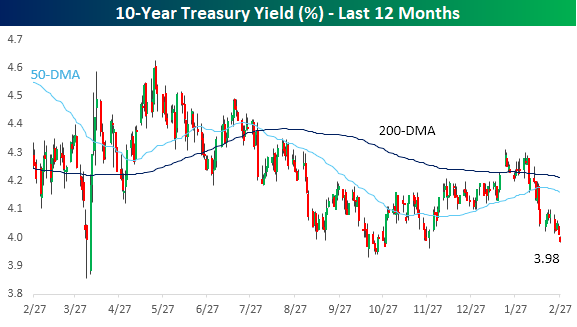
Markets are mostly reacting just as you’d expect given the news of the weekend. Crude oil is sharply higher, stocks are down, and the dollar is up. The only asset class not following the playbook is the 10-year yield. US Treasuries are actually selling off modestly this morning, with the yield on the 10-year up about 3 bps to 3.98%. Higher yields will inevitably raise questions over the sell America trade, but two points are worth highlighting. First, on Friday, yields closed right near 52-week lows even as PPI came in higher than expected, so there was certainly some front-running of the attack on Iran heading into the weekend. Secondly, it’s not just US yields that are higher. Sovereign yields are also higher by similar amounts in Europe as well, so the move is more a reflection of concerns over inflationary impacts of the war.
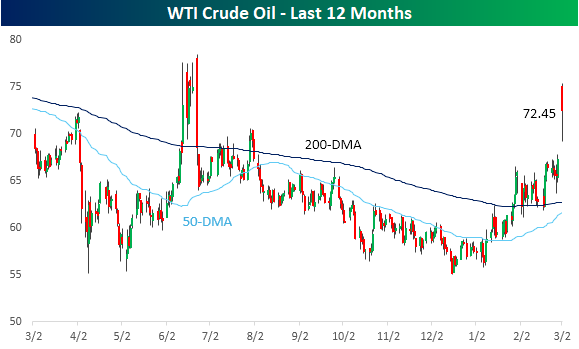
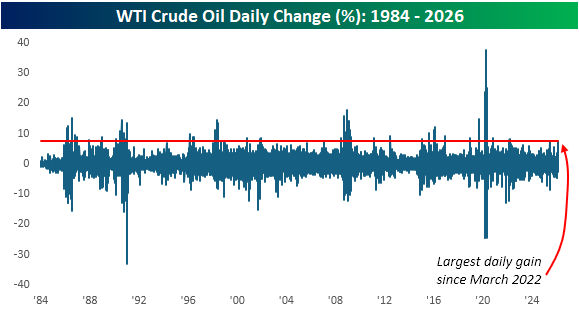
Crude oil has followed the playbook just as you would expect, though. If the pre-market gains hold through the end of the session, it will be the largest one-day rally in WTI crude oil since the early days of the Russia-Ukraine war in March 2022. While crude oil is off the highs from overnight, at over $72 per barrel, it’s right near its highest levels of the last year.
It’s been a large move, but today’s gain would only rank as the 80th largest one-day gain in crude oil since 1984. Given the enormity of the military action, an even larger move in crude oil wouldn’t have been a surprise.
Feb 27, 2026
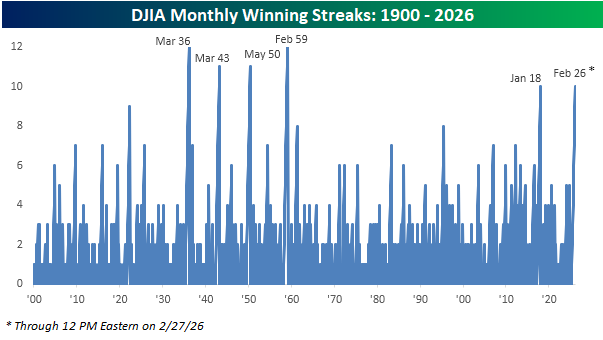
There’s still time in the trading day, but the Dow Jones Industrial Average (DJIA) is barely hanging on to a gain for the month (+0.05%). If it can hold on to these levels, it would extend the current monthly winning streak to ten, tying the streak that ended in January 2018 for the longest since February 1959 (12 months). As shown in the chart below, if the gains for February hold, it would be just the sixth double-digit monthly winning streak in the Dow’s history.
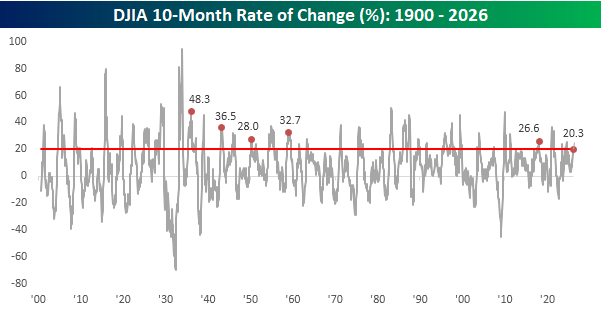
With the Dow up for ten straight months, it’s natural to wonder whether the index is stretched by historical standards. With a gain of just over 20% in the last ten months, its performance ranks in the 81st percentile relative to all other 10-month periods in its history, so the returns have been significantly better than average. However, looking at the chart of the index’s rolling 10-month performance over time shows that relative to prior streaks, the Dow’s gains during this run were actually the lowest of any comparable winning streak in its history. So, yes, the Dow’s performance over the last ten months has been much better than average, but far from extreme.

Feb 27, 2026
See what’s driving market performance around the world in today’s Morning Lineup. Bespoke’s Morning Lineup is the best way to start your trading day. Read it now by starting a two-week trial to Bespoke Premium. CLICK HERE to learn more and start your trial.
“I wonder why progress looks so much like destruction.” – John Steinbeck
Below is a snippet of commentary from today’s Morning Lineup. Start a two-week trial to Bespoke Premium to view the full report.
Paul Hickey will be a guest on “Making Money with Charles Payne” today at 2 PM on Fox Business. Make sure to check it out!
Futures have been steadily losing steam all morning as the S&P 500 and Nasdaq both look to open down over 0.6%. Weakness has been focused on the usual suspects of software stocks, as Salesforce (CRM) drops 3% while Microsoft (MSFT) falls over 1%. A Disappointing earnings report from CoreWeave (CRWV) hasn’t helped either, as that stock is down over 10%. Nvidia (NVDA) is also adding to yesterday’s 5%+ decline with a drop of 1% in the pre-market.
With the weakness in equities, treasuries are rallying as the 10-year yield falls below 4% for the first time since before Thanksgiving. Oil prices are sharply higher with a gain of more than 3% heading into another weekend of uncertainty over whether the US will attack Iran. That uncertainty also has gold trading nearly 1% higher while other metals see even larger gains. Crypto, however, is down over 2% and back below $66K after trading above $69K two days ago.
Asian markets finished the week mixed but broadly higher for the week. South Korean stocks fell 1% but still gained 7.5% for the week and closed to 20% for February. Not bad for the shortest month of the year! Japan and China traded higher, adding to their gains for the week with Japan up 3.6% and China up 2.0%. Inflation data in Japan decelerated relative to January (1.8% y/y from 2.0%) but was higher than the 1.7% y/y consensus forecast. Japan’s economic minister took the glass-half-full view of the data and commented that inflation is slowing and expects real wages to turn positive in the coming months. In Europe, it’s been a modestly positive session in early trading with the STOXX 600 up 0.2%, putting it on pace for a 0.5% gain for the week. At the country level, markets are broadly higher on both the day and the week.
On the data front, January PPI just hit the tape and came in higher than expected for the second month in a row. Futures have dipped lower in reaction to the report, although the 10-year yield hasn’t moved much in reaction. The only other reports on the calendar between now and the weekend are the Chicago PMI at 9:45 and Construction Spending at 10 AM.
As mentioned above, with the 10-year yield below 4.0%, it is on pace for its first close below 4% since the day before Thanksgiving and the lowest close since late October. As shown in the chart below, if the current levels in the 10-year yield hold, today would be just the ninth time in the last 12 months that the yield closed below 4%. These levels come just over a month after yields were as high as 4.3%, as market fears over inflation outweighed any concerns over future employment losses due to AI. We also wouldn’t be surprised if, at some point in the coming weeks, the narrative shifts once again!
Prime beneficiaries of lower yields are the homebuilders, and up until this week, the group was performing very well, but on Wednesday, the iShares US Home Construction ETF (ITB) fell more than 3% following the President’s State of the Union (SOTU) speech. Usually, when a stock or sector falls after one of the President’s speeches, it’s because he said something combative about it. In this case, though, it was what the President didn’t say.
Despite being the longest SOTU speech of all time, the speech was noted for its lack of any meaningful comments regarding housing or increasing housing supply. In fact, the only real mention of housing was in protecting home prices, which can only be done by lowering demand or not meaningfully increasing supply.
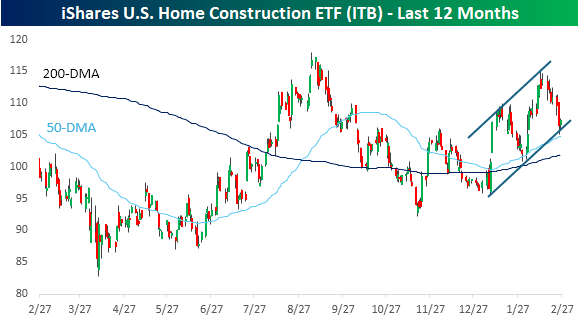
While homebuilder stocks had their worst day in over six months the day after the President’s SOTU speech, ITB remains in a steady uptrend and bounced yesterday right at the bottom of that trend channel. If rates remain below 4%, a move back to the high end of that range wouldn’t be an unreasonable expectation.
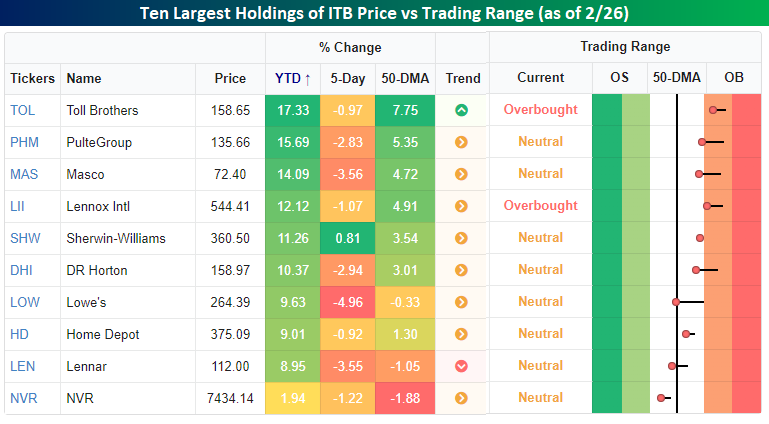
It’s been a good year all around for homebuilders and housing-related stocks. Of the ten largest holdings in ITB, all but one are up at least 8% YTD, even after this week’s declines. Pure-play homebuilders have led the ETF’s gains, with Toll Brothers (TOL) and PulteGroup (PHM) both rallying more than 15% YTD.
Feb 26, 2026
See what’s driving market performance around the world in today’s Morning Lineup. Bespoke’s Morning Lineup is the best way to start your trading day. Read it now by starting a two-week trial to Bespoke Premium. CLICK HERE to learn more and start your trial.
“Bang! Zoom! To the moon, Alice!” – Jackie Gleason
Below is a snippet of commentary from today’s Morning Lineup. Start a two-week trial to Bespoke Premium to view the full report.
Equity futures have moved fractionally into positive territory off their overnight lows as shares of Nvidia (NVDA) turned positive with a gain of nearly 1%. The 10-year yield is down 1 bps to 4.04% while crude oil trades down 2% to $64 per barrel. Gold prices are also down by about 0.5%, while silver plunges nearly 5% and Bitcoin drops over 1% to just over $68K.
Asia was mostly positive overnight. The Nikkei finished higher by a modest 0.3%, and Hong Kong declined more than 1%. South Korean stocks, however, continued to surge as the KOSPI rallied 3.7%, taking its YTD gain to 49.7%! Nearly 50%! Japanese PM Takaichi nominated two dovish candidates for roles within the BoJ, and the yen is weakening as markets now price the odds of a rate hike in April down to just 50%. This comes even as Leading Indicators in Japan came in better than expected.
European stocks are positive again this morning, with the STOXX 600 up 0.2%, with France’s 0.9% gain leading the way higher. February Business and Consumer Confidence unexpectedly declined, although Confidence in Italy bounced.
In the US this morning, the only reports on the calendar are Jobless Claims at 8:30, followed by the KC Fed Manufacturing report at 11. At 10 AM Eastern, Fed Governor Bowman will also testify in front of a Senate panel.
Jackie Gleason, best known as the hot-tempered bus driver Ralph Kramden from the 1950s sitcom The Honeymooners, would have turned 110 years old today. Ralph’s most iconic line from the show was “To the moon, Alice”, and that’s the way things seem to be going for semiconductor stocks. While Nvidia’s (NVDA) stock price, despite surging profits and revenues, has been rangebound for months now, the Philadelphia Semiconductor Index (SOX) hit another record high yesterday, taking its YTD gain to just under 20%.
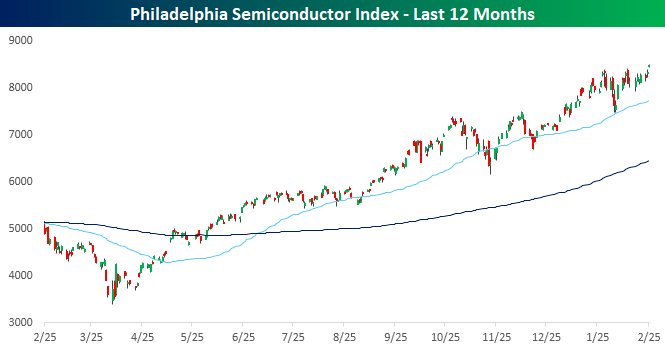
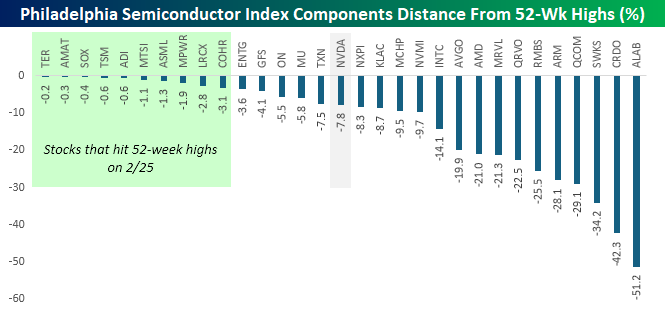
Along with the index itself, breadth in the sector has also been strong. Yesterday alone, nine of the index’s 30 components hit 52-week highs, even as NVDA closed nearly 8% below its respective high.
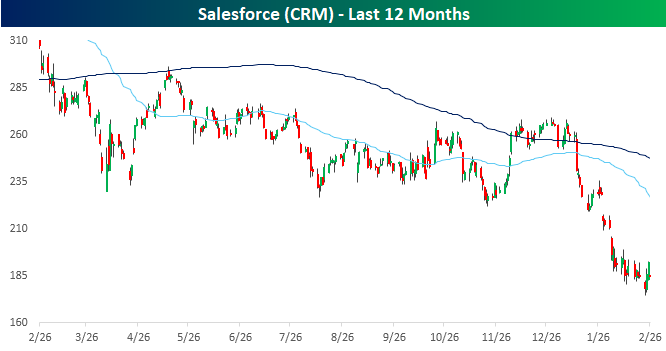
While semis have been strong, software stocks continue to try digging out from the AI-pocalypse. The latest setback for the sector was earnings from Salesforce (CRM) last night. CRM exceeded EPS forecasts on inline revenues. Guidance was mixed with the company raising Q1 EPS forecasts while keeping full-year forecasts in line with expectations. Despite a somewhat positive report at the surface, CRM is down more than 2% in the pre-market.
As software stocks have been cratering in recent weeks, investors have been asking where company managements are with respect to purchasing their stocks. If the declines were a major overreaction, as CRM CEO Benioff and others say, shouldn’t they be buying back stock hand over fist?
CRM addressed that last night when the company announced a $50 bln buyback. CRM’s market cap is $180 billion, so $50 billion represents more than a quarter of the company’s entire market cap. Ideally, investors would like to see company executives putting their own actual money where their mouths are, but a $50 billion stock buyback is a step in the right direction.
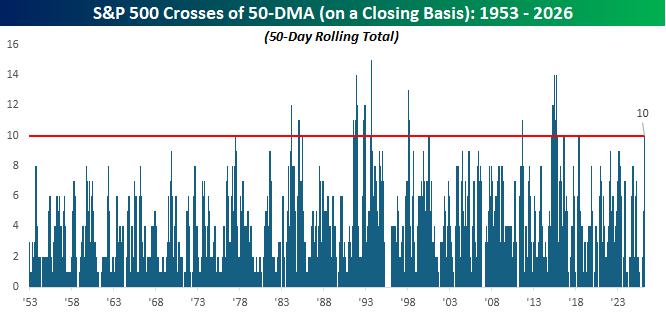
Semis and software are two of the market’s largest sectors, and each one moving in the opposite direction has contributed to the ping pong action at the overall index level. As we noted on X yesterday, the S&P 500 has now crossed its 50-day moving average on a closing basis ten times in the last 50 trading days. That’s the longest streak since March 2018 and one of only a handful of periods with that many crosses in such a short period of time. As we’ve all said to someone close to us multiple times, make up your mind already!