Oct 10, 2025
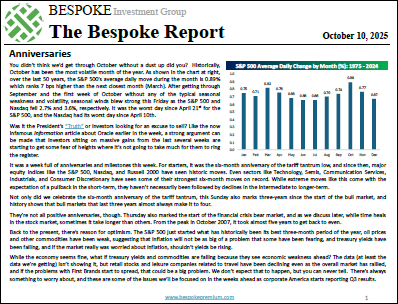
To read our weekly Bespoke Report newsletter and access everything else Bespoke’s research platform offers, start a two-week trial to Bespoke Premium. October is living up to its reputation as the most volatile month of the year! After a quiet start, markets saw a sharp drop, with the S&P 500 and Nasdaq experiencing their worst day in months. Is this a healthy pullback after historic gains, or a sign of something more? This week’s Bespoke report explored these questions and more. Give it a read!
Oct 10, 2025
See what’s driving market performance around the world in today’s Morning Lineup. Bespoke’s Morning Lineup is the best way to start your trading day. Read it now by starting a two-week trial to Bespoke Premium. CLICK HERE to learn more and start your trial.
“If you want a happy ending, that depends, of course, on where you stop your story.” – Orson Welles

Below is a snippet of commentary from today’s Morning Lineup. Start a two-week trial to Bespoke Premium to view the full report.
US equity futures are modestly positive this morning following comments from potential Fed chair-in-waiting Christopher Waller, who said he expects the Fed to cut rates further this year, but at a ‘careful’ pace. Long-term treasury yields are notably lower as the 10-year yield trades down nearly 5 basis points to 4.10%. After dropping below $4,000 per ounce yesterday, gold is up nearly 1%, trading at $4,010. Crude oil prices are down over 1% on the prospects of peace in the Middle East, and crypto trades modestly higher at just about $121K.
With the government still shut down, the only economic data on the calendar is the University of Michigan Sentiment report, and Chicago Fed President Goolsbee will speak at a bank conference shortly after the open. Speaking of economic data, the BLS has recalled furloughed staff this morning to ensure that the September CPI report gets released by the end of the month.
Asian markets were weak overnight, with the notable exception of South Korea, which rallied 1.7%. Japan, Hong Kong, and China, however, were all down 1% or more. Japanese PPI increased 0.3% m/m, triple the rate of consensus expectations, solidified market expectations for another rate hike this year. Despite Friday’s decline, the Nikkei finished the week 5.1% higher while Hong Kong traded down 3.1% and China was up fractionally.
In Europe, equity markets have been much tamer this morning. The STOXX 600 is little changed, and no major country’s benchmark index is up or down more than 0.3%, and most are on pace to finish the week with modest gains or losses.
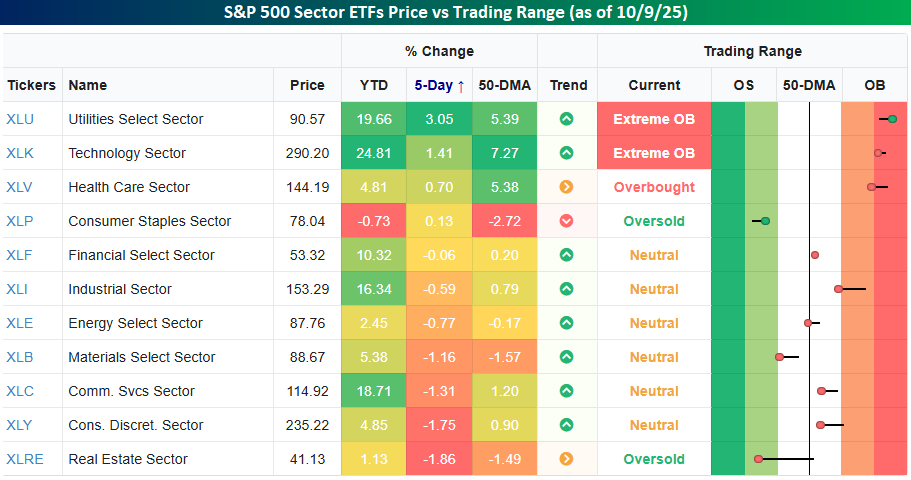
The last five trading days have been full of divergence at the sector level. The S&P 500 is fractionally higher, but seven out of eleven sectors have traded lower, including four sectors – Real Estate, Consumer Discretionary, Communication Services, and Materials – that are down over 1%. The only two sectors with gains of more than 1% are the formerly strange bedfellows of Utilities (3.05%) and Technology (1.4%). Both these sectors are also the only two trading at Extreme Overbought levels.
It wasn’t long ago that Utilities was considered the most defensive sector in the market, while Technology was considered the most risky sector. Like everything else now, it seems, AI has upended prior norms, although given the power-intensive nature of AI-related applications, the moves make sense.
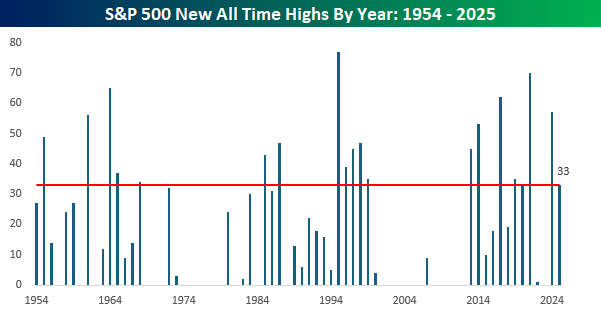
Yesterday was a down day for the S&P 500, but in the seven trading days this month, there have already been five record closes, taking the YTD total to 33. If the year were to end today, 33 record highs in a year isn’t particularly noteworthy as it ranks tied for the 19th most since 1954.
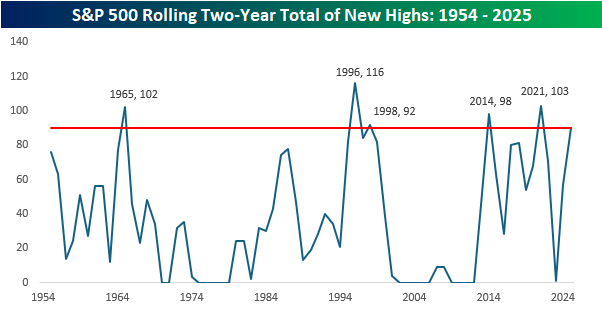
What’s been more impressive is that the 33 record closes followed last year’s total of 57. With 90 record closing highs in the last two calendar years, there have only been five other two-year stretches when the S&P 500 had more record closing highs, and not to jinx anything, but there’s a legitimate chance that by the end of the year, the last two years could end up ranking well into the top five.
Oct 9, 2025
See what’s driving market performance around the world in today’s Morning Lineup. Bespoke’s Morning Lineup is the best way to start your trading day. Read it now by starting a two-week trial to Bespoke Premium. CLICK HERE to learn more and start your trial.
“Reality leaves a lot to the imagination.” – John Lennon
Below is a snippet of commentary from today’s Morning Lineup. Start a two-week trial to Bespoke Premium to view the full report.
Futures are flat with a negative bias this morning as the relentless rally in gold takes a pause, and oil prices see a marginal pullback. Stocks in Asia were higher overnight as China reopened for trading, and shares of Softbank surged more than 10% after announcing a deal to acquire the robotics units of ABB for $5.4 billion. In Europe, trading has been listless with the STOXX 600 down 0.04%.
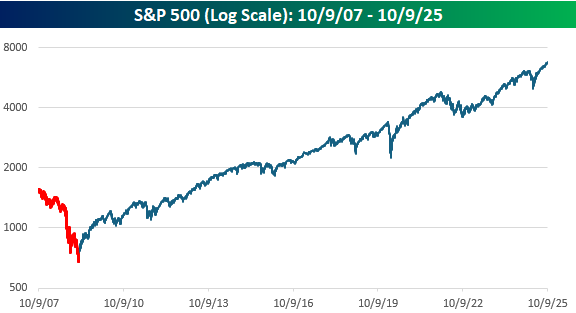
The S&P 500 closed at another all-time high yesterday, just like it did 18 years ago today on 10/9/07. That new high in 2007 followed a late-summer peak-to-trough correction of nearly 12%. It was a time of stress in the financial system as the subprime housing market was in the process of imploding, but the Fed was cutting rates, and the damage ‘appeared’ contained. From a technical perspective, the S&P 500 had traded above resistance to new highs, and the 50-DMA, which has been sloping downwards, turned higher just above its 200-DMA, which was also rising. The one caveat was that the breakout to new highs wasn’t especially convincing, as the S&P 500 had only made a marginal new high.
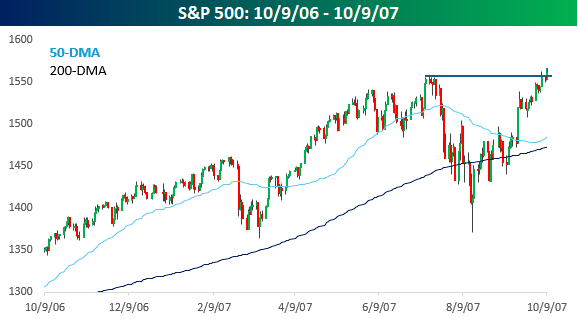
Investors breathed a sigh of relief on 10/9/07, but in the days that followed, the S&P 500 couldn’t follow through on its breakout, and within days, it was back below its summer 2007 highs. Shortly after that, the wheels came off, and the crash began. A year after the October 2007 high, the S&P 500 cratered more than 40%. As loud as the sighs of relief were in October 2007, they had nothing on VIX screamings towards 80 a year later as the entire banking system was on the verge of collapse.
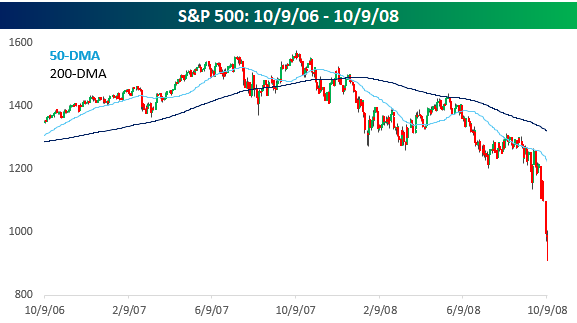
The experience of October 2007 should serve as a reminder that even in the best times, investors should always be prepared for the possibility that the light at the end of the tunnel is a freight train steaming right at us. It’s only fitting this morning that on the anniversary of the 2007 peak, JP Morgan (JPM) CEO Jamie Dimon is in the news, warning of a correction in the market at some point in the next six months to two years. At first glance, that statement seems like something you would hear coming from Captain Obvious. Of course, there will be a correction in the next six months to two years! Stock market corrections occur on average about once a year, so there may actually be two!
If you read more into Dimon’s comments, though, he’s talking more about a serious bear market than a 10% correction. Even still, six months to two years isn’t really a precise forecast. While Dimon’s comments may not be of much use to investors or traders looking for any direction on where the stock market is going, they are exactly the kind of comments you want to hear from the CEO of America’s largest bank. That’s why JP Morgan Chase is just about the only major bank where the name on the CEO’s door is the same now as it was then. Dimon has earned the right to worry!
As bad as the declines were following the October 2007 high, as we always say when it comes to the market, time heals. It took several years, but eventually the market went on to make new highs, and this morning, the S&P 500 will open more than four times higher than it was when it closed at that peak 18 years ago.
Oct 8, 2025
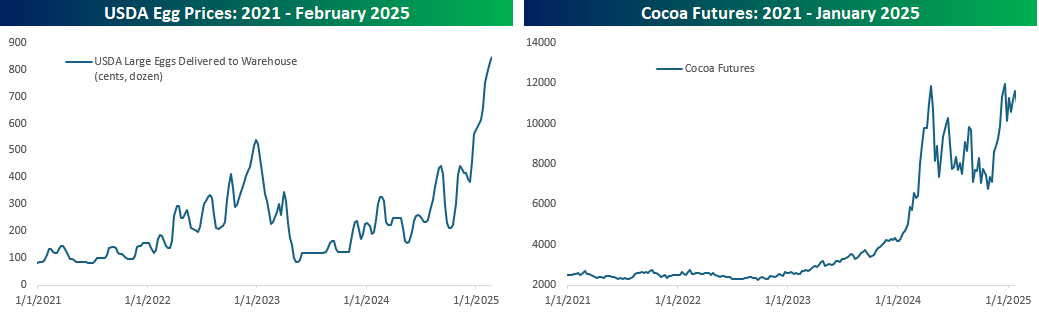
Remember earlier in the year when rising egg and chocolate prices threatened to cancel breakfast and Valentine’s Day? In the case of eggs, retailers, who could get their hands on them, even limited the number of eggs customers could purchase. Regarding chocolate, there were stories about manufacturers reducing the number of chocolate pieces or chips they included in their various products, like ice cream and cookies. The charts below illustrate the spikes in both commodities through their highs earlier in the year, and the media ran with it, extrapolating these events to warn of impending inflation spirals in the global food chain.
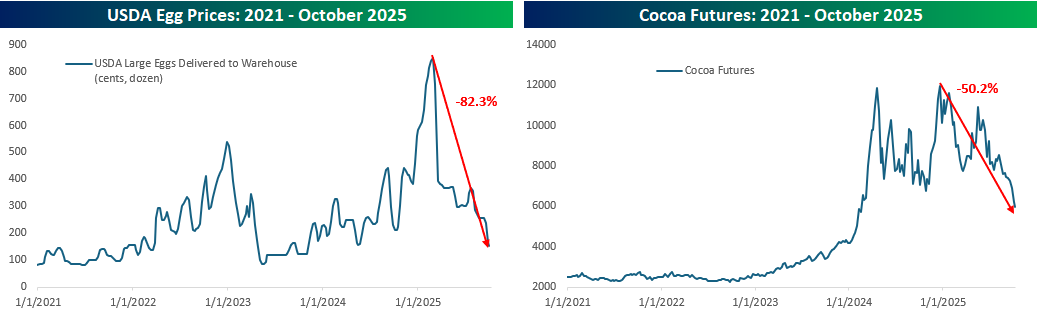
While the stories were all over business and even mainstream news earlier in the year, when was the last time you heard about egg or cocoa prices? Probably not recently, right? Have you wondered why? Maybe the updated charts below explain why. From their highs earlier in the year, egg prices have declined by 82% and cocoa prices are down by half. Given the frenzy over higher prices back then, why aren’t there as many warnings of a deflationary spiral in food prices now? When it comes to commodities, the cure for higher prices has always been higher prices.

Oct 8, 2025
See what’s driving market performance around the world in today’s Morning Lineup. Bespoke’s Morning Lineup is the best way to start your trading day. Read it now by starting a two-week trial to Bespoke Premium. CLICK HERE to learn more and start your trial.
“The harder life is for a man when he is young, the easier it will be in the future.” – Aleksandr I. Solzhenitsyn
Below is a snippet of commentary from today’s Morning Lineup. Start a two-week trial to Bespoke Premium to view the full report.
After across-the-board declines yesterday, futures are looking to regroup this morning as the S&P 500 and Nasdaq are both on pace to open higher by about 0.2%. Treasury yields are modestly higher, and gold went through 4,000 like a hot knife through butter. Along with the increase in gold, other precious metals are also up even more, with platinum spiking over 2% while Palladium is up 4.5%! Even crude oil is trading higher this morning as WTI gains 1.5% to $62.70 per barrel. Finally, after a rough day in the crypto space yesterday, Bitcoin is up 1% while Ethereum is marginally higher at just under $4,500.
In Asia, China remains closed, but Japan, Hong Kong, and India are all lower after Japan’s October Tankan Index declined relative to September. In Europe, the tone is much more positive with the STOXX 600 rallying 0.7% and broad-based strength across the continent. In Germany, Industrial Production declined 4.3% m/m in August versus forecasts for a drop of just 1.0%, so whatever you think about growth in the US, Europe isn’t doing much better.
Sometimes the market moves just because investors are looking for an excuse to buy or sell. Yesterday could have been a case of the latter. The S&P 500 headed into yesterday with seven days in a row of gains, while the Nasdaq traded higher in six of the prior seven days, but those streaks didn’t even begin to illustrate how hot some sectors of the market have become, and you can’t fault investors for getting a little nervous. In fact, it’s very encouraging! Just as the quote above says, a little pain is good for the soul.
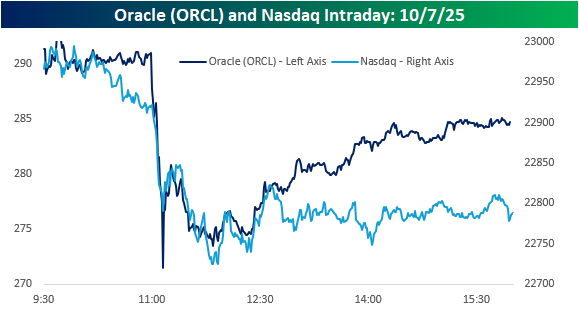
With investors already nervous, a report from The Information suggesting that margins in Oracle’s (ORCL) cloud business were thinner than expected was just the excuse they needed to take some profits. The report suggested that gross margins on the $900 million in revenue that the company generated from its Nvidia (NVDA) cloud business were just 14%, which is less than a quarter of the company’s overall gross margin of 70%.
Within minutes of the story being published, ORCL shares plunged 7% and the Nasdaq traded down over 1%. As shown in the chart below, while the magnitude of their respective moves after the report was published were different, the patterns were basically identical. Within 90 minutes, though, shares of ORCL started to rebound as “sources familiar with the situation” said The Information article was off base. By the end of the day, shares had erased more than half of their initial decline, finishing the day down 2.5%. The Nasdaq, however, didn’t bounce. While the declines didn’t intensify in the afternoon, the index finished right near where it traded after the initial release of the ORCL story.
There are multiple ways to read the divergence between ORCL and the Nasdaq intraday yesterday, and they could all be wrong. But one way to look at it is that investors looking for an excuse to take profits got just what they needed with the ORCL story, and once they rang the register, they were in no hurry to get back in. As the saying goes, “Nobody ever lost money taking a profit.”