Oct 21, 2025
See what’s driving market performance around the world in today’s Morning Lineup. Bespoke’s Morning Lineup is the best way to start your trading day. Read it now by starting a two-week trial to Bespoke Premium. CLICK HERE to learn more and start your trial.
“In hindsight, I slid into arrogance based upon past success.” – Reed Hastings

Below is a snippet of commentary from today’s Morning Lineup. Start a two-week trial to Bespoke Premium to view the full report.
After a strong start to the week yesterday, US stocks are starting Tuesday on a modestly negative note with S&P 500 and Nasdaq futures both down less than 0.10%. The pace of earnings reports is finally starting to pick up, and what has been a strong reporting period so far in terms of results has remained that way this morning. As we type this, of the 14 companies reporting so far this morning, they have all exceeded EPS forecasts, and only one (NOC) missed top-line estimates. You can’t ask for much better than that!
With futures modestly lower, there’s still a lot of time left, but it’s pretty amazing to see that the S&P 500 still hasn’t traded outside of its intraday range from 10/10, which would make it seven straight days of trading inside a prior day’s range. Already, the current period ranks as just the 12th time in the last 40 years, and if the streak extends to seven, it would be just one of eight. For more on the topic, check out today’s Chart of the Day.
Outside of equities this morning, the 10-year yield is still below 4%, crude oil and natural gas are both up 1%, but precious metals are all uncharacteristically getting hit hard. Gold is down over 2%, while silver, platinum, and palladium are all down over 4%. Crypto prices also remain weak as Bitcoin trades back down below $110K and Ethereum is firmly below $4K with a decline of over 2.5%. Neither has been able to get back on track in the last couple of weeks.
Japanese stocks finished off their intraday highs overnight, but, along with other major indices in the region, finished higher on the session. Sanae Takaichi was officially elected PM, but there was a bit of sell-the-news reaction; Chinese stocks were the strongest in the region, finishing up more than 1% on optimism over US trade talks.
Europe is much like Asia this morning, with modest gains across the board. The STOXX 600 is up 0.1%, with Italy leading things higher, rallying by 1%.
Netflix (NFLX) will report earnings after the close today, which reminded us of an earnings report from the company in July 2011, when then CEO Reed Hastings announced that the company would be splitting off its DVD business from streaming, raising prices in the process. For consumers who wanted to continue with both services, the changes resulted in a 60% price hike from $10.00 to $15.98 per month. News of the price hikes and launch of the Qwikster DVD service were received poorly by the company’s customers and investors alike.
Right before the plan was announced, NFLX was trading at record highs, having just rallied 180% in the prior year. Within months, though, it gave up all of those gains, falling more than 70%. While there were other macro-related factors behind that drop, NFLX’s poorly communicated pricing plans and new strategy contributed to the weakness.
Following that decline in the wake of the Qwikster announcement, Hastings issued a public apology regarding how the changes were communicated, which included the quote above. Another month after his apology, Netflix reversed plans to separate the units (but kept the price hikes), relegating Qwikster to the waste bin of other disastrous product launches like New Coke, and more recently, the Cracker Barrel restaurant rebrand. Also, how can we ever forget the Apple Newton, rocking out with the Microsoft Zune, snacking on Olestra-infused WOW! Potato chips, and then the McDonald’s Arch Deluxe for dinner? The story of Qwikster and its demise before ever even launching serves as a reminder that the how of a message’s delivery can take on just as much importance as the message itself. It’s also a lesson that people and companies often become most vulnerable after a long string of successes, just as the feeling of invincibility starts to set in.
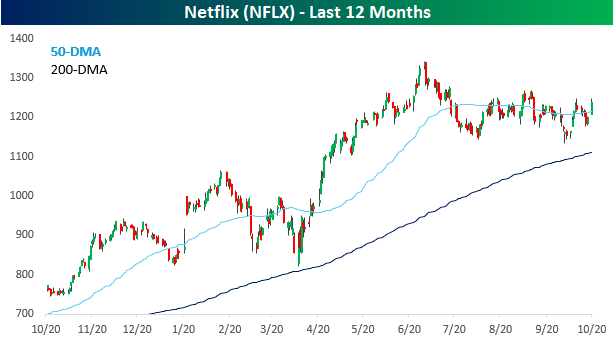
Hopefully, Netflix has no Qwiksters up its sleeve for today’s earnings report. Even after rallying 3% yesterday, the stock heads into the report short on momentum. While up over 60% in the last year and 25% in six months, the stock is down about 8% from its highs in the summer, forming a trend of lower highs. Looking on the bright side, the lack of a meaningful rally leading up to today’s report means that expectations likely aren’t too high.
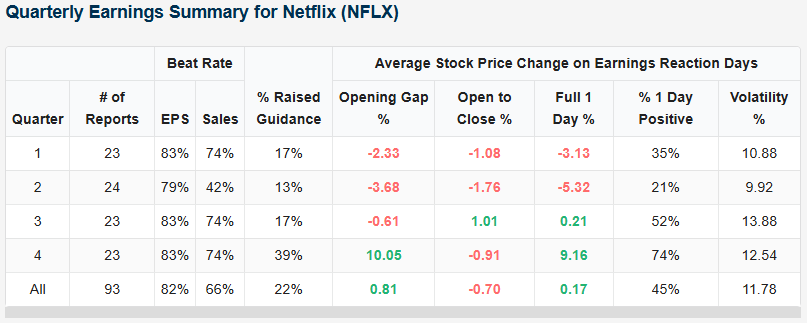
Looking at prior earnings reports from our Earnings Explorer, NFLX also has history slightly on its side. Over the last 23 years, its Q3 report has been the second-best of the four quarters in terms of stock price reaction. As shown in the table below, like Q4, NFLX has exceeded EPS forecasts 83% of the time in Q3 and topped sales forecasts 74% of the time. On its earnings reaction day, the stock averaged a gain of 0.21% with gains 52% of the time. That’s peanuts compared to the average gain of 9.2% following Q4 reports, but it beats the sharp declines that tend to follow Q1 and Q2 reports.
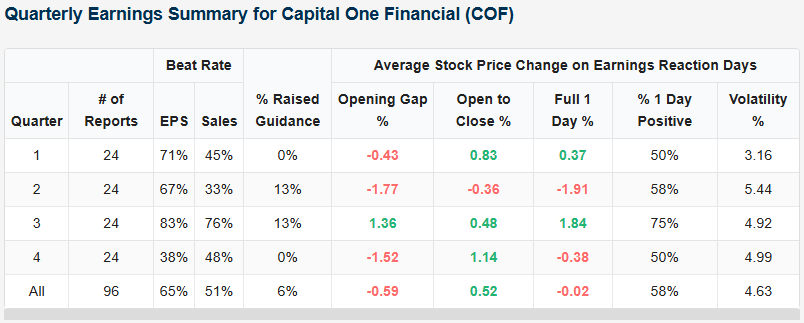
While NFLX will get most of the investor attention after the close today, another stock with a strong track record heading its report today is Capital One Financial (COF). Given its business, it will also give us a good read on the health of the consumer.
As shown in the snapshot below, COF has exceeded EPS and sales forecasts more in Q3 than in any other quarter. As a result, its average earnings reaction day performance has been a gain of 1.84% with positive returns 75% of the time. That’s also better than any other quarter.
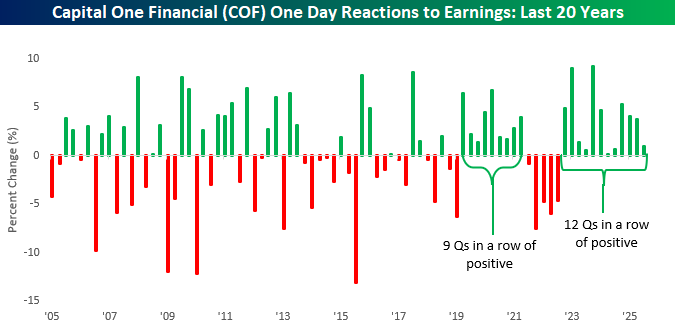
Even more notable for COF is that the company has reacted positively to earnings for an incredible 12 straight quarters! Looking at COF’s one-day reactions to earnings over the last 20 years shows an interesting pattern. Whereas there was no streaky trend in terms of stock price reactions from 2005 through 2019, since then, it has been the opposite. COF has gone nine straight quarters with positive one-day reactions, then five straight quarters with negative reactions, followed by 12 quarters in a row of positive reactions. Talk about streaky!
Oct 20, 2025
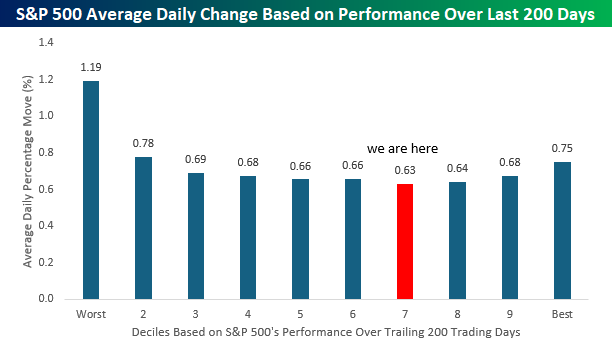
When it comes to the stock market, investors quickly learn of the inverse relationship between performance and volatility. When prices rise, the VIX usually declines, and when the VIX surges as it did back in April, or any other market emergency, stocks crater. The chart below illustrates that relationship. In it, we grouped every 200-trading day window of the S&P 500 since 1975 into deciles based on the index’s performance during those periods. The weakest periods were grouped into decile one while the best 200-day periods went into decile ten. For each of those periods, we then calculated the S&P 500’s average absolute daily move.
The S&P 500’s average absolute daily move during its worst 200-day trading periods was 1.19%, and just experiencing the weakness of April, that makes perfect sense. More interestingly, outside of decile one, the average daily move immediately plummets to 0.78% in decile two, and from there, it remains at or around that level (at least relative to the 1.19% level from decile one) for every decile out to ten. For the current environment, we’re currently in decile seven where the average daily move is lower than any other decile.
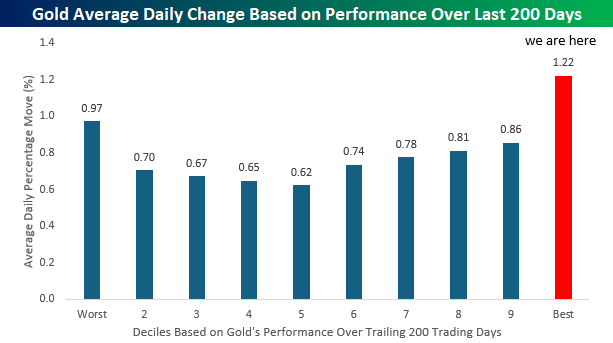
While there’s an inverse relationship between the S&P 500’s performance and volatility, for gold, it’s nearly the opposite. The chart below shows the same analysis for gold. While gold has also historically been volatile during periods when its performance has been the weakest, the strongest returns have historically come during periods when its trailing 200-day performance has been the strongest. During the strongest 200-day periods for gold since 1975, its average daily move has been +/-1.22%, or 25 basis points more than any other decile. Maybe not what you would expect, but for gold to be an uncorrelated asset, when stocks go crazy in one direction, it should go crazy in the opposite way. What makes the current period interesting is that while the S&P 500 falls into decile seven in terms of its trailing 200-day performance, gold’s performance over the last 200 trading days ranks among the best on record since 1975. In other words, they’ve actually been correlated assets so far this year!

Oct 20, 2025
See what’s driving market performance around the world in today’s Morning Lineup. Bespoke’s Morning Lineup is the best way to start your trading day. Read it now by starting a two-week trial to Bespoke Premium. CLICK HERE to learn more and start your trial.
“It’s unbelievable how much you don’t know about the game you’ve been playing all your life.” – Mickey Mantle
Below is a snippet of commentary from today’s Morning Lineup. Start a two-week trial to Bespoke Premium to view the full report.
The government remains shut down this morning as the stalemate between the two parties nears the start of its fourth week. As has been the case nearly the entire time, though, the markets seem indifferent as the S&P 500 will open today pretty much right where it was when the shutdown started. Interest rates are little changed this morning as the 10-year yield remains right at 4%. Crude oil is trading about 1% lower, right at $57 per barrel, and as has been the case for seemingly every day, gold prices are 1.5% higher, but still over 2% off record highs after Friday’s sharp reversal lower. Along with higher gold prices, crypto is also strong this morning with Bitcoin back above $110K and Ethereum back above $4,000. There’s not much economic data due to the shutdown, but the pace of earnings this week will really fill the void.
In Asia overnight, Japan surged more than 3% to new record highs after the LDP and Innovation Party agreed to form a coalition government, paving the way for Takaichi to become Prime Minister effective tomorrow. Elsewhere in the region, Chinese GDP rose more than expected, while Unemployment in Hong Kong rose more than expected.
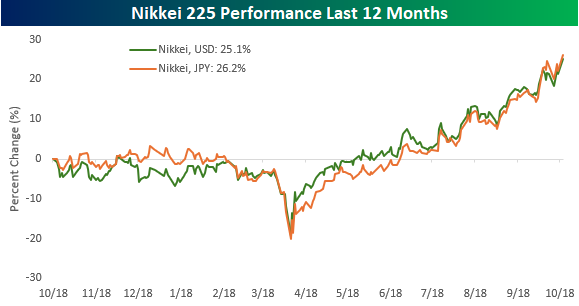
Japan’s rally overnight pushed the index’s ‘marathon’ gain over the last 12 months to 26.2% in local currency terms, and interestingly enough, for all the fluctuations in global currencies this year, the dollar and yen haven’t moved much relative to each other, so on a dollar-adjusted basis, the Nikkei is up slightly less at 25.1%.
European markets aren’t as strong as Asia this morning, but they have a positive bias nonetheless. The STOXX 600 is up 0.6% to start the week. The CAC-40 is the only major benchmark not in the green as S&P lowered the country’s credit rating and an adverse legal ruling against BNP Paribas has that stock trading down over 5%.
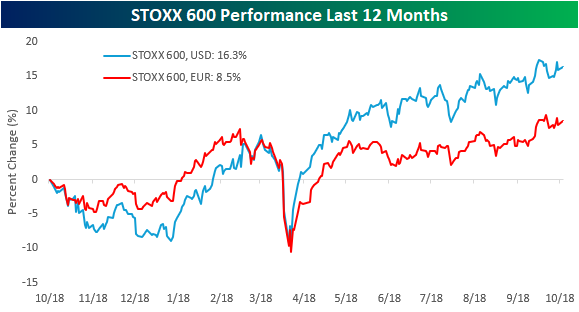
Not only is Europe up less than Japan in early trading today, but the STOXX 600 is also lagging over the last year. As shown in the chart below, on a local-currency basis, Europe’s benchmark index is up a relatively modest 8.5% and trading just shy of new highs. After accounting for the weakness in the dollar this year relative to the dollar, though, it’s up nearly twice that at 16.3%. Depending on which side of the Atlantic you’re on, the performance of European stocks looks a lot different.
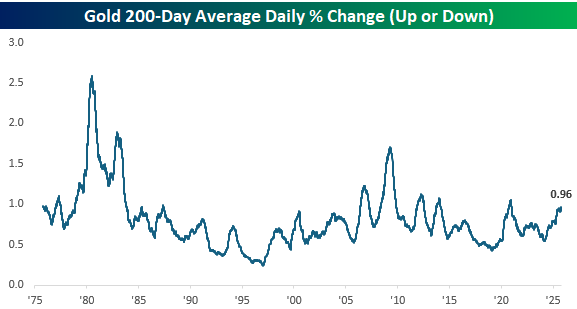
The weakness in the dollar against currencies like the euro has helped to drive the rally in gold, but in addition to being so strong lately, gold has also been volatile. Over the last 200 trading days, gold’s average daily move has been just under 1% which is the most volatility over a trailing 200-day period since Covid, but nowhere near historical extremes like we saw in the 1980s.
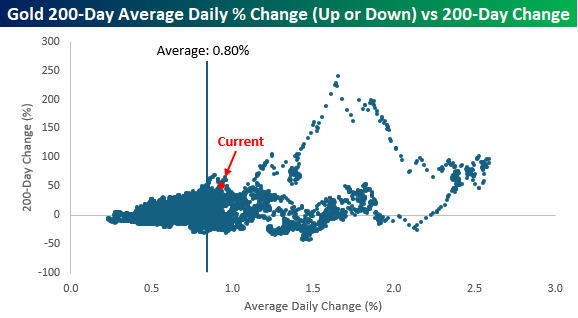
In the equity markets, volatility and large daily moves tend to occur during periods of market weakness, but for gold, that hasn’t necessarily been the case. In periods when gold has rallied 30%+ in 200 days, its average daily change was 1.27% whereas in all other periods, its average daily change was much less at just 0.76%.
Oct 16, 2025
See what’s driving market performance around the world in today’s Morning Lineup. Bespoke’s Morning Lineup is the best way to start your trading day. Read it now by starting a two-week trial to Bespoke Premium. CLICK HERE to learn more and start your trial.
“‘That didn’t work’ is cool, but ‘that won’t work’ is not a way to go through life.” – John Mayer
Below is a snippet of commentary from today’s Morning Lineup. Start a two-week trial to Bespoke Premium to view the full report.
A triple play from Taiwan Semiconductor (TSM)—beating on earnings, revenue, and guidance—is lifting US equity futures, with technology stocks at the forefront. This rally is notably happening despite the President stating yesterday after the close that, “We are in one now,” in reference to a trade war with China. There are also signs that China’s aggressive stance on rare earth exports could be backfiring, as it has started to cause a more unified front between the US and other international partners.
Today was supposed to be a busy one for economic data, but the government shutdown put the kibosh on that, and the only report released was the Philly Fed Manufacturing report, which came in weaker than expected. The pace of earnings, however, remains active, and once again this morning, we’re seeing generally strong results.
Outside of equities, crude oil is fractionally higher but still well below $59 per barrel, the 10-year yield is trying to hang on to 4%, gold and other precious metals are rallying (what else is new), and crypto is also rallying after what has been a rough week for the sector.
It’s been a somewhat rocky week for US equities, although by the standards of October, it’s hard to get too worked up. After trading at an all-time high intraday last Thursday, the S&P 500 closed modestly lower on the day. That modest decline was followed on Friday by a sharp 2.7% decline in the S&P 500 as trade issues with China and concerns over corporate credit in the auto sector nudged investors to take some risk off the table. This week started on a positive note as the S&P 500 erased half of the losses from last Thursday and Friday, but intraday trading has been more volatile, and there’s been more of a tendency to sell rips than buy dips.
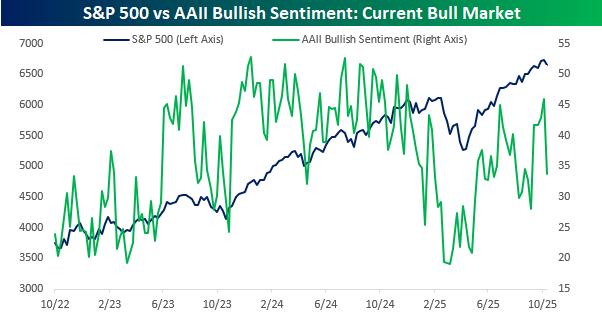
The skittishness showed up in investor sentiment this week as the weekly American Association of Individual Investors (AAII) survey showed that bullish sentiment dropped from 45.9% to 33.7% for the lowest reading in a month. The decline in bullish sentiment comes even as the S&P 500 closed within 2% of a record high yesterday. While bullish sentiment was routinely near 50% throughout 2024 as the market rallied, in the bounce off the April lows, investors have been much less willing to hop on the bandwagon.
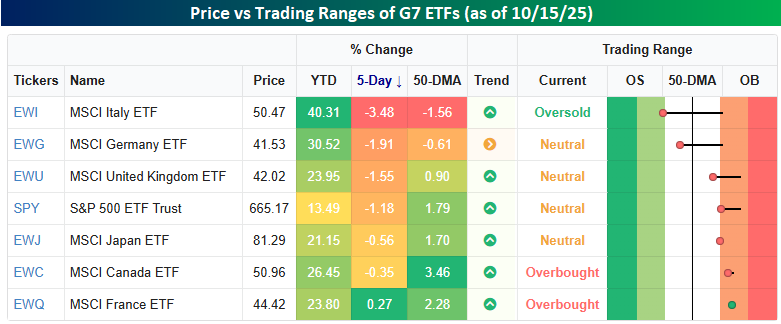
Along with the modest weakness in US stocks over the past five trading sessions, global equities have also been under pressure. Of the US-traded ETFs tracking the stock markets of the seven G7 countries, all but France (EWQ) traded lower in the five trading days ended yesterday, and the US was stuck right in the middle with a decline of 1.2%. The biggest laggards have been Italy (EWI) and Germany (EWG) as their the only two below their 50-DMAs. Markets have certainly been on a tear this year as six of the seven ETFs listed have rallied at least 20% this year, but in the short run, they’ve mostly worked off their overbought conditions as France is the only country still in extended territory.