Feb 5, 2026
The Deepseek sell-off late last January, followed by the tariff tantrum in early April, caused US stocks to plummet. From peak to trough, the S&P 500 fell 19% on a closing basis, just shy of bear market territory, while the Tech-heavy Nasdaq 100 fell 23%.
Once the Trump administration reined in its horns on tariffs, the market flew higher. The six months following the tariff-tantrum low on April 8th was one of the strongest six-month moves in the market’s history (+35%), but equities have basically been flat since that six-month move that ended last October.
The average stock in the Russell 1,000 is still up roughly 37% since the April 8th tariff-tantrum low, but performance across industry groups has been eye-opening.
As shown below, after the sell-off we’ve seen in software names recently due to the perceived threat from AI, the average stock in the Software & Services group is now down since the April 8th low! The average Household & Personal Products stock is also down since then, but these stocks have actually been flying in the last couple of weeks as software sells off.
Amazingly, while software is in the red since Trump’s tariff turmoil, the two groups where stocks are up the most are in the hardware space. Tech Hardware & Equipment stocks are still up an average of 167% since 4/8/25, while Semis are up 125%. That’s basically double the next best group — Capital Goods (+65%).
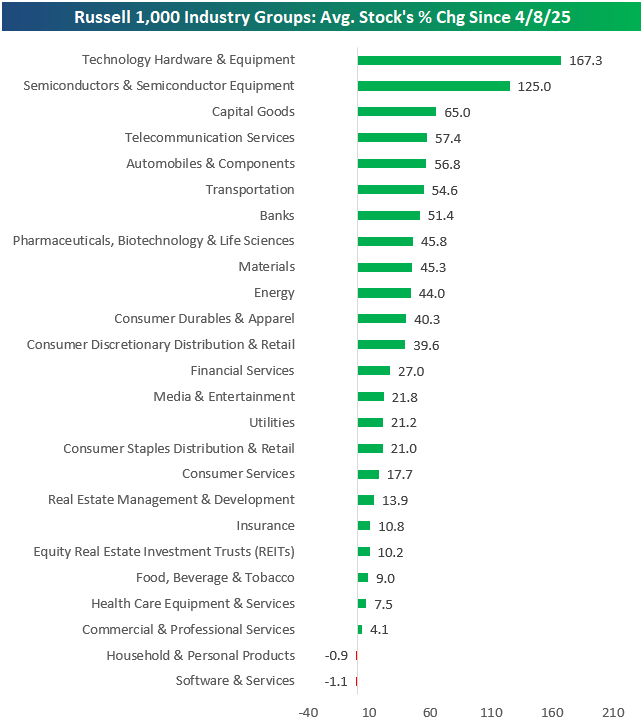
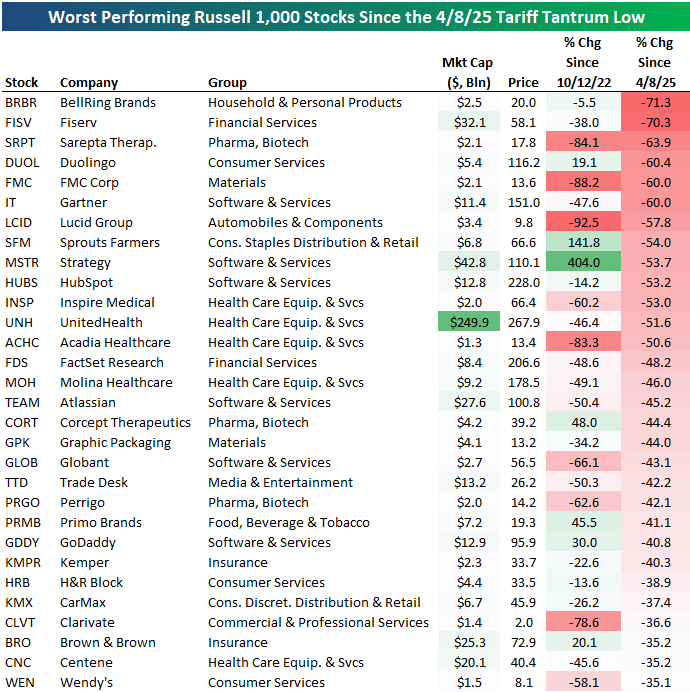
About 23% of Russell 1,000 stocks are lower today than they were at the close on 4/8/25.
Below are the 30 stocks in the index that are down the most:

Feb 3, 2026
Software stocks are getting slammed once again today as there appears to be no floor in the current thinking that AI will crush the software-as-a-service (SaaS) space.
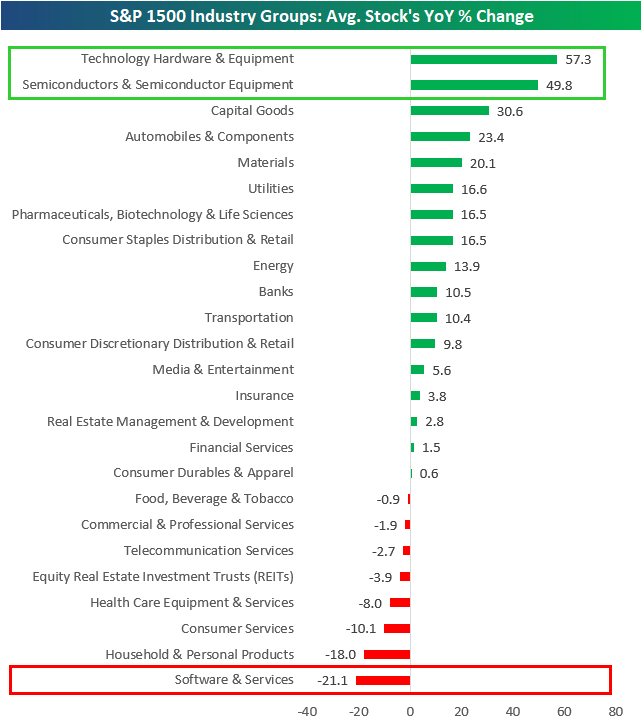
The dichotomy in Tech hardware versus Tech software over the last year has been amazing to watch. As shown below, the average Tech Hardware stock in the S&P 1500 is up 57.3% over the last year, while Semis are up roughly 50%. These two have easily been the best performing groups in the market since last February.
On the other side of the Tech sector sits the Software and Services group, where the average stock is down more than 20% over the last year. Software has now been the worst performing group in the market over this period.
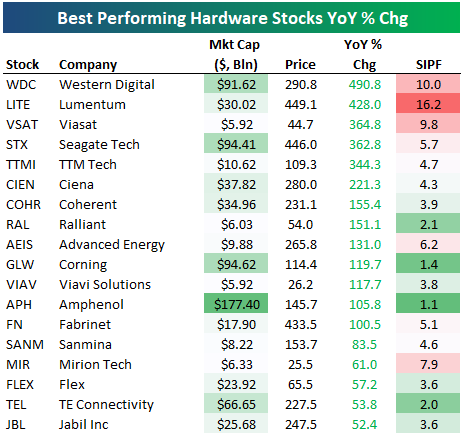
Below is a table showing the best performing stocks in the Tech Hardware group over the last year, where all the names listed are up more than 50% YoY; 13 are up more than 100%.
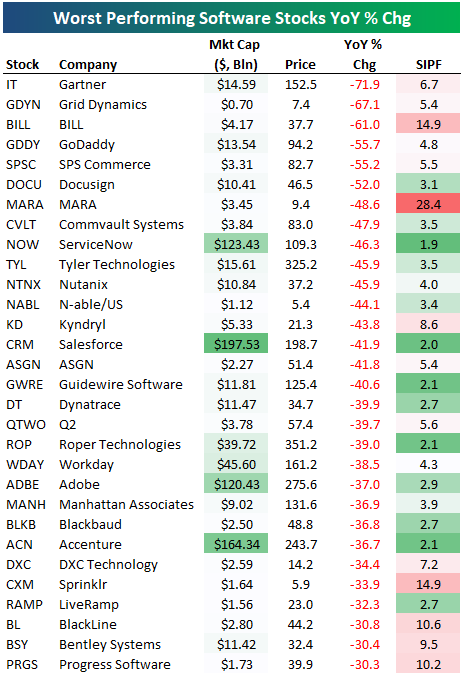
Conversely, there are thirty stocks in the Software group down more than 30% over the last year, and six are down more than 50%.
It’s ugly out there in software land, and it’s starting to bleed over into the rest of the market as the Nasdaq 100 (QQQ) hasn’t been able to make a new high in over three months.
Feb 3, 2026
While digital-retail company (and many other things) Amazon (AMZN) crossed the $1+ trillion mark a few years ago, it took until today for its biggest “physical” competitor — Walmart (WMT) — to do the same.
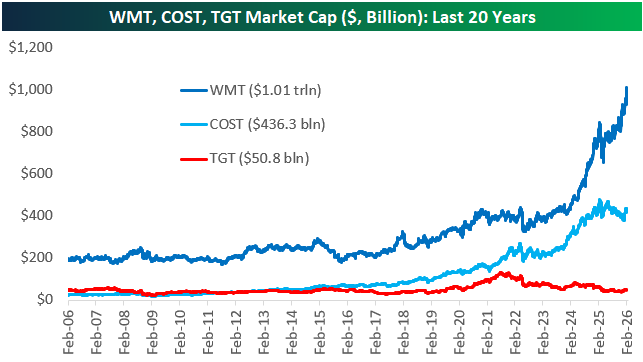
Walmart (WMT) has had an amazing run so far during the 2020s, with its market cap rising from a little more than $300 billion in early 2020 to more than $1 trillion today.
Costco (COST) has seen huge gains during the 2020s as well, while another major player in the big box retail space — Target (TGT) — has gone in the opposite direction lately.
Twenty years ago in early 2006, Walmart had a market cap of $189 billion versus $48.3 billion for Target.
Target’s current market cap of $50.8 billion is just $2.5 billion more than it was twenty years ago, while WMT’s market cap is up 433% to more than $1 trillion.
While WMT was just 3.9x bigger than TGT twenty years ago, it’s nearly 20x as big today.
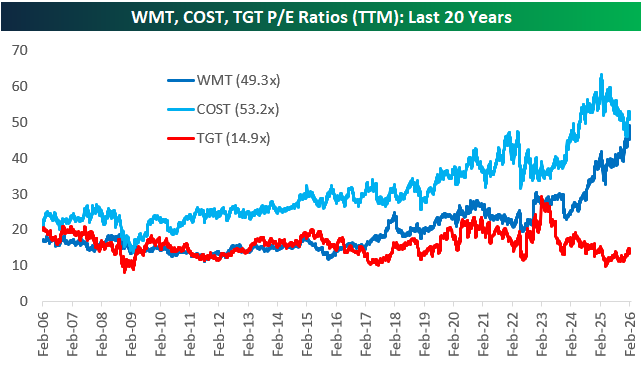
Walmart’s run has been accompanied by EPS and revenue growth, but share price has definitely risen a lot more, causing multiple expansion.
As a trillion dollar company, Walmart also now trades at 49.3 times its trailing 12-month EPS. That sounds more like a high-growth Tech stock multiple rather than a big-box Consumer Staples stock.
Target (TGT), in the meantime, has seen its P/E multiple fall down to just 14.9x, while COST’s P/E of 53.2x is even higher than WMT’s.