
US Dollar Index Testing Resistance
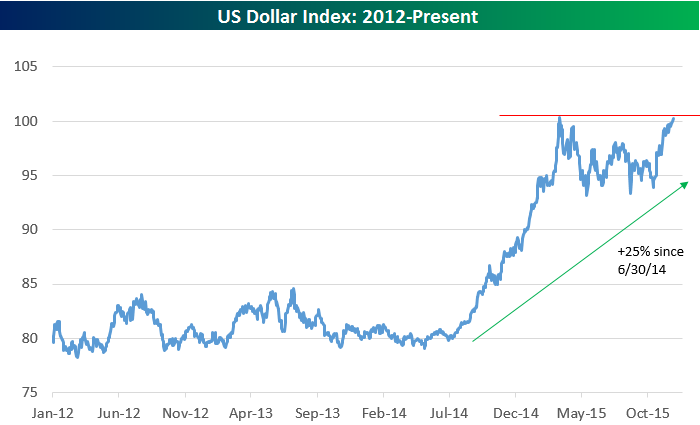
After surging 25% from last July through this March, the US Dollar index went through a “correction” phase in the second and third quarters of 2015. Since the middle of October, though, the dollar has been on fire. In case you weren’t aware of the recent strength, take a look at the chart of the Dollar index below. Since dipping below 94 on October 14th, the index has surged 6.4% and is attempting to take out its highs from earlier this year. On Friday, the index closed above the psychological 100 level. It is still holding that level and needs just a few more ticks to break out. Don’t expect it to be easy, though, because the prior highs could act as stiff near-term resistance.
Movements in the US Dollar can have a big impact on earnings. Companies with a high percentage of international revenues get hurt by a strong dollar, while companies that generate all of their revenues domestically benefit from it. Given the surge in the dollar that we’ve seen over the last six weeks, we’d expect to hear about its impact (mostly negatively from the big internationals) when fourth quarter earnings reports get released in January.
If you’re looking for the geographic revenue breakdown (international vs. domestic) of stocks you own, Bespoke provides this unique info in our International Revenues Database (available to Bespoke Premium and Bespoke Institutional subscribers only). If you’re not yet a subscriber, start a free trial to use our International Revenues Database today.
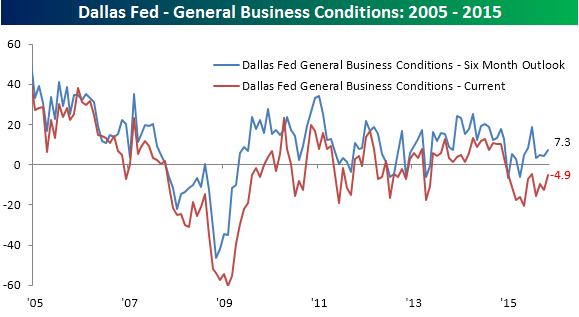
Dallas Fed Gets Less Worse
Today’s Dallas Fed report on the manufacturing sector in the Texas area showed that activity for the sector contracted for the eleventh straight month, which is the longest such streak since the last recession. While the report was negative, it still managed to improve versus October’s level and exceed consensus expectations. While economists were looking for the headline index to come in at the same level as October (-12.7), the actual reading came in at -4.9. Regarding the outlook for six months from now, the headline index increased from 4.1 up to 7.3.
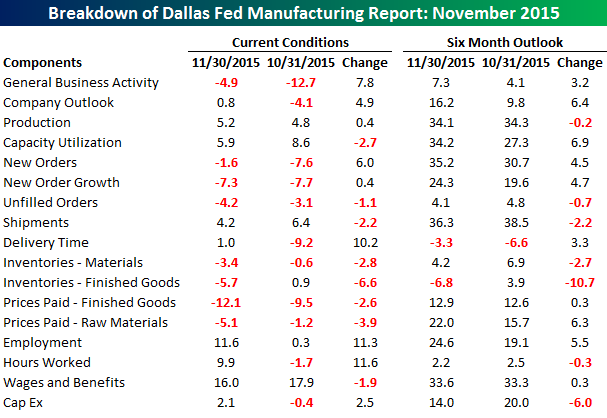
The table below breaks down this month’s report by each of the reports subcomponents. In terms of current conditions, more components are now in positive territory than negative, while breadth was evenly split between gainers and losers. The biggest gainers this month were both employment related as Hours Worked and Employment moved back into positive territory. On the downside, the categories of Inventories and Prices Paid saw the largest declines. In terms of the six-month outlook, just two components are now in the red (Delivery Time and Inventories-Finished Goods).
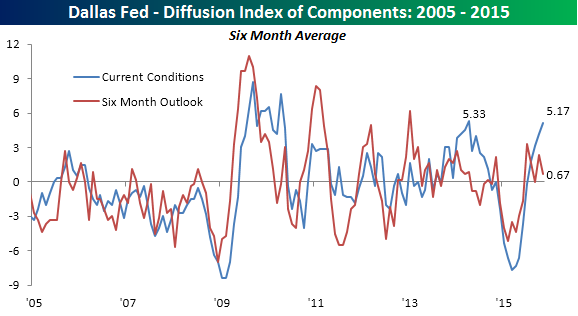
The chart below provides a diffusion index of the Current Conditions and Six Month Outlook components of the Dallas Fed report on a six-month moving average basis. In terms of Current Conditions, the Diffusion Index is up to 5.17, which is near the five-year high of 5.33 from April 2014. Although current conditions saw significant improvement, the Diffusion Index for the six-month outlook has been moving erratically in positive territory.
Bespoke Stock Seasonality Report: 11/30/15
This content is for members onlyBespoke Brunch Reads 11/28/15
Welcome to Bespoke Brunch Reads, our Saturday morning summary of interesting things we’re reading this week. The links are mostly market related, but there will be some other interesting subjects covered as well. The links are in no particular order. We hope you enjoy the food for thought as a supplement to the research we provide you during the week.
S&P Gets In Trouble For Giving AAA Rating To Obviously Terrible Thing by Matt Levine (Dealbreaker)
Matt no longer writes for Dealbreaker, and this piece is quite old, but it’s one we love a quick re-read of every now and then…both for its humor and its sharp analysis. [Link]
Exclusive: Chinese aluminum, nickel producers ask state to buy up surplus metal by Polly Yam (Reuters)
Chinese firms are flooded with inventories of base metals and facing a massive cash crunch amidst rising debts, and the solution is quite predictable. [Link]
Here’s what we know – and don’t know – about Alberta’s carbon tax by Trevor Tombe (Macleans)
An interesting and informed look at the new carbon tax rolled out by Canadian province Alberta; the results have implications for both investors and policy makers. [Link]
Comparative Advantage, Task Allocation, and Trade – In The Style of Dr. Seuss’ “One Fish Two Fish” by Kenny Fennell (University of Michigan)
A hilarious way to think about the way society allocates its human capital, gussied up into a quick rhyming scheme. [PDF Link]
Are There a Thousand Central Banks in China? You Bet. By Chris Balding (Balding’s World)
A helpful review of recent thinking on the monetary situation in China. We note that it links to the next two pieces included below, and all three are worth reading in one sitting. [Link]
Relending program shows China girding for bank bailouts by Christopher Aston (Nikkei Asian Review)
Recent pilot programs indicate that Chinese policy makers are preparing to directly monetize troubled loan portfolios, a step that might be compared to QE but in effect goes far, far beyond that particular central bank tool. [Link]
Wait, China’s employment counting problem…solved? By David Keohane (FT Alphaville)
New data unearthed from several sources give a more clear picture of the labor market – and general economic health – in China; while the new approach is by no means a “bottom line”, they’re certainly helpful in providing more illumination. [Link, registration required]
Junk-Bond Losses Pile Up as Traders Flee Any Whiff of Bad News by Sridhar Natarajan (Bloomberg)
Credit investors are selling first and asking questions later as concerns grow over the health of issuers, but it’s not clear if that is a signal for the broader turn of the credit cycle.
The Doomsday Invention by Raffi Khatchadourian (The New Yorker)
In a long (12,000 words) meditation on the future of the future, this meditation explores the promise and peril of artificial intelligence. [Link]
The Oxford Economist Running the Fed’s Interest Rate Machine by Katy Burne (WSJ)
A nice profile of Simon Potter, who is head of markets for the NY Fed and therefore the official in charge of pushing up Fed Funds effective within the FOMC’s target band should they decide to raise rates. [Link, paywall]
Silicon Valley professionals are taking LSD at work to increase productivity by Adam Boult (The Telegraph)
Micro-doses of LSD may sound like the last thing that would increase productivity when sitting and writing code but the phenomenon is growing amongst California’s coders. [Link]
Amazon Said Planning to Add Other Online Networks to Prime Video by Lucas Shaw (Bloomberg)
For all the talk of a dying cable bundle, Amazon’s commercial strategy of adding new bundle-style offerings indicates that the bundle may be here to stay regardless of the on demand or passive delivery mode. [Link]