Dec 13, 2016
 Our 2017 Bespoke Report market outlook is the most important piece of research that Bespoke publishes each year. We’ve been publishing our annual outlook piece since the formation of Bespoke in 2007, and it gets better and better each year! In this year’s edition, we’ll be covering every important topic you can think of dealing with financial markets as we enter 2017. And to say that 2017 should be an interesting year for asset classes would be an understatement given the huge rotation we’ve already seen in just a few weeks since the Presidential Election was held back on November 8th.
The 2017 Bespoke Report contains sections like Washington and Markets, Economic Cycles, Market Cycles, The Fed, Sector Technicals and Weightings, Stock Market Sentiment, Stock Market Seasonality, Housing, Commodities, and more. In this year’s edition, we’ll also be featuring our new “Trump Index” of stocks that we expect to perform best in 2017 based on the new administration.
Over the next few weeks until the full publication is sent to paid members on December 29th, we’ll be releasing individual sections as we complete them. Today we have published the “Thematic Performance” section of the 2017 Bespoke Report, which highlights the various market themes like large caps versus small caps, value versus growth, and stocks versus bonds that are currently outperforming and underperforming as we get set to enter the new year.
To view this section immediately and also receive the full 2017 Bespoke Report when it’s published on December 29th, simply sign up for a 30-day free trial to Bespoke Premium. It’s that easy!
Oct 18, 2016
With four of its larger components reporting earnings since yesterday’s close, there have been some moderate changes in the weightings hierarchy of the thirty components of the Dow Jones Industrial Average (DJIA). Before going further, for those unfamiliar with the way the DJIA is constructed, the index is made up of 30 stocks which are weighted based on their price. Therefore, stocks with higher share prices have a higher weighting, while those with lower share prices have a lower weighting. Therefore, regardless of how large a company is in terms of revenues, earnings, or market cap, if it has a high relative share price, it gets a larger weighting in the DJIA. The only place where stock splits really matter is when they occur among DJIA components, where a 2-1 split will immediately result in a company having its Dow weighting cut by essentially half.
With that explanation out of the way, the table below lists the 30 Dow components and their individual weightings in the index. With today’s better than expected earnings report, Goldman Sachs (GS) now has the largest weighting in the index ahead of 3M and IBM. Even after its weak earnings report on Monday evening, IBM holds on to the third spot, but with UnitedHealth (UNH) putting up a strong report this morning, the gap between the two has really narrowed. One standout stock with respect to its weighting in the index is Apple (AAPL). Despite being the largest publicly traded company in the United States, AAPL only has the 7th highest weighting in the Dow, even though its market cap is greater than the combined market caps of Goldman (GS), 3M (MMM), IBM, UnitedHealth (UNH), and Boeing (BA)! With a share price of less than $60, Microsoft’s (MSFT) weight is even more distorted at 2.2%, even though its market cap is equal to the combined market caps of the DJIA’s four largest components.
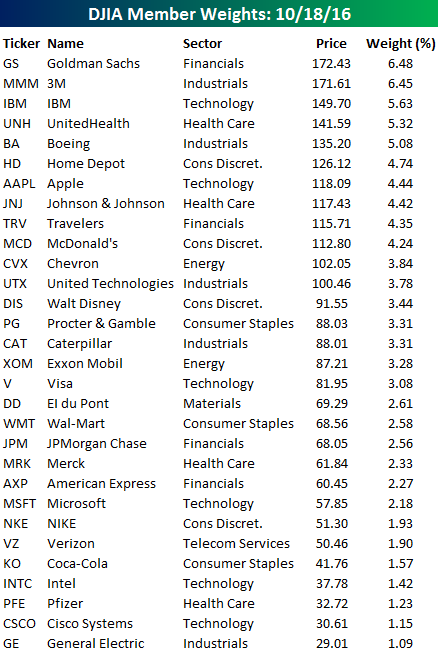
Whatever the shortcomings are for the way the DJIA is constructed, though, the index has withstood the test of time, and whenever someone from Main Street wonders how Wall Street is doing, they ask, “Where’s the Dow?” Yes, there are some years where the awkward construction of the DJIA creates wide divergences between its return and broader measures of the US equity market like the S&P 500, but more often than not, the DJIA tracks the S&P 500 pretty closely. This year, for example, the YTD returns of the two indices are within 50 bps of each other as the S&P 500 is up 4.7% while the DJIA is up 4.2%.

