
The Bespoke Report – 8/8/25 – There Was Supposed To Be An Earth-Shattering Kaboom. Where’s The Earth-Shattering Kaboom?
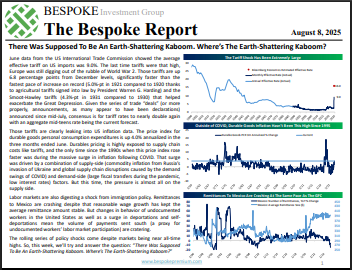
To read our weekly Bespoke Report newsletter and access everything else Bespoke’s research platform offers, start a two-week trial to Bespoke Premium. This week, we look at why the market has been so bulletproof despite all the shocks it’s been given from headlines this year. From economic fundamentals to earnings data, we explain the backdrop while also surveying the historic decline in the dollar, weak commodity prices, US equity market sentiment, and some of the most interesting tidbits from earnings releases we saw this week. Give it a read!
Daily Sector Snapshot — 8/8/25
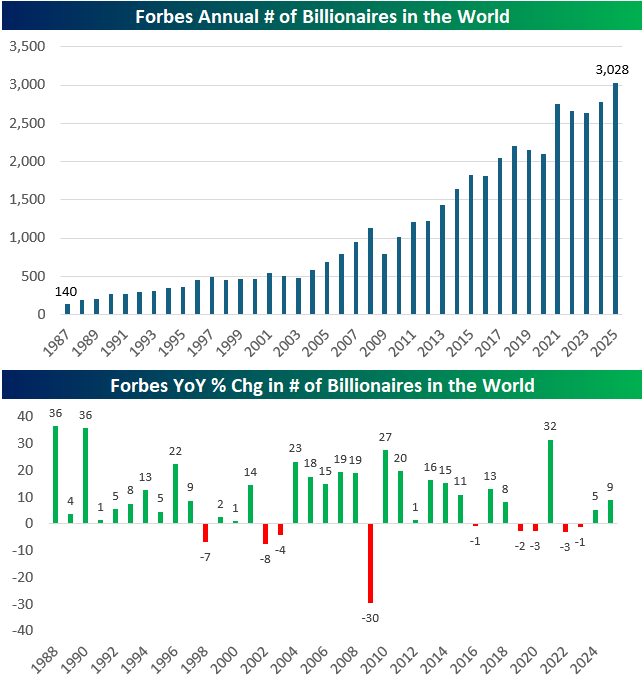
The World’s 3,028 Billionaires
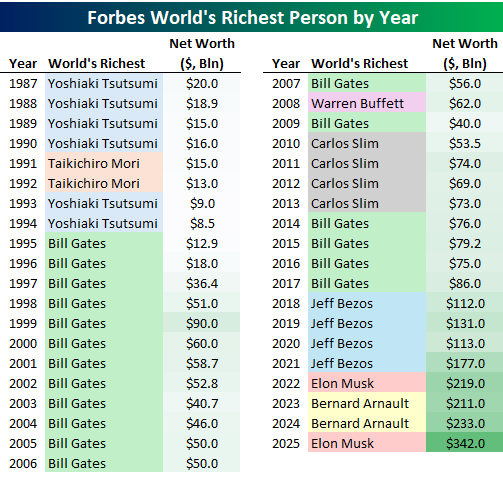
The growth in the number of billionaires over the past four decades is nothing short of extraordinary. Back in 1987, Forbes counted just 140 billionaires globally. As of 2025, that number has surged to a staggering 3,028, a 21x increase. This rise has been largely consistent, interrupted only during periods of financial turbulence. The Dot Com crash in the early 2000s and the Great Financial Crisis in 2009 triggered sharp declines, including a record 30% drop in 2009. More recently, 2022 and 2023 saw modest pullbacks in billionaire numbers, reflecting broader market volatility. But the trend remains unmistakable: billionaire status is becoming more common in an increasingly capital driven world.
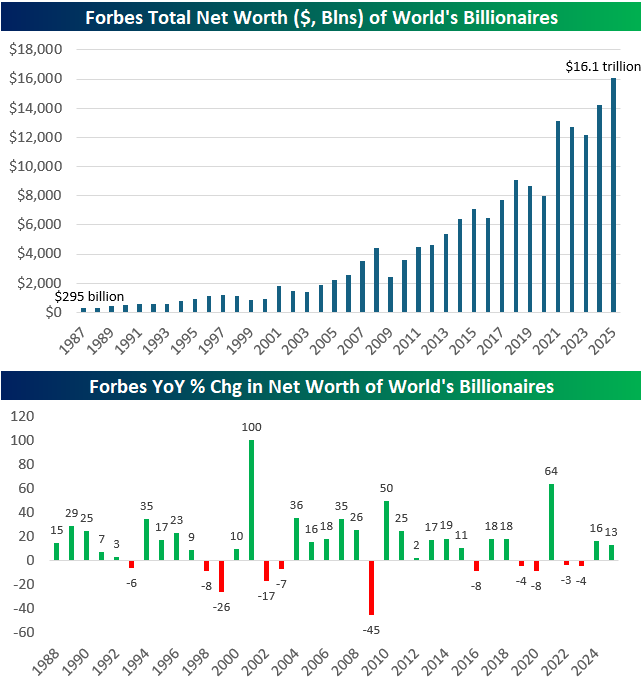
While the number of billionaires has soared, their collective net worth has grown even faster. In 1987, the global billionaire club was worth a combined $295 billion. Today, their net worth has ballooned to $16.1 trillion, more than a 50x increase. The 2009 crash wiped out nearly half of billionaire wealth (-45%), but recoveries have been swift and powerful. For instance, in 2021 alone, billionaire net worth rose by a massive 64% as markets roared back from COVID lows. Even in recent years, with inflation, rate hikes, and geopolitical stress, total billionaire wealth has continued to grow, up 13% in 2024 and another 16% in 2025. It’s clear that the billionaire class not only survives economic storms, it often thrives in their aftermath.
Tracking the richest person in the world each year offers a fascinating glimpse into broader economic and technological trends. The late 1980s and early 1990s were dominated by Japanese real estate moguls like Yoshiaki Tsutsumi and Taikichiro Mori, reflecting Japan’s then-surging property boom. But by the mid-1990s, Bill Gates took over and stayed on top for 13 out of 14 years, riding the explosive growth of Microsoft and the personal computing revolution.
The 2010s saw Carlos Slim ascend amid the rise of telecom and infrastructure in emerging markets. But the real shift came with the tech titans of the 2010s and 2020s: Jeff Bezos led the way during Amazon’s global expansion, and Elon Musk rocketed to the top during the EV and space boom, now commanding a mind-bending $342 billion fortune. The occasional lead by Bernard Arnault, representing luxury goods via LVMH, shows how wealth today isn’t just tech-driven, it’s increasingly global, diversified, and tied to brand power, scale, and platforms.

Increasing Earnings Vol
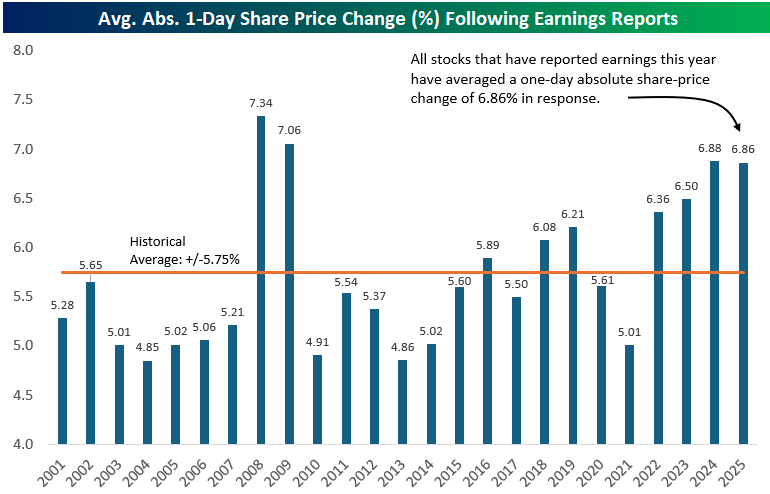
The average stock that has reported earnings this week (more than 600 companies) has seen a one-day share price reaction of more than +/-8.5% (absolute change). That’s much higher than the 20+ year average absolute move of 5.75% that US-traded stocks have historically experienced on their earnings reaction days. (What this means is that in modern markets, the average stock can expect to see a one-day move of +/-5.75% once per quarter following its earnings release. Yes, a large portion of a stock’s move over its lifetime comes from the one trading day each quarter after it reports earnings.)
Notably, stocks have been getting more volatile on their earnings reaction days in recent years. Below is a chart showing the average one-day absolute percentage change that stocks saw in reaction to earnings by year going back to 2001 using our Earnings Explorer tool. (We find this tool extremely useful, and it’s available with a Bespoke Institutional subscription if you’d like to try it out.)
In the early 2000s before the Financial Crisis, investors could expect the average stock to move a little over +/-5% on its quarterly earnings reaction day. The average move on earnings then spiked to record levels above +/-7% during the Financial Crisis when overall market volatility increased dramatically and investors sold everything like their life depended on it for a couple of years.
From 2010 to 2015, things settled down again and the average stock once again moved about +/-5% on earnings. Since 2015, however, we’ve seen a general uptrend in earnings-day volatility for stocks. In 2018, the average move on earnings ticked back above +/-6% for the first time since the Financial Crisis. Aside from a random dip back down to 5% in 2021, daily vol on earnings has ticked higher and higher back up near 7% in 2024 and 2025. So far this year, the average stock that has reported has seen a one-day move of +/-6.86%.
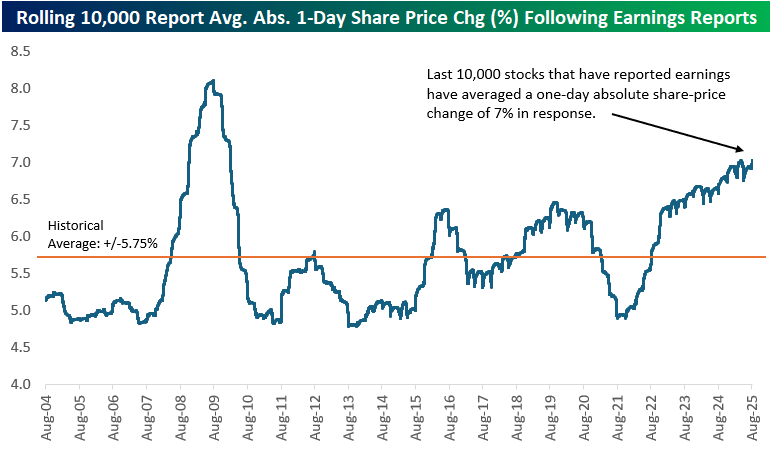
Another way to chart long-term earnings-day volatility is to look at the rolling 10,000-earnings report average one-day move for US stocks that have reported since 2001. Each point on the blue line in the chart below shows the average one-day change on earnings that the prior 10,000 stocks reporting have experienced.
Interestingly, the spike in earnings vol during the Financial Crisis came during a nasty bear market when equities were drawing down sharply for more than a year. The recent move higher has come during a period when US equities have been in an uptrend for multiple years.
In the current day and age of easy, commission-free trading on brokerage apps available right on your smartphone, share-price volatility in reaction to stock-specific earnings news has moved increasingly higher. At the same time, overall market volatility hasn’t seen a similar increase, which means that more and more of a stock’s overall performance is coming from the one trading day per quarter when it posts its financial results and forward guidance.
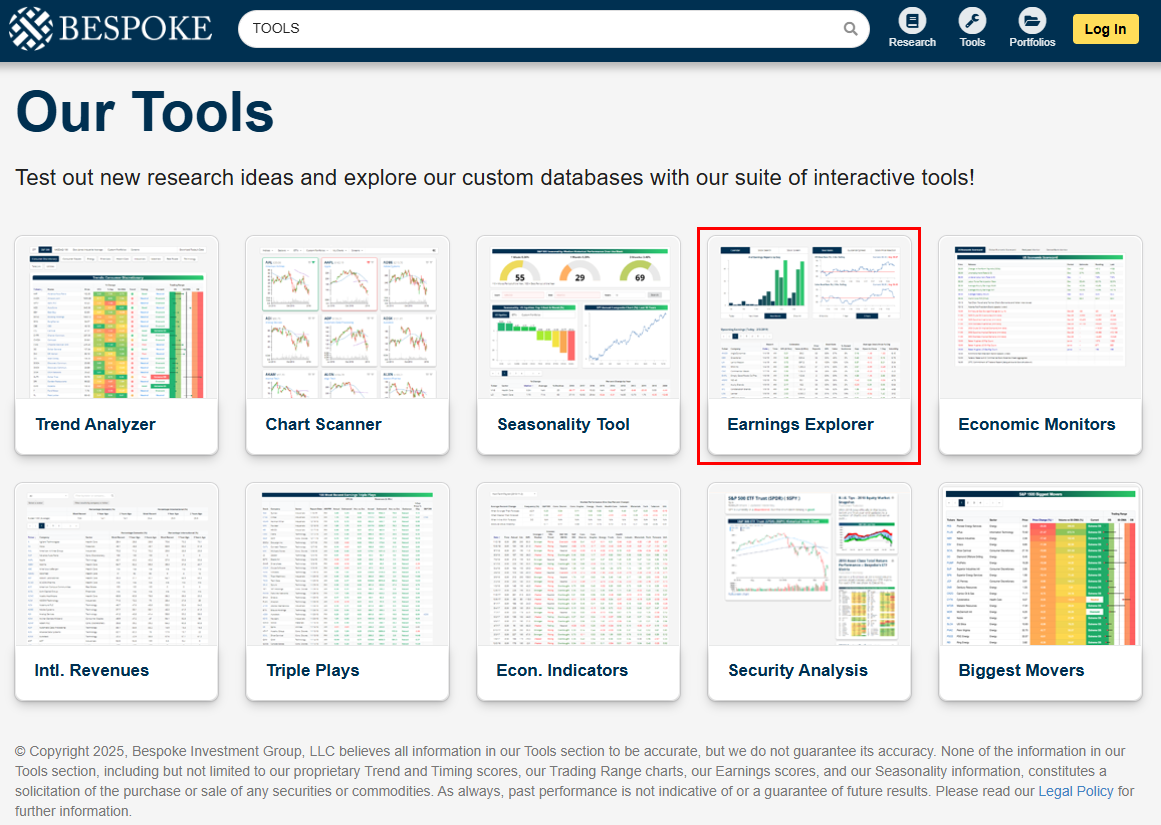
You can try out our Earnings Explorer and all of the other unique investor tools shown in the snapshot below by starting a trial to Bespoke Institutional. Click here to start a trial today!
Bespoke’s Morning Lineup – 8/8/25 – Quitters Never Win
See what’s driving market performance around the world in today’s Morning Lineup. Bespoke’s Morning Lineup is the best way to start your trading day. Read it now by starting a two-week trial to Bespoke Premium. CLICK HERE to learn more and start your trial.
“But the interest of the Nation must always come before any personal considerations.” – Richard Nixon

Below is a snippet of commentary from today’s Morning Lineup. Start a two-week trial to Bespoke Premium to view the full report.
On this day, 51 years ago, President Nixon became the first U.S. president to resign from office. While there are plenty of others that Americans likely wish had also resigned from office since then, Nixon remains the only President to leave office before his term ended, despite saying in his resignation speech that “I have never been a quitter.” As crazy as the political, social, economic, and geopolitical climate feels today, it has nothing on the backdrop from 51 years ago. If you weren’t around then, just ask someone who was.
There’s no shortage of uncertainty or unease in the backdrop today, but equities are within percentage points of record highs, and interest rates are relatively low versus history. This morning specifically, futures are firmly in positive territory on generally positive earnings news overnight. There’s no economic data on the calendar today, and all the earnings for the week are behind us, so unless the President fires up the Truth Social app, we can expect a relatively quiet summer Friday.
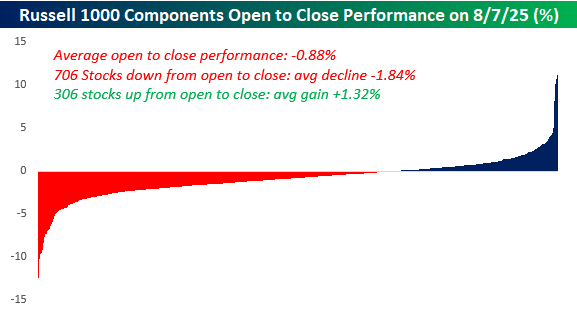
In yesterday’s trading, there were many quitters. Stocks opened the day higher and gave up their gains throughout the trading day. On an average basis, stocks in the Russell 1000 declined 0.88% from the open to close. Of the index’s components, 706 closed lower than they opened, and their average decline from the open to closing bell was 1.84%. On the upside, only 306 stocks (there are more than 1,000 stocks in the index) closed higher than they opened, and their average gain was just 1.32%.
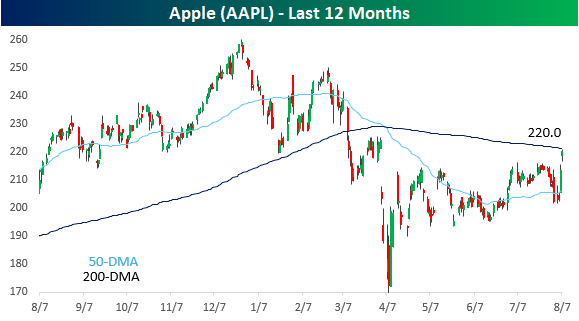
One stock that didn’t quit yesterday was Apple (AAPL). It gapped up around 2% and then added on another 1% from the open to close to finish just below its 200-day moving average (DMA), a level it hasn’t traded above since early March. While the stock didn’t quit Thursday, downward-sloping moving averages have a way of acting as resistance, so whether AAPL can close above its 200-DMA to close out the week will say a lot about how strong this latest two-day rally is. Will today be the day that Cook & Co can say to the bears that they won’t have Apple to kick around anymore?
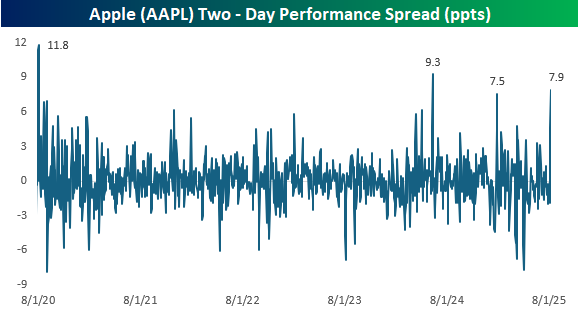
Besides rallying over 8% in the last two days, AAPL also outperformed the S&P 500 by just under 8% since Tuesday’s close, which ranks as one of the strongest two-day rallies relative to the S&P 500 in the last five years. The only two that were stronger were an 11.8 ppt performance spread in early August 2020 after the company reported earnings, and then a 9.3 ppt margin of outperformance after the company’s WWDC conference last summer. Besides those two periods, the only other two-day period of outperformance that was close to the last two days was a 7.5 ppt performance spread following its January report.
The Closer – Reversals, Data Day, Auctions – 8/7/25
Log-in here if you’re a member with access to the Closer.
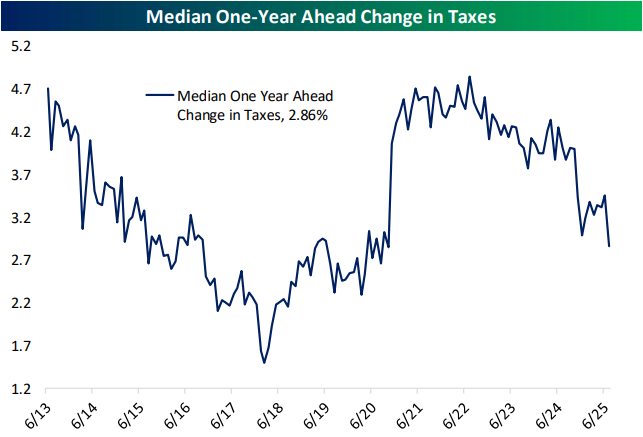
Looking for deeper insight into markets? In tonight’s Closer sent to Bespoke Institutional clients, it’s a full report that starts off with a look into the intraday reversals experienced today (page 1). We then recap a busy day of macro happenings including productivity and jobless claims (page 2), Fed appointments (page 3), and the 30-year bond auction (page 4). We then pivot over to earnings (pages 4 and 5) before switching back to economic data with recaps of the NY Fed’s consumer survey (pages 6 and 7). We cap off with a look into Treasury allotment data (page 8).
See today’s full post-market Closer and everything else Bespoke publishes by starting a 14-day trial to Bespoke Institutional today!
Bespoke’s Weekly Sector Snapshot — 8/7/25
Q2 2025 Earnings Conference Call Recaps: Zillow (ZG)
Bespoke’s Conference Call Recaps use AI to summarize lengthy earnings calls. The commentary below is AI-generated and then edited by Bespoke for quality control. As always, none of these summaries should be construed as recommendations to buy or sell any securities, and investors should do their own research and/or consult with a financial professional before making any investment decisions.
Our latest recap available to Bespoke subscribers covers Zillow’s (ZG) Q2 2025 earnings call.

Zillow (ZG) is a digital real estate platform that connects home buyers, sellers, renters, and real estate professionals through a comprehensive suite of tools, listings, and services. Best known for its Zestimate feature and mobile-first experience, Zillow has evolved into a transaction-focused ecosystem, offering mortgage origination through Zillow Home Loans, property management tools, and its agent CRM, Follow Up Boss. It operates the #1 rental and for-sale real estate websites in the US, with an average of 243 million monthly unique users. Zillow reported 15% revenue growth YoY, outperforming a flat housing market, with standout gains in rentals (up 36%) and mortgages (up 41%). Multifamily listings rose 45% to 64,000, supported by expanded distribution via Redfin and Realtor.com. Enhanced markets drove 27% of connections, with Zillow Home Loans adoption in the double digits and expected 40%+ origination growth in Q3. Product innovation was a major theme, including AI-powered agent tools, the immersive SkyTour feature, and the affordability-focused BuyAbility tool. Executives maintained a confident tone on reaching 2025 goals, despite macro housing stagnation and affordability headwinds. ZG shares recorded an up-and-down day on 8/7 after posting mixed results…
Continue reading our Conference Call Recap for ZG by becoming a Bespoke Institutional subscriber. You can sign up for Bespoke Institutional now and receive a 14-day trial to read our newest Conference Call Recap. To sign up, choose either the monthly or annual checkout link below:
Q2 2025 Earnings Conference Call Recaps: Duolingo (DUOL)
Bespoke’s Conference Call Recaps use AI to summarize lengthy earnings calls. The commentary below is AI-generated and then edited by Bespoke for quality control. As always, none of these summaries should be construed as recommendations to buy or sell any securities, and investors should do their own research and/or consult with a financial professional before making any investment decisions.
Our latest recap available to Bespoke subscribers covers Duolingo’s (DUOL) Q2 2025 earnings call.

Duolingo (DUOL) is the world’s most popular language-learning platform, offering gamified courses in over 40 languages through its mobile app and website. The company has expanded into adjacent educational verticals like math, music, and, most recently, chess. Duolingo serves a wide global user base, with particularly strong growth among English learners in Asia. Its tiered subscription model, including Super and Max plans, supports both free and paid users. What makes Duolingo stand out is its use of AI to personalize learning experiences at scale and its viral, irreverent brand voice. Duolingo posted another strong quarter, raising full-year guidance on the back of 40% DAU (Daily Active User) growth, an 8% Max subscriber mix, and record profitability. Growth in Asia (especially China, boosted by a Luckin Coffee partnership) was a standout. The company highlighted progress in its new “Energy” system, which has lifted DAUs, revenue, and time spent, while drawing some user backlash. AI-related costs fell as token prices dropped, improving gross margins. Video Call remains the “killer feature” of Max, and the team is adding bilingual dialogue and engagement-based fine-tuning. Social media strategy was reined in after controversial AI remarks, affecting US virality but now stabilizing. The stock was up as much as 31% on 8/7 after the triple play but gave up half of those gains intraday…
Continue reading our Conference Call Recap for DUOL by becoming a Bespoke Institutional subscriber. You can sign up for Bespoke Institutional now and receive a 14-day trial to read our newest Conference Call Recap. To sign up, choose either the monthly or annual checkout link below:
Q2 2025 Earnings Conference Call Recaps: Cheniere Energy (LNG)
Bespoke’s Conference Call Recaps use AI to summarize lengthy earnings calls. The commentary below is AI-generated and then edited by Bespoke for quality control. As always, none of these summaries should be construed as recommendations to buy or sell any securities, and investors should do their own research and/or consult with a financial professional before making any investment decisions.
Our latest recap available to Bespoke subscribers covers Cheniere Energy’s (LNG) Q2 2025 earnings call.

Cheniere Energy (LNG) is the largest producer and exporter of liquefied natural gas (LNG) in the United States and a top-five global LNG supplier. Operating major export terminals at Sabine Pass (Louisiana) and Corpus Christi (Texas), Cheniere transforms US shale gas into LNG for delivery to over 45 countries. The company serves utilities, energy companies, and governments, offering flexible, long-term supply contracts that help anchor energy security worldwide. What sets Cheniere apart is its vertically integrated, brownfield-driven growth model, expanding capacity through debottlenecking and modular additions rather than full greenfield builds. The company finalized FID (Final Investment Decision) on Corpus Christi Midscale Trains 8 & 9 and achieved substantial completion of Train 2 in Stage 3. Debottlenecking added about 1 MTPA (Million Tons Per Annum) in capacity at low cost, while a new 1 MTPA long-term contract with JERA (Japan) marked a strategic commercial milestone. Management emphasized robust LNG demand in Europe (up 25% YoY) and a strong long-term outlook in Asia despite short-term softness. LNG shares hovered around flat in 8/7’s session despite stronger-than-expected results…
Continue reading our Conference Call Recap for LNG by becoming a Bespoke Institutional subscriber. You can sign up for Bespoke Institutional now and receive a 14-day trial to read our newest Conference Call Recap. To sign up, choose either the monthly or annual checkout link below: