The Closer – Rotation, Earnings, Treasury Allotment – 10/22/25
Log-in here if you’re a member with access to the Closer.
Looking for deeper insight into markets? In tonight’s Closer sent to Bespoke Institutional clients, we kick off with a look at the market’s rotation (page 1) followed by a rundown of all the latest earnings including results from Tesla (TSLA), IBM (IBM), and more (pages 2 and 3). We cap off with a look into the latest Treasury auctions (page 4).
See today’s full post-market Closer and everything else Bespoke publishes by starting a 14-day trial to Bespoke Institutional today!
Daily Sector Snapshot — 10/22/25
Chart of the Day – Decent Breadth, No New Highs
B.I.G. Tips – Speculative Stocks Pop
Q3 2025 Earnings Conference Call Recaps: PulteGroup (PHM)
Bespoke’s Conference Call Recaps use AI to summarize lengthy earnings calls. The commentary below is AI-generated and then edited by Bespoke for quality control. As always, none of these summaries should be construed as recommendations to buy or sell any securities, and investors should do their own research and/or consult with a financial professional before making any investment decisions.
Our latest recap available to Bespoke subscribers covers PulteGroup’s (PHM) Q3 2025 earnings call.

PulteGroup (PHM) is a leading US homebuilder that operates under well-known brands like Pulte Homes, Centex, and Del Webb, delivering thousands of single-family homes annually across 45+ markets. They serve first-time buyers, move-up buyers, and active-adult (55+) communities, offering insight into how large homebuilders navigate affordability, macroeconomic strain, and regional migration. In Q3, the company closed roughly 7,500 homes with home-sale revenue of about $4.2 billion and delivered a 16.8% home-building margin while managing an ROE of about 21%. They noted that buyer demand remains “good, albeit competitive,” but is challenged by weak consumer confidence and stretched affordability, even as interest rates decline. Their active-adult segment grew about 7% in orders, while first-time buyers fell about 14%. They started roughly 6,557 homes and reduced their build cycle to 106 days to manage inventory; spec homes remain near 50% of production, above their 40-45% target, but they’re comfortable with that in the near term. Regionally, Florida and the Southeast showed relative strength, while Texas and the West lagged. On the policy front, they reiterated the US housing shortage (about 3-4 million homes) and flagged a potential $1,500 build-cost headwind per home from tariffs in 2026. They moderated 2025 land spend ($5 billion) but maintain control of about 240,000 lots and noted that easing horizontal development costs (earth-moving/underground) should benefit future lot inflation. On better-than-expected results, PHM shares opened more than 6% lower on 10/21, but recovered the declines by around mid-day…
Continue reading our Conference Call Recap for PHM by becoming a Bespoke Institutional subscriber. You can sign up for Bespoke Institutional now and receive a 14-day trial to read our newest Conference Call Recap. To sign up, choose either the monthly or annual checkout link below:
Q3 2025 Earnings Conference Call Recaps: RTX (RTX)
Bespoke’s Conference Call Recaps use AI to summarize lengthy earnings calls. The commentary below is AI-generated and then edited by Bespoke for quality control. As always, none of these summaries should be construed as recommendations to buy or sell any securities, and investors should do their own research and/or consult with a financial professional before making any investment decisions.
Our latest recap available to Bespoke subscribers covers RTX’s (RTX) Q3 2025 earnings call.

RTX (RTX), formerly Raytheon Technologies, is one of the world’s largest aerospace and defense companies, formed by the merger of Raytheon and United Technologies. Its three segments (Collins Aerospace, Pratt & Whitney, and Raytheon) span everything from jet engines and avionics to precision missiles and integrated air defense systems. RTX’s technologies power both the world’s most advanced commercial aircraft and critical defense programs like Patriot, AMRAAM, and Stinger. The company serves global airlines, aircraft OEMs, and defense agencies across the US and allied nations, offering an unusually comprehensive view into commercial aviation trends and global defense spending priorities. RTX delivered a strong quarter, with sales up 13% organically. Defense bookings surged as Raytheon’s record $16 billion in new orders drove backlog to $72 billion, 44% international. Commercial aerospace also stayed hot, as resilient global air travel and low aircraft retirements boosted Collins and Pratt & Whitney’s aftermarket sales. Supply chain pressures are easing, with key material output up double digits, while RTX is investing over $600 million in new capacity and deploying AI tools to double missile output. Tariff headwinds (about $90 million per segment) weighed on margins but were offset by pricing strength. Shares were up as much as 11% on 10/21 after reporting the triple play…
Continue reading our Conference Call Recap for RTX by becoming a Bespoke Institutional subscriber. You can sign up for Bespoke Institutional now and receive a 14-day trial to read our newest Conference Call Recap. To sign up, choose either the monthly or annual checkout link below:
Bespoke’s Morning Lineup – 10/22/25 – Mixed Picture
See what’s driving market performance around the world in today’s Morning Lineup. Bespoke’s Morning Lineup is the best way to start your trading day. Read it now by starting a two-week trial to Bespoke Premium. CLICK HERE to learn more and start your trial.
“Women who seek to be equal with men lack ambition” – Timothy Leary
Below is a snippet of commentary from today’s Morning Lineup. Start a two-week trial to Bespoke Premium to view the full report.
The post 10/8 range-bound slog looks set to continue for the S&P 500 today as it enters its eighth day in a row of trading within its intraday range from 10/10. S&P 500 futures are essentially unchanged, while Nasdaq futures point to a modest decline. Yesterday’s weakness in gold and other precious metals has continued this morning, with gold down more than 1%, and while the crypto markets had a positive reversal yesterday, they’re giving it all back today as volatility in that space continues.
Overnight in Asia, most indices saw modest declines, although South Korea managed to buck the trend as it seems nothing can keep the Kospi down. European shares are mixed. The STOXX 600 is trading modestly higher on the session, led higher by the FTSE 100 and Spain’s Ibex 35, while Italy is down 0.5%. This morning’s strength in the UK was catalyzed by a much weaker than expected September CPI report, which showed no change in consumer prices relative to forecasts for an increase of 0.2%.
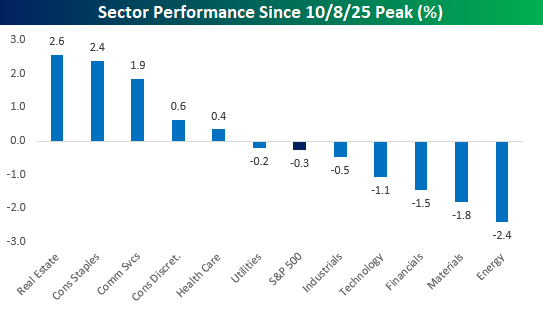
It’s now been two weeks since the S&P 500’s last record high, and while the S&P 500 has seen just marginal declines, some of the moves within sectors have been much larger. As shown in the chart below, Real Estate and Consumer Staples have both rallied over 2% and join Communication Services as the three sectors with gains of over 1%. To the downside, five sectors have declined since the 10/8 high, but four of them are down over 1%, including Energy (-2.4%) and Materials (-1.8%). Technology has also slumped 1.1%, which has acted as the main driver of the index’s decline.
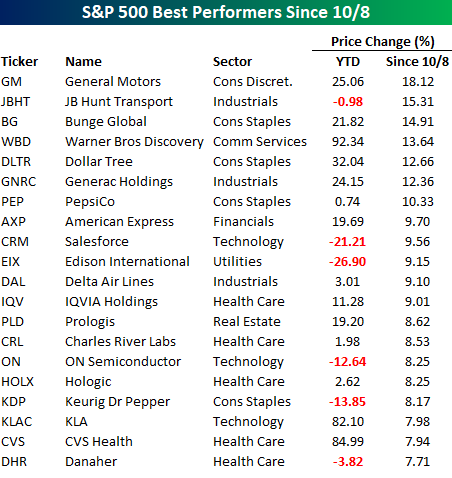
At the individual stock level, it’s been an eclectic mix of winners and losers. Starting with the winners, General Motors (GM) tops the list after yesterday’s post-earnings surge, and it’s one of seven stocks in the S&P 500 that have rallied over 10% since the 10/8 peak. While many of the 20 best-performing stocks in the S&P 500 are handily up YTD, they aren’t exactly the typical winners investors have been used to seeing throughout most of the year. The sector breakdown of these winners further illustrates that trend, as nearly half of the names listed are either from the Health Care (5) or Consumer Staples (4) sectors.
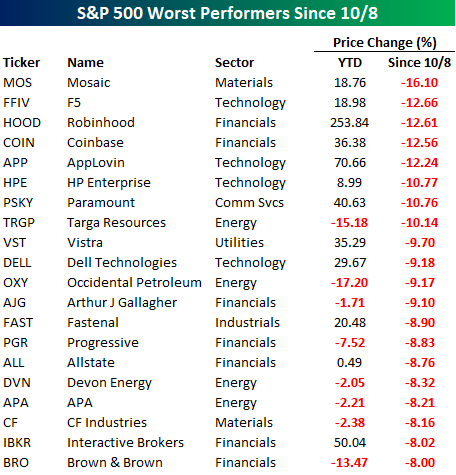
Shifting to the biggest losers, eight stocks in the S&P 500 have seen double-digit percentage declines since the 10/8 peak. Leading the way to the downside, Mosaic (MOS) has declined more than 16%. While many stocks listed have underperformed this year, for stocks like Robinhood (HOOD), Paramount (PSKY), Vistra (VST), Dell (DELL), and Interactive Brokers (IBKR), it has been a pause to potentially refresh.
At the sector level, Financials has been most heavily represented, with over a third of the names listed as concerns in the credit markets have hit some of the names in the sector hard. After Financials, the next most heavily represented sectors are Energy and Technology, with four each.
The Closer – Earnings Review, Gold Gutted, NBFI, 10/21/25
Log-in here if you’re a member with access to the Closer.
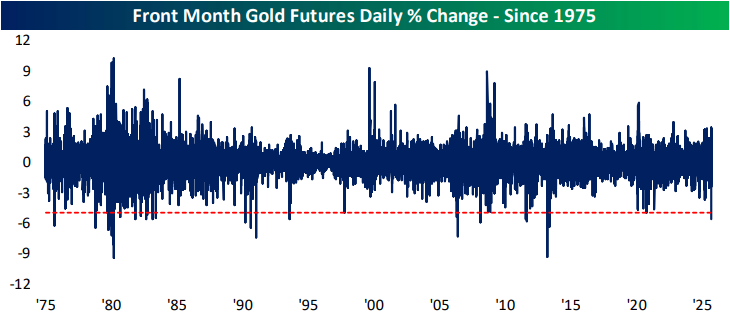
Looking for deeper insight into markets? In tonight’s Closer sent to Bespoke Institutional clients, we begin with a recap of all the latest earnings including results from Netflix (NFLX), Capital One (COF), and more (pages 1 and 2). We then dive into the historic decline in gold prices (pages 3 and 4) before turning over to a look into non-bank financial institutions (page 5) and CPI North of the border (page 6).
See today’s full post-market Closer and everything else Bespoke publishes by starting a 14-day trial to Bespoke Institutional today!
Daily Sector Snapshot — 10/21/25
200-Day Check-In
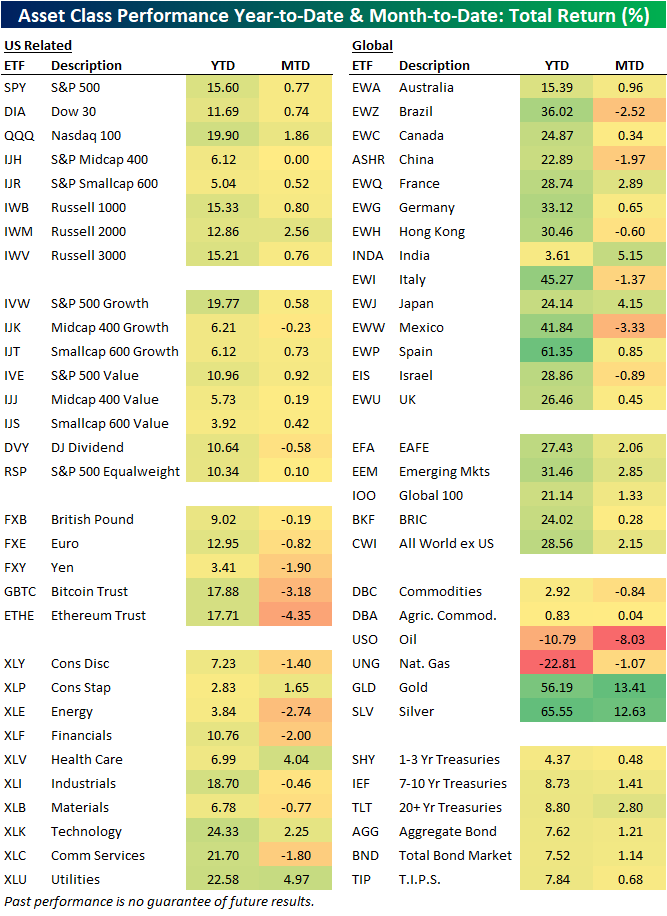
Yesterday marked the 200th trading day of the year. With tariff troubles, new policy implementations, geopolitical tensions, there’s already been a ton for markets to contend with in 2025. However, assets have broadly rallied anyways. In the table below, we show year to date returns through yesterday’s close across a range of ETFs covering a variety of assets both year-to-date through the first 200 trading days in addition to month-to-date for a look at more recent performance.
US equities are up double digits this year with the S&P 500 (SPY) gaining 15.6%, whereas the Nasdaq 100 (QQQ) is nearly up 20%. Small and mid-caps have some variation depending on how you look at them. The broader look at small caps, the Russell 2,000 (IWM), is only slightly underperforming the likes of SPY year-to-date. Meanwhile, the more selective S&P 600 (IJR), which is constructed only using companies that have reported positive earnings, is up a more modest 5% YTD. The midcap S&P 400 (IJH) is also up in the mid single digits. In other words, it has been the more speculative small caps gaining the most. Additionally, growth has outperformed value with the same small and mid-cap weakness relative to large caps.
On a sector level, the single best performer should come as no surprise: Tech (XLK) which has risen 24.3% YTD. The runner up may be more surprising: the historically defensive Utilities sector (XLU), which has gained 22.58%. The only other sector up over 20% is Communication Services (XLC), and two others, Financials (XLF) and Industrials (XLI), are up double digits. All other sectors have risen mid-to-low single digits with declines more recently MTD.
International stock markets using domestically-traded ETFs have handily outperformed the US this year. In fact, of those shown below, only two have underperformed the US (SPY) YTD, and those are Australia (EWA) and India (INDA). Finally, we would note that the single largest rallies haven’t come from the equity space this year as gold (GLD) and silver (SLV) are both up 50%+. In fact, GLD’s 13.4% MTD gain is only a couple percentage points less than what the S&P 500 has gained YTD.
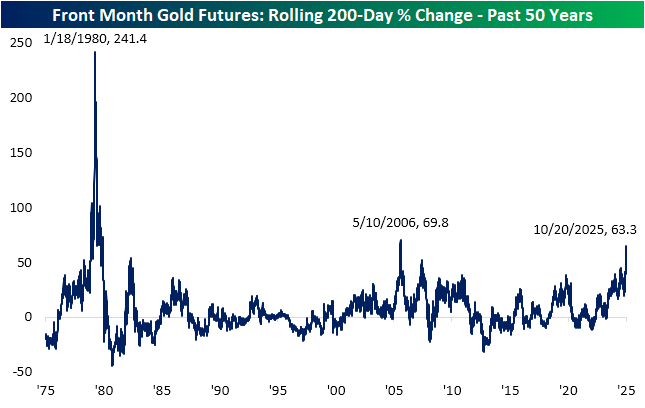
We have frequently noted this year’s strength in gold, although the yellow metal and its cohorts are reverting sharply lower today. We discussed that drop in an earlier B.I.G. Tip in addition to the Morning Lineup. With those declines in mind, that has not stolen from what has been a historic rally for gold prices. As shown below, over a 200-trading day span, gold’s over 60% gain is the largest since 2006; one factor of the rally back then was the emergence of gold ETFs like GLD. Prior to that, the only larger 200-day rally of the past half century came during 1979/1980 when there was a surge from catalysts including high inflation, geopolitical instability, and a speculative frenzy in silver.