
Small Improvements in Claims
Initial jobless claims fell to 260K this week after last week’s higher than expected reading that was revised even higher to 286K this week. Claims were expected to drop this week, but the actual decline was 5K larger than forecasts.
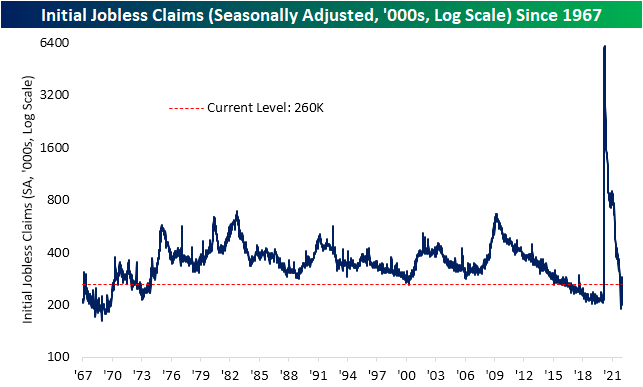
The beginning of the year typically sees a seasonal high in claims which abates into the early spring. In fact, the third (last week) and fourth (this week) weeks of the year are some of the most consistent periods for week over week declines in the NSA number. Specifically, the third week of the year has never seen a WoW increase in the NSA number and the fourth week of the year (this week) has only seen claims rise 9% of the time; the fifth-best of any week of the year.
Given this, last week’s weaker than expected adjusted number was a result of a smaller than normal decline in NSA claims. This week’s drop of 73.3K to 267.6K was again smaller than normal, but much closer to the historical average of a 76.5K decline. In other words, the actual drop in claims before seasonal adjustment continues to be weaker than normal for this point of the year potentially as a result of high COVID case counts. Regardless, the actual level of claims for the current week of the year is basically right in line with the average from the few years prior to the pandemic.

Continuing claims are delayed an extra week to the initial claims number making the most recent print through the week of January 14th. Claims rose that week from 1.624 million to 1.675 million. That was the third increase in a row, but all things considered, it was only a minor increase as the level of claims remains well below the range of the past several decades and is even below levels from the second half of December. Click here to view Bespoke’s premium membership options.

B.I.G. Tips: Three Consecutive Days of Reversals
Bespoke’s Morning Lineup – 1/27/22 – The Roller Coaster Continues
See what’s driving market performance around the world in today’s Morning Lineup. Bespoke’s Morning Lineup is the best way to start your trading day. Read it now by starting a two-week trial to Bespoke Premium. CLICK HERE to learn more and start your trial.
“There is no risk-free path for monetary policy.” – Jerome Powell
Futures are pointing to a higher open this morning ahead of a busy morning for economic data and what has already been a busy overnight session for earnings and one that saw some wild moves in futures. With Asia down sharply overnight, S&P 500 futures were down well over 1% in the middle of the night, so thankfully most US investors were asleep to see that! As Europe opened for trading, sentiment started to rebound with markets in that region of the world posting mixed returns. Wherever futures are now, it’s unlikely they will stay right where they are for the remainder of the day. The market is attempting to find a new equilibrium point, and that process will keep markets volatile in the weeks ahead.
As mentioned above, the economic calendar is loaded this morning. Jobless claims were mostly inline, Durable Goods missed expectations, GDP was much stronger than expected while Personal Consumption was weaker. On the inflation front, the GDP Price Index was higher than expected at just under 7% while the Core PCE rose 4.9% which was in line with forecasts. The only two reports left on the calendar for today are Pending Home Sales and KC Fed Manufacturing which will both hit the tape at 10 AM.
Read today’s Morning Lineup for a recap of all the major market news and events from around the world, including the latest US and international COVID trends.
Yesterday’s market action showed broad-based declines across the board as the S&P 500 dropped more than 1.6% from 2 PM through the close and every sector dropped more than 0.65%. Sectors hardest hit in the after-meeting sell-off were some of the sectors you would most expect. The rate-sensitive Real Estate sector was the hardest hit falling 2.27%. Behind Real Estate, growth-oriented sectors like Technology, Consumer Discretionary, and Communication Services all reversed their gains falling more than 2%.
At the other end of the spectrum, defensive sectors like Utilities and Consumer Staples held up the best along with Financials which was the only other sector not to reverse at least 1% lower in the aftermath of Powell’s hawkish comments.
Try as they might to seek a port, if the Fed continues to guide to a more hawkish policy stance than markets anticipate at the time, there will little in the way of places for investors to hide in order to avoid at least some of the waves.

Start a two-week trial to Bespoke Premium to read today’s full Morning Lineup.
Daily Sector Snapshot — 1/26/22
Brazil and Russia Go In Opposite Directions
Earlier today, we updated our Global Macro Dashboard highlighting major economic data points of 22 major global economies. In the table below, we show the ETFs tracking the stock markets of those same countries and their performance YTD, since their 52-week high, and where that leaves them within their trading ranges (standard deviations from the 50-DMA).
With only four ETFs up in a meaningful way year to date, heavy selling has not just been isolated to the US. Brazil (EWZ) has bucked the trend, though, rallying 10.33%. Despite the strong start to the year, EWZ is still one of the ETFs down the most from its 52-week high. The huge rally this month leaves EWZ deeply overbought alongside South Africa (EZA). While there are only two overbought countries, nearly half of the list is oversold. South Korea is the most oversold of these, but it has not experienced the largest decline this year. Russia (RSX) takes that crown as RSX has fallen 16.65% YTD as geopolitical tensions with Ukraine arise and the threat of sanctions weighs on that market

As previously mentioned, two of the biggest movers are the first half of the BRIC countries. While the decline for RSX recently has been severe, it is a leg lower in a longer-term downtrend that has been in place since the fall. Brazil, meanwhile, has been in a downtrend since last spring, but the recent surge has resulted in it definitively breaking that trend. China’s (MCHI) downtrend is approaching a year in length, but there has not been much in the way of technical improvements. The same can also be said for India (INDA) which has failed to reclaim its 50-DMA.
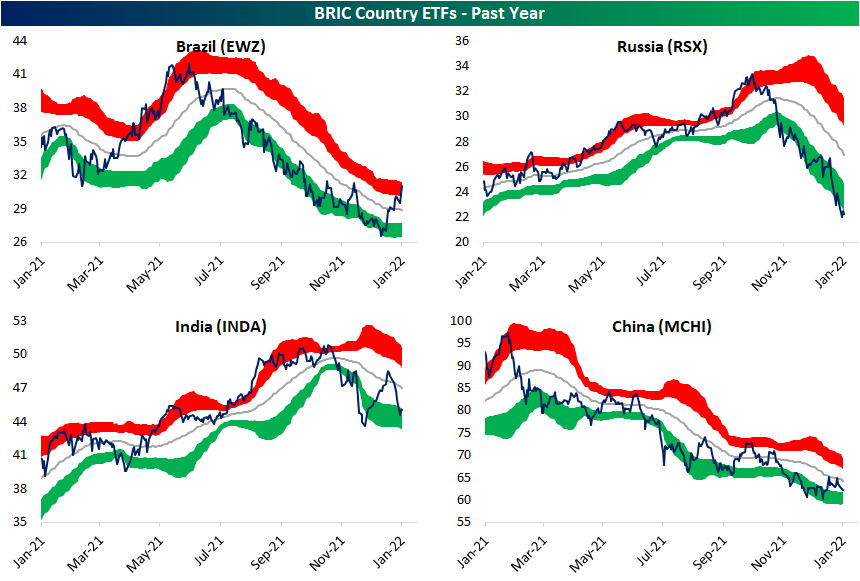
While no other BRIC country ETF has broken out of its downtrend, Hong Kong (EWH) and South Africa (EZA) have both been stronger. That being said, EWH has begun to reverse lower after reaching overbought territory, and EZA failed to take out resistance at the fall highs and has since been consolidating. Click here to view Bespoke’s premium membership options.


Mortgage Rates Surge, Refis Slump
The recent rise in rates has lifted the national average for a 30-year fixed-rate mortgage to 3.68% which is nearly a half percentage point higher than it was just one month ago. That is also the highest rate since April 2020.

Such a large jump in rates in only a month’s span is not totally without historical precedent, but it is on the large side of monthly moves. Going back to 1998, the current one-month change in rates stands in the top 2% of all periods. It is also the largest jump since March 2020.

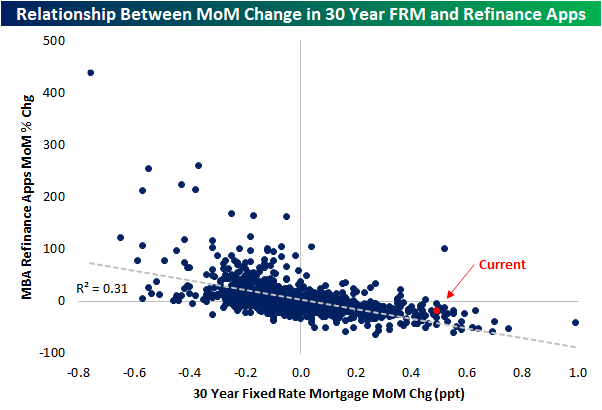
Weekly data from the Mortgage Bankers Association released this morning has reflected that rise in rates. Mortgage applications fell over 7% WoW on a seasonally adjusted basis. Refinance applications experienced a sharper 12.6% WoW decline as the index hit the lowest level since the first week of 2020 bringing the total decline over the past month up to 17.5%. While applications are falling somewhat dramatically, current levels are now only slightly above the historical average.

The moves in refinance applications relative to mortgage rates are consistent with what could be reasoned. As the price to (re)finance a home rises, there will be fewer applications, and the data is consistent with that line of thought. In the chart below, we show the relationship between the MoM changes in mortgage rates and refinance applications. Typically as rates rise, mortgage apps fall and vice versa. The most recent week’s data sits toward a more extreme end of things though the drop in refinance applications is not as large as might have been expected.
Pivoting over to related stocks, the iShares Home Construction ETF (ITB) is up half of one percent today, albeit having come off of the morning’s highs on the weaker than expected MBA numbers and stronger than expected new home sales figures. The bounce over the past few days brings ITB back up toward its 200-DMA which acted as support back in the early fall. Overall, ITB’s pandemic uptrend is also still more or less in place.
Meanwhile, mortgage REITs (which is a more direct play on MBA data) proxied by the iShares Mortgage Real Estate ETF (REM) have gotten hit harder recently with a more defined downtrend since the late fall. While it too is bouncing in the past few sessions with a 1.6% gain today, the technical damage has been more severe than the homebuilders.Click here to view Bespoke’s premium membership options.


Chart of the Day: Gaps Higher After Recent Market Weakness
Bespoke’s Morning Lineup – 1/26/22 – All Eyes on the Fed
See what’s driving market performance around the world in today’s Morning Lineup. Bespoke’s Morning Lineup is the best way to start your trading day. Read it now by starting a two-week trial to Bespoke Premium. CLICK HERE to learn more and start your trial.
“The path to innovation begins with curiosity.” – Robert Iger
It’s not often that one of the top stories on the lead into a mainstream show like “The Today Show” is a Fed Meeting (don’t ask us how we know), but that was the case this morning as market volatility has made its way into the mainstream zeitgeist. Futures are sharply higher this morning with S&P 500 futures trading up 1.5% and the Nasdaq up by over 2%. After dropping sharply immediately after it reported results last night, shares of Microsoft (MSFT) reversed course and are now up over 5%.
The economic calendar is light today with Wholesale Inventories at 8:30 and New Home Sales at 10 AM, but the Fed will take center stage this afternoon with its 2 PM announcement and 2:30 Powell presser.
Read today’s Morning Lineup for a recap of all the major market news and events from around the world, including the latest US and international COVID trends.
It’s been a volatile start to 2022 so far as the Nasdaq is currently on the pace for its 11th 1%+ daily move in 17 trading days so far this month. At a rate of just under 65%, this would rank as the most volatile month for the S&P 500 since March 2021 but is nowhere near the levels of volatility that were experienced during the COVID crash. While this month hasn’t been nearly as volatile as early 2020, looking back all the way to the start of 2010, there have only been a handful of other months where the percentage of daily 1% moves for the Nasdaq in a given month was higher.

Looking further back, though, investors have been relatively spoiled by the lack of volatility. During the Financial Crisis and before that, leading up to the peak of the dot-com bubble, the Nasdaq routinely experienced 1% daily moves during many months.

Start a two-week trial to Bespoke Premium to read today’s full Morning Lineup.