
Bespoke’s Weekly Sector Snapshot — 11/13/25
Chart of the Day: Crypto Flow
Bespoke’s Morning Lineup – 11/13/25 – Goodbye Penny, Hello Thousand-Dollar Club
See what’s driving market performance around the world in today’s Morning Lineup. Bespoke’s Morning Lineup is the best way to start your trading day. Read it now by starting a two-week trial to Bespoke Premium. CLICK HERE to learn more and start your trial.
“We must go on, because we can’t turn back.” – Robert Louis Stevenson

Below is a snippet of commentary from today’s Morning Lineup. Start a two-week trial to Bespoke Premium to view the full report.
It’s over. After 43 days, the longest Federal Government shutdown has ended, and investors don’t know whether to smile or cry. While Washington was closed, the S&P 500 rallied 2.4% and the Nasdaq rallied 3.33%, but the Equal-weight S&P 500 was up just 0.1%, so maybe where you were invested depends on how you feel. Markets aren’t exactly sure how to react either, as equity futures trade modestly lower with the S&P 500 indicated to open down 0.1%. Treasury yields are modestly higher, which makes sense since all they do in Washington is spend money they don’t have. Meanwhile, crude oil is up fractionally after plunging below $60 per barrel yesterday, while gold and bitcoin rally.
In Asia overnight, major equity indices were higher across the board with gains of less than 1%. Loan data out of China was weaker than expected, while PPI in Japan rose less than expected, and employment data in Australia was better than expected.
In Europe, trading has been mixed. The STOXX 600 is down fractionally, led lower by Germany and the UK, while Italy, France, and Spain are all higher. Industrial Production in Europe missed by a lot in September as the year/year growth rate of 1.2% missed forecasts by nearly a full percentage point.
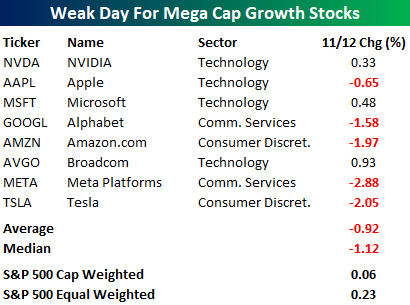
As the Dow rallied to a record high yesterday, the S&P 500 barely gained, and the Nasdaq finished down 0.26% as megacap growth stocks acted as a drag. Of the eight trillion-dollar market cap growth stocks, five finished down on the day, with four trading down over 1%. Their median decline was just over 1% compared to a gain of 0.06% for the cap-weighted S&P 500 and 0.23% for the equal-weighted index.
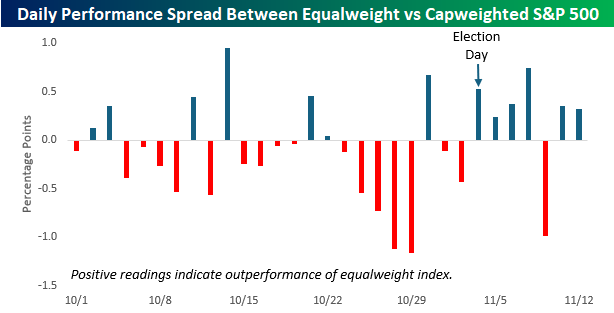
With no economic data to speak of, all anyone could talk about during the shutdown seemed to be the outperformance of the cap-weighted S&P 500 versus the equal-weight index. On 16 of the month’s 23 trading days, the equal-weight index underperformed the cap-weight index, and towards the later part of the month, the daily divergences were increasingly wide, with spreads of more than a full percentage point on 10/28 and 10/29. That certainly raised some eyebrows!
Just as the underperformance of the equal-weight index reached an extreme, though, the trend started to reverse, and so far this month, the equal-weight index has outperformed the cap-weighted index on six out of eight trading days. Since Election Day, when it became clearer that the shutdown was nearing an end, there has only been one day when the equal-weight index underperformed.
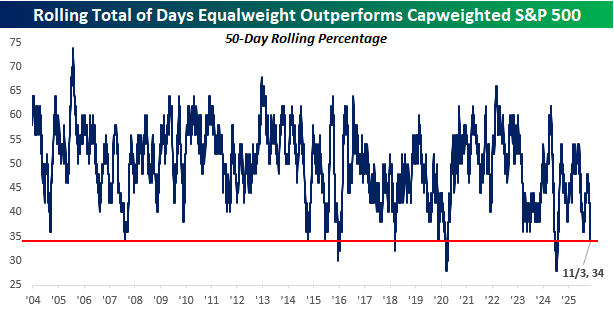
Even with the recent broadening of the market, the overall trend of the cap-weighted index outperforming has remained entrenched. The chart below shows the rolling 50-day percentage of days where the equal-weight S&P 500 outperformed the cap-weighted index. As of 11/3, the percentage dropped to 34% which was the lowest since last summer and a level that has only been breached to the downside a handful of other times in the last 20 years, with all of them occurring in the last ten years as markets have become more concentrated at the top.
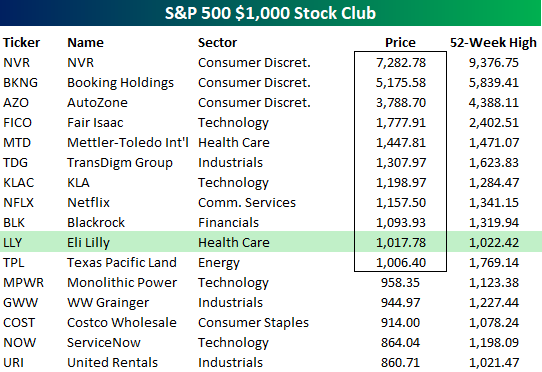
Another notable milestone was reached yesterday as the $1,000 stock price club gained another member when shares of Eli Lilly (LLY) rallied 3% to a record high of $1,017.78. At current prices, LLY is one of eleven companies in the S&P 500 with a four-digit share price, and one of 16 that have had a four-digit share price at some point in the last year. Homebuilder NVR (NVR) and travel company Booking Holdings (BKNG) both have share prices in excess of $5,000, and NVR even got within 6.3% of the five-digit club last November. Just like stock splits, share prices have no meaningful impact on the fundamentals of a company, and are more of a status symbol than anything else, but with the penny going away yesterday, we find it fitting that the $1,000 club got another member, and we only expect to see more in the years ahead. A thousand dollars isn’t what it used to be!
The Closer – Triple Plays, Kids These Days – 11/12/25
Log-in here if you’re a member with access to the Closer.
Looking for deeper insight into markets? In tonight’s Closer sent to Bespoke Institutional clients, we start with a review of the elevated rate of triple plays reported this earnings season (page 1). We then dive into generational differences in wealth, incomes, and employment (pages 2 – 5).
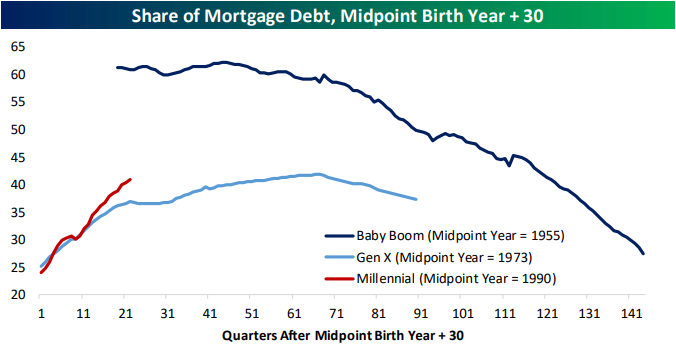
See today’s full post-market Closer and everything else Bespoke publishes by starting a 14-day trial to Bespoke Institutional today!
Daily Sector Snapshot — 11/12/25
Short Interest Update
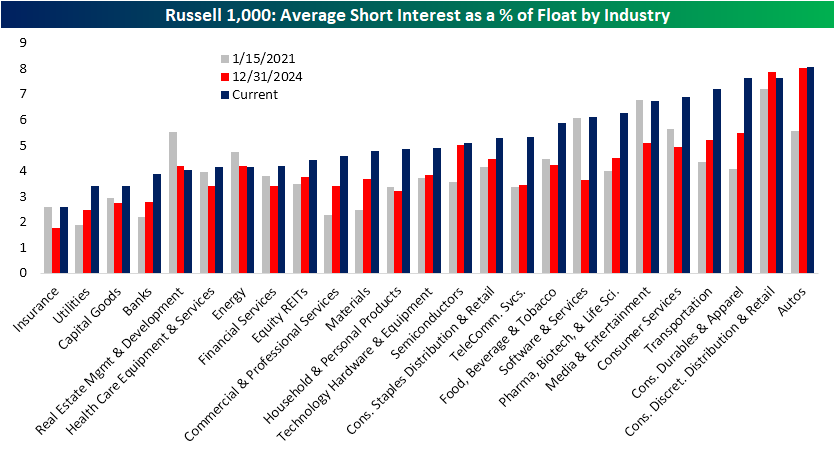
Short interest data through the end of October was published yesterday. For Russell 1,000 stocks, the average stock has 5% of float sold short (median: 3.5%). For the whole of the index, that is up a little over 1 percentage point from the start of the year. In the chart below, we show the average reading across all industries as of 10/31, at the end of last year, and in mid-January 2021, at the height of the meme-stock mania. Current readings are up versus both of those prior periods for Russell 1,000 members. With that said, we would note that for 2021 readings, the Russell 1,000 did not include some of the most heavily shorted and focused-on names like GameStop (GME) and AMC Entertainment (AMC), to name a few.
On an industry level, auto stocks continue to see elevated levels of short interest, largely due to the presence of EV-only names like Lucid (LCID). Behind that, many retailers and consumer-facing stocks make up the list of most shorted, while industries like Consumer Durables and Apparel, Transportation, and Consumer Services have seen some of the largest average increases. Another industry high up on the list of YTD increases has been out of the Tech sector, with Software and Service stocks going from 3.6% average short interest to 6.1% today. Conversely, the only declines in short interest since the start of the year have come out of the Energy and Real Estate Management and Development industries.
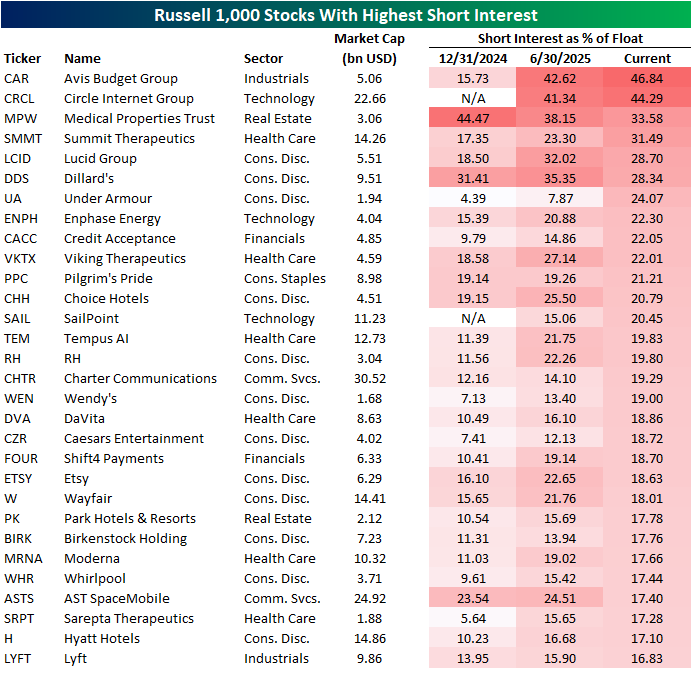
In the table below, we show the individual index members with the highest level of short interest per the latest update. Two stocks have readings above 40%: Avis Budget (CAR) and Circle (CRCL). The latter is a newer stock with an IPO in early June, while the former has seen short interest triple since the start of the year. The third-highest reading in short interest comes from Medical Properties Trust (MPW). While short interest remains high above 30%, it is down from 44.5% entering the year.
Again, CAR has seen short interest triple this year. That is by far the largest uptick of any current Russell 1,000 members. The next largest increase, Under Armour (UA) has seen an increase of less than 20 percentage points so far, although it started 2025 with a mid-single digit reading.
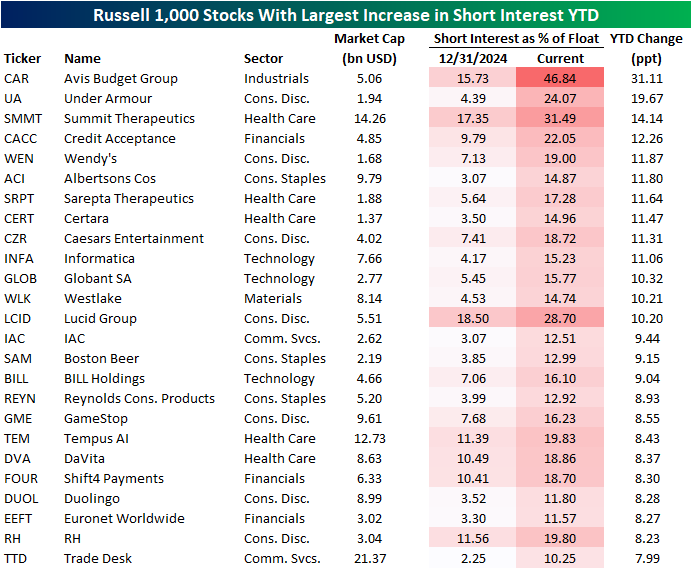

Chart of the Day: Biotech Rally Continues
Bespoke’s Morning Lineup – 11/12/25 – Broader
See what’s driving market performance around the world in today’s Morning Lineup. Bespoke’s Morning Lineup is the best way to start your trading day. Read it now by starting a two-week trial to Bespoke Premium. CLICK HERE to learn more and start your trial.
“Luck’s a revolving door, you just need to know when it’s your time to walk through.” – Stan Lee
Below is a snippet of commentary from today’s Morning Lineup. Start a two-week trial to Bespoke Premium to view the full report.
After two days of gains to start the week, futures are looking to make it a third as the S&P 500 trades up 0.4% while the Nasdaq jumps 0.6%. Treasury yields are lower after being closed for Veterans Day yesterday. Crude oil is down over 1% and back down to testing the $60 level, while gold and crypto trade higher with Bitcoin up over 2% and near $105K, while Ether surges 3.5% to just under $3,600.
Asian stocks were mostly higher overnight. South Korean stocks led the way as the ultimate high-beta country stock market rallied 1.1%, taking its week-to-date gain to 5%. It’s now less than 1.7% from its record closing high just over a week ago. The Nikkei was up 0.4% while China’s Shanghai Composite was down modestly (-0.1%) despite comments from the PBoC that it would maintain its appropriately loose monetary policy stance.
The rally in Asia made its way into Europe this morning, and the STOXX 600 is already up 0.7% in early trading. Most major benchmarks are more than 1% higher, while the UK’s modest decline sticks out like a sore thumb. German CPI rose 0.3% which was right in line with expectations and up from a rate of 0.2% in September, while the UK weakness has been driven by homebuilders after a warning from Taylor Wimpey.
Throughout the shutdown, there was a view that once Election Day passed, we would start to see some movement towards a resolution on the government shutdown. The idea was that Democrats wanted to use the shutdown as an election issue, so once the election passed, some members would cross the aisle. Sure enough, a week after Election Day, the Senate passed the resolution to fund the government, setting the stage for federal workers to get back to work.
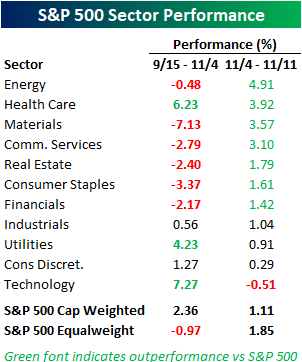
Election Day also served as a catalyst for the market to broaden out. The chart below shows sector performance from mid-September (when the odds of a shutdown on betting markets first exceeded 50%) through Election Day and then in the week since Election Day. During the shutdown period from 9/15 through 11/4, it was a narrow market rally as just three sectors outperformed the S&P 500, led higher by Technology, Health Care, and Utilities. Since Election Day, though, seven out of eleven sectors have outperformed the index as the market broadened out. As a result, the equal-weighted index has performed much better than the cap-weighted index, whereas it seriously lagged the cap-weighted index during the shutdown period.
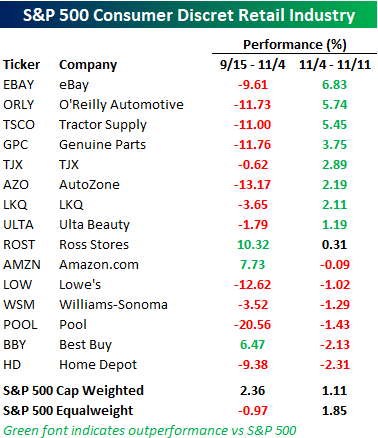
Stocks tied to the consumer have also rebounded. The table below shows the performance of stocks in the S&P 500 Consumer Discretionary and Retail Group during both the “shutdown period” and over the last week. During the shutdown period, just three of the 15 stocks in the group were up as investors avoided the group, as a large block of US consumers weren’t getting paid, and consumers overall retrenched given the uncertainty. On an average basis, they fell 5.7% compared to a gain of 2.36% for the S&P 500, which was driven higher by a handful of mega-cap names. Since Election Day, though, there has been a reversal in the performance of stocks tied to the consumer. 9 of the 15 stocks in the group have seen positive returns over the last week, and 8 of them have outperformed the S&P 500.
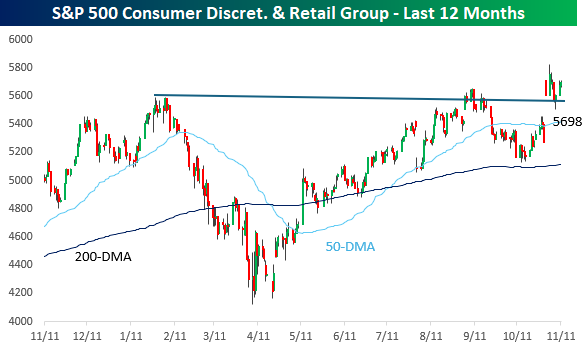
The group’s chart also looks positive. After hitting a marginal new high just before the shutdown, the group pulled back sharply towards its 200-DMA. After that successful test in mid-October, the group has erased all its initial shutdown declines and broken out to new highs and above resistance, forming what some technicians would describe as a positive cup and handle formation. We’ll drink to that!
The Closer – ADP, AI Returns, Sentiment – 11/11/25
Log-in here if you’re a member with access to the Closer.
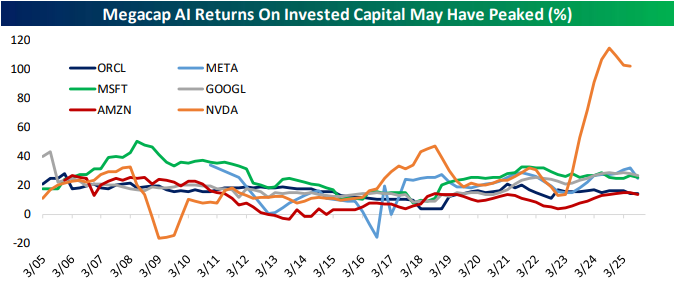
Looking for deeper insight into markets? In tonight’s Closer sent to Bespoke Institutional clients, we begin with a look at weekly ADP employment figures and some news flow surrounding transportation names (page 1). Next, we look at profitability and return on investments and assets for hyper-scalers (page 2) before closing out with a look at various forms of investor sentiment (page 3).
See today’s full post-market Closer and everything else Bespoke publishes by starting a 14-day trial to Bespoke Institutional today!