
Jobless Claims Seasonality Not What It Used to Be
Among a number of better than expected economic data points this morning was initial jobless claims. Seasonally adjusted claims were expected to rise to 205K from an upwardly revised level of 203K last week. Instead, claims were much healthier than expected, dropping all the way down to 187K. As shown below, that puts the indicator within 5K of the late September 2022 low of 182K. Zooming further out, that is also one of the strongest readings on record, ranking in the first percentile of all weeks since the start of the data in 1967.

In reality, before seasonal adjustment, claims are much higher at 289.2K as the reading is currently working off a seasonal peak. However, that is not to say claims are weak. As shown in the first chart below, versus comparable weeks of the year going back to 2004, this most recent reading was only slightly above where they stood this time last year. In fact, that reading last year currently stands as the record low for the second week of the year of all years going back to 1967. Looking ahead to next week, another week-over-week decline is more than likely given it is the week of the year with perhaps the strongest seasonal tendencies. Going over the history of the data, there has not been a single time that NSA claims have risen week over week in the third week of the year.

As previously mentioned, claims tend to spike to seasonal highs around now, and there has been only one previous time that NSA claims have been lower in the second week of the year, and that was in 2023. But looking back over the past several years shows that the strong reading on claims for this time of year even pre-dates COVID. As shown below, in the 50 years from 1967 through 2016, the second week of the year averaged 656.5K for NSA claims. But since 2017 (excluding 2021 when claims were an outlier with far more elevated readings due to the pandemic) those same weeks have averaged a significantly lower reading of 340.3K. Put differently, the seasonally elevated level that claims have begun the year at is not exactly what it used to be.

Looking at things from another angle, below we show the percent change in NSA claims during the period that the indicator has historically experienced its seasonal runup, lasting roughly from September through the first couple of weeks of the new year. As shown, since the late 1990s, that seasonal climb has been trending smaller and smaller in size. All together, that means there appears to have been some structural changes in seasonal patterns over the past couple decades (which could also have implications for the seasonally adjusted number understating). As a result of a smaller seasonal spike, claims have spent the first few weeks of the year at lower levels than may have been the case in the past.

Finally, we would note that in addition to strong initial claims, seasonally adjusted continuing claims have also continued to roll over, totaling 1.806 million last week. That was a solid decline versus 1.834 million the previous week compared to an expected increase to 1.84 million. That also sets a three month low in continuing claims.


Chart of the Day – Winners And Losers Abound Less Than Three Weeks In
B.I.G. Tips – Weight Loss Drugs Giving AI a Run for Its Money
Bespoke’s Morning Lineup – 1/18/24 – Strong Data
See what’s driving market performance around the world in today’s Morning Lineup. Bespoke’s Morning Lineup is the best way to start your trading day. Read it now by starting a two-week trial to Bespoke Premium. CLICK HERE to learn more and start your trial.
“The man who wants to lead the orchestra must turn his back on the crowd.” – Captain Cook
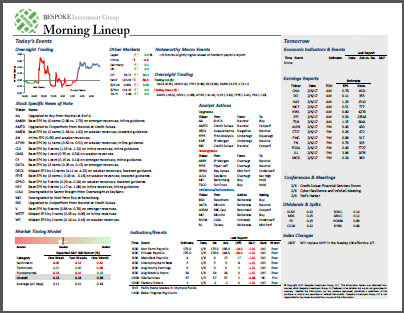
Below is a snippet of commentary from today’s Morning Lineup. Start a two-week trial to Bespoke Premium to view the full report.
It’s looking like a much more positive start to the day than many others recently as the S&P 500 is indicated to open up by about half a percent, and the Nasdaq is looking at a 1% gain. A strong batch of economic data has put a little bit of a damper on things as rates ticked higher, but outside of the Dow where a large decline in UnitedHealth (UNH) is weighing in the index, the start of the trading day at least looks to be positive.
As far as the economic data is concerned, both Building Permits and Housing Starts came in better than expected, initial jobless claims dropped to 187K for the lowest reading since last January, continuing claims also beat, and even though the Philly Fed report was weaker than expected (-10.6 vs -6.5 expected), it wasn’t near the disaster that the Empire Manufacturing report was earlier in the week.
Anyone who was expecting a continued broadening out of the market in 2024 has been majorly disappointed by how the year has started. Eleven trading days into the year, the cap-weighted S&P 500 has declined 0.64%, but the equal-weighted version of the index is down much more with a decline of 2.55%. That puts the performance spread between the two indices at 1.91 percentage points and represents the widest performance gap eleven trading days into the year in favor of the market cap weighted index since at least 1990.
It may sound hard to believe, but this year’s outperformance on the part of the market cap weighted index ends a streak of three years where the equal weighted index outperformed the cap weighted index at the year’s outset. In two of those three years, the trend reversed for the remainder of the year as the cap weighted index outperformed the equal weighted index, including last year where the gap in favor of the cap weighted index was the second highest of any year since 1990 trailing only 1998. Looking more broadly, in the 34 years since 1990, the direction of the performance gap between the cap weighted versus the equal weighted index eleven trading days into the year continued in the same direction for the remainder of the year less than 60% of the time. In other words, it’s hardly set in stone that just because the cap weighted index came out of the year strong this year doesn’t necessarily mean it will continue for the remainder of the year.

Sign up for a two-week trial to Bespoke Premium to continue reading more of today’s macro analysis.
Daily Sector Snapshot — 1/17/24
Bespoke Baskets Update — January 2024
Chart of the Day – Intraday Tops After Hours in 2024
B.I.G. Tips – Hunky Dory Retail Sales: Six Straight Better Than Expected Prints
Bespoke’s Morning Lineup – 1/17/24 – Busy Economic Calendar
See what’s driving market performance around the world in today’s Morning Lineup. Bespoke’s Morning Lineup is the best way to start your trading day. Read it now by starting a two-week trial to Bespoke Premium. CLICK HERE to learn more and start your trial.
“We must guard against the acquisition of unwarranted influence, whether sought or unsought, by the military-industrial complex. The potential for the disastrous rise of misplaced power exists and will persist.” – Dwight D. Eisenhower, 1/17/61
Below is a snippet of commentary from today’s Morning Lineup. Start a two-week trial to Bespoke Premium to view the full report.
It’s not a pretty morning for risk assets as Asian stocks, specifically China, were down sharply overnight, and Europe is down sharply this morning after ECB President Lagarde followed the lead of US central bankers when she noted that rate cuts aren’t likely to start until the Summer and UK inflation came in higher than expected. Here in the US, it’s a busy day of economic data. Retail Sales and Import Prices were just released, and they both came in higher than expected. On the docket, we have Industrial Production and Capacity Utilization at 9:15 and then Business Inventories and Homebuilder Sentiment at 10 AM.
When comments like the above are made today, the people making them are often written off by the mainstream as candidates being on the fringe, but President Dwight D. Eisenhower made the statement above as part of a nationally televised farewell speech from the Oval Office when his approval rating was just under 60%. Eisenhower’s concerns stemmed from the fact that after multiple major wars, the US defense industry was becoming a much larger share and player within the US economy, and he was pointing out that as its size grew, so too would its influence.
During Eisenhower’s last year in office (1960), total US defense spending, according to the World Bank, was $47 billion. Within 16 years, defense spending had doubled, and just six years later, it had more than doubled again to over $220 billion. Under Reagan, spending steadily increased and reached a short-term peak in 1990 at $325 billion. For the remainder of George H. Bush’s term through most of Clinton’s entire time in office, total spending actually drifted lower but then surged exponentially after 9/11. Spending then generally declined for most of Obama’s time in office and then ramped back up again after Trump came into office (“When I took over our military, we didn’t have ammunition”). As of 2022, the latest year of available figures, total defense spending in the US reached $877 billion, or more than 18 times the level during Eisenhower’s last year in office.

While it may look as though defense spending has only become a larger influence on the US economy since Eisenhower left the Oval Office for the last time, when measured as a percent of GDP, defense spending has generally been on the decline. During Eisenhower’s last year in office, total defense spending equaled about 9% of GDP, and through the decades steadily declined to a low of 3.09% of GDP in 1999 during Clinton’s second to last year in office. Again, spending ballooned as a percent of GDP during George W Bush’s Presidency after the 9/11 attacks, but then started to decline again after Obama came into office. While total dollar-spending surged after Trump came into office, as a share of the economy, the increase looks much more subdued.

In terms of the current US geo-political picture, it’s hard to remember a time when more fires were smoldering around the world, so you would think that it would be a great time for defense contractors. Based on the performance of the largest US defense contractors over the last year, though, that has hardly been the case. The chart below shows the one-year performance of the five largest defense contractors (market cap greater than $50 billion), and during that time, TransDigm (TDG) is the only one that is outperforming the S&P 500. Of the remaining four, two are up less than 4% while Boeing (BA) is down over 5% and RTX is down over 13%. BA is facing its own issues as the company tries to get its act together, but for the other companies rising geo-political instability hasn’t necessarily been good for their stocks.

Sign up for a two-week trial to Bespoke Premium to continue reading more of today’s macro analysis.