
ETF Trends: International – 4/12/16
NFIB Small Business Optimism Falls For Third Month Straight
A “chartist” looking at the data historically might conclude that the Index has clearly hit a top and is flashing a recession signal.
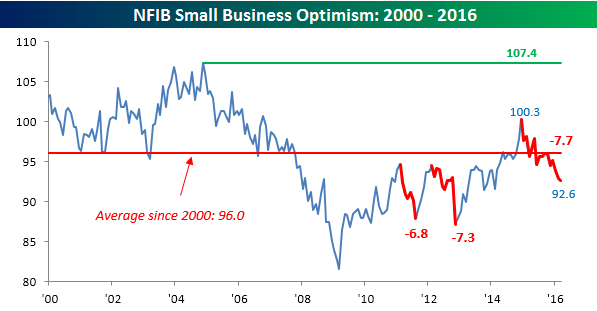
Ouch. The above line from this month’s NFIB monthly economic trends report doesn’t pull any punches regarding the state of sentiment among small businesses in the US. As the chart below illustrates, the NFIB’s overall index of small business optimism has declined for three straight months, extending what has been its largest peak to trough decline of the current economic expansion, and taking the index down to its lowest level since February 2014. Not only has the headline index declined for three straight months, but it has also missed expectations in each of those months.
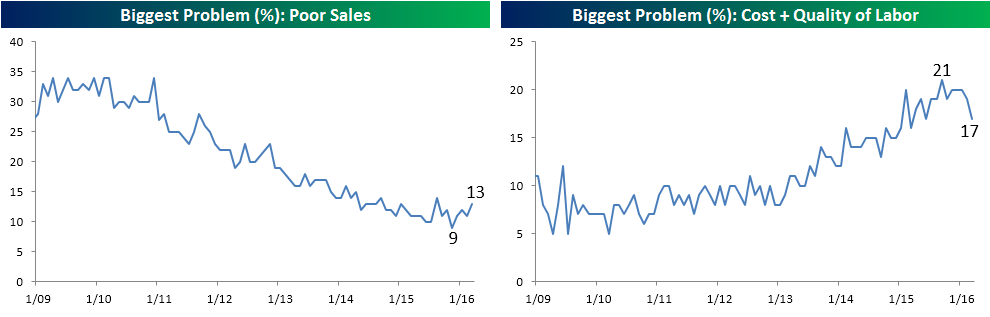
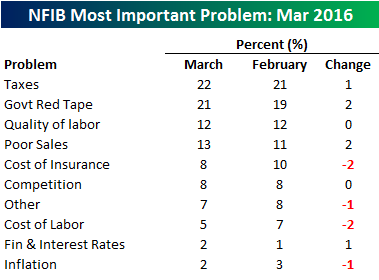 The table to the right breaks down which issues small businesses consider to be their number one problem. Topping the list this month (like they do every other month) are the issues of Taxes and Government Regulation/Red Tape. Both issues saw the percentage citing them increase this month, taking the combined total up to 43%. Behind these two issues, Poor Sales saw the percentage citing it as the number one problem increase by two percentage points up to 13%. Back in November, this issue bottomed out at 9% but has seen a pretty steady increase over the last four months. As businesses have become increasingly worried about sales, concerns over the cost and/or quality of labor have declined by a proportionate amount.
Start a trial now to get Bespoke’s premium research free for the next two weeks.
The Closer 4/11/16 – “Education: Have We Reached A Peak?”
Looking for deeper insight on global markets and economics? Tonight in The Closer we dive into education: its impact on workers, debt, and investment are all examined.
The Closer also includes its standard charts, large volume and price movers in the US equity market, and Bespoke’s Market Timing Model. The Closer is one of our most popular reports, and you can sign up for a trial below to see it free for the next two weeks!
[thrive_leads id=’58717′]ETF Trends: US Sectors & Groups – 4/11/16
B.I.G. Tips – Analysts Negative Heading Into Earnings Season…Again!
Chart of the Day: Gold (4/11/16)
Earnings Season Sector Beat Rates and Volatility
Earnings season is a great time to start a 14-day no obligation free trial to receive Bespoke’s paid content. Our subscription packages have some of the most in-depth earnings season coverage that you’ll find. Start a trial now with just your name and email.
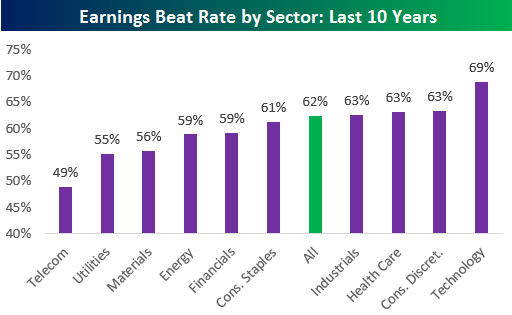
Earnings season starts after the close today with Alcoa’s (AA) report. Bespoke Institutional members have access to our Interactive Earnings Report Database, which contains detailed quarterly information for nearly every US company that has reported numbers over the last 15 years. We recently analyzed the more than 70,000 individual earnings reports that have been released over the last ten years to put together some notable sector stats. In the chart below, we highlight the percentage of companies that have beaten consensus analyst earnings estimates by sector over the last ten years.
As shown, the earnings beat rate for all stocks that have reported over the last ten years has been 62%. So just over six stocks in ten beat their quarterly EPS estimates. Technology sector stocks beat earnings at a much higher rate — 69%. That’s six percentage points above the next closest sectors — Consumer Discretionary, Health Care, and Industrials, which all have beat rates of 63%.
The Telecom sector has the lowest beat rate and the only beat rate that is less than 50%. Utilities, Materials, Energy and Financials all have beat rates below 60%.
In terms of stock price volatility in reaction to earnings, the average one-day change on the first trading day following earnings for all stocks that have reported over the last ten years has been +/-5.3%. That means you can expect any given stock to move just over 5% (up or down) on its earnings reaction day. (For stocks that report in the AM before the open, we use that day’s change. For stocks that report after the close, we use the next day’s change.)
While it has the highest earnings beat rate, Technology stocks also experience the biggest moves in reaction to earnings. As shown below, the average Tech stock that reports earnings experiences a one-day change of +/-6.97% on its earnings reaction day. That’s nearly 1.7 percentage points higher than the average for all stocks. Behind Technology is Consumer Discretionary, whose stocks average a one-day change of +/-6.33% on earnings. Health Care ranks third at +/-5.64%.
While Tech stocks see the biggest moves in reaction to earnings, Utilities stocks see the smallest moves. The average Utilities stock that has reported earnings over the last ten years has moved just +/-2.02% on its earnings reaction day.
It makes total sense that Technology stocks would move more in reaction to earnings than Utilities stocks. The numbers below just show you how much more.
Start a trial now to get Bespoke’s premium earnings coverage.

Bespoke Stock Seasonality: 4/11/16
Dynamic Upgrades/Downgrades: 4/11/16
Bespoke Brunch Reads: 4/10/16
Welcome to Bespoke Brunch Reads — a linkfest of the favorite things we read over the past week. The links are mostly market related, but there are some other interesting subjects covered as well. The links are in no particular order. We hope you enjoy the food for thought as a supplement to the research we provide you during the week.
The Panama Papers
Last Sunday, the International Consortium of Investigative Journalists started to release reporting on a trove of millions of documents spirited out of Panamanian law firm Mossack Fonseca. A full set of links can be found here, but below we’ve plucked a couple of the more interesting stories; we’ll let the headlines speak for themselves. UK PM David Cameron has been implicated in what appears to be a legal investment orchestrated by Fonseca (link), and the Icelandic PM has resigned after he was revealed to be shielding bank investments in an offshore vehicle (link).
Panama Papers: Mossack Fonseca leak reveals elite’s tax havens by Richard Bilton (BBC) [Link]
Revealed: the $2bn offshore trail that leads to Vladimir Putin by Luke Harding (The Guardian) [Link]
How Reporters Pulled Off the Panama Papers, the Biggest Leak in Whistleblower History by Andy Greenberg (Wired) [Link]
Nearly Every Latin American Country Is Using This Software To Spy On Their Citizens by Karla Zabludovsky and Sheera Frenkel (Buzzfeed)
In an altogether not shocking follow up to our discussion of hacking and Latin American elections last week, Buzzfeed has chased down evidence that numerous governments are engaged in similar, if less dramatic, clandestine hacking of their citizens. [Link]
How a Dogged L.A. DEA Agent Unraveled the CIA’s Alleged Role in the Murder of Kiki Camarena by Jason McGahan (LA Weekly)
There’s really no way to describe this story, which reads more like a fantasy spy novel than reality. Some of the details are impossible to confirm, so take with a grain of salt….but nonetheless an enthralling read on US power and Latin America. [Link]
Lunch With The FT: Nigel Farage by Henry Mance (FT)
The paywall-free Lunch With The FT series is just fantastic and deeply amusing, with many of the most prominent and controversial figures in pop culture, finance, and politics getting the “where should we go?” treatment. These are typically “proper”, aka alcohol-assisted, affairs and usually either amusing or deeply revealing if not both. This week, it’s the populist UKIP leader and Brexit campaigner Nigel Farage. [Link]
A capital constraint by James W. Paulsen, Ph.D (Wells Fargo Asset Management)
The US labor force has grown much faster than the economy’s physical capital over the last five years, and that has implications for the economy as a whole per the Wells Asset Management Chief Investment Strategist. [Link, PDF]
So Just How Much of an Overshoot on Inflation Will the Fed Tolerate? By Timothy A. Duy (Bloomberg)
Oregon economics professor and Fed watcher Duy walks through his interpretation of whether the FOMC will be comfortable with inflation above their 2% target. [Link]
The Gig Economy Is Powered by Old People by Justin Fox (Bloomberg View)
The demographics of the gig economy (people working temporarily on short-term jobs) are often pitched as a Millennial thing. But as Fox reveals, that’s not in sync with reality. [Link]
Millennials are being dot.conned by cult-like tech companies by Kyle Smith (New York Post)
While Millennials may not be the drivers of the gig economy, they are the drivers of start-ups. And working conditions that may involve them leaving quite a lot on the table. [Link]
Millennial Employees Confound Big Banks by Daniel Huang and Lindsay Gellman (WSJ)
The average junior banker has only been employed at their firm for 1.4 years. That attrition level is one that many Wall Street firms are trying to change. [Link, paywall]
U.K. Banks Struggle to Lure Talent for Top Jobs as Rules Bite by Stephen Morris and Ambereen Choudhury (Bloomberg)
Elsewhere in finance labor shortages, the top of the food chain is also having retention issues as new regulation makes those positions less remunerative and much riskier. [Link]
Bitcoin’s Blockchain Technology Proves Itself in Wall Street Test by Telis Demos (WSJ)
A clearing technology that can help settle trades on a bilateral basis (without a trusted third party record keeper such as a clearinghouse like the CME or the LCH) has helped settle a credit default swap trade in an important step forward for the technology. [Link, paywall]
The Unraveling of a Wall Street Scion by Serena Ng, Bradley Hope, Christopher M. Matthews, and Rob Copeland (WSJ)
One of the more salacious frauds in recent memory is being revealed as the son of a billionaire is charged by the Justice Department and SEC presiding over a $95 million scam. [Link, paywall]
Banks’ Favorite New Strategy: Footnote 151 by Katy Burne and Ryan Tracy (WSJ)
A little-mentioned footnote that alleviates capital requirements for very short-term swaps with extremely low risk is being used to reduce requirements on longer-dated derivatives. [Link, paywall]
Sequoia Fund Symbolizes What Was, But No Longer Is by Johbn Rekenthaler (Morningstar)
A 30% weighting in embattled pharmaceutical company Valeant has punished SEQUX shareholders, spurring lawsuits and a re-evaluation of the fund’s reputation. [Link]
How the world’s currencies got their names by Alex Lockie (World Economic Forum)
A handy – and fascinating – lexicon of lucre around the world. [Link]
We Finally Know Why the North Pole Is Moving East by Maddie Stone (Gizmodo)
In an interesting twist on planetary physics, recent data on the distribution of water around the planet’s surface produced by NASA has helped shed light on what has Santa’s Workshop wandering. [Link]
Swim. Bike. Cheat? by Sarah Lyall (NYT)
A cheating scandal has erupted in the elite world of Ironman triathalons, where a local hero’s win at the Whistler event has come into question. The result is a unique human drama. [Link, soft paywall]
Yale Made 93% a Year on Venture Capital in Past Two Decades by Janet Lorin (Bloomberg)
An interesting breakdown of the gaudy returns earned investing in early-stage companies by the endowment which finances Yale’s operations and investment. [Link]
EU considers restricting visa-free travel for Americans, Canadians by Tara Palmeri and Maia De La Baume (Politico)
In an example of the unintended consequences of policy, North American rules that prevent visits without visas for citizens of Bulgaria, Croatia, Cyprus, Poland and Romania could mean that citizens of Canada and the US are unable to fly to the entire EU without apply for a visa first. [Link]
Spain’s Prime Minister set to ‘drop siesta’ to shorten working day by two hours by Matt Payton (The Independent)
In productivity news, Spaniards may no longer get an afternoon nap and late hours afterwards, with PM Rajoy seeking to align the standard work day with the rest of the continent. [Link]
‘Hamilton’: Who’s Making Millions Off Broadway’s Hottest Show by Rebecca Sun (The Hollywood Reporter)
An interesting look at the economics of a Broadway smash hit, which the hip-hop oriented and diversely casted Hamilton has managed to do and then some in one of the biggest musical hits in years. [Link]
Medium Takes Aim at WordPress With a New Way to Power Websites by Jessi Hempel (Wired)
We often link to pieces hosted on Medium and with good reason; the platform does a good job encouraging high quality, thoughtful reads. Now the company is aiming to help publishers make money through their platform. [Link]
How Drugs and Alcohol Fueled the 1986 Mets to a Championship by Ron Darling (WSJ)
Revealing, and indeed perhaps trust-breaking, revelations on the culture of Major League Baseball as observed by former Game 7 World Series starter Ron Darling. [Link, paywall]