Top and Bottom Line Beat Rates: Q1 2016
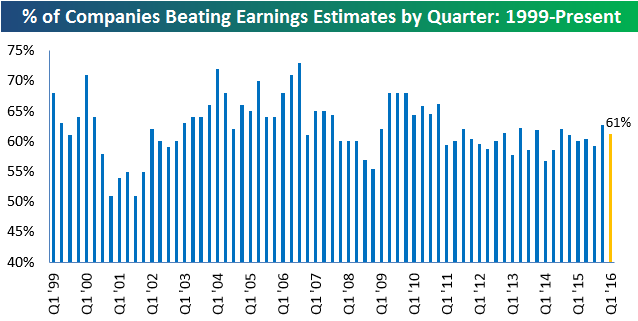
More than 2,000 companies have reported their Q1 2016 numbers so far this earnings season, and below is a look at the percentage of companies that have reported stronger than expected EPS and revenues. The first chart below shows the bottom-line earnings beat rate (% of companies posting EPS that are above consensus analyst estimates) by quarter going back to 1999. As shown, so far this season, 61% of companies have beaten estimates. As recently as last Monday, the beat rate for this season was tracking at 65%, which would have been the strongest reading since 2010. But last week’s reports really brought down the overall beat-rate tally, and now this season is tracking below last season’s.
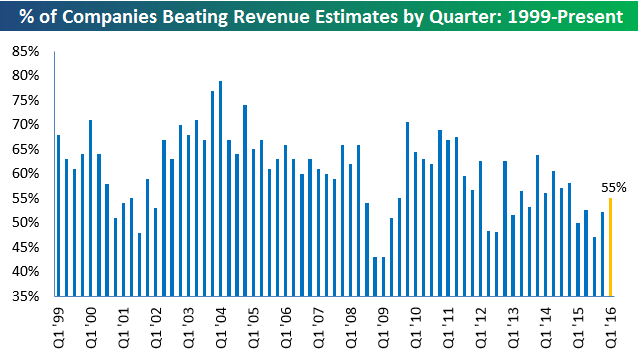
The top-line revenue beat rate is much harder for companies to massage each quarter, and that’s why many investors put more stock in it over the earnings beat rate. So far this season, 55% of companies have beaten consensus analyst revenue estimates. That’s six percentage points below the bottom-line EPS beat rate, but it also would be the strongest revenue beat rate since Q4 2014 if it can hold.
Wal-Mart (WMT) reports earnings in the middle of next week, and Wal-Mart’s report is the unofficial end to earnings season. Hundreds more companies will report between now and then, so there’s still time for these readings to shift a bit.
Start a 14-day no obligation free trial to our premium research platform for more earnings season analysis.
Bespoke Brunch Reads: 5/8/16
Welcome to Bespoke Brunch Reads — a linkfest of the favorite things we read over the past week. The links are mostly market related, but there are some other interesting subjects covered as well. We hope you enjoy the food for thought as a supplement to the research we provide you during the week.
Business Model Troubles
The Hazards of Financial Engineering by James Mackintosh (WSJ)
An overview of the efforts by various companies (including the SUNE complex and Valeant) to use debt and complexity to engineer stock gains. [Link, paywall]
This area of startup investing has fallen off a cliff by Matt Rosoff (Business Insider)
As labor markets have tightened, start-ups best described as “Uber, but for…” are seeing much lower levels of funding. [Link]
Inside Palantir, Silicon Valley’s Most Secretive Company by William Alder (Buzzfeed)
An overview of the secretive security company run founded by Peter Thiel, which has run into trouble retaining clients and generating revenue. [Link]
Kick Your New-Store Habit, Retailers by Shelly Banjo (Bloomberg)
An overview of the glut in retail square footage, which is more than twice as high per capita in the United States as in the next highest developed market (Australia). [Link]
Lending Disruption
The Uberization of Banking by Andy Kessler (WSJ)
An interview with SoFi founder Mike Cagney. Sample quote: “The overbearing regulator that was Elizabeth Warren’s brainchild thus far hasn’t come down on SoFi”. [Link]
SoFi offers equity to tempt new partners by Ben McLannahan (FT)
Running out of funding options, SoFi is hoping that lenders will offer commitments to fund new loans in exchange for equity in the fast-growing company. [Link, soft paywall]
Prosper Marketplace to Cut Jobs and Shuffle Executives by Telis Demos and Peter Rudegair (WSJ)
An online consumer lender similar to SoFi is pulling back from several markets as loan volumes decline and performance is questioned. [Link, paywall]
Autonomous Vehicles
GM, Lyft to Test Self-Driving Electric Taxis by Mike Ramsey and Gautham Nagesh (WSJ)
The age of autonomous vehicles may be closer than we think as a major ridesharing startup and one of the largest auto OEMs in the world prepare to start real-world testing. [Link, paywall]
Billions Are Being Invested in a Robot That Americans Don’t Want by Keith Neaghton (Bloomberg)
An overview of the effort to convince consumers that efforts to build autonomous vehicles are being sunk into a project that will actually be purchased. [Link]
Strange Internet
_9MOTHER9HORSE9EYES9: the mysterious tale terrifying Reddit by Leigh Alexander (The Guardian)
The extremely odd tale of a story written on Reddit, unleashed over time in the comment threads around the site. [Link]
Anonymous attack Greek central bank, warns others by George Georgiopoulos (Reuters)
Online hacking group (with anarchist tendencies) Anonymous has decided to wage a campaign against central banks. The already embattled Greek one was the first target. [Link]
Facebook pays $10,000 to 10-year-old Instagram hacker by Tuomas Foresell (Reuters)
A Finnish child discovered a major flaw in Instagram’s security. His reward was a lot of money for a ten year old but seems a bit paltry given that he may have averted a significant security issue for the company and its users. [Link]
Sports
Why NBA Players Lie About Their Height by Chris Herring (WSJ)
The peculiar sets of incentives that cajole NBA players to exaggerate or diminish their actual heights; depending on the situation, both take place. [Link, paywall]
‘We’ve Come To Win The League!’ by Wright Thompson (ESPN)
An oral history of Leicester, who were pegged at 5000-to-1 odds to win the English Premier League at the start of the season, but clinched that victory this week. [Link]
Evolving Markets
Index Investing Makes Markets and Economies More Efficient by Jesse Livermore (Philosophical Economics)
Pseudonymous blogger Livermore makes a compelling case that the markets are not made less efficient by large numbers of index-only investors. [Link]
FastMatch leading talks to create central tape for FX by Solomon Teague (Euromoney)
The current structure of FX markets are quite messy: there’s no central ledger recording the various transactions across electronic networks that support trading. A central tape would be a significant step towards transparency. [Link]
US Treasury debates new-for-old bond swap by Joe Rennsion (FT)
An interesting overview of a new plan for the US Treasury to buy back old bonds that trade at higher yields than newer issues. The result would be bigger auctions and lower cost of issuance for the Treasury with no impact on the overall size of the debt stock. [Link, soft paywall]
Regulators Want to Slow Runs on Derivatives by Matt Levine (Bloomberg)
A deep look into the regulatory and theoretical exercise around what might happen if a large financial institution had to be resolved out of bankruptcy. Wonky, but interesting. [Link]
The Book That Will Save Banking From Itself by Michael Lewis (Bloomberg)
A typically Lewisian yarn on the subject of former Bank of England Governor Mervyn King’s new book, including a summary of its themes. [Link]
Geopolitics
There Are So Many Warplanes Over Iraq That Baghdad’s Air Traffic Controllers Can’t Keep Up by Joseph Trevithick (War Is Boring)
With planes and drones running constant combat missions over Syria and Iraq, the airspace over northern Iraq is so dense that a Danish support unit is being called in with a new radar unit to help keep planes from colliding. [Link]
Royal Navy fires warning shot at Spanish patrol boat ‘hassling’ US nuclear submarine attempting to dock at Gibraltar by Julian Robinsion (Daily Mail)
The UK’s sovereignty over Gibraltar and Spain’s distaste for that particular relationship isn’t under any sort of legal uncertainty. But that hasn’t stopped a Spanish patrol boat from harassing an American nuclear submarine making a friendly visit to the British port. This was a confusing and perplexing story given that all involved navies are NATO allies. [Link]
Why Europe’s energy policy has been a strategic success story by Time Boersma and Michael E. O’Hanlon (Brookings)
A major international effort has made Europe dramatically less reliant on Russia for natural gas. While 1/3rd of the gas consumed in Europe comes from Russia still, new distribution networks and storage points have made the continent much more resilient. [Link]
Erdoğan gets his wish by Emad Mostaque (Governments and Markets)
An overview of the current political situation in Turkey and what could be next for the country, by Ecstrat analyst Mostaque. [Link]
Real Estate
The Hamptons Housing Market Is Getting Clobbered by Wall Street Jitters by Emily Jane Fox (Vanity Fair)
The volatility and generally trendless price action in financial markets are adding to a strong dollar’s problematic impact on housing in the elite getaways at the eastern tip of Long Island. [Link]
Affordable Starter Homes Prove Increasingly Elusive by Chris Kirkham (WSJ)
An excellent overview of the struggles homebuilders have completing houses at reasonable cost; high prices for land have pushed starter homes out to the exurban edge of most major metros. [Link, paywall]
Local Taxes
Princeton’s Neighbors Say to Heck With Freebies — We Want Cash by Elise Young (Bloomberg)
Residents of Princeton, New Jersey are suing the university. Their aim is to collect property taxes, reducing the tax burden on homeowners in the area. [Link]
CT’s top taxpayers took a big earnings hit last year by Keith M. Phaneuf (The CT Mirror)
Declining profits at hedge funds are hitting the incomes of Connecticut’s top tax filers; the lower incomes of the 50 largest filers alone could reduce income tax revenues by $217 million for this quarter alone. [Link]
Millennials
How Millennials Ended the Running Boom by Rachel Bachman (WSJ)
After years of surging race registration, many young adults are now pivoting to less competitive classes for their fitness. [Link]
This Year’s College Grads Are The Luckiest In A Decade by Ben Casselman (538)
The starting salaries and wage growth achieved by college graduates are seeing their best levels in years as labor markets tighten and the economy improves, per this excellent analysis of Census microdata conducted by 538. [Link]
Abuse
“You Want A Description of Hell?” Oxycontin’s 12-Hour Problem by Harriet Ryan, Lisa Girion, and Scott Glover (LATimes)
A frankly terrifying overview of the chemistry, economics, and social impact of Oxycontin and why it’s a prime driver being the surging prescription drug abuse problem. [Link]
Enron culprit Andy Fastow’s ugly tale and sobering warning by Cheryl Hall (Dallas Morning News)
A summary of the speaking tour currently being held by Enron co-conspirator Andy Fastow, with a full review of his story and current point of view. [Link]
China
China Evicts Investment Firms Amid Fears of Unrest (Bloomberg)
A painful summary of the efforts by Chinese regulators and overseers to keep angry customers from taking violent revenge on companies that offered high risk investments to retail investors. [Link]
Media Matters
Here’s what Business Insider employees just said about why people are leaving by Tom Kludt (CNN)
The sale of Business Insider to Axel Springer marked something of a high point in this cycle of digital media businesses. Since then, it’s been a rockier path. [Link]
Random
Putting the Tesla HEPA Filter and Bioweapon Defense Mode to the Test (Tesla)
Say what you want about Tesla as an investment (positive or negative!), but we can’t get enough of their products. What other car company has a “Bioweapon Defense Mode”?
This Is Why So Many Labrador Retrievers Are So Very Fat by Melissa Dahl
The chubby pups are just following the genetic instructions of a mutation in their genome, and that has implications for humans too. [Link]
Start a 14-day no obligation free trial to sample Bespoke’s premium research. Our Bespoke Report newsletter sent to paid members every Friday is a great read if you’re looking for additional weekend reading.
The Bespoke Report – 5/6/16
Each week, Bespoke sends clients across all of its subscription levels the Bespoke Report newsletter. If you’re looking for Bespoke’s analysis of current market internals, economic data, earnings beats and misses, individual stock ideas, and more, the Bespoke Report has it all.
Continue reading this week’s Bespoke Report by starting a 14-day no-obligation free trial to our paid research platform.
Have a great weekend!
S&P 500 Weekly Chart Book — 5/6/16
S&P 500 Tests and Holds 50-Day Moving Average
Start a 14-day no obligation free trial to our premium research platform to see more of our market analysis.
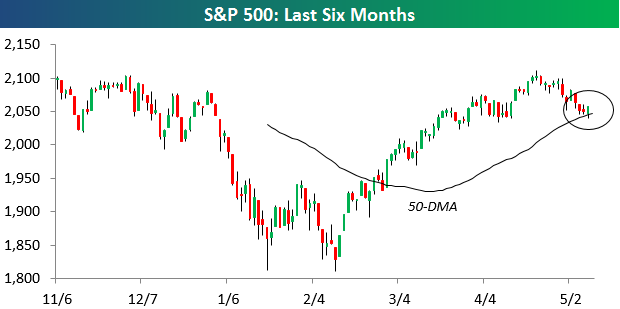
The S&P 500 has pulled back roughly 3% from its 4/20 closing high. Today the S&P had its first test of its 50-day moving average (DMA) during this pullback. Although the index breached its 50-DMA on an intraday basis, it managed to close nicely above it with a rally into the close. Chart watchers and technicians can sleep easy this weekend.
The Best Horse At The Derby? CHDN
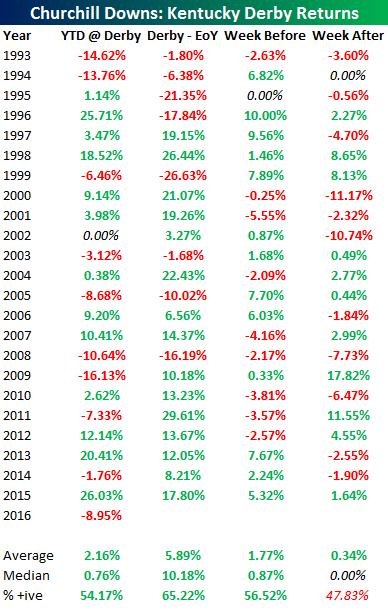
With the Kentucky Derby this weekend, we thought we’d take a look at the returns for Churchill Downs (CHDN) around the track’s iconic event. (Yes, Churchill Downs is a public company.) While the broad market may follow a “sell in May, go away” pattern with lower than average returns between May and October, CHDN is the opposite. From the start of the year through the running of the Derby on the first Saturday each May, CHDN has a sub-par median return of 0.76% since its IPO in 1993. But returns are better than double that from the running of the Derby through the end of the year, with +5.9% returns on average and +10.18% median; positive returns go from little better than a coin flip pre-Derby to 65% of the time post-Derby.
The week before the Derby (which we just saw) delivers average returns of 1.77%, while the week after is typically a buying opportunity for the second half rally, delivering 0.34% returns on average with a median of zero and worse than a coin flip in terms of win percentage. Below we table up the historic returns for Churchill Downs around the Derby, which we’ll be watching this weekend with a mint julep in hand.
Start a 14-day no obligation free trial to our premium research platform to see more of our market analysis.
Bespoke’s ETF Asset Class Performance Matrix — 5/6/16
Start a 14-day no obligation free trial to our premium research platform to see more of our market analysis.
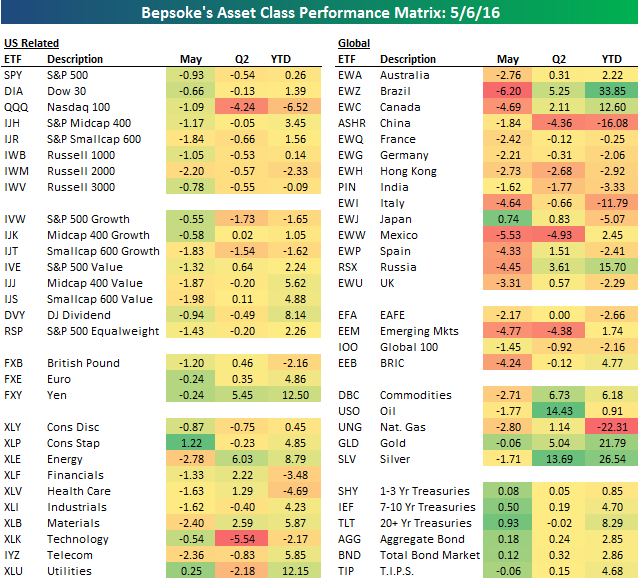
Below is a look at our asset class performance matrix using key ETFs included in our daily ETF Trends report. For each ETF, we include its performance in May, so far in Q2, and year-to-date. Equities are down across the board in May, with the worst pullbacks coming outside of the U.S. in countries like Brazil, Canada, Mexico, Spain, Russia and the UK. In the U.S., major indices are down roughly 1% across the board, and sectors like Energy, Materials and Telecom are down 2%+. The Consumer Staples and Utilities sectors are the only ones higher so far this month.
For Q2, the Nasdaq 100 (QQQ) and the Tech sector (XLK) have been clear areas of pain, while the Energy sector is leading with a gain of 6%. Commodities are up nicely in Q2, with oil and silver leading the way. On a year-to-date basis, Brazil has posted a monstrous 33.85% gain. Gold and silver are the next best performers with gains of 21.8% and 26.5% respectively. The S&P 500 (SPY) is as close to flat as it gets on the year with a gain of 26 basis points.