
Homebuilder Sentiment Unchanged
Homebuilder sentiment for May was unchanged from April, coming in at a level of 58 (anything above 50 indicates optimism). While the headline index was unchanged at 58, economists were actually expecting a reading of 59, so that makes this month’s report the seventh straight that the NAHB sentiment index has come in shy of expectations. The last time we saw a streak that long was in mid-2006.
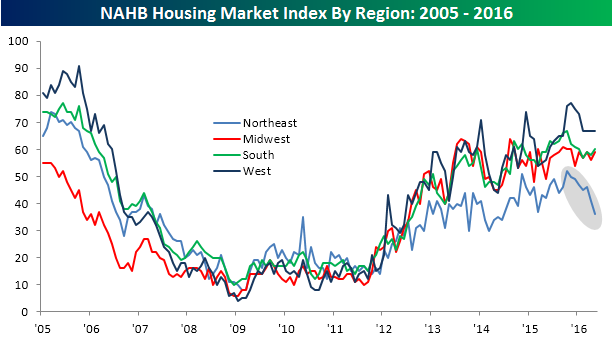
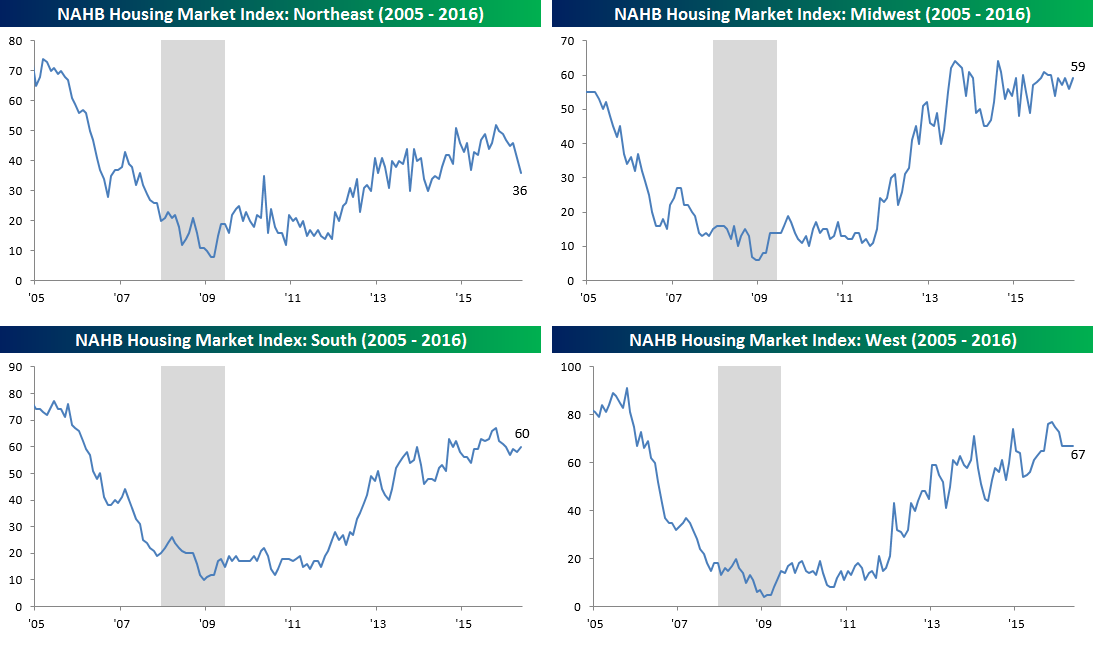
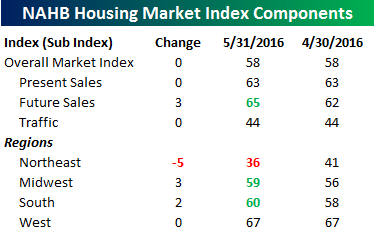 The table to the right breaks down this month’s report by present and future sales, traffic, and overall regional sentiment. Present Sales and Traffic were both unchanged on the month while Future Sales rebounded to a level of 65. On a regional basis, sentiment out west was unchanged, while sentiment in the midwest and south saw modest improvements. In the northeast, though, we saw a sharp decline, where overall sentiment dropped 5 points for the second straight month. Since October (the last time the NAHB index was better than expected, sentiment in the northeast has fallen 16 points; that’s the largest seven-month decline since 2006. Unlike that period, though, where sentiment was dropping precipitously across the country, during this period, only the northeast has seen a significant decline.
Bespoke’s Dow 30 Trading Range Screen
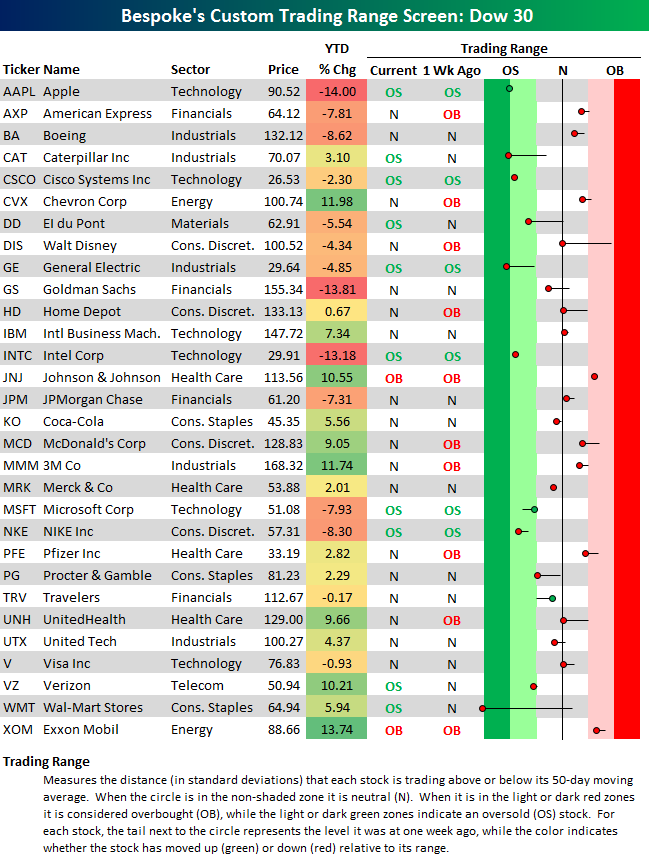
Below is a look at our Dow 30 trading range screen as we begin a new week. For each stock, the dot represents where it’s currently trading within its normal “trading range” (see bottom of screen for details), while the tail end represents where it was trading one week ago. The black vertical “N” line represents each stock’s 50-day moving average.
After three weeks of declines for the market, ten Dow stocks are now oversold while just two are overbought. A week ago there were ten overbought stocks and six oversold.
Apple (AAPL), Caterpillar (CAT), General Electric (GE) and Wal-Mart (WMT) are at the most extreme oversold levels, while Cisco (CSCO) and Intel (INTC) are just on the cusp of extreme territory (more than two standard deviations below 50-DMA). The two overbought stocks are Johnson & Johnson (JNJ) and Exxon Mobil (XOM). It has been a while since an Energy stock like XOM has stood out for its strength!
Looking at year-to-date returns, Apple enters the week as the worst performing Dow stock of 2016 (-14%). Goldman Sachs (GS) and Intel (INTC) aren’t far behind, though, with declines of 13%+. Exxon Mobil (XOM) and Chevron (CVX) are the two top performing Dow stocks year-to-date.
Empire Fed Manufacturing Report Reverses to the Downside
So much for that rebound. After two months of positive prints that ended seven straight negative readings, today’s report on manufacturing activity for the New York region in the month of May saw a relatively large reversal to the downside. While economists were forecasting the headline print of the Empire Manufacturing report to come in at 6.5, the actual reading was -9.02, which was down from April’s reading of 9.56. Relative to expectations, it was the biggest miss since last August, and in terms of the m/m decline (-18.58), it was the largest since October 2014. While the weakness in this month’s report is no doubt disappointing for anyone hoping the recent rebound had legs, we would point out that this index is one of the more volatile economic indicators we track, so there’s always the possibility that it rebounds next month.

In addition to the weak headline reading, the internals of the May Empire Manufacturing report were also weak with big declines in New Orders (-16.7) and Shipments (-12.1). The only category that showed an increase in May was Number of Employees which saw a marginal increase of 1.9 up to 2.1.

Finally, like the reversals seen in the headline reading and most of its internals, plans for cap ex and technology spending also reversed much of their recent gains. In fact, the index of plans to spend on cap expenditures fell to its lowest level since February 2014.

Bespoke Brunch Reads: 5/15/16
Welcome to Bespoke Brunch Reads — a linkfest of the favorite things we read over the past week. The links are mostly market related, but there are some other interesting subjects covered as well. We hope you enjoy the food for thought as a supplement to the research we provide you during the week.
The Big Picture
Some thoughts on the end of economic growth by Timothy B. Lee (Bottom-up)
A round-up and analysis of the argument that economic growth has either slowed or stopped on a permanent basis. [Link]
Stop Crying About the Size of Government. Start Caring About Who Controls It by David Sloan Wilson and Daron Acemoglu (Evonomics)
The title of this piece is a bit melodramatic but we think it makes a good point. Institutions matter, and their structure is often just as important as their size or primacy. [Link]
Did inequality cause the First World War? Contra Hobson-Lenin-Milanovic by Pseudorasmus
Warning: this piece is very, very long, and very, very dense, but it’s a helpful analysis in thinking about the complexity of economic history as well as the tendency to over-simplify and narrativize. [Link]
Learning To Be Who We Are (Thought Economics)
A combined interview on the nature of human consciousness. Very long, very dense, and very worth your time. [Link]
Tech
25 years later, Walt Mossberg says technology is still too hard to use by Eric Johnson (recode)
A wide-ranging interview with veteran tech watcher Mossberg, conducted by his business partner at recode, Kara Swisher. The talk covers a wide range of relevant subjects, belied by the rather bland headline. [Link]
The new 140-character war on India’s caste system by Rama Lakshmi (WaPo)
India’s caste system is deeply engrained, but Twitter is allowing members of its bottom rung (Dalits) to flex their political and social muscles. That movement follows the path of black users in the United States that birthed #BlackLivesMatter. [Link]
New Frontiers
Get Ready for the World to Be Covered in Electronic Ink by David Pierce (Wired)
Electronic ink is under-penetrated and could be on the verge of a big ramp-up in adoption, reducing the use of paper, helping add capacity to smart phones, and reducing the need for physical displays. [Link]
As consumers shift to non-GMO sugar, farmers may be forced to abandon environmental and social gains by Andrew Kniss (Weed Control Freaks)
Genetically modified crops are out of favor, and that’s created a 15% spread between the price of sugar from sugar beets and the price of sugar cane. This incents beet farmers to plant non-GMO crops which require more herbicide, more labor, and yield fewer plants. [Link]
China
China is buying Canada: Inside the new real estate frenzy by Charlie Gillis, Chris Sorenson, and Nancy Macdonald (Macleans)
Inside the panic buying from mainland China that’s fueled massive price appreciation in some Canadian cities, helping fuel fears that the entire country is caught up in a real estate bubble. [Link]
The great leap upward: China’s Pearl River Delta, then and now by Eric Hilaire and Nick Mead (The Guardian)
A fantastic multi-media view of the economic growth and urbanization in southern China over the last generation. [Link]
CIC Official Trolls Hedge Fund Managers, Short Sellers by Brendan Byrne (ValueWalk)
In an amusing and ironic turn of events, the head of China’s sovereign wealth fund took the axe to the hedge fund industry. [Link]
Former Facebook Workers: We Routinely Suppressed Conservative News by Michael Nunez (Gizmodo)
Former employees for a contractor at Facebook claim that human-curated topics that appeared in the “trending topics” frame (thus driving significant web traffic and discussion) were made prominent via a biased process. [Link]
Facebook and Fear by Derek Thompson (The Atlantic)
A wide-ranging follow-up to the story above the other prominent developments in the orbit of Facebook. [Link]
Facebook ‘Live’ Doesn’t Have to be Live by Jack Marshall and Steven Perlberg (WSJ)
Changes to Facebook Live, the video product which features content Facebook pays media companies for, have made it possible for those companies to run pre-recorded content, turning Facebook into something which very much resembles current cable TV. [Link, paywall]
Media Matters
Podcasts Surge, but Producers Fear Apple Isn’t Listening (NYT)
Inside the evolution of the mobile audio medium which has strong growth and a wide audience. [Link, soft paywall]
Fox’s Sports Network Hires an ESPN Veteran for a Reinvention by Richard Sandomir (NYT)
Fox Sports 1 is aiming to load its docket with opinionated, brash programming that draws ratings and negative attention. [Link, soft paywall]
Labor
Uber just agreed to let a labor union represent its drivers in New York by Johana Bhuiyan (recode)
A new agreement creates a little bit of breathing room for the company’s relationship with driver/contractors. But it also opens the door to strikes and more formal negotiation over drivers’ share of the company’s revenues. [Link]
The Six-Hour Workday Works in Europe. What About America? by Rebecca Greenfield (Bloomberg)
Could a 25% reduction in hours worked actually boost output? Recent studies suggest so, but it’s not terribly likely such an idea will catch on in the United States. [Link]
Banking
Marketplace Lending Takeaways by David Schawel (Economic Musings)
New River Investments’ Schawel casts a critical eye to the business model and viability of the marketplace lenders like Lending Club; we had several links covering that space last week. [Link]
Germany’s School for Central Bankers Draws Risk-Averse Crowd by Tom Fairless (WSJ)
The primacy of the Bundesbank in the thinking of the ECB was famously present for years. Even in today’s more dovish and experimental environment, though, Germans are still educating future central bankers in the hawkish conservatism that is German central banking. [Link]
Cheating
Thai student caught using ‘Mission Impossible’ exam spy glasses (France24)
Our only reaction to this story? How on earth is this sort of cheating not more common? [Link]
Exclusive: U.S. investigates market-making operations of Citadel, KCG by Charles Levinson (Reuters)
Federal regulators are in the process of investigating high-frequency market-making operations in US equities. [Link]
Municipal Madness
Voters approve nation’s most expensive high school football stadium (USAToday)
McKinney, Texas has approved a staggering $220 million bond package which supports the construction of a $50 million, 12,000 fan stadium for the local football team. [Link]
LAPD testing Teslas as ‘high-pursuit’ police cruisers by Jeff Daniels (CNBC/Yahoo Finance)
In an amusing twist, the world capital for high-speed car chases is looking to Tesla to fill its need for policing speed. [Link]
C’mon, Man
The World’s Smallest Ukulele by Robert Kolker (Bloomberg)
Three separate interviewees managed to make comparisons to the horrific human toll of Jim Crow laws, the Apartheid, and Nazi Germany in this astounding summary of a property dispute in Hawaii. We don’t have a view on the validity of either side’s point of view, but the rhetoric is some of the most hyperbolic we’ve ever seen. [Link]
The Bespoke Report: 5/13/16
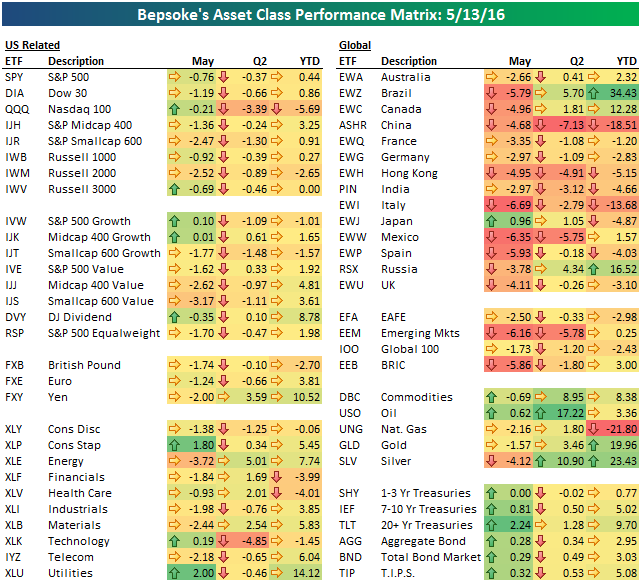
Equity markets across the globe remain in the red both in May and for the second quarter. Year-to-date, the US is still in the green but not by much. Outside of the US, some areas are up (Brazil, Russia, Australia) but most are down. Please have a look at this week’s asset class performance matrix below:
Each week, Bespoke sends clients across all of its subscription levels the Bespoke Report newsletter. If you’re looking for Bespoke’s analysis of current market internals, economic data, earnings beats and misses, individual stock ideas, and more, the Bespoke Report has it all.
Continue reading this week’s Bespoke Report by starting a 14-day free trial to our paid content below.
Have a great weekend!
ETF Trends: Hedge – 5/13/16
Chart of the Day: Earnings Season Winds Down
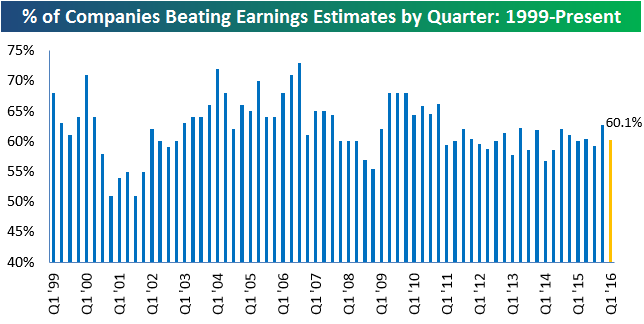
Below is a look at the earnings beat rate so far this earnings season (highlighted in orange) compared to past quarters going back to 1999. As shown, 60.1% of the 2,400+ companies that have reported this quarter have beaten consensus analyst estimates. That’s well below last quarter’s reading but slightly above the reading from two quarters ago. Since 1999, the average beat rate for any given quarter has been 61.9%, so this season is tracking just below average.
In today’s Chart of the Day sent to paid subscribers, we highlight a few additional earnings statistics that shed light on sector beat and miss rates as well as how stocks are reacting to earnings this season. To view the report, please start a 14-day free trial below.
S&P 500 Weekly Chart Book – 5/13/16
The State of Retail in One Chart
Some charts just don’t need a whole lot of explanation. While we have been highlighting the trend of ‘bricks to clicks’ for well over five years now, based on the performance of stocks in the retail sector this week, many are still coming to the realization that the more a company competes with Amazon or other online retailers, the more they’re going to struggle. This week, the only two sub-industries of retail besides Internet that were up were Food and Automotive, which coincidentally enough are two types of products that consumers don’t tend to purchase online (at least not yet).
