
The Closer 6/20/16 – “Quantitative Banks”
Looking for deeper insight on global markets and economics? In tonight’s Closer sent to Bespoke clients, we do some quantitative modelling of US banks.
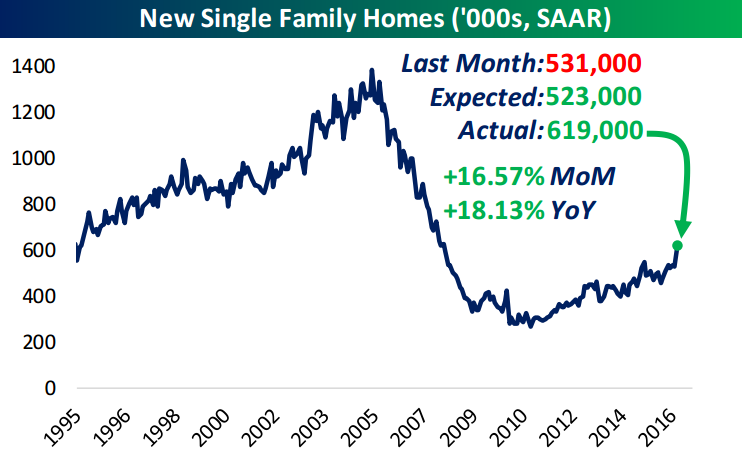
The Closer is one of our most popular reports, and you can sign up for a trial below to see it and everything else Bespoke publishes free for the next two weeks!
Click here to start your no-obligation free Bespoke research trial now!
ETF Trends: Hedge – 6/20/16
Below is our daily list of the twenty best and twenty worst performing ETFs over the last five trading days. Non-hedged European exposures topped the list of best performers, with Italy and the UK leading the way as Brexit probabilities fell late last week and to start this week. Fifteen of top twenty stocks were country or region based, with Latin American and smaller Asian exposures also performing strongly as global equities leaped higher. It was a mixed run for natural resources as Steel Producers and Natural Gas did well but Energy Exploration & Production and Gold saw big losses. Financial exposures and Treasury ETFs underperformed. Biotech also turned in a weak performance.
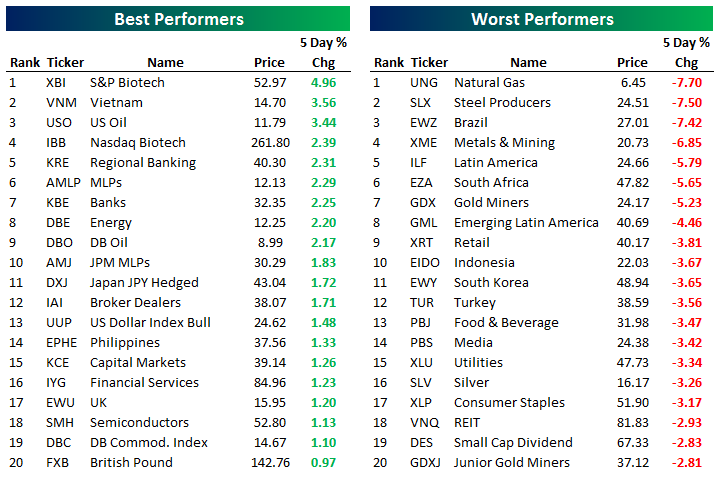
Bespoke provides Bespoke Premium and Bespoke Institutional members with a daily ETF Trends report that highlights proprietary trend and timing scores for more than 200 widely followed ETFs across all asset classes. If you’re an ETF investor, this daily report is perfect. Sign up below to access today’s ETF Trends report.
See Bespoke’s full daily ETF Trends report by starting a no-obligation free trial to our premium research. Click here to sign up with just your name and email address.
Platinum to Gold Ratio Plummets
Start a 14-day no-obligation free trial to Bespoke’s research platform to get top-level market analysis on a daily basis.
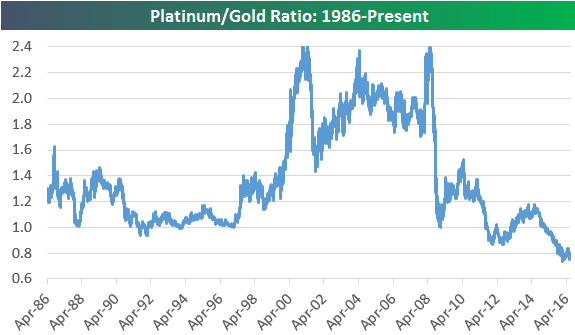
From the late 1990s through early 2008, platinum traded at a much higher price per ounce than gold. There were many periods where platinum was double the price of gold, even, but the ratio has completely turned around in recent years. Below is a chart showing the ratio of platinum to gold since 1986. When the line is rising, platinum is outperforming gold and vice versa. Since 2008, the ratio has been trending lower, and it has fallen off a cliff since early 2014. At current levels, platinum trades at just 75% of the price of gold. How low will it go?
Bespoke Stock Seasonality: 6/20/16
Dynamic Upgrades/Downgrades: 6/20/16
Chart of the Day – 2,100: Here We Go Again?
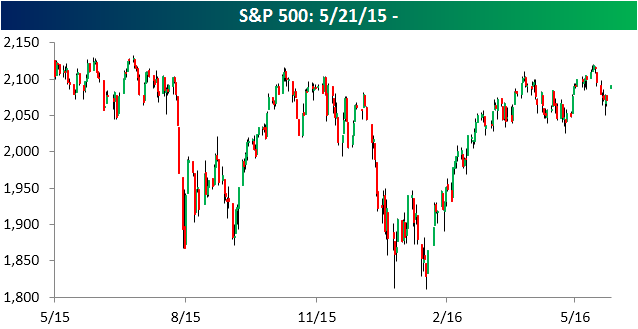
US futures are currently implying a positive gap opening of over 1% for the S&P 500. This would be the first upside gap of 1%+ for the index in more than four months (2/16/16) and the 13th since the S&P 500’s peak last May. Based on prior occurrences, should you buy or sell the opening rip in equities? In today’s Chart of the Day sent to paid subscribers, we analyzed the S&P 500’s performance from the open to close on prior occurrences where the S&P 500 gapped up 1% or more. To view the report, please start a 14-day free trial below.
Scattered Sectors in 2016; Best and Worst Performing S&P 500 Stocks YTD
Start a 14-day no-obligation free trial to Bespoke’s research platform to get top-level market analysis on a daily basis.
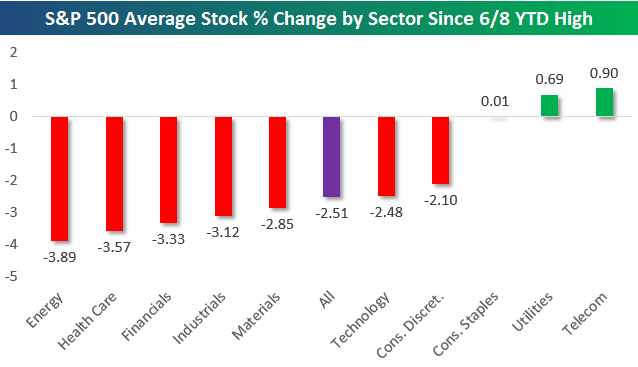
The S&P 500 closed at its year-to-date high on June 8th, and since then the average stock in the index is down 2.51%. Below is a chart showing the average change for stocks by sector since the June 8th close. Three sectors have averaged gains since 6/8, and they’re all defensive in nature — Telecom, Utilities, and Consumer Staples. Consumer Discretionary and Technology stocks have done slightly better than average with declines of 2.10% and 2.48%, respectively. The sectors that have seen their stocks fall the most since June 8th — thus leading the market lower — are Energy (-3.89%), Health Care (-3.57%), Financials (-3.33%), and Industrials (-3.12%).
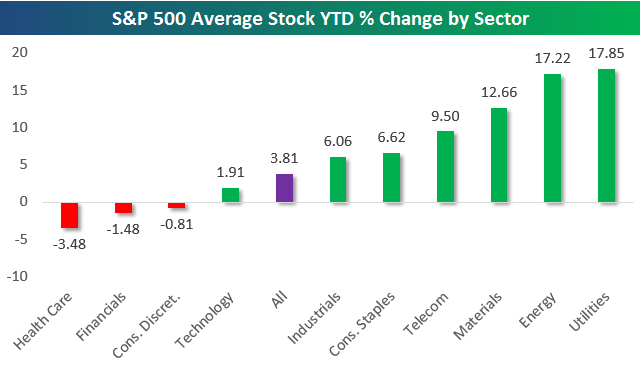
Things look much different when we look at the average stock’s change by sector on a year-to-date basis. The average stock in the S&P 500 has gained 3.81% so far in 2016, but six of ten sectors have seen their stocks average even bigger gains than that — some much bigger. The problem, though, is that the four sectors whose stocks have underperformed the broad-market average are the four biggest sectors. Technology has the biggest weighting in the S&P, and its average stock is up just 1.91% — half that of the average stock in the S&P 500 as a whole. The average stock in the Consumer Discretionary, Financials, and Health Care sectors is in the red on the year.
On the plus side, Utilities and Energy stocks are up an average of 17%+ so far in 2016. Materials stocks are up an average of 12.66%, while Telecom, Consumer Staples, and Industrials stocks are averaging gains of 5%+.
Usually you see the sectors with the largest weightings lead the market higher, but so far this year, it’s the six smallest sectors that have collectively led the way.
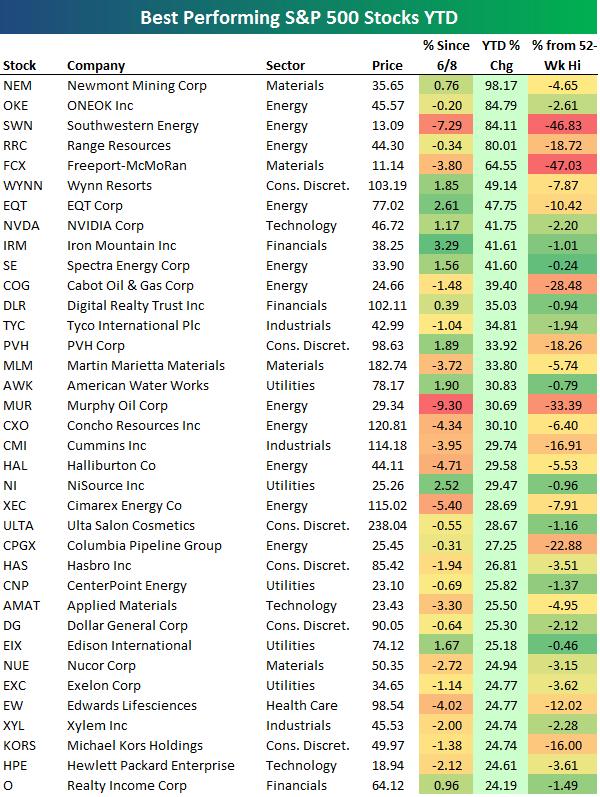
Below is a list of the best performing S&P 500 stocks year-to-date. You’ll notice that not one stock is up more than 100%, while just five are up more than 50%. Gold-miner Newmont (NEM) is up the most with a gain of 98.17%, followed by three Energy stocks — ONEOK (OKE), Southwestern Energy (SWN), and Range Resources (RRC). Freeport-McMoRan (FCX) rounds out the top five with a YTD gain of 64.55%.
Wynn Resorts (WYNN) ranks sixth with a gain of 49.14%, and stocks like NVIDIA (NVDA), Cummins (CMI), Halliburton (HAL), Ulta Salon (ULTA), Hasbro (HAS), Dollar General (DG), and Michael Kors (KORS) are other notables on the list of winners.
Endo International (ENDP) is down more than any other stock in the S&P 500 in 2016 with a huge decline of 73.15%. That’s nearly double the second worst stock — Seagate Technology (STX) — which is down 36.66%. Ten other stocks are down more than 30%, including Marathon Petroleum (MPC), Regeneron Pharma (REGN), Alexion Pharma (ALXN), Signet Jewelers (SIG), and Vertex Pharma (VRTX). Other notable stocks on the list of 2016’s biggest losers include First Solar (FSLR), TripAdvisor (TRIP), Delta Air (DAL), Nordstrom (JWN), Kohl’s (KSS), Biogen (BIIB), Legg Mason (LM), Morgan Stanley (MS), Bank of America (BAC), and Harman (HAR).

Bespoke Brunch Reads: 6/19/16
Welcome to Bespoke Brunch Reads — a linkfest of the favorite things we read over the past week. The links are mostly market related, but there are some other interesting subjects covered as well. We hope you enjoy the food for thought as a supplement to the research we provide you during the week.
Middle Class Pain
Real Clear Politics is running a five part series on the big economic issues facing the middle class this election. We note the first three instalments below; the full series is available here.
Stagnant Pay Says It All by Alexis Simendinger (Real Clear Politics)
Stagnant wages for much of the country (median real income has been flat for years) belies the relatively strong economic growth the United States has enjoyed versus other major developed countries since the end of the recession. [Link]
NAFTA and the Angry Middle-Class Voter by Carl M. Cannon (Real Clear Politics)
The North American Free Trade Agreement, envisioned by Reagan, negotiated by George H. W. Bush, passed by Clinton, and expanded by George W. Bush, has been a target this election season; what are its actual effects? [Link]
Families Struggle to Afford College by Emmeline Zhao (Real Clear Politics)
Pain for the middle class isn’t just about dollars in or jobs out; it’s also about growing costs to achieve a measure of stability via the educational system. [Link]
Brexit Consequences
FX: Brexit imperils City’s status as euro-clearing hub by Paul Golden (Euromoney)
London currently enjoys the ability to clear euro-denominated trades under the aegis of its links via EU membership. But the ECB, anxious to oversee clearing and settlement as part of its efforts to maintain financial stability, could render The City unable to process euro-linked trades after a Brexit. [Link]
Brexit – Won’t Somebody Think of the Money Markets? by Tracy Alloway (Bloomberg)
Short-term interest rate differentials for money markets in dollars are starting to show some signs that Brexit would bring unintended (and possibly very problematic) consequences. [Link]
Market Structure
Please let’s stop saying US primary dealers are required to make markets (updated) by Alexandra Scaggs (FT Alphaville)
In her debut post at Alphaville, Scaggs delivers a frankly fantastic myth-busting of how the market for Treasury debt actually works. WARNING: nerds – or market structure fanatics – only. [Link; registration required]
Silicon Valley’s Audacious Plan to Create a New Stock Exchange by Ellen Huet and Brad Stone (Bloomberg)
The latest idea on how start up tech businesses could avoid traditional IPOs involves the creation of an entirely new market for equity stakes in companies. [Link; auto-playing video]
Green Tech, Greenbacks
Apple is making so much clean energy, it formed a new company to sell it by Jordan Golson (The Verge)
An effort to provide green energy for its facilities has left the company with a surplus of power; it’s now working to monetize that surplus. [Link]
Tesla’s Betting You’ll Pay $9,000 for a Software Upgrade by David Ingold (Bloomberg)
An overview of the software upgrade which can add 40 miles of range to a Tesla with a little bit of code and no hardware of any kind. [Link]
Nature Harnessed
Weather-tracker offers ray of sunshine for hedge funds by Lindsay Fortado (FT)
Some details on the fantastic profits of the weather derivatives fund Cerberus, which has returned 970% cumulative over the last decade. [Link; soft paywall]
A rare tour of the Strategic Petroleum Reserve by Brian Scheid (S&P Platts)
A fascinating look at the geological formations which hold millions of barrels of oil underground along the Gulf Coast. [Link]
Social Networking
Facebook Offers Tools for Those Who Fear a Friend May Be Suicidal by Mike Isaac (NYT)
Intervention from loved ones and friends can play a critical role preventing tragedy, so Facebook has started to integrate tools for outreach when its users suspect one of their friends may be suicidal. [Link; soft paywall]
One Unspoken Reason Behind the Microsoft-LinkedIn Deal by Andrew Ross Sorkin (NYT Dealbook)
Stock-based compensation ran extraordinarily high at LinkedIn and the profligacy of grants to employees may have been one of the key motivations to sell. [Link]
Microscopic Microchips
Barefoot Networks’ New Chips Will Transform The Tech Industry by Cade Metz (Wired)
A new entrant has developed an open architecture that will allow end users to modify how switches (which connect computers within networks) operate. [Link]
A rare, risky mission is underway to rescue sick scientists from the South Pole by Sarah Kaplan (WaPo)
An unspecified illness suffered by a Lockheed Martin employee at the Amundsen-Scott research station at the South Pole is forcing a risky rescue flight in the middle of the Antarctic winter. [Link]
Investing
A Fireside Chat With Charlie Munger by Jason Zweig (WSJ)
An overview of 5 hours of Mungerisms from the sidekick to Warren Buffet at Berkshire Hathaway, Charlie Munger. [Link]
Central Banking
Fed Decision Makers Wrestle With So-Called Natural Rate by Harriet Torry (WSJ)
A summary of the ongoing debate within and around the Federal Reserve regarding the natural rate of interest which is neither stimulative nor a damper on economic growth. [Link; paywall]
Real Estate
Bidding Wars in the Suburbs by Lisa Prevost (NYT)
Entry level homes close to amenities, a short commute from New York City, and within strong school districts are commanding an enormous premium to the rest of the market as large luxury homes see slack demand. [Link; soft paywall]
The Closer 6/17/16 – “End of Week Charts”
Looking for deeper insight on global markets and economics? In tonight’s Closer sent to Bespoke clients, we break down weekly Commitment of Traders data from the CFTC, recap weekly price action, and update economic surprise indices for world economies.
The Closer is one of our most popular reports, and you can sign up for a trial below to see it and everything else Bespoke publishes free for the next two weeks!
Click here to start your no-obligation free Bespoke research trial now!
ETF Trends: US Indices & Styles – 6/17/16
Below is our daily list of the twenty best and twenty worst performing ETFs over the last five trading days. The week saw a great performance for the Japanese yen and some less-covered commodities including coffee and natural gas. REITs and other vehicles with interest rate risk also did well on a big bond rally through the week. The worst performers were banks, some specific Energy exposures, and biotech while Europe also had a rough showing.
Bespoke provides Bespoke Premium and Bespoke Institutional members with a daily ETF Trends report that highlights proprietary trend and timing scores for more than 200 widely followed ETFs across all asset classes. If you’re an ETF investor, this daily report is perfect. Sign up below to access today’s ETF Trends report.
See Bespoke’s full daily ETF Trends report by starting a no-obligation free trial to our premium research. Click here to sign up with just your name and email address.