
Bespoke’s Consumer Pulse Report — 6/27/16
You do not currently have access to this report. Sign up for a 30-day free trial to our Pulse add-on service here.
Bespoke Short Interest Report: 6/27/16
Chart of the Day: July 4th Market Returns
European Equity Declines in Perspective
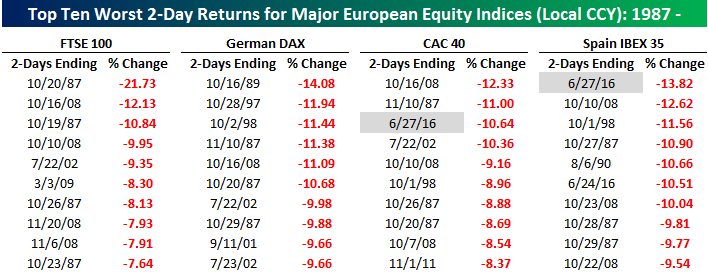
No matter how you look at it, the last two days have been nasty for equities. However, the declines vary greatly depending on whether or not you adjust for currency movements. For instance, last Friday when equity indices around Europe were down sharply, we heard a number of commentators suggesting the fact that the 3% decline in UK’s FTSE-100, which was down less than half as much as major European bourses, signaled that perhaps the Brexit vote was worse for Europe than it was for the UK. What these commentators failed to take into account, however, was the monstrous decline in the British pound. After taking the impact of currency into account, UK equities were flat out creamed and continued to decline on Monday.
The first table below lists the ten largest two-day declines in major European equity indices over the last thirty years expressed in local currency returns. As shown, the FTSE-100’s 5% decline doesn’t even register in the top ten. Likewise, the decline in the German DAX, which has dropped slightly more than 9%, doesn’t make the cut for the top ten either. Meanwhile, for French equities, the CAC 40 is down over 10% in the last two trading days, which ranks as the third worst decline since 1987 behind only October 2008 and November 1987. Finally, in Spain, the IBEX 35 is currently having its worst two-day decline since the start of 1987.
While local currency returns for major European benchmark indices have been extremely weak, when translated into USD returns, the last two days have been even worse. The table below shows the worst two-day returns for major European indices in dollar adjusted terms. As shown, for all four benchmarks shown, the last two days ranks in the top ten. For the UK, it is the worst two-day stretch since the 1987 Crash. For Germany, the only other two-day stretches that have been worse than the current one are October 2008 and October 1989. For France, the only two-day stretch that was worse was in October 2008, while for Spain it is the worst two-day stretch in the last 30 years. In USD adjusted returns, the last two days have been a time for the ages.

Dynamic Upgrades/Downgrades: 6/27/16
Bespoke Stock Seasonality Report: 6/27/16
B.I.G. Tips – What’s Next After Brexit?
With Brexit dealing shockwaves around global markets Friday and a wave of political recriminations working their way through UK politics, we took the time to sketch out a flow chart of “what’s next” in the process of the UK leaving the EU. It’s extremely complicated, but in a B.I.G. Tips report just sent to Bespoke Premium and Bespoke Institutional members, we outline the basic range of outcomes possible and what needs to happen to get there. Read the full report by signing up.
See the full B.I.G. Tips report by signing up for a monthly Bespoke Premium membership now. Click this link for a 10% discount ($89/month).
Bespoke Brunch Reads: 6/26/16
Welcome to Bespoke Brunch Reads — a linkfest of the favorite things we read over the past week. The links are mostly market related, but there are some other interesting subjects covered as well. We hope you enjoy the food for thought as a supplement to the research we provide you during the week.
After Brexit
Britain’s Democratic Failure by Kenneth Rogoff (Project Syndicate)
We don’t necessarily endorse this particular interpretation of democracy, but feel the points raised are worth consideration in the wake of the shock of a UK vote to leave. [Link]
EU’s Article 50 could become first Brexit stand-off by Alex Barker (FT)
An excellent overview of what’s next in the process of unwinding UK membership in the EU following the Brexit vote. In short: don’t expect anything to be settled any time soon. [Link, soft paywall; annotated version link]
‘Why not Texit?’: Texas nationalists look to the Brexit vote for inspiration by Tom Dart (Guardian)
While there’s no imminent danger of secession by the Lone Star State, the dream of an independent Texas is alive and well for some. [Link]
Bank Chiefs Seek to Allay Staff Concerns After Britain Quits EU by Gavin Finch (Bloomberg)
CEOs of major financial institutions are trying to manage perceptions around how Brexit may impact their lines of business. [Link]
Wall Street banks just had a trading bonanza by Portia Crowe (Business Insider)
In a remarkable feat of systems engineer, JPM executed trades with clients up to 1000 times per minute during the height of Brexit volatility. [Link]
Food
Debate: How Crispy Should Bacon Be? By Kevin Pang and Anne Dwyer (Extra Crispy)
Like minds can disagree over national destinies and the ideal crispiness of pork belly. [Link]
Inside Silicon Valley’s Robot Pizzeria by Olivia Zaleski (Bloomberg)
“We are going to be the Amazon of food” proclaims the founder of a start-up that seeks to cook up high quality pizza in 3 minutes and 15 seconds. [Link]
It Took McDonald’s 6 Months to Swap From Margarine to Butter—and That Was Fast by Leslie Patton (Bloomberg)
When your supply chain is bigger than the GDP of many countries, small shifts in how you make your products can create big headaches. [Link]
Economic Data
Income Inequality Matters, but Mobility Is Just as Important by Daniel R. Carroll and Anne Chen (FRB Cleveland Economic Commentary)
Some measure of inequality will always persist in a capitalist system, but if there is lots of turnover between income brackets that inequality doesn’t become embedded. This piece updates some recent figures on US inequality and mobility. [Link]
You Want the CPI? Or the DPI? What Consumer Prices Look Like Sliced Digitally by Peter Coy (Bloomberg)
Adobe has recently started releasing a price index that tracks the cost of goods sold online; the index differs from CPI in some key areas. [Link]
Labor Market
A Cautionary Note on the Help Wanted Online Data by Tomaz Cajner and David Ratner (FEDS Notes)
The Fed’s unofficial Labor Market Conditions Index may be getting badly skewed to the downside thanks to changes in prices for listing ads on Craigslist. A cautionary tale about the use of non-traditional economic indicators. [Link]
Is It Ever OK to Quit on the Spot? By Sue Shellenbarger (WSJ)
A guide to quitting, in an era when quitting is becoming more common. [Link]
Fed Optimism, Pessimism
The Fed May Not See It, But There’s Reason for Optimism by Conor Sen (Bloomberg View)
Wages are going up. The pool of workers without a college education is falling, reducing slack. Here is the bull case for the labor market – and inflation. [Link]
Three Remarks on the US Treasury Yield Curve by Olivier Blanchard (Peterson Institute for International Economics)
An overview of the relationship between interest rates, inflation, productivity, and growth. [Link]
Opinion: Fed’s changing outlook doesn’t explain about-face on raising rates by Caroline Baum (MarketWatch)
An overview of the confusing messages being sent in Federal Reserve communications over the last few months. [Link]
Governing Millennials
Why Millennials Won’t Fix Washington Anytime Soon (First Person Politics)
A data-driven approach to figuring out when a given generation rises to prominence within the halls of Congress and the White House. [Link]
Financial Industry
Active Managers Start to Feel the Pain by Charles Stein (Bloomberg)
With over $1 trillion of flows into passive funds and net outflows from active funds over the last five years, the scrabble for AUM that has traditionally defined the finance industry is getting a lot more competitive. [Link]
Humans Strike Back Against Stock Market Robots by John Detrixhe (Bloomberg)
Trading big blocks of shares when algorithms sniff out every consistent seller like bloodhounds isn’t an easy job, but bringing humans back into the loop often makes it more efficient. [Link]
Strife
Wukan, China: Villagers rally behind chief after ‘confession’ (BBC)
A leading activist and village leader in a Chinese village was arrested and later confessed to accepting bribes, but his constituents think the confession was forced. [Link]
Venezuelans Ransack Stores as Hunger Grips the Nation by Nicholas Casey (NYT)
Socialist and oil-dependent Venezuela is teetering on the brink as inflation explodes, food supplies disappear, and social unrest builds. [Link, soft paywall]
The Cultural Roots of Crime by David Frum (The Atlantic)
An overview of the “soft” causes of crime and the outlook for where crime rates may wander in the future. [Link]
Genetics
Crispr Wins Key Approval to Fight Cancer in Human Trials by Tom Randall
Slicing and dicing of DNA is now officially approved (in a trial) by the US government in a landmark win for a new gene editing tool. [Link]
First World Problems
The Weird World of Expensive Wine by Oliver Roeder (538)
A deep-dive into the strange pricing and frankly odd culture of high price fermented grape juice. [Link]
These CEOs Could Earn Millions From Stock Awards Valued at Zero by Anders Melin (Bloomberg)
A rare but lucrative practice is allowing some corporate officers to receive stock grants for free, though the practice relies on some dubious frameworks. [Link]
Investing
Opinion: What the ‘single best stock-market predictor’ is saying now by Mark Hulbert (MarketWatch)
Historically, the share of equities owned by households has been a high-quality predictor of future returns. Here’s what that measure currently suggests about where prices will go over the next decade or so. [Link]
Bespoke’s Weekly Chart Book – 6/24/16
The Closer 6/24/16 – “End of Week Charts”
Looking for deeper insight on global markets and economics? In tonight’s Closer sent to Bespoke clients, we round up the week which finished on a volatile note in the wake of the UK’s decision to leave the EU Thursday night.
The Closer is one of our most popular reports, and you can sign up for a trial below to see it and everything else Bespoke publishes free for the next two weeks!
Click here to start your no-obligation free Bespoke research trial now!