
The Closer 9/19/16 – ETFs, By Decile
Looking for deeper insight on global markets and economics? In tonight’s Closer sent to Bespoke clients, we discuss relative performance of both emerging markets and utilities. We also lay out a decile analysis of recent ETF performance.
The Closer is one of our most popular reports, and you can sign up for a trial below to see it and everything else Bespoke publishes free for the next two weeks!
Click here to start your no-obligation free Bespoke research trial now!
B.I.G. Tips – Valuation Update
Chart of the Day – New Highs Slow, But We’re Well Off The Lows
RealClearPolitics.com National Average Poll Tracker Update
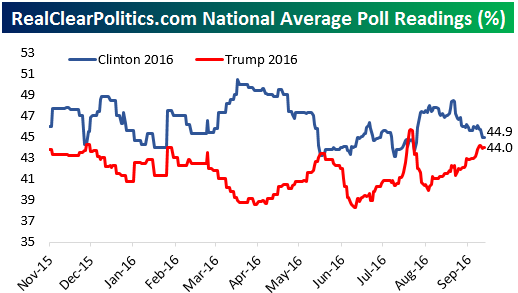
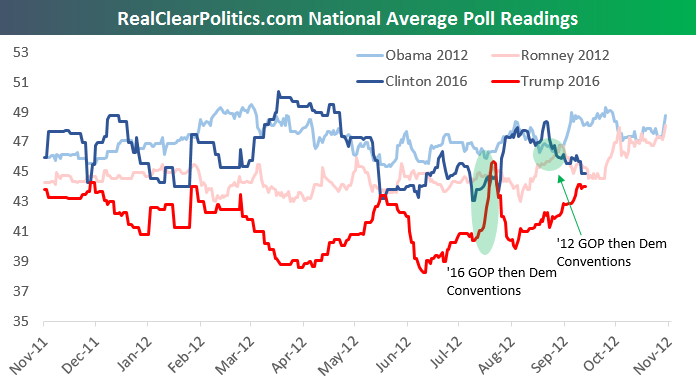
We first posted on the RealClearPolitics.com national average Presidential election poll tracker at the end of July. That was just after the Republican convention had ended and Trump had actually taken a slight lead in RCP’s poll tracker. Below is an updated look at where the RCP numbers currently stand compared to where they stood at this point in the 2012 election.
Remember, RCP’s tracker is an average of the most widely followed national Presidential election polls. As shown below, the race has slowly tightened over the last month, and as of this morning, Clinton’s reading stood at 44.9% compared to Trump’s 44%.
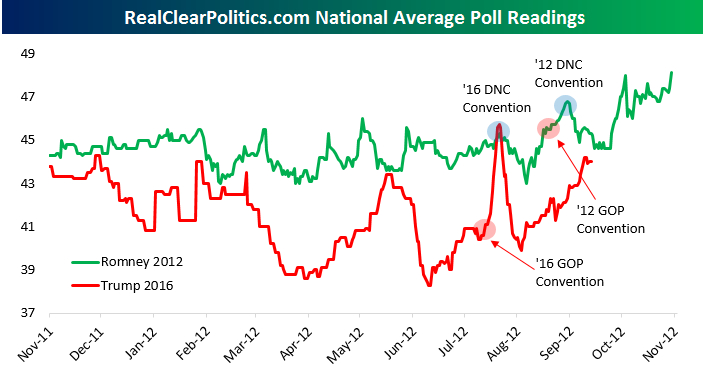
Below is a look at where Trump’s numbers currently stand compared to Romney’s numbers throughout the 2012 election. In 2012, the conventions came about a month later than they did this year, but in both years the candidates on both sides saw post-convention bounces. On September 19th, 2012, Romney’s RCP average stood at 45.3%. That’s 1.3 percentage points above Trump’s current level of 44%. In 2012, Romney’s numbers drifted slightly lower through the end of September, but then they began to climb from the start of October through election day. On election day 2012, Romney was behind Obama 48.1% to 48.8% in the RCP average, but as we all know, that reading was much tighter than the actual results. The final popular vote tally was 51.1% for Obama and just 47.2% for Romney.
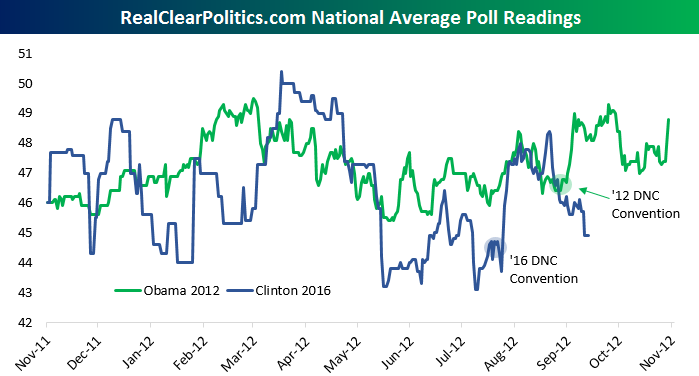
Below is a comparison of Clinton’s RCP average to Obama’s RCP average in 2012. Clinton’s recent drop from 48%+ down to 44.9% has opened up a huge gap versus where Obama stood on September 19th. Back in 2012, Obama’s RCP average was 48.2% on 9/19, which is 3.3 percentage points higher than where Clinton is now.
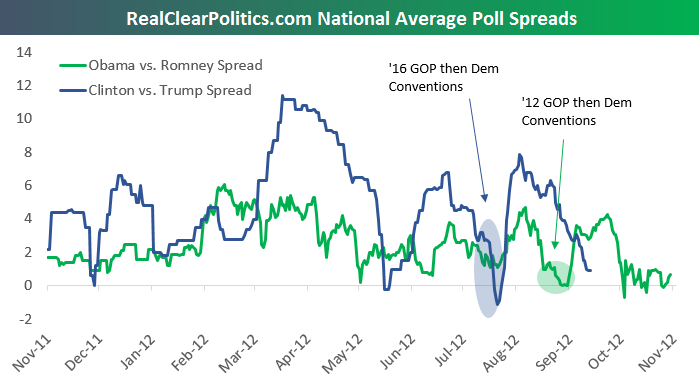
Below we show the RCP candidate trackers for both the 2012 and 2016 elections. The second chart represents the spreads between both candidates in both elections. At this point in 2012, Obama had opened up a big post-convention lead on Romney, but the race began to tighten once October rolled around. We saw Clinton open up a wide lead on Trump in the weeks after the DNC convention, but the current race has tightened significantly over the last few weeks.
Bespoke Stock Seasonality Report: 9/19/16
ETF Trends: Fixed Income, Currencies, and Commodities – 9/19/16
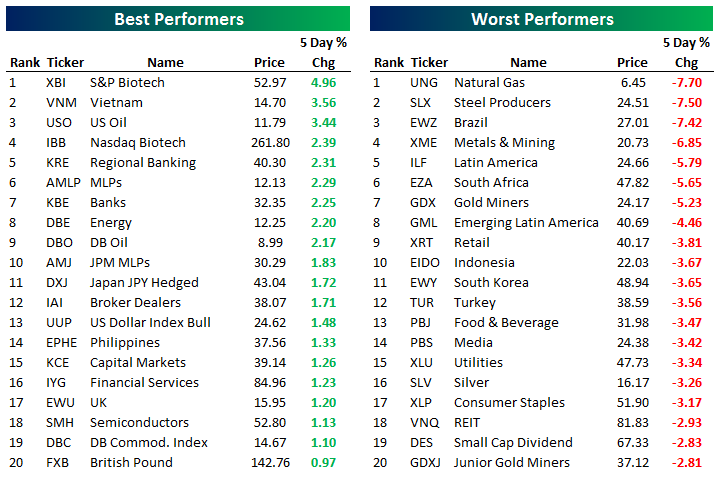
Mexican equities are the worst performing ETF we track over the last five days as markets have viewed improvements in GOP candidate Trump’s polling numbers to mean a rougher road ahead for the peso. Solar stocks have also gotten hit hard, while biotech, semiconductors and emerging Asia are the best performers. Energy and European equities have been among the worst performers, while tech in the US has outperformed.
Bespoke provides Bespoke Premium and Bespoke Institutional members with a daily ETF Trends report that highlights proprietary trend and timing scores for more than 200 widely followed ETFs across all asset classes. If you’re an ETF investor, this daily report is perfect. Sign up below to access today’s ETF Trends report.
See Bespoke’s full daily ETF Trends report by starting a no-obligation free trial to our premium research. Click here to sign up with just your name and email address.
B.I.G. Tips – The Bespoke Death By Amazon Indices Update 9/19/16
Homebuilder Sentiment Surges
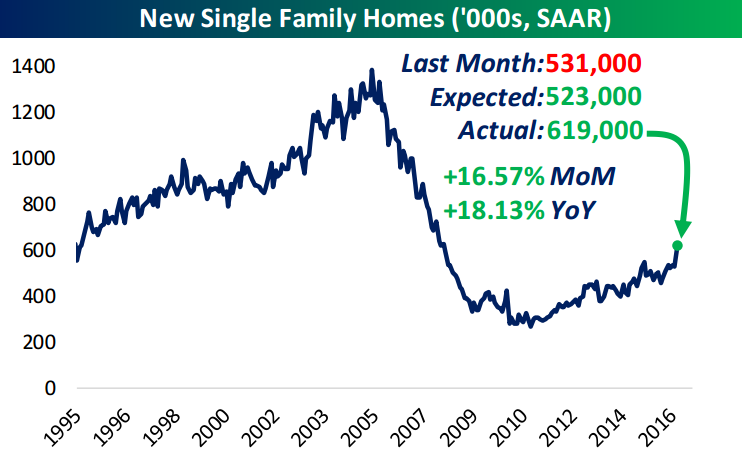
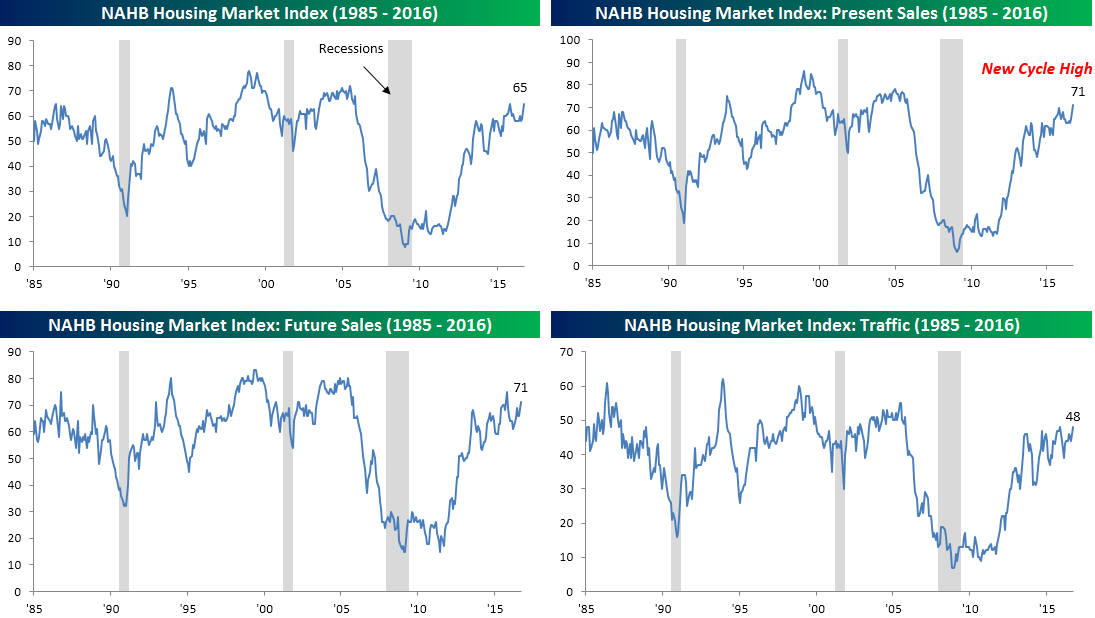
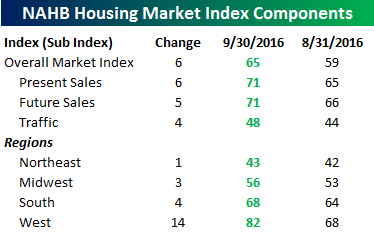 Homebuilder sentiment took a sharp turn for the better this month as the monthly sentiment index from the NAHB rose back to its highest levels of the current recovery. While economists were forecasting the NAHB’s monthly sentiment index to come in at a level of 59, the actual reading came in at 65, which was last seen back in October. Relative to expectations, the September report was the strongest since July 2013. The table to the right breaks down this month’s report by category and region and shows the current levels for each relative to last month. As shown, Present Sales saw the biggest monthly gain and hit a new cycle high. On a regional basis, sentiment in the West saw a huge jump, rising by 14 points to its highest level since October 2005.
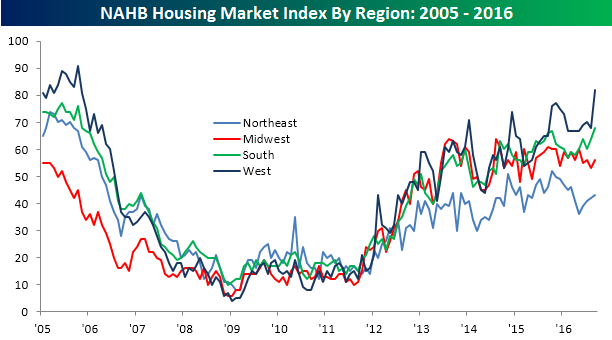 Finally, the chart to the right shows the regional sentiment indices for the NAHB going back to 2005. While all four sentiment indices essentially tracked each other closely from 2005 through the early stages of the current expansion, in recent years there has been a bit of a divergence as sentiment in the Northeast has been fading, sentiment in the Midwest has plateaued, while the South and Western regions remain in uptrends.
Dynamic Upgrades/Downgrades: 9/19/16
Bespoke Brunch Reads: 9/18/16
Welcome to Bespoke Brunch Reads — a linkfest of the favorite things we read over the past week. The links are mostly market related, but there are some other interesting subjects covered as well. We hope you enjoy the food for thought as a supplement to the research we provide you during the week.
Mi-Census-ellania
People Fled the Bronx in the 1970s. Now Its Population Is Booming. by Tim Wigmore (NYT)
20% of the Bronx left the borough during the period of the worst urban decay. Now, new immigrants are flooding into New York’s least expensive neighborhoods. [Link; paywall]
Actually, Income in Rural America Is Growing, Too by Quoctrung Bui (NYT)
Last week’s ASEC release showed that income grew robustly across demographics in 2015, except for rural areas. However, ASEC’s definition of rural may be misleading, and Americans far from cities may have actually enjoyed fairly robust growth afterall. [Link; paywall]
Census considers new approach to asking about race – by not using the term at all by D’Evra Cohn (Pew)
This is a bit of an older story, but interesting nonetheless: on the challenges facing statisticians regarding race and how to best understand how people categorize themselves. [Link]
Hollywood
The Netflix Backlash: Why Hollywood Fears a Content Monopoly by Kim Masters (The Hollywood Reporter)
As Netflix continues to spend billions on original content in an effort to build a moat, worries of a single buyer (monopsony) appear to be just as problematic as those for a single seller (monopoly). [Link]
Fedwatch
The Fed Is About to Make a Mistake by Narayana Kocherlakota (Bloomberg)
An argument that the Fed, far from raising rates or holding the policy rate constant, should be easing aggressively in the face of weak inflation and low breakeven inflation pricing. [Link]
Hacking
This is everything Edward Snowden revealed in one year of unprecedented top-secret leaks by Paul Szoldra (Business Insider)
NSA thief Edward Snowden illegally downloaded around 1.5 million files before fleeing the country (he’s now a guest of the Russian government). Here’s a summary of what information has emerged from the affair. [Link]
Over the Moon: Alibaba Engineers Fired for Mooncake Hacking by Pei Li and Alyssa Abkowitz (WSJ)
Alibaba dismissed four engineers who used code to illicitly procure about 100 boxes of mooncakes, red bean paste-filled confectionaries traditionally distributed to celebrate the Mid-Autumn Festival. [Link]
iPhone 7
iPhone 7 Review: The future in disguise by Nilay Patel (The Verge)
A comprehensive and picture-filled review of the latest iPhone, whose release has seemed to catalyze a fairly significant rally for its maker, the largest company in the world by market cap. [Link]
Simulations
Elon Musk: The chance we are not living in a computer simulation is ‘one in billions’ by Andrew Griffin (The Independent)
The founder of Tesla and SpaceX asserts that either a) the world is about to end or b) the world is an illusion. We’re fairly comfortable taking basically any other option. [Link]
Bank of America analysts claim there’s a 50% chance we live in a ‘Matrix reality simulation’ by Scott Campbell (The Mirror)
Elsewhere in “we’re all living inside a simulation” news, BAML analysts cited a recent estimate that there’s a 1 in 2 chance every experience you’ve ever had has taken place inside a computer. Once again, we’ll take the under on the odds being offered there. [Link]
If You Die in This Video Game, You Can Never Play Again by Danny Lewis (Smithsonian News)
Finally, we find the premise of “Upsilon Circuit” (a new game that only allows a single life) very interesting, and a fantastic social experiment. Built-in features geared towards streaming of the game via popular platforms like Twitch which are extremely popular is also a fascinating dynamic. [Link]
Uber
If Apple or Uber Really Build A Car, Here’s Where They Might Start by Alex Webb, Elisabeth Behrmann, and Gerrit De Vynck (Bloomberg)
For autonomous vehicle deployment, designing effective systems for cars to safely navigate roads without a driver is at best half the battle. Actual manufacturing (let alone funding) of massive fleets of AVs is a massive undertaking. Canada’s Magna may be just the partner to get that deployment done. [Link]
Uber, the trading stamp unicorn by Izabella Kaminska (FT Alphaville)
An absolute demolition of the premise behind Uber’s business model and more importantly the valuation of the company. [Link; registration required]
Real Estate
Canada’s Household Debt Burden Is Now Bigger Than Its GDP by Greg Quinn (Bloomberg)
While net worth has risen in-line with debt and debt service ratios remain low, the total amount of debt in Canada is continuing to rise along with the country’s real estate market boom. [Link]
BRICKX offers fractional ownership of residential property for investors by John Collet (Sydney Morning Herald)
A new Australian app allows investors to speculate on the local residential market $100 at a time via mutualized ownership of investment property. [Link]
What Good Is a $20 Million Mansion if You Can’t Walk to Dinner? by Patrick Clark (Bloomberg)
Lower compensation for Wall Street and changing preferences on what people want in real estate have made the low-density, wooded, and extremely high-priced Connecticut suburbs a brutal market for real estate investors lately. [Link]
Alternative Investments
At BlackRock, a Wall Street Rock Star’s $5 Trillion Comeback by Landon Thomas Jr (NYT)
A profile of the man behind one of biggest piles of assets in the world, and his efforts to steer the firm through a huge shift in the business model of Wall Street. [Link; paywall]
Private Equity Snapping Up Unloved Plants in Tough Power Market by Mark Chediak and Jim Polson (Bloomberg)
Utilities are seeing lower margins thanks to cheap natural gas and plummeting cost off renewable energy. But private equity sees opportunity and is stepping in to grab assets. [Link]
Hedge Funds May See Up to $8.7 Billion Windfall From Calstrs by Klaus Wille (Bloomberg)
Believe it or not, investors adding to hedge fund investments actually exist! $193bn California Teachers is stepping up to participate in funds, unlike many of its pension peers. [Link]
Overseas Domestic Affairs
Britain’s one-party state (The Economist)
Following the collapse of the Liberal Democrats over the last half decade and the ongoing push leftwards from Labour Party leader Jeremy Corbyn, the Conservatives face an almost unprecedented lack of opposition for the foreseeable future. [Link]
Japan opens door to temporary foreign workers by Robin Harding (FT)
In what could be the start of a big change, the tight Japanese labor market is forcing employers to look abroad for workers, a major change for the typically closed (often harshly described as xenophobic) culture of Japan. [Link; paywall]
Climate
A Timeline of Earth’s Average Temperature Since The Last Ice Age Glaciation (xkcd)
Science around the historically prevalent temperature is reasonably well-settled, and this fantastic infographic does an amazing job putting variations in global temperatures in perspective, both geologically and for human history. [Link]