
Looking for Action? S&P 1500 Most Volatile Stocks
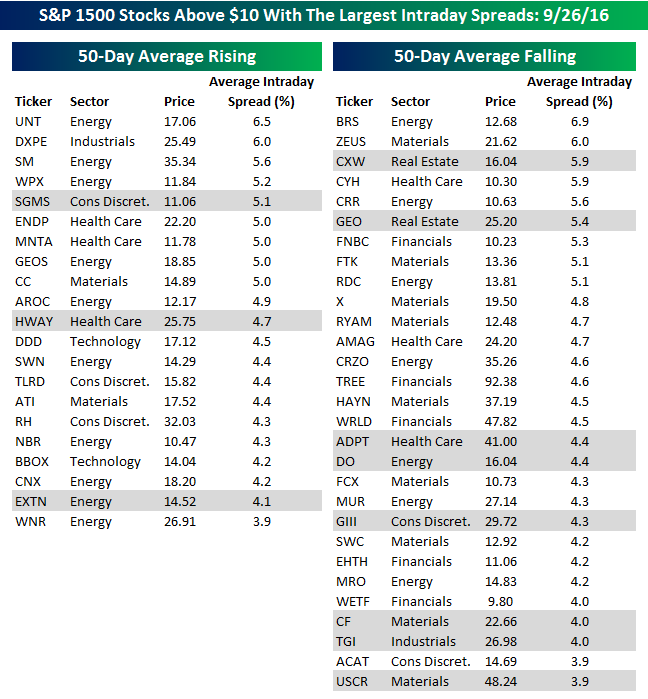
For traders with a short-term time horizon who are looking for big moves over a short period, we have updated our list of the S&P 1500 stocks trading above $10 that have the largest intraday high-low ranges (based on the average percent spread between the intraday high and low over the last 50 days). The stocks are grouped based on whether they have a rising or falling 50-day moving average (DMA). Stocks highlighted in gray are new to the list this month.
While volatility in the overall market has picked up, volatility among individual stocks hasn’t really seen a notable uptick. In fact, compared to our last update in mid-August, the number of stocks with an average daily intraday move of more than 5% has actually declined. The reason for this is that while September has seen an uptick in volatility, the 50-day period now no longer includes the volatility spike following the Brexit vote. The title of most volatile stock this month belongs to Bristow Group (BRS), which has seen an average intraday range of 6.9%. However, at a price of $12.68 per share, that range works out to less than a dollar. The highest priced stock on this month’s list is LendingTree (TREE). At a price of $92.38 per share, the stock has had an average daily range of $4.25 per share over the last 50 trading days.
Finally, while things have really calmed down in the Energy sector this year, the number of stocks from the sector making up the ranks of most volatile is still extremely high at 17 of the 50 stocks listed. Behind Energy, the sector with the next most number of stocks listed is Materials, which has also been no stranger to volatility in the last several months.
ETF Trends: Fixed Income, Currencies, and Commodities – 9/26/16
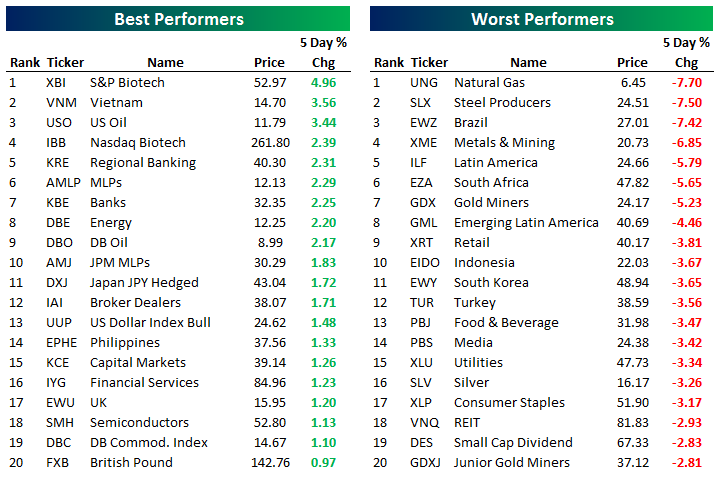
Coffee finally gave up its caffeinated streak of gains over the past week, with a variety of financial companies legging lower on the back of flattening global yield curves as well. On the gain side, iron ore, steel, and other metals-related plays are up on the week along with Latin America, Australia, Biotechs, REITs, and MLPs.
Bespoke provides Bespoke Premium and Bespoke Institutional members with a daily ETF Trends report that highlights proprietary trend and timing scores for more than 200 widely followed ETFs across all asset classes. If you’re an ETF investor, this daily report is perfect. Sign up below to access today’s ETF Trends report.
See Bespoke’s full daily ETF Trends report by starting a no-obligation free trial to our premium research. Click here to sign up with just your name and email address.
Clinton and Trump Odds Ahead of First Debate
The long anticipated day is finally here as Hillary Clinton and Donald Trump square off tonight in the first of three Presidential debates. For both, the stakes really couldn’t be higher, and each is preparing in their own way. According to campaign reports, Clinton was holed up this weekend brushing up on policy and watching tape of Trump’s prior debates and speeches. Trump, for his part, spent part fo the weekend eating cheesesteaks. The importance of Monday’s debate can’t be overstated, especially after the last two weeks where Donald Trump has seen a surge in his poll numbers and odds following Clinton’s health scare at the 9/11 memorial service earlier this month. A strong performance by Clinton tonight could instantly put a stop to Trump’s momentum and put her back in the driver’s seat. Meanwhile, any misstep on her part or a strong performance from Trump could really spell trouble for a campaign that up until this point has not been behind.
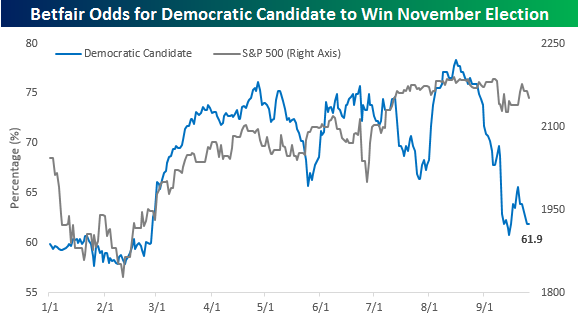
The first chart below shows the odds for the Democratic candidate to win in November compared to the S&P 500. For the entire year, the contract for the Democratic candidate has been above 50% and even exceeded 75% following the Democratic convention in August. However, late August and early September were good for “the Donald” as Clinton’s odds have now declined down to 61.9%. What is interesting to note about this chart is that while the S&P 500 closely tracked Clinton’s odds for much of 2016, since July they have really stopped tracking each other. When her odds declined in July, the S&P 500 actually rallied. More recently, as Clinton’s odds have sunk to new lows, the S&P 500 has, for the most part, held up.
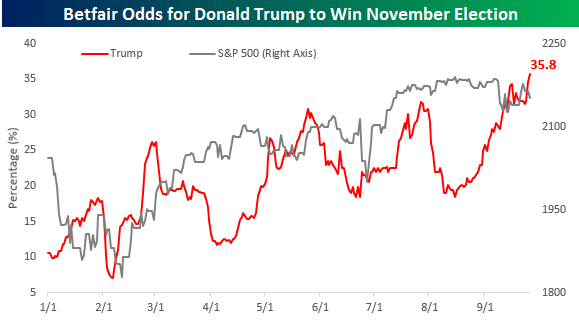
For Trump, it’s the opposite (obviously). For much of the year, the S&P 500 and Trump generally moved in opposite directions, but more recently the two have started to move independently of each other. In terms of Trump’s current odds, we have seen a major shift. After several attempts of trying and failing to get above 30% earlier this year, Clinton’s troubles have pushed Trump up to new highs at 35.8%. While Trump’s odds are at new highs, we would once again stress that at 35.8% Trump is still a big underdog. However, he has moved into a position where a strong debate showing tonight could really turn this into a serious race.
Bespoke Stock Seasonality: 9/26/16
Bespoke Brunch Reads: 9/25/16
Welcome to Bespoke Brunch Reads — a linkfest of the favorite things we read over the past week. The links are mostly market related, but there are some other interesting subjects covered as well. We hope you enjoy the food for thought as a supplement to the research we provide you during the week.
Real Estate
ABS East: Steve Eisman Brings Down the House (Again) by Allison Bisbey (Asset Securitization Report)
One of the most prominent figures from the global financial crisis has some tough words for banks and some fairly reassuring predictions about the economy. [Link]
The Contrarian Signal in the REIT Breakout by Barry Ritholtz (Bloomberg)
Is the christening of its own GICS sector a negative for tax-advantage real estate investment trusts? [Link]
5 Surprising Cities Rapidly Attracting Millennial Job Seekers by Rachel Bowley (LinkedIn Official Blog)
Using job search data, the team at LinkedIn took a look at where the largest generation in American history are headed for work. [Link]
House-Flippers Turn to the Crowd for Quick Cash. What Could Go Wrong? by Heather Perlberg (Bloomberg)
Some more signs of a bit of speculation trickling back into the real estate market as Perlberg runs down the surprisingly crowded landscape of crowd-funded home flipping. [Link]
Education
Public vs Private by cavandy (As Rando As It Gets)
Amidst the chaos that is the Chicago Public School system, one mother is glad her boys aren’t tucked away in a private – and uncaring – alternative. [Link]
Cocktails
Bill Murray, Brooklyn Bartender by Foster Kamer (NYT)
A fantastic account of a night with the everyman that is Bill Murray, late for a shift behind the bar at a restaurant opening. [Link; paywall]
What’s the Hottest New Thing in Craft Cocktails? Ice Cubes by Rachel Witkowski (WSJ)
Inside the absurd world of high end ice and the libations it gets dropped in to. [Link; paywall]
Tasting Epic’s $43 martini made with San Francisco fog by Esther Mobley (SF Chronicle)
Just when you thought the cultural dynamic of tech-fueled San Francisco couldn’t get further into the absurd, the admittedly accomplished Hangar One (we speak from experience) has devised a vodka made from the one of the city’s most defining features. [Link]
Nuts & Bolts
Inside the Pipeline That Transfers 2.7 Billion Euros a Minute by Lorcan Roche Kelly (Bloomberg)
An excellent explainer for the financial plumbing that holds together the Eurozone. While others may not share our enthusiasm for a good “look stuff up and write it down” effort, we loved this walk-through. [Link]
Covered interest parity lost: understanding the cross-currency basis by Claudio Borio, Robert Neil McCauley, Patrick McGuire and Vladyslav Sushko (BIS Quarterly Review)
A detailed investigation of a broken law of financial markets: that arbitrage should make interest rates implied by the FX market the same as those in the interest rate market. [Link]
Employment Outflows and the Mystery of the 11 O’Clock Bounce by Ernie Tedeschi (Averpoint)
A data-driven investigation of a repeating pattern in the labor market which has played out ahead of the last two recessions and is ominously rearing its head again. [Link]
Most Battleground States Posted Healthy Job Growth Over the Past Year by Josh Mitchell (WSJ Real Time Economics)
A review of the tightest political races this fall from the perspective of new state-level employment data furnished by the BLS. [Link]
Bold Predictions
Either the demographic bond models are broken, or yields are headed to 10%. by Jim Leaviss (Bond Vigilantes)
With a new enthusiasm for demographics-related market analysis, it’s worth pointing out one model that is either badly broken or about to positively wreak havoc on the UK bond market (we’re leaning towards the former). [Link]
The Seven-Year Short (Bloomberg)
A long read on the long, painful bets against the Chinese yuan placed by a Texas fund manager on a quest to hold the world’s most populous country to economic gravity. [Link]
Depressing Reads
Monday night ratings down, again by Mike Florio (Pro Football Talk)
NFL ratings are down YoY in each of the first seven prime-time games this year. Regardless of the causes, the decline should make some of the league’s biggest fans (and sponsors) nervous. [Link]
I Used to Be a Human Being by Andrew Sulivan (NY Mag)
A long and winding indictment of our modern obsession with information, conversation, and all manner of online distraction. [Link]
Food
The People’s Cheeseburger by Willy Blackmore (Eater)
We absolutely love this story about efforts to mesh capitalism, wholesome food, social change, and racial awareness in Watts, LA. And of course…we’re dying to try the innovative cuisine, described throughout. [Link]
Lunch is too expensive by Abha Bhattaral (WaPo)
With 40% of Americans working from home and therefore forgoing the need for an office lunch and surging costs of labor despite low grocery store prices, the business of serving up salads is under pressure. [Link]
Eataly is coming, and it’s enormous. Now how to fill all those open jobs? by Dugan Arnett (Boston Globe)
Opening a large eatery doesn’t just require a focus on menus, location, and inventory: the biggest problem facing Mario Batali for his new Boston store could be the labor market. [Link]
Errors & Omissions
How Hampton Creek Sold Silicon Valley on a Fake-Mayo Miracle by Olivia Zaleski, Peter Waldman and Ellen Huet (Bloomberg)
Silicon Valley hype, when combined with vegan mayonnaise and cookies, can apparently lead to securities fraud and SEC investigations. [Link]
AC Milan’s Chinese Buyer Said to Show False Bank Letter in Talks (Bloomberg)
Buying one of the most popular professional soccer teams on the planet is no small thing, and a basic proof of credibility is worthwhile for sellers. Only problem is, sometimes, that basic proof isn’t actually proof. [Link; auto-playing video]
Facebook Overestimated Key Video Metric for Two Years by Suzanne Vranica and Jack Marshall (WSJ)
This week, Facebook alerted ad buyers that some of its metrics had been improperly devised, artificially inflating the average view time of video advertisements. [Link; paywall]
A note from the editor-in-chief about Chris Ziegler by Nilay Patel (The Verge)
We don’t even know what to say about this one: a writer for The Verge decamped for a job at Apple, without telling his then-current employer, who dismissed him upon finding out. [Link]
Changing Landscapes
China’s Changing Trade and the Implications for the CLMV Economies by Koshy Mathai, Geoff Gottlieb, Gee Hee Hong, Sung Eun Jung, Jochen Schmittmann, and Jiangyan Yu (IMF)
A superb overview of how China’s trade has evolved over the years: more efforts to move up the value chain as unit labor costs rise faster than any other country in the world. [Link; 84 page PDF]
New Record Low Solar Price in Abu Dhabi – Costs Plunging Faster Than Expected (Ramez Naam)
A startling and impressive update on the plunging cost of installing solar electricity generation capacity, especially in regions with weather best suited to the alternative power source. [Link]
Wall Street’s IPO Business: The Worst in 20 Years by Maureen Farrell (WSJ)
With the most spectacular growth stories in the entire economy largely taking place in the private markets, there’s very little deal flow to fight over and the results have been painful for the banks that market new public market offerings. [Link; paywall]
Securitize ALL The Things
Insurance Liabilities Could Be Next Big Thing for Investors by Julie Segal (Institutional Investor)
Pay some premium, receive a big payout when something happens. Alternatively, receive some premium, and pony up when that something happens. These are the basics of both insurance policies and credit default swaps on financial assets. Now, there are plans to use techniques that blew up countless investors in the financial crisis (CDOs, CDO-squareds, and other structures linked to CDS premium payments) on risk borne by insurance companies. [Link]
China
Beijing Wants More Baby-Making by Mei Fong (Foreign Policy)
In a matter of a few years, China has gone from a one-child policy to an effort to boost births as a demographic collapse looms over the horizon. [Link; soft paywall]
Jack Ma’s Finance Business May Be Worth More Than Goldman Sachs by Lulu Yilun Chen (Bloomberg)
China’s most popular payments processor is only one part of the broader Alibaba ecosystem. [Link; auto-playing video]
The Closer 9/23/16 – End of Week Charts
Looking for deeper insight on global markets and economics? In tonight’s Closer sent to Bespoke clients, we recap weekly price action in major asset classes, update economic surprise index data for major economies, chart the weekly Commitment of Traders report from the CFTC, and provide our normal nightly update on ETF performance, volume and price movers, and the Bespoke Market Timing Model.
The Closer is one of our most popular reports, and you can sign up for a trial below to see it and everything else Bespoke publishes free for the next two weeks!
Click here to start your no-obligation free Bespoke research trial now!
The Bespoke Report — 9/23/16
S&P 500 Quick-View Chart Book — 9/23/16
Unemployment Rates By State
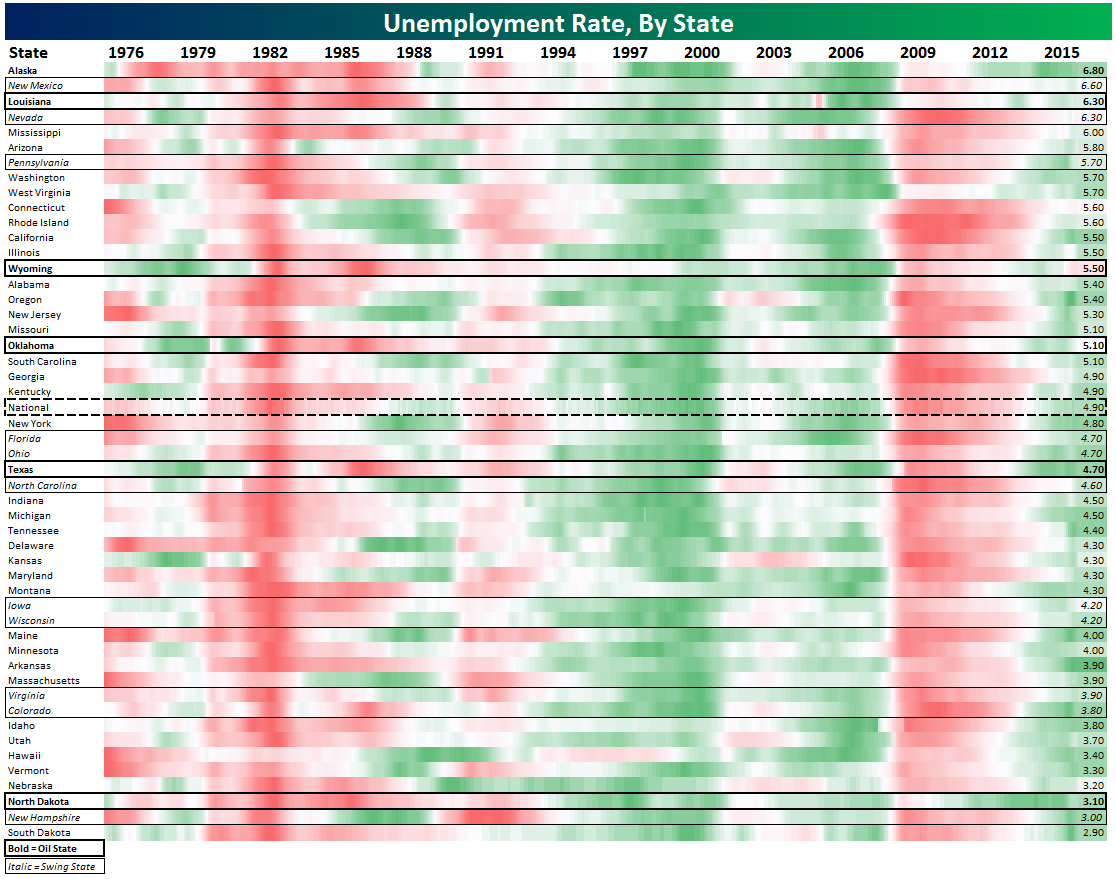
Below we show our unemployment rate heatmap by state. The latest unemployment rates were updated by the Bureau of Labor Statistics for the month of August earlier this week. Many of the states with deteriorating (higher) unemployment rates are those that have large exposure to the oil & gas sector. We’ve bolded those states in the heatmap. With election buzz in full swing, it’s also worth paying attention to the economies of key swing states. We’ve noted those with a lighter outline and italics. Finally, the national unemployment rate is outlined in dashes as a reference point.
Year To Date Currency Returns: Interesting Results
Below we chart YTD currency returns by type of return. Often forgotten in FX is the importance of interest; while spot rates can change dramatically, the interest rate differentials between currencies can add up significantly over time. Below we show the spot return (changes in the FX rate; left axis) and the interest return (interest differential, bottom axis). For most developed market currencies, interest rate differentials are relatively small, so there isn’t much of a return to be found there; spot returns dominate. For EM, however, it’s a much different story. Interest rates are higher and can overcome significant changes in the spot rate. For instance, Argentina’s peso is down over 15% YTD in the spot market, but a monster interest rate return close to 20% has made ARS a profitable long versus USD on the year. As shown, high interest returns have generally led to higher spot rates on the year, especially in EM. In the final chart below, the overall weakness of the USD is visible; only three major crosses are lower versus the buck on the year, and there are 7 currencies up more than double digits versus the USD YTD in total return terms.
