
Best and Worst Performing Stocks 2016 YTD
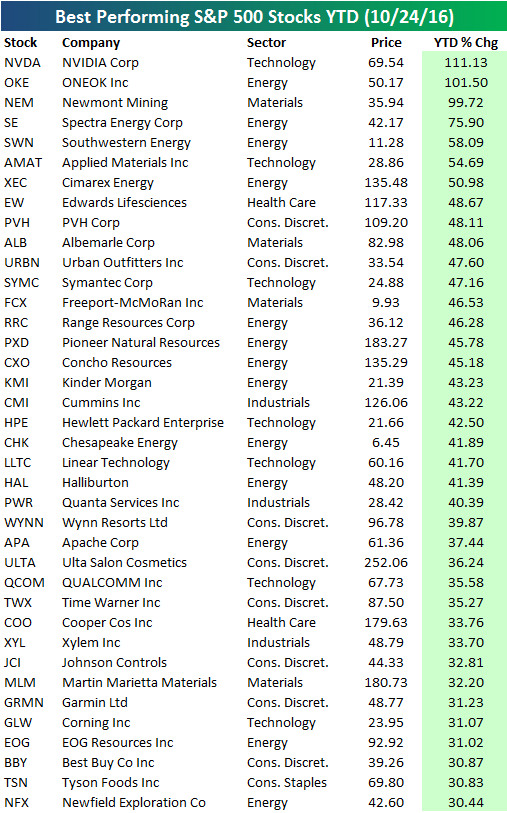
The average stock in the S&P 500 is up 7.01% year-to-date as of 10/24/16. Within the index, 64% of members are in the green for the year, while 36% are in the red. A total of 29 stocks in the index are down more than 20% year-to-date, while 100 stocks in the index are up more than 20%. However, although a fifth of the index is up more than 20%, just 7 stocks are up more than 50%, and 2 are up more than 100%. You typically see a few more big winners in an up year like this one.
Nonetheless, the two stocks in the S&P that are sitting on triple-digit percentage gains year-to-date are NVIDIA (NVDA) and ONEOK (OKE). It looks like using all caps for your company name is a winning strategy! Newmont Mining (NEM) ranks third with a gain of 99.72% (nope, we’re not rounding up on this one), while Spectra Energy (SE) and Southwestern Energy (SWN) round out the top five. Notably, 3 of the 5 best performing stocks are from the Energy sector. Other notables on the list of 2016’s big winners include Urban Outfitters (URBN), Halliburton (HAL), Wynn Resorts (WYNN), QUALCOMM (QCOM), Time Warner (TWX), and Best Buy (BBY).
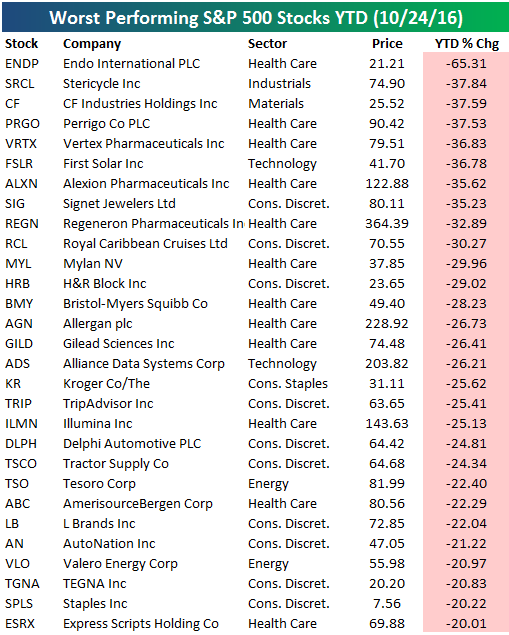
Below is a list of the S&P 500 stocks down more than 20% year-to-date. Endo (ENDP) tops the list of losers with a decline of 65.31%. That’s nearly double the next worst stock, which is Stericycle (SRCL) at -37.84%. Other notables on the list of losers include First Solar (FSLR), Bristol-Myers (BMY), Gilead Sciences (GILD), TripAdvisor (TRIP), and Staples (SPLS). Twelve of the 29 stocks down 20%+ this year are from the Health Care sector.
Bespoke Stock Seasonality: 10/24/16
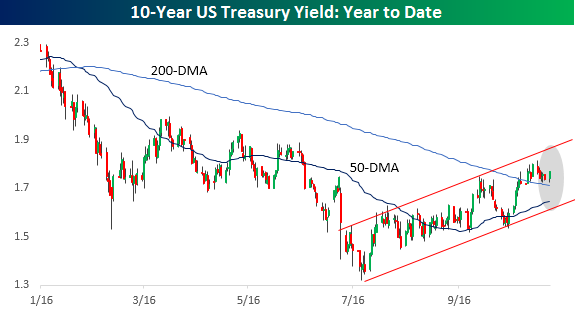
10-Year Yield Bouncing at Support
Earlier this month, the yield on the 10-year US Treasury broke above its 200-DMA for the first time since the opening days of 2016. In the days that followed, the yield on the 10-year continued to rise, hitting its highest level since the Spring nearly two weeks ago. Since then, rates have moved sideways with a downward bias. After holding above the 200-day moving average for several days, though, rates are back on the rise today, with the 10-year yield seeing its largest one-day increase in nearly two weeks, rising to 1.77%. If October’s high of 1.81% gets taken out in the next few days, the uptrend in rates will only become more firmly established.
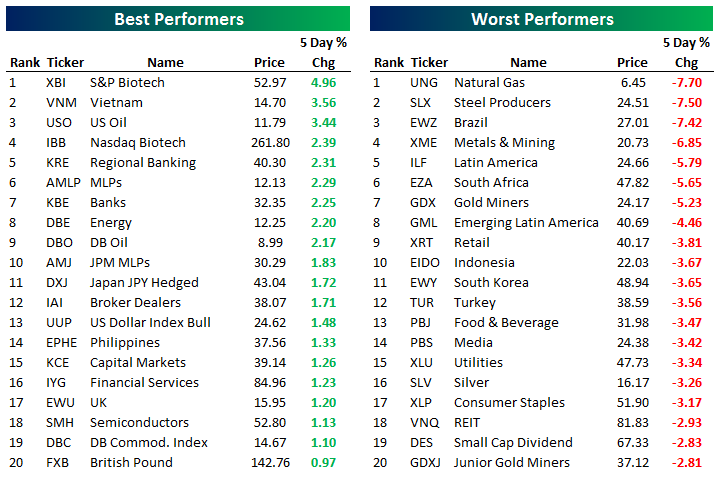
ETF Trends: Fixed Income, Currencies, and Commodities – 10/24/16
Foreign currencies have suffered mightily over the past week as the dollar has made new multi-month highs on a broad basis. Low volatility stocks have also suffered. On the winning side of the equation, steel producers have surged over the past few days, helped today by stronger Flash Markit PMIs for Japan, Europe and the US. EM equities have also outperformed over the past week along with banks.
Bespoke provides Bespoke Premium and Bespoke Institutional members with a daily ETF Trends report that highlights proprietary trend and timing scores for more than 200 widely followed ETFs across all asset classes. If you’re an ETF investor, this daily report is perfect. Sign up below to access today’s ETF Trends report.
See Bespoke’s full daily ETF Trends report by starting a no-obligation free trial to our premium research. Click here to sign up with just your name and email address.
Gas Prices and Inflation
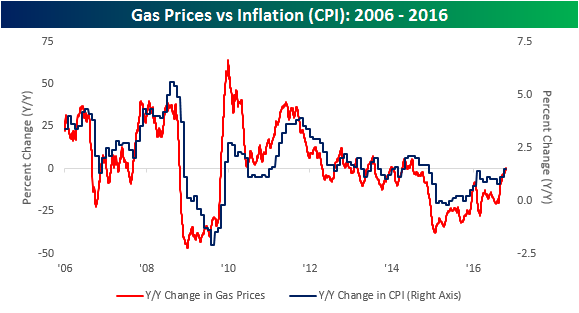
In last Friday’s Bespoke Report, we included a chart showing the y/y change in the national average price of gasoline, highlighting the fact that it ticked into positive territory for the first time in over two years. In the chart below we have taken the chart of the y/y change in gasoline prices and overlaid the y/y change in CPI over that same period. While the two are plotted on different axes, and the sizes of the moves vary, the patterns have tracked each other tick for tick, suggesting that headline inflation may be turning higher.
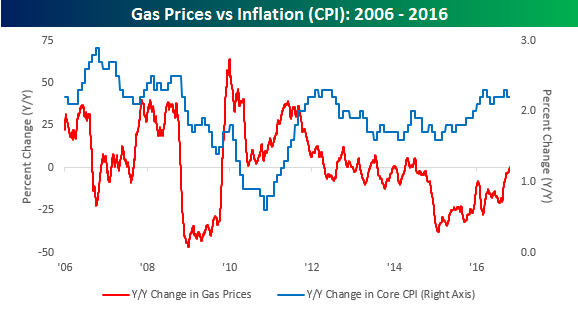
While gas prices may be pushing headline inflation higher, the FOMC is more focused on core readings of inflation which have had little correlation to gas prices over time. That being said, signs of pricing pressures are increasingly rearing their heads from a number of different areas.
Bespoke’s Country Trading Range Screen
With a new trading week upon us, below is a look at where global equities stand using our trading range screen for the 30 largest country ETFs. For each ETF, the dot represents where it’s currently trading within its range, while the tail end represents where it was trading one week ago. The black vertical “N” line represents each ETF’s 50-day moving average, and moves into the red or green zone are considered overbought or oversold.
Over the last week, we’ve seen global equity markets mostly trend higher within their ranges, whether it’s moving from oversold to neutral territory or neutral to overbought. Last week at this time, more than half of the countries in the screen were oversold, but just five are oversold as we begin the week. 2016’s best performing country — Brazil (EWZ) — is the most overbought name in the screen, while Switzerland (EWL) is the most oversold. The US (SPY) has actually been one of the weaker areas of the world recently.

Dynamic Upgrades/Downgrades: 10/24/16
Bespoke Brunch Reads: 10/23/16
Welcome to Bespoke Brunch Reads — a linkfest of the favorite things we read over the past week. The links are mostly market related, but there are some other interesting subjects covered as well. We hope you enjoy the food for thought as a supplement to the research we provide you during the week.
North American Relations
What it’s like when your Tinder date lives across the U.S.-Mexico border by Alana Levinson (Fusion)
A very twenty-first century conundrum brought about by international borders, new technology, and the age old problem of trying to find love any place it exists. [Link]
Sympathetic Canadians Have a Message for Americans: You Guys Are Great by Liam Stack (NYT)
With election year hyperbole and division boiling up, Canadians have, in their classically Canadian way, decided that the USA needs a pep talk. The results are wonderful. [Link; paywall]
Inflation
The A/S and A/D Curves Are Not A Wassily Kandinsky Painting by Matt Busigin (Medium)
A basic critique of the primacy with which policymakers hold inflation expectations over other analytical models we can use to think about inflation. [Link]
“Limited Attention” and Inflation Expectations of Households by Claudia Sahm and Jason Sockin (FEDS Notes)
A quantitative investigation of consumers’ reported inflation expectations and the skew between negative consequences of high and low inflation. [Link]
Labor Markets
4 newspaper headlines tell the whole story of the US labor market by Myles Udland (Yahoo Finance)
When wages aren’t rising quickly and there are ample supplies of workers to get jobs done, you don’t see the kind of media coverage that is becoming near-typical recently. [Link]
Black Workers See Fastest Wage Growth in More Than 15 Years by Eric Morath (WSJ Real Time Economics)
In a fantastic piece of news, Q3 data from the BLS reports that black workers saw their median weekly earnings surge 9.8% YoY, a dramatic acceleration that’s been part of their strong post-recession increase of 15.7%, the better than white, Latino, or Asian workers. [Link]
Lululemon warns it might move HQ out of Vancouver by Tina Lovgreen (CBC)
Facing untenable delays from regulations requiring that it must give a first look on jobs to Canadians, the athleisure titan is considering a move away from Vancouver in search of more flexible labor laws. [Link]
Long Reads
David Letterman (and His Beard) Shop at Target These Days by Dave Itzkoff (NYT)
The end of a 33 year career steering the comedic tack of CBS’s “Late Show” has Letterman as relaxed as any former (or even current?) pop culture icon could possibly be. [Link; paywall]
The Soviet InterNyet by Benjamin Peters (Aeon)
A fascinating dive into the strong effort put towards digital communism by the USSR; the foibles of the system that was devised as a competitor to the decentralized internet remain relevant to this day. [Link]
The cult of the expert – and how it collapsed by Sebastian Mallaby (The Guardian)
In a preview of his new book on the Fed, Mallaby traces out the career of Allen Greenspan as a case study in the rise and fall of expert technocrats’ sway over policy in modern democracies. [Link]
Hedge Funds
Hedge Fund Managers Struggle to Master Their Miserable New World by Saijel Kishan (Bloomberg)
With returns lagging (badly, in many cases), the hedge fund industry is desperate to explain to itself and the rest of the financial world how the brutal series of losses have piled up. [Link]
Hedge Fund Launches Dwindle to 16-Year Low as Returns Lag: Chart by Nathaniel Baker and Suzy Waite (Bloomberg)
With returns lacking for existing funds, the environment for hedge fund capital raising is dour and the result is a tiny number of launches for the vehicles relative to the past few years. [Link]
Firm Economics
The Rise and Fall of Industries by Barbara Lejczak (Credit Suisse)
Change is a constant of capitalism, and this summary of Credit Suisse’s returns yearbook for 2015 (linked to in the post) does a good job of illustrating that fact. Do click through to the whole PDF as well; it’s filled with interesting data and observations. [Link]
Is The ClassPass Model Sustainable? by Ruth Reader (Fast Company)
One of the most successful on-demand startups of the past few years is being squeezed as it tries to balance user cost with how it pays providers – an age-old margin problem for any distribution business. [Link]
Business of Banking
How Banks Are Losing Clients to Their Own Employees by Neil Weinberg (Bloomberg)
Lured by the stable fee income from an RIA model, billions of dollars are moving out of traditional brokerage industry advisor networks and into new independent businesses. [Link]
How One Goldman Sachs Trader Made More Than $100 Million by Justin Baer (WSJ)
Acting in its traditional role as a liquidity provider, Goldman Sachs’ high yield desk stepped in and bought when credit markets got hairy in January, yielding massive profits as bond prices recovered later in the year. [Link; paywall]
Investing
Investor Cash Levels Jump Toward Levels Not Seen Since 9/11 by Sid Verma and Luke Kawa (Bloomberg)
Per recent data collected in BAML’s Fund Manager Survey, cash positions across the industry are higher than at any point since the post-tech bear market and recession start around 9/11. [Link]
Bitesize: 250 years of the bond-equity correlation by Matt Roberts-Sklar (BoE Bank Underground)
Over the last decade or so, the mechanical inverse movements of stocks and bonds have become accepted wisdom; when risks rise, interest rates fall. But that’s an historical anomaly; for most of history, the two kinds of prices have moved together, not opposite. [Link]
Deep Credit
Fighting Armed Gangs Becomes New Page in Creditor Handbook by Luca Cairaghi and Volodymyr Verbyany (Bloomberg)
If bond investors can seize an asset, they’ll try and do so – but that process becomes a bit harder when said asset is being held by 30 armed intruders. [Link]
The Ultimate Ebitda Fighting Championship by Lizz Hoffman and Matt Wirz (WSJ)
With a couple of creative spreadsheet line items, pre-tax cashflow for the combat promoter nearly doubled, illustrating the relatively pliable assumptions underpinning many models of bank regulation and the remarkably buoyant market for bank loans. [Link; paywall]
Housing
Texas Builder Aggressively Markets Starter Homes by Chris Kirkham (WSJ)
The combination of aggressive marketing and low cost building have allowed Texas builder LGI Homes to achieve what few others can in the modern housing market: delivering low-cost entry-level supply. [Link; paywall]
As Land-Use Rules Rise, Economic Mobility Slows, Research Says by Laura Kusisto (WSJ)
Research from Harvard’s Daniel Shoag and Peter Ganong of the NBER show that tightening restrictions on land use results in less economic mobility up the income distribution and therefore higher inequality. [Link; paywall]
Trade
Cumulative U.S. Trade Deficits Resulting in Net Profits for the U.S. (and Net Losses for China) by Federico S. Mandelman, Makalaya Palmer, and Giulia Zilioa (Atlanta Fed Macroblog)
Lost in the discussion of the yawning trade deficit between the US and China is the uncomfortable fact that some of that deficit is recycled back to the United States via US companies’ ownership of production in China. So while Americans may be buying more Chinese goods and services than vice-versa, there’s an effective rebate to the US economy via US investment in Chinese enterprises. [Link]
The Game Theory Inherent In Brexit by Gavin Jackson (FT Alphaville)
An excellent summary of a couple of different game theoretical models for thinking about the daunting task of UK negotiators trying to secure a negotiated departure from the EU – hard Brexit is going to be very hard indeed under this line of thinking. [Link; registration required]
The Closer 10/21/16 – End of Week Charts
Looking for deeper insight on global markets and economics? In tonight’s Closer sent to Bespoke clients, we recap weekly price action in major asset classes, update economic surprise index data for major economies, chart the weekly Commitment of Traders report from the CFTC, and provide our normal nightly update on ETF performance, volume and price movers, and the Bespoke Market Timing Model.
The Closer is one of our most popular reports, and you can sign up for a trial below to see it and everything else Bespoke publishes free for the next two weeks!
Click here to start your no-obligation free Bespoke research trial now!
ETF Trends: International – 10/21/16
Anything metals-related – gold producers, steelmakers, and metals and mining – rallied significantly over the past week. Many emerging markets also climbed, while natural gas, the insurance industry, and New Zealand lead to the downside.
Bespoke provides Bespoke Premium and Bespoke Institutional members with a daily ETF Trends report that highlights proprietary trend and timing scores for more than 200 widely followed ETFs across all asset classes. If you’re an ETF investor, this daily report is perfect. Sign up below to access today’s ETF Trends report.
See Bespoke’s full daily ETF Trends report by starting a no-obligation free trial to our premium research. Click here to sign up with just your name and email address.