
Bespoke Summary of Economic Indicators: 11/7/16
Recent Losers Don’t See Much Bounce
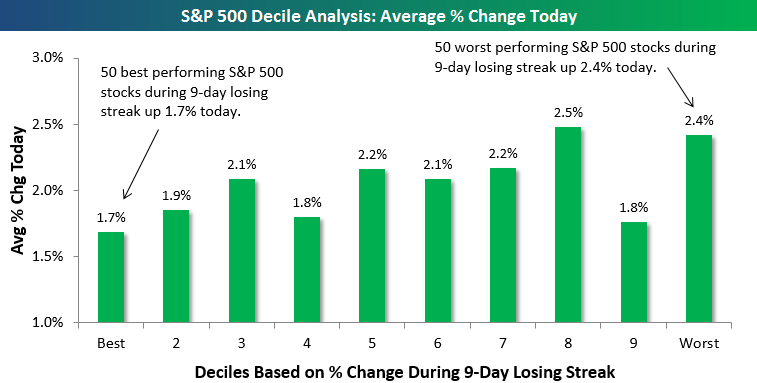
Typically when you see a big bounce like today after a series of losses, the stocks that lost the most during the pullback will also bounce back the most. That hasn’t really been the case today. In the chart below, we’ve broken the S&P 500 into deciles (10 groups of 50 stocks each) based on stock performance during the 9-day losing streak that ended on Friday. The decile all the way to the left of the chart contains the 50 stocks that held up the best during the 9-day losing streak, the decile all the way to the right contains the 50 stocks that declined the most during the losing streak. The number shown for each decile represents the average percentage change today for its 50 stocks. As shown, the 50 best performing stocks during the 9-day pullback are up an average of 1.7% today, while the 50 worst performing stocks during the pullback are up an average of 2.4% today. That difference of just 70 basis points is about as tight as you’ll see on a day like today. We would have expected to see the biggest losers during the 9-day losing streak up at least double the biggest winners today, and maybe even more.
B.I.G. Tips – Election Day Market Performance and the Day After
ETF Trends: Fixed Income, Currencies, and Commodities – 11/7/16
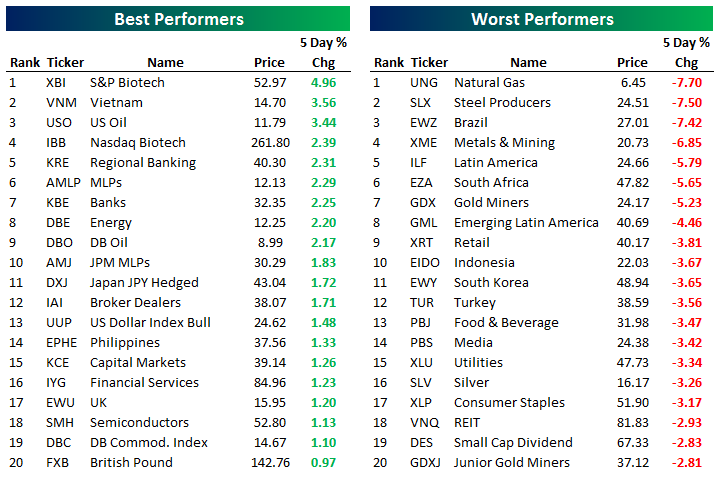
Metals continue to rally as Singapore-traded iron ore futures popped another 5% overnight. Markets are rallying ahead of results from tomorrow’s US election, but there’s plenty of five day losing returns to go around. Turkey, oil, natural gas, and utilities all stand out as large decliners.
Bespoke provides Bespoke Premium and Bespoke Institutional members with a daily ETF Trends report that highlights proprietary trend and timing scores for more than 200 widely followed ETFs across all asset classes. If you’re an ETF investor, this daily report is perfect. Sign up below to access today’s ETF Trends report.
See Bespoke’s full daily ETF Trends report by starting a no-obligation free trial to our premium research. Click here to sign up with just your name and email address.
Chart of the Day – S&P 500 Strong Mornings
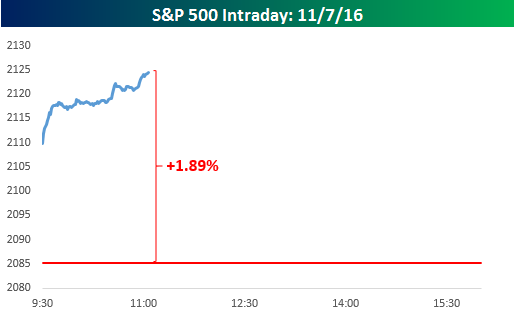 The S&P 500 opened up strong and has built on those gains so far this morning. After gapping up over 1% at the open, the S&P 500 is currently trading up just under 2%% after the 90 minute mark. Since the S&P 500 first crossed 2,000 to the upside in the summer of 2014 and around the time when this long period of consolidation began there have been 36 prior days where the S&P 500 was up over 1% at 11 AM with 14 of those prior occurrences coming in 2016.
In today’s Chart of the Day, we looked at how the S&P 500 performed for the remainder of the day as well as the day and week after each of these prior occurrences. You can see today’s Chart of the Day by starting a 14-day free trial to Bespoke’s premium research below, and if you decide that the service isn’t for you, there is no obligation whatsoever.
Best and Worst Performing Stocks Between Comey Letters
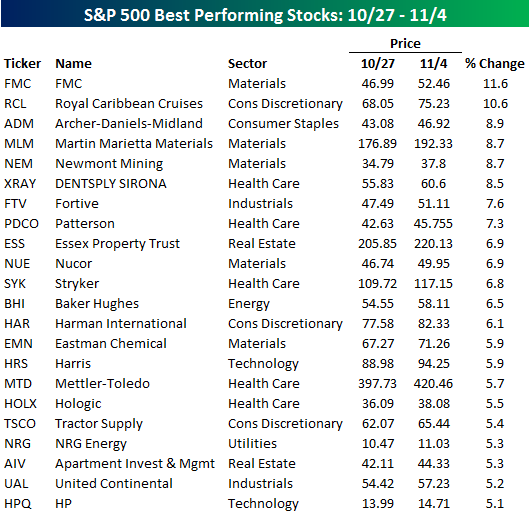
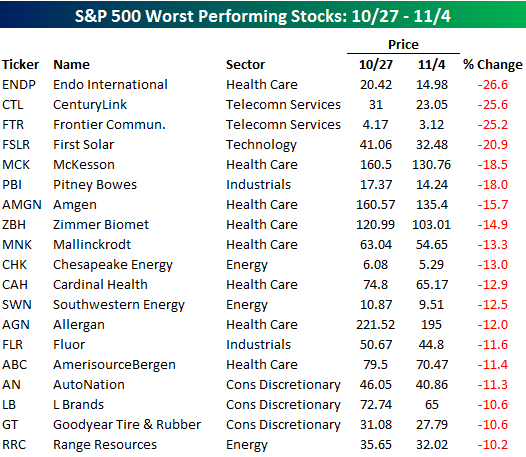
In an earlier post, we highlighted the strange performance of sectors during the periods between FBI director James Comey’s letters to Congress regarding Hillary Clinton’s emails found on Anthony Weiner’s laptop. In this post, we wanted to look at the best and worst performing stocks during the period from 10/27’s close through last Friday’s (11/4) close. As shown in the first table below, there weren’t a lot of winners during this period. Within the entire S&P 500, just 22 stocks were up more than 5%. Leading the way higher were shares of FMC and Royal Caribbean (RCL), which both rallied more than 10%. Looking at this list of names, there really isn’t much of a theme behind them. Of the eleven S&P 500 sectors, nine are represented. The only two missing are Financials and Telecom Services. The sectors showing up the most are Health Care and Materials with five stocks each. The fact that a number of Health Care stocks are on the list would seem to make sense given the fact that Hillary Clinton has been so outspoken against many of the sector’s practices. Therefore, anything that pressured her odds of winning should have been beneficial for stocks in the sector.
What doesn’t necessarily make sense is the fact that even more stocks from the Health Care sector are on the list of losers than the list of winners. As shown below, 19 stocks in the S&P 500 were down more than 10% in the period spanning the two Comey letters. Of those 19, eight were from the Health Care sector, including the biggest lower of all Endo International (ENDP) which declined lost more than a quarter of its value in just over a week of trading.
Dynamic Upgrades/Downgrades: 11/7/16
Sector Performance Between Comey Letters to Congress
It was a hectic 10-days for the political and financial world, but what seemed like a major election curveball two Fridays ago on 10/28 straightened back out on Sunday when FBI director James Comey said that the FBI would not be changing its recommendation (originally issued in July) regarding Hillary Clinton. Perhaps the biggest winner of the whole drama was the news media, especially the New York Post. Despite the fact that another major political bombshell seems a lot less likely heading into Tuesday, the waves from the political world certainly made their presence felt in the financial markets. When news of James Comey’s first letter to Congress 10 days ago surfaced, stocks immediately sold off and haven’t seen positive territory since. But on Sunday, when Comey stood by his original decision from July, US equity futures surged and have now erased more than half of their losses from when the first letter surfaced.
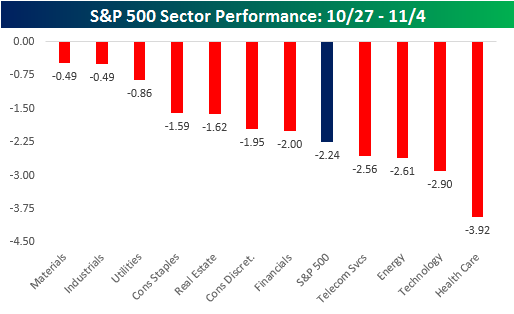
The chart below shows S&P 500 sector performance from the close on 10/27 (before Comey’s first letter surfaced) through last Friday (11/4). As shown, along with the S&P 500, which was down 2.24%, every sector in the market was down during that period. Sectors that held up the best included Materials and Industrials, which were both down 0.49%. Along with those two, the only sector down less than 1% was Utilities (-0.86%). The more interesting aspect of this chart, however, is on the right side. As shown, Health Care was not only the worst performing sector in the market, but it was the worst performer by a LOT, falling 3.92%, or more than a full percentage point more than the next weakest sector.
What’s interesting about Health Care’s underperformance is that it came during a period when Clinton’s odds in the polls were falling. Based on her tweets and prior policy stances, Hillary Clinton has long been considered the candidate that would be the least friendly to the Health Care sector. Further, a Clinton victory coupled with a Democratic sweep of Congress, which seemed like a possibility two weeks ago, was a nightmare scenario for the sector. However, during a period when Clinton’s odds of winning saw a large decline and odds of a Democratic sweep in Congress all but faded, Health Care was by far the worst performing area of the market.
Little Love for Beats, Misses Crushed
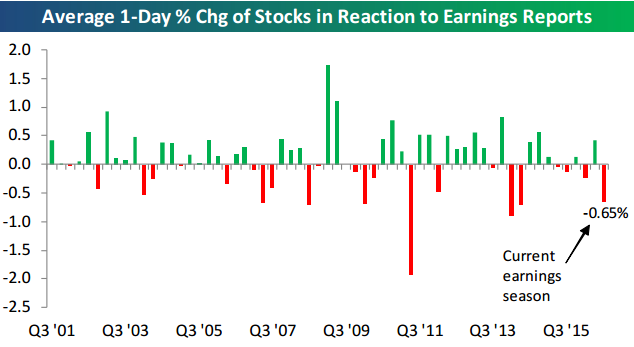
In various reports for Bespoke subscribers over the last couple of weeks, we’ve been highlighting the extreme weakness that stocks reporting earnings have experienced this earnings season. Below is a chart showing the average one-day price change for stocks reporting earnings by quarter going back 15 years to 2001. As shown, stocks that have reported this earnings season have averaged a decline of 0.65% on their earnings reaction days. (For stocks reporting before the open, their earnings reaction day is that trading day. For stocks reporting after the close, its earnings reaction day is the next trading day.)
Investors are clearly selling first and asking questions later in response to earnings this season. Should the average one-day change of -0.65% hold through the remainder of the reporting period, it will be the worst season in nine quarters.
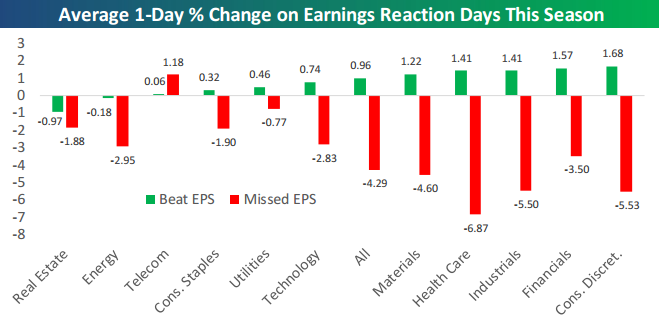
Below we’ve broken down the one-day price reaction to earnings by sector and whether or not the stock beat or missed consensus earnings per share estimates. For all stocks that have reported, the average stock that has beaten earnings estimates has risen just 0.96% on its earnings reaction day. Conversely, the average stock that has missed estimates has fallen -4.29%. That’s a huge gap. The winners this season have not been rewarded, while the losers have gotten slaughtered.
Looking at individual sectors, Real Estate and Energy stocks that have beaten estimates have averaged declines on their earnings reaction days! And while Health Care, Consumer Discretionary, and Industrials stocks that have beaten estimates have averaged gains of more than 1%, stocks that have missed in these sectors have fallen more than 5.5%.
Bespoke Brunch Reads: 11/6/16
Welcome to Bespoke Brunch Reads — a linkfest of the favorite things we read over the past week. The links are mostly market related, but there are some other interesting subjects covered as well. We hope you enjoy the food for thought as a supplement to the research we provide you during the week.
Active Management
The Money Management Gospel of Yale’s Endowment Guru by Geraldine Fabrikant (NYT)
A view inside the adversarial yet collegial world of Yale’s $25 billion dollar endowment, captained by multi-decade veteran David F. Swensen. [Link; paywall]
DAN LOEB: We used to pick stocks in a ‘virtual bubble,’ but now the investing game has changed by Rachael Levy (Business Insider)
Third Point’s Loeb argues that while the firm still focuses closely on single-stock picking, adapting to the increasingly macro-driven nature of equity markets involves significant use of data and risk management. [Link]
Day Traders Confuse Retiring Baseball Player for Bank of Japan’s Governor by Lorcan Roche Kelly, Gearoid Reidy, and Sid Verma (Bloomberg)
Following vaguely worded tweet by a Japanese day trader with a significant following online, there was a brief panic that the BoJ’s Governor Kuroda was headed for a resignation. [Link]
Big Hit on Drug Stocks Caps $26 Billion Decline for John Paulson by Gregory Zuckerman (WSJ)
One of the “heroes” (in terms of returns, anyways) of the subprime crisis is suffering through an epically bad run of things in 2016 as pharma has crushed returns. [Link; paywall]
Food
The ‘Ice Cream’ That Helps You Slim Down or Swole Up by Carrie Battan (Bloomberg)
Ice cream is in many ways the epitome of “junk” food but a new offering that clocks in at a scant 240 calories per pint promises the same indulgence with none of the guilt. [Link]
Hatched From Peanuts, the South’s Hot New Oil by Kim Severson (NYT)
The origin story and appeal of a new spin on a cheap and classic staple of the American obsession with fried foods. [Link; paywall]
FinTech
The Finance Sector Is Feeling the Robot Burn by Richard Partington (Bloomberg)
A rundown on how technological advances (including digital check handling, a rare area where US payments tech is ahead of the UK) are impacting the British financial system. [Link]
Here’s why financial firms’ fintech strategies are failing (BI Intelligence)
Even if new technologies can help improve efficiency, they aren’t always effective in doing so. Business Insider’s Intelligence briefing provides some explanation around what’s getting in the way. [Link]
Venture Capitalists Get Radical and Invest in a…Bank by Telis Demos (WSJ)
The combination of fixed infrastructure costs and regulatory requirements are increasingly forcing financial technology platforms to work as a part of chartered banks; hence the interest in New Jersey’s Cross River Bank. [Link; paywall]
Imposters
Australian impostors play official golf tournament in North Korea (BBC)
The only golf course in North Korea played host to a pair of Aussies masquerading as professional golfers, who were able to compete in a tournament and return from the authoritarian country without incident. Our favorite quote: “I hit 120 and my caddy told me I had bought great shame to my family.” [Link]
How Podesta’s Gmail Account Was Breached by William Bastone (The Smoking Gun)
Another example of how modern electronic communication systems are not invulnerable to human error, even if they’re very secure without mistakes from users. [Link]
Real Estate
Tesla unveils its solar roof and Powerwall 2 by Roberto Baldwin (Engadget)
Updates to the residential offering from Tesla’s Solar City subsidiary caused a stir given how little they stand out; the new tiles look exactly like traditional roof tiles. [Link]
America Is Building More Three-Car Garages Than One-Bedroom Apartments by Patrick Clark (Bloomberg)
While it’s still possible to build large houses in outlying areas at a combination of price point and builder margin that works, doing so with small residences inside urban areas is a much tougher proposition. [Link]
Viewership
ESPN Loses 621,000 Subscribers; Worst Month In Company History by Clay Travis (Outkick The Coverage)
Amidst an all-out assault on the historically dominant bundle model of cable TV, ESPN is losing subscribers at an alarming rate per Nielsen figures; though the company disputes those figures. [Link]
Fox Business Network Sees First Monthly Win Over CNBC by Chris Ariens (TVNewser)
CNBC viewership has been falling for years, but it retains its top spot amongst business channels in the coveted 25-54 demo. Fox Business has been gathering steam, logging its first ever monthly viewership win over CNBC in October. [Link]
Economics
A Little-Noticed Fact About Trade: It’s No Longer Rising by Binyamin Appelbaum (NYT)
We would contest the notion that declining trade intensity of GDP is going “little-noticed”, but Appelbaum does a good job summarizing the odd fact that trade is not rising faster than the growth of output around the world. [Link; paywall]
Why does the BEA think American media are in a golden age? by Matthew Klein (FTAV)
A dive deep into the NIPA tables for an analysis of why the Bureau of Economic Analysis’ “newspaper and periodicals” series is not even close to accurate. [Link; registration required]
The Tradeoffs in Leaning Against the Wind by Francois Gourio, Anil K Kashyap, and Jae Sim (IMF Conference Papers)
New research from a trio of Federal Reserve economists argues that restraining excess credit growth at the cost of lower output and inflation. [Link; 48 page PDF]
Consuming
Instagram Wants to Ease Its Users into Shopping by Sarah Frier (Bloomberg)
As Instagram matures, the company (a unit of Facebook) is searching for ways to monetize users not by raw display advertising, but via actual purchases through the app. [Link]
Socially Influenced Preferences by Chris Dillow (Stumbling and Mumbling)
Are our choices natural or nurtured? This isn’t just an age-old philosophical question but is also a key for economists who depend so much on modeled assumptions about preferences of consumers and other kinds of agents. [Link]
Modern Politics
White House Announces Plans for Transition of Twitter Handles by Derek Wallbank (Bloomberg)
When the election is all wrapped up, one of two possible teams will have to take over the bevy of Executive Branch Twitter accounts. Such is life in our era of social media. [Link]
Fantasy Sports
Daily Fantasy Sports Firms Said to Unite Under DraftKings CEO by Eben Novy-Williams, Alex Sherman, and Scott Soshnick (Bloomberg)
After facing bans, fighting tooth and nail for customers, and trying to reinvent how we gamble on sports, daily fantasy leagues are starting to consolidate. [Link]
Frontline Reporting
28 hours: Leading the Mosul attack, under fire then trapped by Arwa Damon (CNN)
In an astounding feat of embedded reporting, a CNN crew moved into the teeth of the fighting around Mosul with a convoy of Iraqi special forces. [Link]