
B.I.G. Tips – February 2017 Seasonality
ETF Trends: US Indices & Styles – 1/30/17
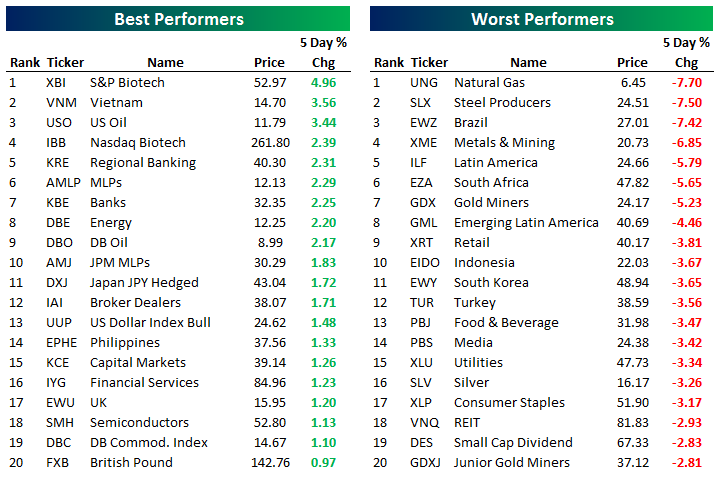
MLPs continue to rally, with Mexico also delivering solid returns on a relative basis as well. Banks and other Financial sectors have outperformed including homebuilders. On the losing side of the equation, there’s been no joy for EWI as Italian banks have weighed, while REITs, long-term Treasuries, and Retail have undeperformed within the US equity market.
Bespoke provides Bespoke Premium and Bespoke Institutional members with a daily ETF Trends report that highlights proprietary trend and timing scores for more than 200 widely followed ETFs across all asset classes. If you’re an ETF investor, this daily report is perfect. Sign up below to access today’s ETF Trends report.
See Bespoke’s full daily ETF Trends report by starting a no-obligation free trial to our premium research. Click here to sign up with just your name and email address.
Energy, Materials Stocks Responding Positively to Earnings
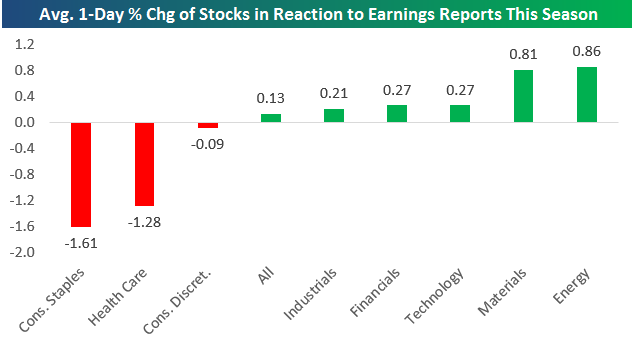
We keep track of every single earnings report throughout the quarter so we can continuously monitor emerging trends in things like beat rates and price reactions. So far this earnings season, the average stock that has reported has gained 0.13% on its earnings reaction day, which is the first trading day following a stock’s earnings report. (For a stock that reports in the morning before the open, its earnings reaction day is that trading day. For a stock that reports in the afternoon after the close, its earnings reaction day is the next trading day.)
The chart below only shows sectors where more than 10 stocks have reported earnings this season. Of the sectors shown, two stand out to the upside and two stand out to the downside. Energy and Materials stocks that have reported earnings this season have been reacting positively. The average Energy stock has gained 0.86% on its earnings reaction day, while the average Materials stock has gained 0.81%. Consumer Staples and Health Care stocks, on the other hand, have been selling off on earnings this season. The average Consumer Staples stock that has reported has fallen 1.61% on its earnings reaction day, while the average Health Care stock has fallen 1.28%.
Hundreds more companies will report their quarterly numbers this week, so we’ll have a much bigger sample size by week’s end.
Want to see more research like this? Click here to start a no-obligation two-week free trial.
Bespoke Brunch Reads: 1/29/17
Welcome to Bespoke Brunch Reads — a linkfest of the favorite things we read over the past week. The links are mostly market related, but there are some other interesting subjects covered as well. We hope you enjoy the food for thought as a supplement to the research we provide you during the week.
Investing
Harvard Endowment to Lay Off Half Its Staff by Juliet Chung and Dawn Lim (WSJ)
The world’s largest university endowment has decided it’s time to call it quits and will pass off management to an outside manager. [Link; paywall]
Hedge Funds Risk Treasuries Wipeout After Bearish Bets Soar by Brian Cappatta and Liz McCormick (Bloomberg)
In futures markets, hedge funds are extremely short bonds, setting up the possibility of a messy market should rates fail to make a further significant upside move. [Link; auto-playing video]
Hedge Funds Strike Paydirt on Actelion Deal After Tracking J&J’s Jet (Bloomberg)
Is this what you call alternative investing? [Link]
Betting on Nordic Rain Pays Better Than Average Hedge Fund by Jesper Starn (Bloomberg)
And this as well? [Link]
Science
Hydrogen turned into metal in stunning act of alchemy that could revolutionise technology and spaceflight by Ian Johnston (The Independent)
Squeezing together two diamonds, hydrogen has been fused into a metal that has a huge range of potential applications in addition to its theoretically fascinating properties. [Link; auto-playing video]
Two Infants Treated with Universal Immune Cells Have Their Cancer Vanish by Antonia Regalado (MIT Technology Review)
While the results are not conclusive (due to the concurrent use of chemotherapy), there have been extremely promising results of new tests that use artificial immune-system cells to combat blood cancer. [Link]
Even wasps make trade deals, scientists discover (University of Sussex/Science Daily)
A new study about the “economic” structure of wasps and how they react to other wasps in uncertain social settings suggests they follow the laws of supply and demand. [Link]
Demographics
“Estimating trends in mortality for the bottom quartile, we found little evidence that survival probabilities declined dramatically.” by Andrew Gelman (Statistical Modeling, Causal Inference, and Social Science)
Are lower-income men dying at greater rates, as reported by Case and Deaton last year? It depends how you count it! When adjusting for the shifting prevalence of education, the effect disappears. [Link]
Real Estate
China’s Army of Global Homebuyers Is Suddenly Short on Cash (Bloomberg)
Housing markets from California to the UK are starting to sag as Chinese capital controls choke of the spigot of investment that has supported prices in recent years. [Link; auto-playing video]
Home prices in the Hamptons are collapsing by Akin Oyedele (Business Insider)
High-end New York vacation property has seen prices decline as much as 20% YoY with buyers hesitant to step in and sellers pushing higher numbers of listings. [Link]
Mall Owners Rush to Get Out of the Mall Business by Esther Fung (WSJ)
With declining fortunes for the retail industry, their landlords are starting to select default and foreclosure over keeping the doors of indoor malls open. [Link; paywall]
Remember ABX? Wall Street Said to Test New Mortgage Index by Matt Scully (Bloomberg)
Prime mortgage credit risk is starting to trade again, part of an effort to reduce credit risk for government sponsored entities like Fannie and Freddie. But the new derivatives look nothing like the sub-prime CDS index of “The Big Short” fame. [Link]
Economic Research
A Challenge to the ‘Secular Stagnation’ Theory by David Harrison (WSJ Real Time Economics)
Arguing that productivity variations driven by workers’ ages are more important than dependency ratios, a new Acemoglu and Restrepo paper argues that automation will unleash per capita growth. [Link]
Expert group studying the causes of low inflation (ECB)
An impressive 14 papers on the causes of low inflation in the Euro area. We haven’t had a chance to read through all of these yet but the repository is quite a thing! [Link]
The Best vs. the Rest: The Global Productivity Slowdown Hides an Increasing Performance Gap across Firms by Dan Andrews, Chiara Criscuolo, and Peter Gal (OECD Ecoscope)
Interesting data from the OECD on the extreme levels of productivity achieved by the most efficient firms, but the middling at best levels of output per worker hour in the rest of the business sector. [Link]
Local Government
Assessing Fiscal Capacities of States by Tracy Gordon, Richard Auxier, and John Iselin (Urban Institute)
We can’t blame you for not clicking on a link to a PDF this large, but we assure you that the data assembled within is worth some of your time, detailing the mechanics of revenue collection and spending outlays across the 50 states. [Link; 150 page PDF]
Alternative Perspectives
Disability Is Not An Asterisk: Eric Garcia Interviews Dylan Matthews by Eric Garcia (NOS Magazine)
A conversation between two of DC’s small handful of autistic journalists. We found the conversation deeply revealing and offering a very different perspective than one that would have played out between two neurotypical conversationalists. [Link]
Trump Trade
Under Trump, It’s Make a Deal With the President—or Else by Justin Sink (Bloomberg)
A summary of the techniques by which Trump is hoping to push growth. [Link; auto-playing video]
Trump Aide Reassures Canada on Trade Talks, Isolating Mexico by Josh Wingrove and Greg Quinn (Bloomberg)
North of the border, there’s little attachment to defending NAFTA, though free trade with the United States is viewed as critical. [Link; auto-playing video]
Will U.S. Policy Trump Canadian Trade? Some Questions And Answers by Brian DePratto (TD Economics)
A handy primer on the US-Canada bilateral trade relationship, with a variety of detailed backgrounders, charts, and outlook for trade with the United States. [Link; 7 page PDF]
Amazon
Amazon’s next frontier to conquer? Auto parts by Josh Kosman and James Covert (NY Post)
Auto parts are a huge business ($50bn per year) and Amazon wants a piece, turning its expertise in inventory, logistics, and customer interfacing towards traditional retailers. [Link]
AWS Snowmobile (Amazon Web Services)
In a bid to help clients convert server farms to the cloud, Amazon is rolling out a service that amounts to a motorized shipping container full of flash memory. [Link]
FedEx Bandwidth (xkcd what if?)
Semi-related to the above link, this is a fantastic if somewhat unserious answer to the question “what is the bandwidth of FedEx?” [Link]
The Buck
Companies Can’t Stop Talking About the Strong Dollar by Ben Eisen (WSJ Moneybeat)
A round-up of the earnings commentary related to the US dollar so far this earnings season. While it’s early yet, there’s been a lot of it. [Link]
Media
Facebook, Snapchat Deals Produce Meager Results for News Outlets by Gerry Smith (Bloomberg)
Despite handy user interfaces and large user counts, content owners are having a very hard time squeezing blood out of the stones that are Snapchat and Facebook. [Link]
Pursuits
The Fitness Shift That Should Worry Every Gym Owner by Rachel Bachman (WSJ)
Services that allow users to flit between gyms offering workout classes are fantastic for folks getting in their exercise but carry dangers for gym owners. [Link; paywall]
Doomsday Prep For The Super Rich by Evan Osnos (The New Yorker)
How do you get ready for the end of the world when you have too much money to spend? The answer to that question is, if this article is any indication, a barrel of laughs. [Link]
Have a great Sunday!
The Bespoke Report — Trump 20,000 — 1/27/17
If you’re not yet a Bespoke subscriber, you can still get Bespoke’s 2017 Outlook Report with a 30-day free trial to Bespoke’s premium research! Click here to learn more.
The screen below is one of many graphics included in our just-published Bespoke Report newsletter (included weekly with all of our membership packages). As shown, we closed out the final full week of January with nearly all country ETFs trading above their 50-day moving averages. All but 7 of the 30 country ETFs in the screen are overbought. The post-election rally continues.

If you’d like to see the rest of this week’s Bespoke Report newsletter, take advantage of our one-month Bespoke Premium free trial offer that includes our 2017 Outlook Report. Sign up now at this page.
Have a great weekend!
Quick View Chart Book – 1/27/17
The Closer 1/27/17 – End of Week Charts
Looking for deeper insight on global markets and economics? In tonight’s Closer sent to Bespoke clients, we recap weekly price action in major asset classes, update economic surprise index data for major economies, chart the weekly Commitment of Traders report from the CFTC, and provide our normal nightly update on ETF performance, volume and price movers, and the Bespoke Market Timing Model.
The Closer is one of our most popular reports, and you can sign up for a trial below to see it and everything else Bespoke publishes free for the next two weeks!
Click here to start your no-obligation free Bespoke research trial now!
Sears: The 19th Century Amazon
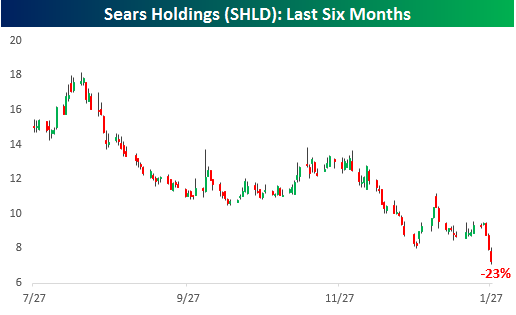 Shares of Sears Holdings (SHLD) have been in free-fall the last three days, falling a staggering 23% during that span. This week’s decline is only a continuation of a longer-term decline where the stock has lost over half of its value in the last six months. The reason behind the most recent leg lower in the stock stems from a ratings downgrade from Fitch where there the agency said that, “although Sears has been able to fund its continued cash shortfalls through planned asset monetization, and additional financings, a meaningful business turnaround in fiscal 2017 is critical given the continued reduction of its asset base.” In other words, unless business picks up for Sears, it is going to run out of assets to fund its liabilities.
The history of Sears is really a fascinating case study of how technology has upended the retail landscape. Whereas over a century ago, Sears completely altered the retail landscape with its famous catalog, today companies like Sears are being upended by technology and online sales. Back in the late 1800s, when the country was much more agrarian in nature, farmers had just one option to purchase their goods and supplies – the local general store. With zero competition, the owner of the store was a price maker and could, within reason, charge whatever he wanted for whatever he decided to sell. The customer basically had no choice as to selection or price. When the Sears catalog was first introduced, it completely upended the retail landscape by introducing uniform prices and a wider selection of merchandise (sound familiar).
With the success of the catalog business, Sears began to diversify its product offerings as well as its distribution by opening retail stores in cities and towns around the country. The company saw massive growth and success over a period that spanned decades, and in the early 1970s finished building the Sears Tower, which was at the time of its completion the world’s largest skyscraper. Sears was literally on top of the world! Nothing lasts forever, though, and looking back, the 1970s were probably the peak for Sears. Sales from the catalog started to decline as the concept became stale, and in the 1990s the company stopped publishing it. Then ten years later Sears was purchased by Kmart, another once famous retailer that was losing its relevance. While the combined company saw some success in its stock price after the merger, most of the period as a combined company has been negative for shareholders.
The experience of Sears really provides a perfect example of the ‘bricks to clicks’ trend we first highlighted several years ago in our Death By Amazon index. Like Sears over a century ago, starting with books, Amazon came into the traditional retail environment and completely transformed it. Numbers don’t lie, and the stock performance of Sears and Amazon.com over the last decade illustrates how traditional retail’s pain (in this case Sears) has been Amazon’s gain. Over that span, shares of AMZN are up over 2,000% while SHLD is down over 90%!
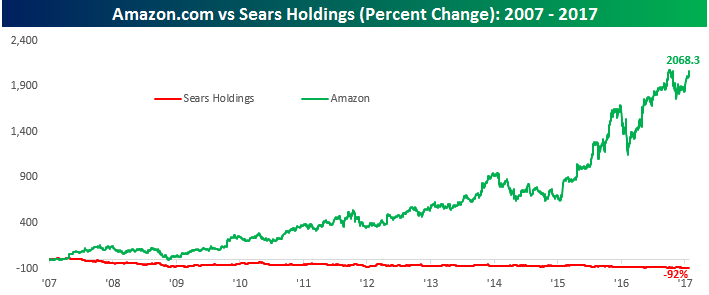
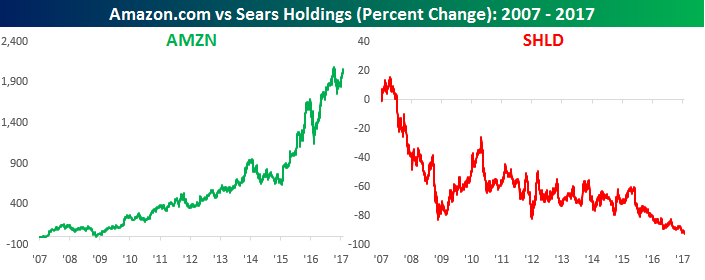
In fact, the chart above doesn’t even do justice to the disparity in the performance of the two stocks, because AMZN’s return has been so positive and SHLD’s has been so negative. Below we show the performance of both stocks on separate charts. Just to get back to where it was ten years ago, Sears would have to rally more than 1,300%. There’s probably a good chance that ten years from now Sears will no longer be around, but as ancient as the company now seems, it was once the Amazon of its day.
Most Shorted Stocks Getting Trounced
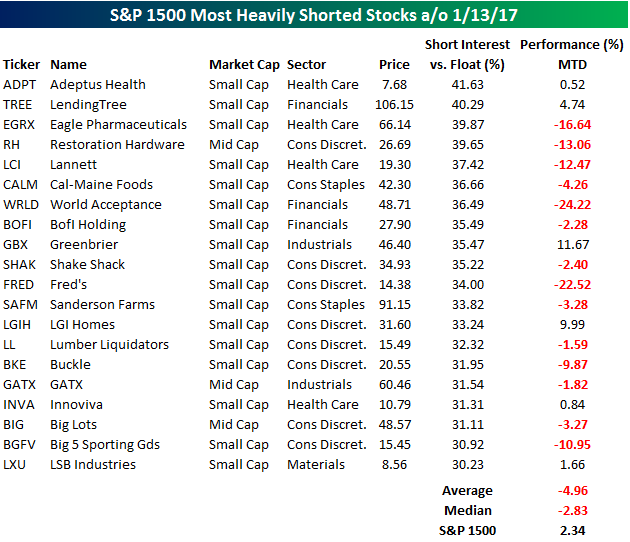
Short interest figures for the middle of January were released after the close Wednesday and as the rally in equities stalled out, traders took the opportunity to add some shorts to their books hoping that the stall would turn into a downdraft. The table below lists the 20 stocks in the S&P 1500 that have 30% or more of their free-floating shares sold short, and for each stock we also include how they have fared so far in 2017. Even though equities have rallied so far this year, the most heavily shorted stocks have completely sat out of the rally. The average return of the 20 stocks listed is a decline of 4.96% (median: -2.83%). In terms of breadth, it’s just as weak with only six out of the twenty stocks posting YTD gains.
The primary culprit behind the declines in the most shorted stocks this month is the consumer. Of the 20 names listed, eight are from the Consumer Discretionary (6) or Consumer Staples sectors (2), and of those stocks just one (LGIH Homes) is up YTD. Collectively, these stocks are down an average of 6.1% on the year, while the other 12 stocks are down an average of less than 4%. We’ve been discussing the ‘bricks to clicks’ trade and our Death By Amazon index for several years now, but based on the performance of many consumer related stocks so far this year, a lot of investors in the sector seem to still just be figuring it out.
Interested in a more in-depth analysis of short interest trends? Yesterday, we published our bi-monthly short interest report, which is available to all Bespoke Premium and Institutional clients. Click here to start a no-obligation 14-day free trial now.
ETF Trends: Fixed Income, Currencies, and Commodities – 1/27/17
A surprising name has popped up among the best performers of the past week. Master limited partnerships (oil infrastructure plays) are up over 5% versus last week, the second-best performer in our list of ETFs. Mexico, Russia, Homebuilders, and Materials have all performed well. The worst performers were precious metals, Turkey, and Italy. Retail and Pharma have also continued to underperform.
Bespoke provides Bespoke Premium and Bespoke Institutional members with a daily ETF Trends report that highlights proprietary trend and timing scores for more than 200 widely followed ETFs across all asset classes. If you’re an ETF investor, this daily report is perfect. Sign up below to access today’s ETF Trends report.
See Bespoke’s full daily ETF Trends report by starting a no-obligation free trial to our premium research. Click here to sign up with just your name and email address.