
The Closer — Play The Wedge — 2/27/17
Log-in here if you’re a member with access to the Closer.
Looking for deeper insight on global markets and economics? In tonight’s Closer sent to Bespoke Institutional clients, we lay out a trade idea in fixed income, chart up the strong reading for today’s Dallas Fed Manufacturing Composite, and review preliminary durable goods numbers.
The Closer is one of our most popular reports, and you can see it and everything else Bespoke publishes by starting a no-obligation 14-day free trial to our research!
The “Gone Fishing” Market
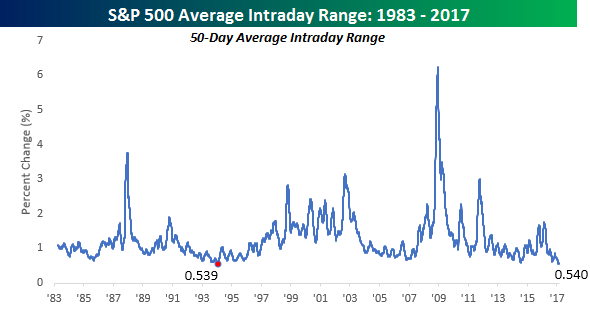
The lack of volatility in the markets these days has really been something to behold. If your EKG looked like an intraday chart of the S&P 500 recently, the doctor would probably be reaching for the paddles. The latest example of zero volatility in the market comes courtesy of the S&P 500’s intraday trading range. Over the last 50 sessions, the S&P 500’s average percentage spread between the intraday high and intraday low has been 0.540%. Going back to 1983, when our database of intraday data begins, there has only been one other time where the S&P 500’s 50-day average intraday range was narrower. That was back in early February 1994 when the average range got as low as 0.539%, so the current narrow range is close to a record. But it gets even better. Barring a big intraday move tomorrow (greater than 1% – an intraday range we haven’t seen since mid-December), the S&P 500’s average daily range will drop below the record low of 0.539% that has been in place for nearly a quarter of a century. Even the computers have gone fishing.
What makes the period of low intraday volatility even more amazing is that it has occurred in the middle of a Presidential transition, which is often a period of increased volatility, especially when the outgoing administration has been in office for two terms. Judging by virtually all of the media accounts, the current transition has been the most chaotic and disorganized in modern history, riddled with blunders coming from an inexperienced Administration, but through it all the market has been humming. So, who has it wrong? The markets or the media?
B.I.G. Tips – Russell 3,000 Dividend Screen
B.I.G. Tips – March 2017 Seasonality
Chart of the Day: Tesla (TSLA) In Sudden Need of a Charge
Tesla (TSLA) shares received a downgrade from Neutral to Sell at Goldman Sachs today. Based on Goldman’s historical calls on the stock, though, we’re not sure how closely this call should be followed. Only time will tell.
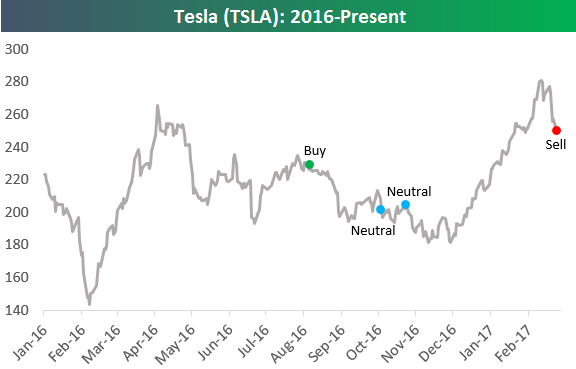
In today’s Chart of the Day (available to all paid clients), we took a closer look at the short-term and long-term price action in Tesla (TSLA) to identify possible entry points on the long side. To see the report, sign up for a free trial using the form below:
Bidders Lining Up For Sotheby’s
Bidders are piling into Sotheby’s (BID) stock today like a post-Thanksgiving crowd into a department store as the stock is on pace for its best single-day performance in over five years. Today’s driver is a better than expected earnings report where the company smashed consensus estimates on both the top and bottom line. In its commentary, the company noted that its “results reflect growing confidence in the market as collectors responded enthusiastically to the great collections and works we secured for sale.”
Given that Sotheby’s caters mostly to people who have too much money lying around that they feel the need to spend it on paintings and pricey tchotchkes, its performance would seem to have little bearing on how regular consumers are doing. In the past, however, the stock’s performance has been cited as a relatively good predictor of the business cycle. The chart below shows the performance of Sotheby’s stock since 1989 with recessions overlaid in gray.
As shown, there were three major peaks in Sotheby’s from 1989 to 2009 where the stock lost more than two-thirds of its value, and all three of them preceded recessions. Sotheby’s share price once again did fall by over 60% to its low in early April of last year, and while a total recession didn’t follow here in the US, there was a soft spot. Additionally, the European and Chinese economies (where many of Sotheby’s buyers come from) were also under a pressure.
To see Bespoke’s full line of macro and micro research, simply sign up for one of our premium membership options today! You won’t be disappointed.
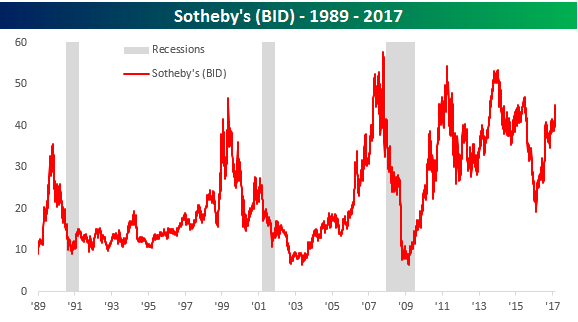
So what is Sotheby’s telling us about the economy now? While the stock is still well off its highs from the last several years, today’s 14% rally implies that business for the company is improving, and that should be a positive signal for the global economy. One caveat we would note, though, is that the strong earnings report wasn’t solely due to improved business conditions in Sotheby’s market. As noted in the release, “The Company also benefited from a lower effective tax rate and a significantly lower number of shares outstanding due to share repurchases made throughout 2016.” Leave it to financial engineering to ruin what was once a great off-beat economic indicator.
ETF Trends: Fixed Income, Currencies, and Commodities – 2/27/17
Utilities have been the strongest part of the US equity market over the last five days with Mexican peso’s significant rally over the same period also boosting EWW. Homebuilders, REITs, and precious metals have also rallied. Natural gas has made new lows, while metals and mining swan-dived last week along with an ongoing grind lower for Energy names.
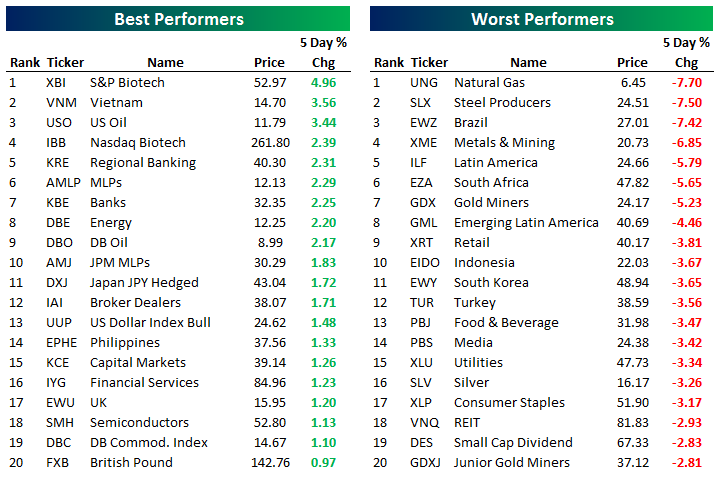
Bespoke provides Bespoke Premium and Bespoke Institutional members with a daily ETF Trends report that highlights proprietary trend and timing scores for more than 200 widely followed ETFs across all asset classes. If you’re an ETF investor, this daily report is perfect. Sign up below to access today’s ETF Trends report.
See Bespoke’s full daily ETF Trends report by starting a no-obligation free trial to our premium research. Click here to sign up with just your name and email address.
Stock Seasonality Report: 2/27/17
A Four-Legged Rally
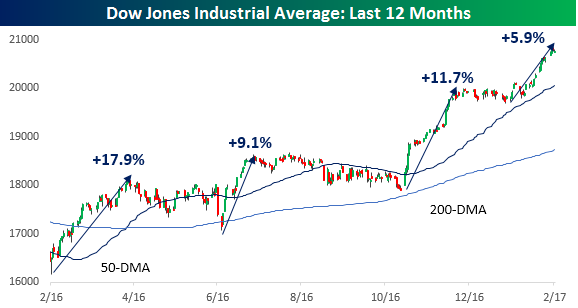
Since its closing price of 16,484.99 a year ago on 2/24/16, the DJIA has rallied a tremendous 26% in a move that virtually no one at the time was predicting. What’s even more notable about the rally is how the gains have been confined to four distinct legs higher. From late February to mid-April of 2016, after what was the worst start to a year in the market’s history, the DJIA saw the first leg higher, rallying 17.9%. At that point, it rested for a little over two months, and then spiked 9.1% in late June following the Brexit vote, in what again was a rally that very few would have predicted at the time. Towards late July, the market shifted its focus on the November election and drifted lower all summer into early fall.
The catalyst for the third leg higher over the last year came from another unlikely source as Donald Trump’s election, which was ‘supposed’ to trigger a cascade lower in equity prices, propelled the DJIA higher by over 11% through mid-December. After that post-election surge, the conventional wisdom morphed into a strategy of “buy the election and sell the inauguration,” as all the good news of a Trump victory surely had to have been priced into the market before he even came into office. Therefore, once in office, there was nowhere for the market to go but down. With that sentiment in place, you guessed it, there was obviously nowhere for the market to go post-inauguration but up, and from late January through Friday, the DJIA started another leg higher! This leg higher includes the current winning streak of eleven straight positive closes, which is the longest winning streak for the index since January 1992! What is interesting about this most recent leg higher is that even as the market seems so extended, the percentage gain is the smallest of the four legs higher.
As mentioned above, the DJIA’s rally over the last year has been confined to four short spurts higher for the index. In fact, the trading days included in these four legs higher comprise just 100 out of 254 trading days in the last year. Even more notable is the fact that all four legs higher came at times when few if any investors were expecting them. As any seasoned investor will tell you, the stock market’s single biggest role at any given time is to make the seemingly most intelligent investors look as foolish as possible. Looking back at the last year, it has been mission accomplished.
To see Bespoke’s full line of macro and micro research, simply sign up for one of our premium membership options today! You won’t be disappointed.
Bespoke Brunch Reads: 2/26/17
Welcome to Bespoke Brunch Reads — a linkfest of the favorite things we read over the past week. The links are mostly market related, but there are some other interesting subjects covered as well. We hope you enjoy the food for thought as a supplement to the research we provide you during the week.
Thinkers of Note
Charlie Munger on Getting Rich, Wisdom, Focus, Fake Knowledge and More (Farnham Street)
A series of quotes and anecdotes offering insight into the way Charlie Munger (of Berkshire Hathaway) thinks about investing and the world more broadly. [Link]
Kenneth Arrow, Nobel-Winning Economist Whose Influence Spanned Decades, Dies at 95 by Michael M. Weinstein (NYT)
Probably best known for a theory that’s more important for political science than economics, Arrow was a giant of the economics field, winning a Nobel and profoundly influencing the development of economic thinking in the latter half of the 20th century. [Link; soft paywall]
Hedge Funds
How Does the Hottest Metals Trade Work? First, Find Storage by Mark Burton (Bloomberg)
As battery demand explodes thanks to electric vehicle market penetration, hedge funds are buying physical stocks of cobalt. [Link]
Hedge Fund Liquidity Falls to Danger Zone in U.S. Stock Market by Lu Wang (Bloomberg)
As the market has rallied, gross exposures have risen and cash balances have fallen in the hedge fund community. [Link]
Science
Why are we the only human species still alive? by Melissa Hogenboom (BBC)
Numerous close relatives of our species existed in relatively recent history, and often in close proximity to modern homo sapiens. So where did they go? [Link]
NASA Telescope Reveals Largest Batch of Earth-Size, Habitable-Zone Planets Around Single Star (NASA)
While 235 trillion miles may seem like a very long way, it’s part of our astronomical backyard. That makes the discovery of multiple planets inside the habitable zone (where liquid water would be possible) of a star 40 light years away extremely exciting. [Link]
Tech Capital Raising
Jeff Bezos had to take 60 meetings to raise $1 million for Amazon, giving up 20% to early investors by John Cook (GeekWire)
With a current market cap of $400bn, it seems impossible to imagine the struggle its founder had raising capital for the original company. [Link]
My Snap Story: Valuing Snap ahead of it’s IPO! by Aswath Damodaran (Musings on Markets)
Dean of valuation and NYU professor Damoradan takes aim at the parent company of Snapchat, which plans to IPO in the next couple of weeks. [Link]
International Affairs
What One Photo Tells Us About North Korea’s Nuclear Program by Max Fischer and Jugal K. Patel (NYT)
A fascinating breakdown of the tiny visual cues left behind in propaganda pictures, with commentary from experts in nuclear proliferation. [Link; soft paywall]
Dogs
Opening the Heart’s Floodgates, With a Paw by Amy Sutherland (NYT)
If you’re a dog person – whether you have a four-legged companion of your own or not – you’ll love this account of working in a shelter, helping pups find forever homes. [Link; soft paywall]
Italy
Mike Piazza Learns How to Be an Owner. Of a Soccer Team. In Italy. by Andrew Keh (NYT)
Piazza was a giant behind the plate in ballparks, but his new focus is a move to a small city 100 miles south of Milan, where he has purchased a third division soccer franchise. [Link; soft paywall]
Stretch of Roman road unveiled beneath McDonald’s restaurant by Nick Squires (The Telegraph)
A side of history goes well with burgers and fries. At a new fast food spot outside Rome, a stretch of Roman road is visible beneath the area where customers order their food. [Link]
Opportunities & Costs
The Big Idea for Middle America: Think Small by Conor Sen (Bloomberg View)
While the large city has been associated with opportunity, lower cost of living, accessible political institutions, and the ability to own a home are all important competitive advantages for small town America. [Link]
The High Cost of Cheap Labor by Brian Barth (Modern Farmer)
Inside the farm economy’s dependence on cheap immigrant labor in a country where available jobs aren’t always sought after. [Link]
Health Care
You’re Overpaying for Drugs and Your Pharmacist Can’t Tell You by Jared S. Hopkins (Bloomberg)
A look at the practice of clawbacks, a practice that steers consumers towards more expensive drugs despite the existence and availability of extremely cheap alternatives. [Link]
Bad Business Models
Beepi’s Series B Surprise by Chris Coleman (Carlypso)
An analysis (from a competitor, so perhaps to be taken with a grain of salt) of the failure of Beepi. The post is a fascinating insight into the function of the used car market and used car dealers. [Link]
Inside Disney’s troubled $675 mil. Maker Studios acquisition by Sahil Patel (Digiday)
Back in 2014, Disney purchased a stable of creative talent and syndication via YouTube called Maker Studios. The purchase has not panned out. [Link]
Have a great Sunday!