
The Closer — CFNAI, Auto Assemblies, Truck Tonnage — 3/20/17
Log-in here if you’re a member with access to the Closer.
Looking for deeper insight on global markets and economics? In tonight’s Closer sent to Bespoke Institutional clients, we take a look the Chicago Fed’s National Activity Index, chart up some recent data on US auto production, and update trends in truck tonnage.
The Closer is one of our most popular reports, and you can sign up for a free trial below to see it!
The Closer is one of our most popular reports, and you can see it and everything else Bespoke publishes by starting a no-obligation 14-day free trial to our research!
China’s Record Stock Market Streak
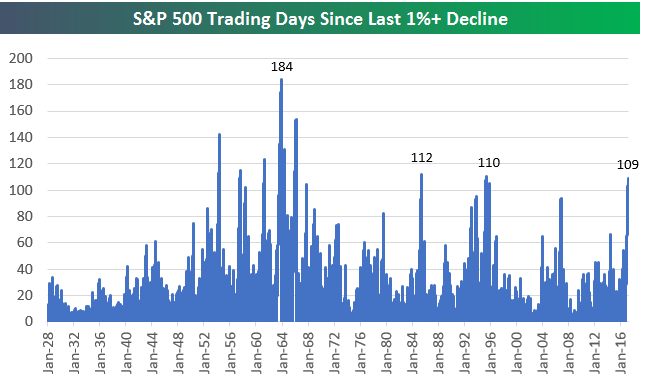
About six weeks ago we began highlighting the S&P 500’s streak of consecutive trading days without a 1%+ decline. The streak remains intact through today, and it now stands at 109 trading days. If we make it past Wednesday without a 1%+ decline, we’ll surpass the 110-trading day streak that ended in May 1995. If we make it through the end of the week without a 1%+ decline, we’ll surpass the 112-trading day streak that ended in June 1985. Below is a look at historical streaks of trading days without a 1%+ decline going back to 1928:
But while the S&P 500’s streak of 109 trading days without a 1%+ decline is impressive, China’s stock market is on an even more impressive one. As shown below, China’s Shanghai Composite has now gone 64 trading days without a 1%+ decline! While not as long as the US streak, it’s easily a record for China, which has historically been much more volatile than the US market.

Top-Heavy Market Thus Far in 2017
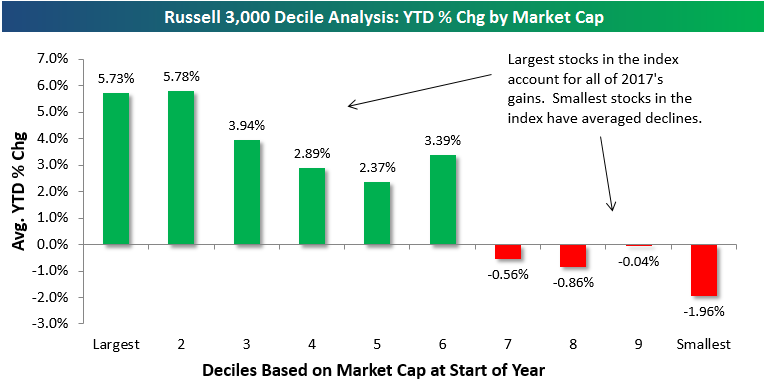
The S&P 500 is up over 6% already in 2017, but thus far it has only been large-cap stocks posting meaningful gains. We broke the Russell 3,000 into deciles (10 groups of 300 stocks each) based on market caps in order to highlight this trend. In the chart below, decile 1 (labeled “Largest”) contains the largest 10% of stocks in the index at the start of the year. Decile 2 contains the next largest 10%, and so on and so forth until you get to the last decile (labeled “Smallest”), which contains the smallest 10% of stocks in the index. For each decile, we’ve calculated the average stock’s year-to-date percentage change. The two deciles containing the largest stocks in the Russell 3,000 have averaged gains of more than 5.7%. The next four deciles have all averaged YTD gains as well, but the four deciles containing the smallest stocks in the index are all averaging declines in 2017. The average YTD change of the stocks in the smallest decile is -1.96%, which represents significant underperformance compared to the cap-weighted S&P 500’s year-to-date gain.
Want to see more? Start a two-week no obligation free trial to Bespoke’s premium research platform.
Can Wynn Resorts (WYNN) Finally Break Out of Its Range?
Wynn Resorts (WYNN) has seen a big jump lately, rising up to its current level above $110/share from a low in the mid-$80s late last year. As shown in the chart below, the stock has jumped more than 10% just over the last week, causing shares to break above highs made last September.
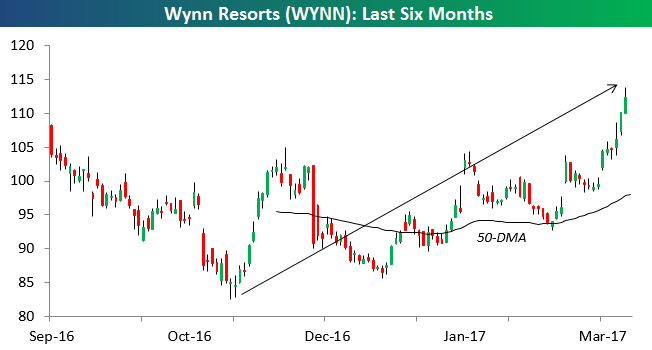
We’ve been tracking WYNN closely over the last couple of years, and the last twelve months have been remarkable — not because the stock has spiked or crashed, but because it has traded in such a back-and-forth sideways range. As you can see in the two-year chart of WYNN below, since last March, the stock has bounced up and down between $80 and $110 seven different times. Each time it has hit the top of its range, it has failed to break above resistance, and each time it has dipped to the bottom of its range, it has failed to break below support.
The reason we’re highlighting WYNN now is because today shares finally broke above resistance and hit a new 52-week high. WYNN longs are hoping this breakout finally puts an end to the game of ping-pong that has been going on for the last year.
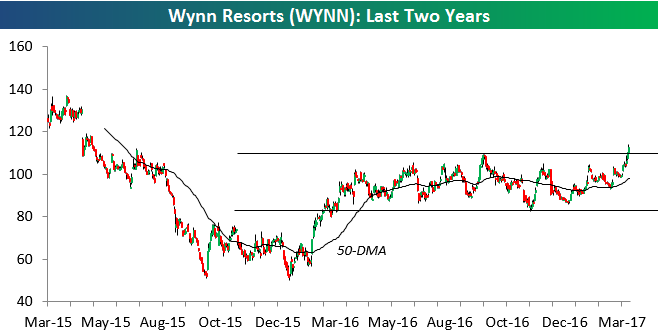
Chart of the Day: The Retail Productivity Revolution And Collapse
Stock Seasonality Report – 3/20/17
ETF Trends: Fixed Income, Currencies, and Commodities – 3/20/17
Mexico continues to outperform, with 5 other EM country ETFs leading our list of the best performers. A few metals names and Spanish equities joined the rally as well. Undeperforming ETFs over the past week include banks (hit by a flattening yield curve), MLPs, and the US dollar.
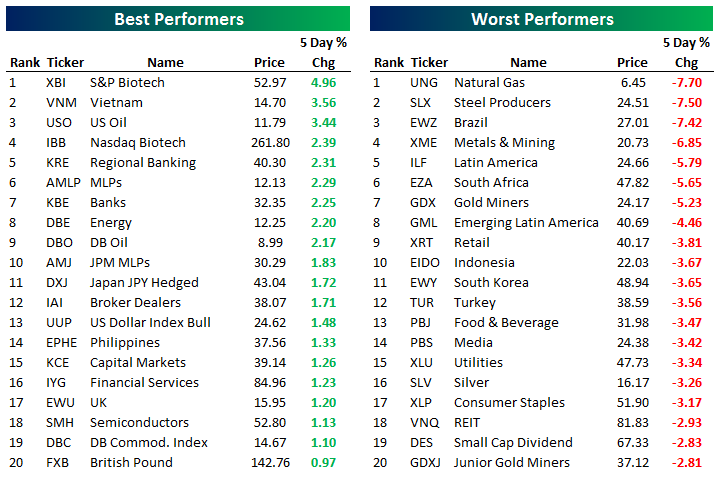
Bespoke provides Bespoke Premium and Bespoke Institutional members with a daily ETF Trends report that highlights proprietary trend and timing scores for more than 200 widely followed ETFs across all asset classes. If you’re an ETF investor, this daily report is perfect. Sign up below to access today’s ETF Trends report.
See Bespoke’s full daily ETF Trends report by starting a no-obligation free trial to our premium research. Click here to sign up with just your name and email address.
FANG Still Has its Bite
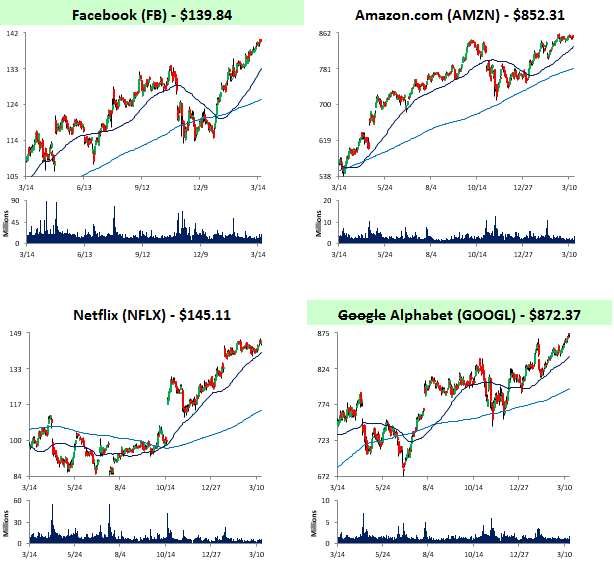
Ever since the strong upside reaction to President Trump’s address to Congress at the start of the month, the S&P 500 has been trading in a bit of a sideways range with no new highs since the first trading day of the month. While the broader market has been treading water, FANG stocks have continued to claw their way higher. In fact, just last Friday alone, both Facebook and Alphabet (formerly Google) hit 52-week highs, while Amazon.com and Netflix finished the week just shy of new highs.
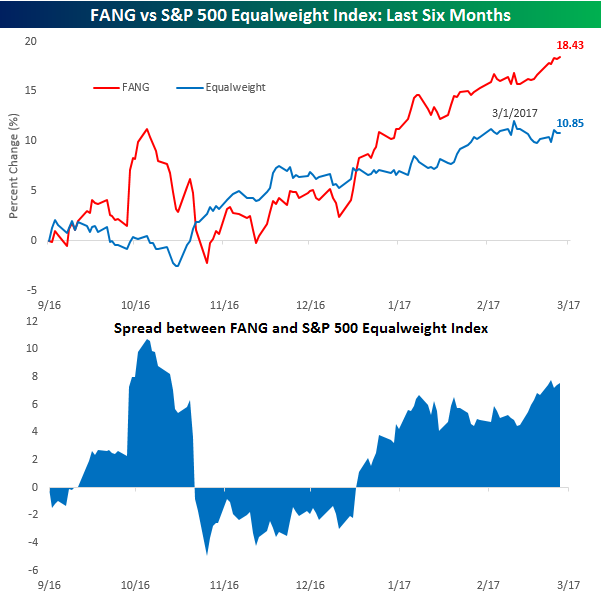
The recent strength of the FANG stocks has really helped the group to widen its lead over the rest of the market. The chart below shows the performance of the four FANG stocks on an equal-weighted basis versus the S&P 500 equal-weighted index, which includes every stock in the index. Over the last six months, stocks in the S&P 500 are up an average of just under 11%, which is impressive under just about any scenario. When you compare this performance to the average rally of 18% for the FANG stocks, however, the gains seem rather modest.
The lower chart shows the spread in performance between the FANG stocks and the S&P 500 equal-weight index over the last six months. While the FANG stocks saw a wider performance spread last October (following strong earnings from Netflix), their lead over the broader market is the widest it has been since the election. What’s even more impressive about this outperformance is that it comes after a period immediately following the election where the group lagged the market as investors rotated into groups more associated with the “Trump trade.” Investors have a way of quickly changing their minds!
Bespoke Brunch Reads: 3/19/17
Welcome to Bespoke Brunch Reads — a linkfest of the favorite things we read over the past week. The links are mostly market related, but there are some other interesting subjects covered as well. We hope you enjoy the food for thought as a supplement to the research we provide you during the week.
Europe
The Quiet German by George Packer (The New Yorker)
Not a recent story, but given the focus on European politics in 2017 (the ongoing Brexit process, last week’s Dutch elections, French elections in April, and Germany’s own elections this fall) we think this profile of der kanzler. [Link]
EU could sue US over border tax, Germany warns by Guy Chazan (FT)
While international trade law may seem like a trivial matter for the current administration, the use of WTO-sanctioned countervailing tariffs as a possible response to a border-adjusted tax is something worth keeping an eye on. [Link, paywall]
Why Populists Can’t Win in Europe’s Heartland by John Follain and Simon Dawson (Bloomberg)
An anecdotal survey (with less clear conclusions than the rather misleading title) of working people and voters across Europe’s multinational industrial heartland. [Link]
‘London Bridge is down’: the secret plan for the days after the Queen’s death by Sam Knight (The Guardian)
Morbid though it may be, a fascinating investigation of the public relations and national pride disaster plan that will be deployed when beloved UK monarch Queen Elizabeth II passes. [Link]
Mobile Matters
Do YOU hear ‘phantom phone buzzing’? 80% of college students admit they experience major sign of phone addiction by Daniel J. Kruger (Daily Mail)
One of the symptoms of psychological dependence on our “external brains” (cellphones) is an imagined buzzing notification. [Link]
Health Care
Tanning Salons See Ray of Hope in ACA Tax Repeal by Katy Stech and Richard Rubin (WSJ)
A fascinating example of both obscure passages in large legislation and Pigouvian taxes, the tanning industry is hoping that passage of the AHCA (the House Republicans’ proposed replacement) will end the 10% levy applied to their revenue by the ACA. [Link, paywall]
‘Stunning’ gap: Canadians with cystic fibrosis outlive Americans by a decade by Eric Boodman (Stat News)
One highly specific example of the astounding differences in health care outcomes across countries, which can be driven by numerous factors including but not limited to centralized guidelines for disease treatment, transplant prioritization, access to care and/or medication, demographics, and others. [Link]
Investors
Great Groveling, Guys: Counting All the Ways Analysts Fawn Over Management by Jason Zweig (WSJ)
Thanks to the efforts of two Florida International University researchers, we now have quantitative proof that analysts are sycophants. [Link]
Hedge funds close at faster pace in 2016 than 2009 recession by Carleton English (NYP)
Over 1,000 funds closed their doors this year, the most since 2008 (1,471). It wasn’t all bad news, with 729 hedge funds launched, though launches were down from 968 in 2015. [Link]
Homebrew Quanting
Big Data for Little Kids: A New Approach to Coaching Youth Lacrosse by Ryan Floyd and Joe Rosenbaum (Inside Lacrosse)
Some may consider this approach over the top, but it turns out that data digging is making its way into youth sports. The authors’ U-13 lacrosse team was helped by correlations and averages, which they also note helped focus their efforts and reduce micromanagement of their young players. [Link]
“Spreadsheets Are Dope”: The Allure Of DIY College Basketball Fantasy League (Vice Sports)
First off, let’s be clear: we agree spreadsheets are dope, we use them constantly. This is a fun look at the nascent college basketball fantasy world, which relies on similar techniques as the original Rotisserie baseball leagues that were the first iteration of the now enormous fantasy sports world. [Link]
Weird But True
Humpback whales are organizing in huge numbers, and no one knows why by Sara Chodosh (Popular Science)
We’re either living in one of the Star Trek movies or we don’t understand whale behavior very well. In either case, the super-pods of humpbacks currently frolicking off the coast of South Africa are pretty odd. [Link]
The Extra-Large Omelet of Death… by Brad DeLong (Grasping Reality with All Tentacles)
A French aristocrat found his end during the French revolution thanks to his desire for obscenely large quantities of eggs. [Link]
Portland Anarchists Are Rebelling Against the Lazy Government by Fixing Roads Eve Peyser (Vice)
In a hilariously normcore act of rebellion, anarchists in the admittedly quirky city of Portland have taken to random acts of infrastructure repair. [Link]
Advertising
Duopoly watch: Google and Facebook gobble up even more ad dollars by Sara Fischer (Axios)
Google and Facebook continue to devour egregious shares of new dollars flowing into digital advertising. [Link]
Rise of the Machines
Rogue factory robot blamed for death of human colleague by Mark Molloy (The Telegraph)
A Michigan woman lost her life in tragic accident at an auto parts factory when an industrial robot strayed into an area it was programmed to avoid. [Link]
Steve Cohen Ramping Up Effort To Replace Idiot Humans With Machines by Bess Levin (Vanity Fair)
Famous for once trading the performance of traders, family office operator Steve Cohen (who will be able to take outside money again at the start of next year) is considering betting on algorithms instead. [Link]
Fast Food
Domino’s Atoned For Its Crimes Against Pizza And Built A $9 Billion Empire by Susan Berfield (Bloomberg)
Mobile ordering has been a key plank in the recovery of ubiquitous pizza chain Domino’s, where menu improvements have also helped fuel huge gains in market share and massive revenue growth. [Link]
U.S. Soldiers Heading to Poland Face a Grim Ordeal: No Burger King by Julian E. Barnes (WSJ)
Did you know the term “expeditionary fast food restaurants” existed? We did not, but they’re apparently a key to morale for service men and women far from home. [Link; paywall]
Have a great Sunday!