
Bespoke CNBC Appearance (4/10/17)
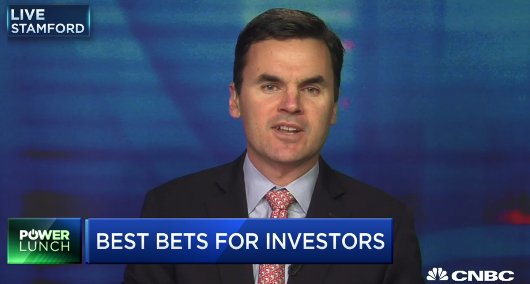
Bespoke co-founder Paul Hickey appeared on CNBC’s Power Lunch yesterday to discuss markets ahead of earnings season. To view the segment, please click on the image below.
The Closer — Retail Valuation, LMCI Update — 4/10/17
Log-in here if you’re a member with access to the Closer.
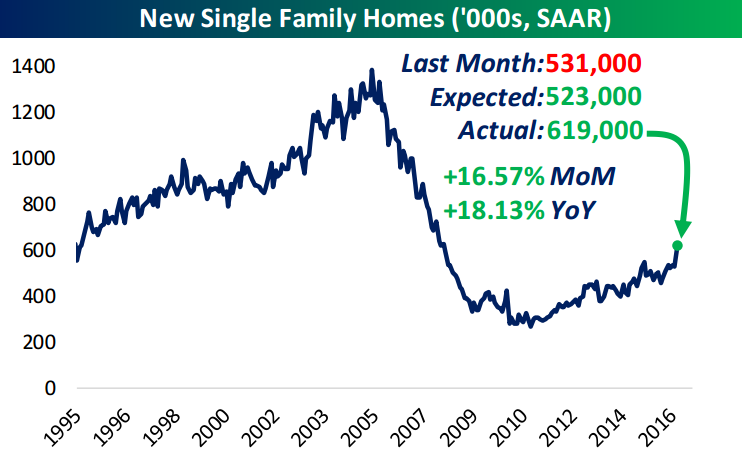
Looking for deeper insight on global markets and economics? In tonight’s Closer sent to Bespoke Institutional clients, we take a look at valuation in the retail sector and update our tracking of the Fed’s unofficial labor market conditions index.
The Closer is one of our most popular reports, and you can sign up for a free trial below to see it!
The Closer is one of our most popular reports, and you can see it and everything else Bespoke publishes by starting a no-obligation 14-day free trial to our research!
High Yield Spreads Tracking Equity Prices
Learn more about Bespoke’s research and wealth management services.
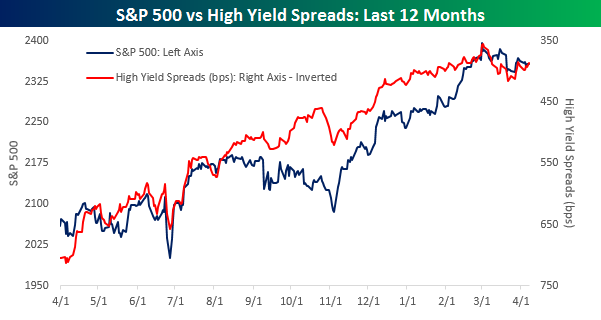
Whenever we are looking for positive or negative divergences in the equity market, one area we look to is the high yield credit market. Here, we look to see how spreads on high yield debt relative to treasuries are trending over time. If you are unfamiliar with the term, when we use the term spreads we are simply referring to the difference in yield between a high yield debt security and the yield of a US treasury with a similar maturity. Generally speaking, rising spreads in the high yield market indicate an increase in risk aversion on the part of investors as the higher spread indicates that investors are requiring higher compensation in exchange for taking on the credit risk. Conversely, when spreads are narrowing it indicates that investors are willing to take less in the way of compensation for the particular credit risk.
In the chart below, we have plotted the S&P 500 (blue line) versus high yield spreads (red line) based on the Merrill Lynch High Yield Master II Index. However, since spreads tend to move in the opposite direction as prices, we have plotted them on an inverse basis in order to make it easier to compare the two. Looking at the chart, high yield spreads and the equity market have generally tracked each other pretty closely over time. The only period of divergence was a positive one in the summer, where the S&P 500 was drifting lower while spreads continued to narrow. Ultimately, that divergence was a good reason to stay positive even during the uncertainty regarding the election.
Fast-forwarding to the present, high yield spreads have been tracking the S&P 500 pretty closely over the last several weeks. In fact, the S&P 500 saw its most recent peak just as spreads in the high yield market reached their narrowest levels, and since their respective extremes, the S&P 500 has been drifting lower as spreads have been listlessly moving higher. If you’re a bull, in an ideal world you would prefer to see spreads remaining near their narrowest levels or making new lows during this period of consolidation for the S&P 500, but at this point judging by the movement in the high yield market, there is nothing to suggest that the last six weeks of trading have been anything more than a pause.
B.I.G. Tips – Large Cap Coiled Spring
Most Volatile Large Cap Stocks on Earnings
Learn more about Bespoke’s research and wealth management services.
In our prior post we highlighted our quarterly list of the most volatile stocks on earnings. That list contains stocks across the market cap spectrum, and it’s mostly made up of small-cap names. For those that want to see a list of more widely traded names, below is a list of the most volatile stocks on earnings that have market caps greater than $5 billion. As shown, Netflix (NFLX) tops the list with an average one-day move of +/-13.87% in reaction to earnings. Twitter (TWTR) ranks second, followed by Vipshop (VIPS), Priceline (PCLN), Align Tech (ALGN), and Akamai Tech (AKAM).
Amazon.com (AMZN) is another name on the list with an average move of +/-9.61% on its earnings reaction days. With a market cap of more than $425 billion, a 9% move represents a swing of more than $40 billion in market cap once per quarter.
Other notables on the list of most volatile large-cap stocks on earnings include Michael Kors (KORS), Ulta Beauty (ULTA), Nvidia (NVDA), Expedia (EXPE), Chipotle (CMG), Tesla (TSLA), Baidu (BIDU), and Under Armour (UA). Many of you likely own at least one or two of the names on the list below, so be sure to keep a close eye on them heading into their earnings reports this season. Remember, you can always use our Interactive Earnings Report Database to get a sense of how these names typically trade.
To receive Bespoke’s actionable earnings season analysis, sign up for one of our premium membership options today!
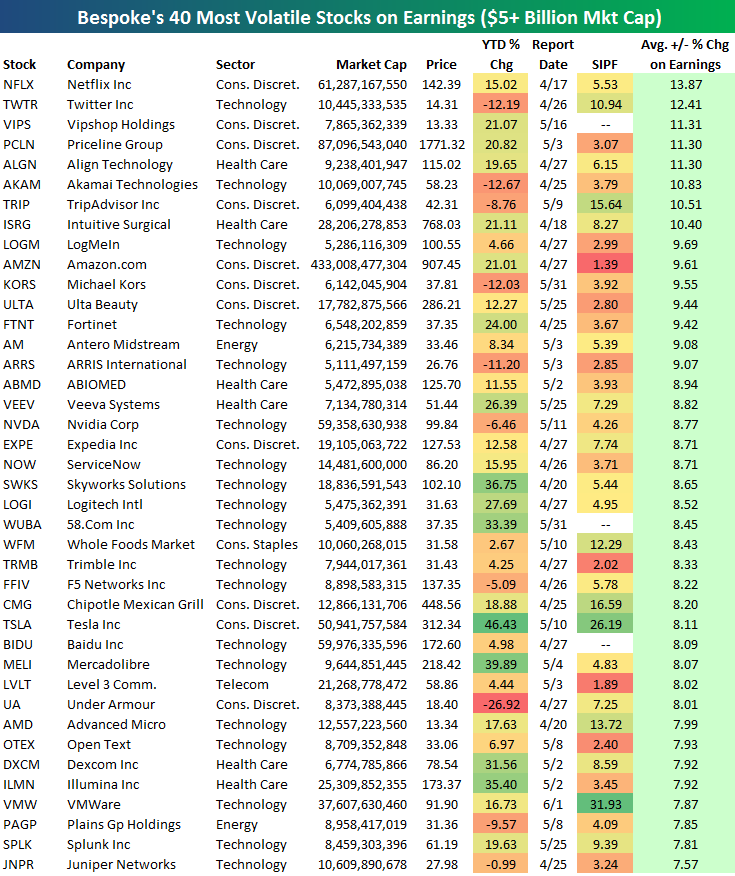
Chart of the Day — The First 100 Days (Of the Year)
Bespoke’s Most Volatile Stocks on Earnings
 Learn more about Bespoke’s research and wealth management services.
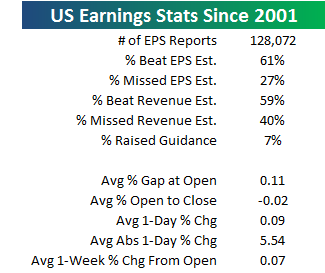
Bespoke has some of the most comprehensive earnings season analysis you’ll find. One of the main products included with our Bespoke Institutional service is our Interactive Earnings Report Database. This database contains more than 128,000 quarterly earnings reports from individual companies going back to 2001. At right we show what percentage of these individual companies have beaten or missed both EPS and revenue estimates (consensus analyst estimates) since 2001. As shown, 61% of earnings reports have been EPS “beats,” while 59% have been revenue “beats.” Just 7% of all quarterly earnings reports have seen the company raise forward guidance.
In terms of share price reaction, the average stock that reports earnings sees an initial gap up of 0.11% on its first trading day following earnings. It then sees an average decline of 0.02% from the open to the close of trading for a full one-day change of +0.09% on its “earnings reaction day.” (For a stock that reports before the open, its earnings reaction day is that trading day. For a stock that reports after the close, its earnings reaction day is the next trading day.)
Finally, in terms of earnings reaction day volatility, the average stock that has reported since 2001 has seen an average absolute 1-day change of +/-5.54%. This means you can expect any given stock to see a move of +/-5.54% on its first trading day following its quarterly earnings report.
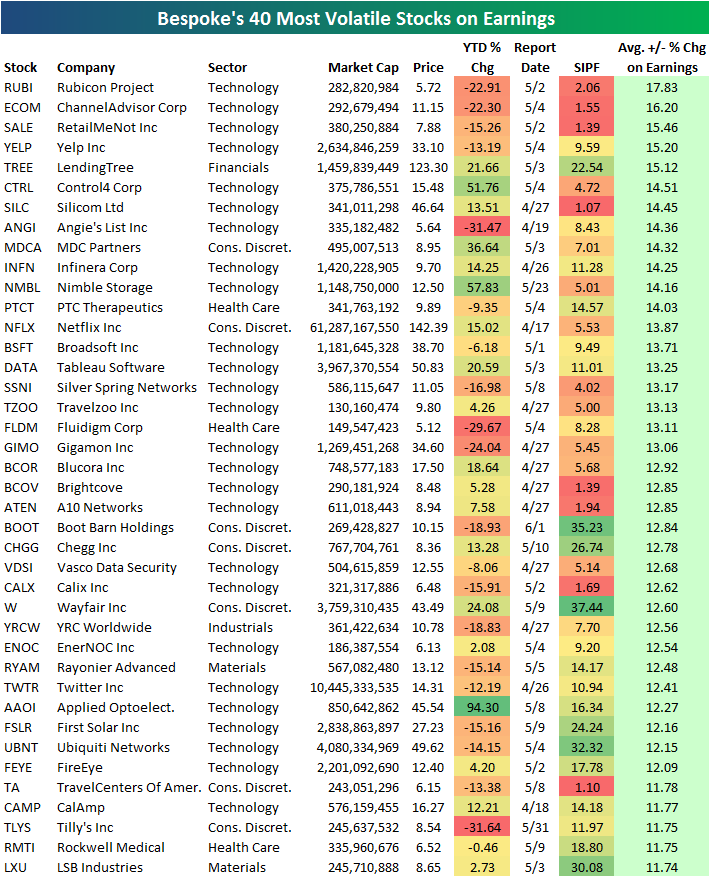
Obviously, some stocks are more volatile than others. Each quarter prior to the start of earnings season, we publish our list of the 40 most volatile stocks on earnings. The stocks that made our list below trade for more than $5/share and have at least 10 quarterly earnings reports in our Interactive Earnings Report Database. As shown, Rubicon Project (RUBI) tops the list with an average move of +/-17.83%! You can expect RUBI to see a one-day move of close to 1/5th of the company’s value when it opens for trading following its report on May 2nd. ChannelAdvisor (ECOM) ranks 2nd with an average move of +/-16.20%, while RetailMeNot (SALE) ranks 3rd at +/-15.46%. Yelp (YELP) and LendingTree (TREE) round out the top five at +/-15%+.
Other notables on the list of most volatile stocks on earnings include Netflix (NFLX), Tableau Software (DATA), Travelzoo (TZOO), WayFair (W), Twitter (TWTR), First Solar (FSLR), and FireEye (FEYE). For each stock on the list, we’ve also included its year-to-date % change and its short interest as a percentage of float (SIPF). You’ll notice that while some stocks are up nicely in 2017, there are plenty that are down quite significantly to start the year as well. Stocks that are down big that also have high levels of short interest are set up to see big upside moves if they can post even remotely positive numbers. Conversely, stocks that are up significantly with low short interest levels could see big downside moves if they don’t knock the cover off the ball.
To receive Bespoke’s actionable earnings season analysis, sign up for one of our premium membership options today!
ETF Trends: US Sectors & Groups – 4/10/17
Oil and energy ETFs continue to outperform along with Philippines equities and broad commodities indices. Decliners over the last five days are broadly found among EM countries, Japanese equities, and European equities.
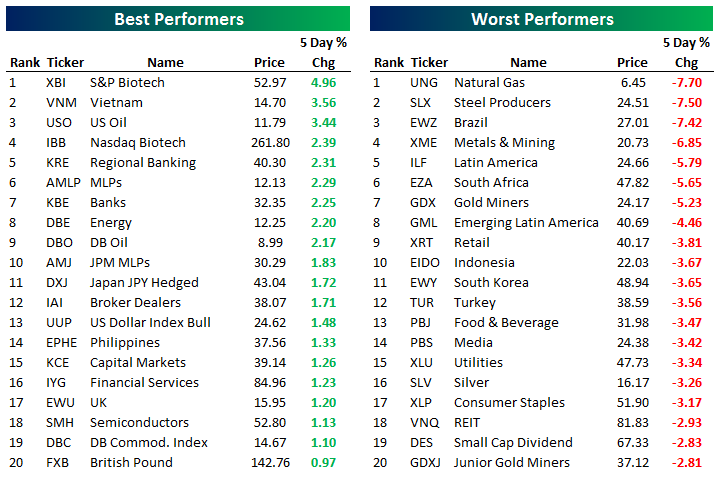
Bespoke provides Bespoke Premium and Bespoke Institutional members with a daily ETF Trends report that highlights proprietary trend and timing scores for more than 200 widely followed ETFs across all asset classes. If you’re an ETF investor, this daily report is perfect. Sign up below to access today’s ETF Trends report.
See Bespoke’s full daily ETF Trends report by starting a no-obligation free trial to our premium research. Click here to sign up with just your name and email address.
Bespoke Stock Seasonality: 4/10/17
Bespoke Brunch Reads: 4/9/17
Welcome to Bespoke Brunch Reads — a linkfest of the favorite things we read over the past week. The links are mostly market related, but there are some other interesting subjects covered as well. We hope you enjoy the food for thought as a supplement to the research we provide you during the week.
Trade and China
The “China Inc.” Challenge to Global Trade Governance by Mark Wu (Harvard International Law Journal)
In this very long read, Wu advances the case that the unique economic and legal system of China makes it unsuitable for the country to participate in the WTO’s framework. Given the size and importance of the Chinese economy, that creates an existential threat for the WTO itself. [Link; 64 page PDF]
What’s Really Driving the Trade Deficit With China by Michael Pettis (Bloomberg)
We like to think of goods and services – consumption – as more important than capital. But for international balance of payments questions, it’s usually very much the other way around. [Link]
Monetary Plumbing
Taper Tranquility Not Tantrum Greets Fed Bond-Reduction Plan by Matthew Boesler (Bloomberg)
Unlike the market reaction to the winding down of new quantitative easing purchases, the market has digested the discussion of reinvestment halting with much more aplomb. [Link]
The Federal Funds Market since the Financial Crisis by Ben R. Craig (Federal Reserve Bank of Cleveland)
An excellent overview and reference piece for understanding the basic plumbing of the financial system, which also has a significant impact on the implementation of monetary policy. [Link]
Money Markets at a Crossroads: Policy Implementation at a Time of Structural Change by Simon Potter (Federal Reserve Bank of New York)
More along a similar vein, as NYFRB EVP (and money market maestro) Simon Potter gives an excellent overview of recent developments in funding markets and how they impact the execution of monetary policy. [Link]
Fed Approves Deposit Accounts on Behalf of Asset Managers by Katy Burne (WSJ)
A new tool designed to facilitate the flow and availability of collateral at central counterparties has gained approval from the Federal Reserve. [Link; paywall]
Cybersecurity
Your Tax Refund Is Selling Cheap On the Dark Web by Suzanne Woolley (Bloomberg)
For less than $100, it’s possible to purchase all the information necessary to defraud someone of their tax refund. [Link]
Spreadsheet Suffering
Morgan Stanley made an error analysing Snapchat, and it shines a light on some big flaws in Wall Street research by Matt Turner and Rachael Levy (Business Insider)
A 10 figure EBITDA error wasn’t enough to get MS to change its price target on SNAP. [Link]
Coal
Trump declares end to ‘war on coal,’ but utilities aren’t listening by Valerie Volcovici, Nichola Groom and Scott DiSavino (Reuters)
While less regulation may benefit some existing coal power plants and mines, it’s unlikely that the lighter touch from the Trump administration will lead to higher coal demand: structural factors including cheap natural gas, state laws, and legal challenges to the regulatory rollback are all key reasons utilities have chosen to build gas instead of coal plants, putting a cap on demand.[Link]
Battery Transport
Tesla Has Something Hotter Than Cars to Sell: Its Story by James B. Stewart (NYT)
Eschewing cash flow estimates, Tesla investors cannot resist the story the company tells; and it could continue selling that story for a long time. [Link; soft paywall]
Boeing and JetBlue just invested in a tiny electric-jet startup that could revolutionize air travel by Benjamin Zhang (Business Insider)
The US’s largest exporter and an upstart airline have shelled out to get in early on a startup that proposes to build planes that run on batteries. As a side note: the fact that both JetBlue and Boeing have venture capital arms is indicative of…something. [Link]
Asia
The Rise of the Asian Middle Class and Its Effects on Demand, Skills & Growth by Adam Carstens (Medium)
An exhaustive analysis of the source of the next generation or two of consumer spending, including implications for state and local governments in the US as well as businesses. [Link]
Consulting
The Management Myth by Matthew Stewart (The Atlantic)
An old but instructive article on the benefits – or more frequently, harms- brought to firms that outsource management to third parties. [Link]
Modern Frustrations
Apple Pay Promised to Make Plastic Obsolete. Then Came Wary Shoppers, Confused Clerks by Tripp Mickle (WSJ)
Apple Pay has been slow to catch on, with fewer than 20% of iPhone users trying the service and a longstanding confusion at the point of sale. [Link; paywall]
The Matchmaker Who Flirts on Dating Apps for You by Allie Jones (NY Mag)
Online dating apps makes it much easier to find a date, but of course like any other activity, some people would rather outsource their streamlined text based flirting to someone else. [Link]
Investors
Joel Greenblatt’s Talk at Google (Market Folly)
Notes (and a full video) of a talk Gotham Capital founder Greenblatt gave to employees at Google. [Link]
Diversification, Adaptation, and Stock Market Valuation by Jesse Livermore (Philosophical Economics)
What if high valuations are simply a reflection of better risk management due to falling costs of diversification? [Link]
Caution Signals Are Blinking for the Trump Bull Market by Robert J. Shiller (NYT)
The finance professor and originator of the CAPE ratio (who also called the housing market’s overvaluation in the mid-2000s) has some words of caution on the high levels of equity prices. [Link; soft paywall]
Big Trades
The Corporate Debt Bonanza Is Helping Employers Shore Up Pensions by Katherine Chiglinsky and Claire Boston (Bloomberg)
Companies are issuing debt to add capital to underfunded pension schemes, winning on two legs of the trade as the cost to insure underfunded pensions has risen. [Link]
Uncovering the Secret History of Wall Street’s Largest Oil Trade by Javier Blas (Bloomberg)
Inside the Hacienda hedge: Mexico’s annual forward sale or options hedge of production from its oil fields, designed to reduce volatility and lock-in prices it receives for each barrel. [Link]
Tipoff From JPMorgan Sends Traders Hunting for Obscure Ukraine Debt by Natasha Doff and Marton Eder (Blooomberg)
Following a report from JPM analysts, GDP warrants linked to economic growth in the Ukraine jumped by about 20%. [Link]
Lighter Faire
Seinfeld: 5 storylines you never saw by Dan Snierson (Entertainment Weekly)
We love a good “Serenity Now!”, and these five storylines that never were are likely to get you smiling. [Link; auto-playing video]
An Excavation Of One Of The World’s Greatest Art Collections by Oliver Roeder (FiveThiryEight)
A quantitative and qualitative deconstruction of the enormous art collection housed on the east side of Central Park. [Link]
Have a great Sunday!