Bespoke Brunch Reads: 4/2/17
Welcome to Bespoke Brunch Reads — a linkfest of the favorite things we read over the past week. The links are mostly market related, but there are some other interesting subjects covered as well. We hope you enjoy the food for thought as a supplement to the research we provide you during the week.
Research
Measuring Stock Performance Against The Market by Gideon Vigderhous, PhD (Stocks & Commodities)
A summary of partial correlation methods developed by Vigderhous, with Bespoke’s Interactive Earnings Database as source material. [Link; 3 page PDF]
Chinese Financial Markets
Have a Donkey to Trade? China Has an Exchange for That (Bloomberg)
There are greater than 1,000 venues for exchanging financial assets of one kind or another across China, with over 140 regional agricultural exchanges alone, trading a dizzying array of products. [Link]
Will China Succeed in Efforts to Woo Foreigners Into Its Bond Markets? by Peng Qinqin and Dong Tongjian (Caixin)
An interview with Mark Austen, the CEO of the Asia Securities Industry and Financial Markets Association on the problems and possibilities of Chinese interest rates. [Link]
Privacy
Congress just voted to let internet providers sell your browsing history by Taylor Hatmaker (TechCrunch)
In a vote passed via tie-breaker from Vice President Mike Pence, the Senate passed House legislation that removes restrictions placed on ISPs by the Obama Administration which prevent them from selling user browsing data without consent. In other words, your internet activity can now be sold without your consent. [Link]
This Is What It’s Actually Like To Live In A Surveillance State by Otillia Steadman (Buzzfeed)
A look at the reality of living under an authoritarian regime which spies on its own citizens. For former East Germans, the consequences – not to mention the experience itself – have lasting impact to this day. [Link]
Commodities
Fracking 2.0: Shale Drillers Pioneer New Ways to Profit in Era of Cheap Oil by Erin Ailworth (WSJ)
Drilling rigs run from iPhones, a former subsidiary of Enron, and the 64 other apps it uses to produce more oil than Exxon Mobil in the continental US. [Link; paywall]
The DNA of oil wells: U.S. shale enlists genetics to boost output by Ernest Scheyder (Reuters)
Apps are one thing but shale producers are also exploiting information signals from the DNA of living organisms which decompose into the valuable oil sought by US shale drillers. [Link]
Coal isn’t dead, but it won’t revive Appalachia, either by Alexandra Scaggs (FT Alphaville)
A series of reasons that the jobs, output, and cultural primacy of coal in the Appalachian mountains is unlikely to return to its much-harkened-to past. [Link; registration required]
Political Research
Creating a National Precinct Map by Ryne Rohla (Decision Desk HQ)
A fascinating effort at data collection that maps (nearly) every precinct in the country and compares them to voting results. The country-level map isn’t terribly different from more common county-level maps, but we highly recommend zooming in to take a look at your area’s results at an extremely granular level. [Link]
Is Europe an optimal political area? by Alberto Alesina, Guido Tabellini, and Francesco Trebbi (Brookings Papers on Economic Activity)
There are limits to the relatively small sample sizes used, but with that caveat we found this paper’s conclusion (that the European Union’s polities are less culturally different than those of the United States) fascinating. [Link; 58 page PDF]
Consumer Banking
Former Citizens Bankers Say They Faked Data for Customer-Meeting Program by Rachel Louise Ensign (WSJ)
In yet another example of an effort by a large bank to drum up business getting gamed, Citizens Financial representatives often invented meeting reports for sit-downs that didn’t even happen. [Link; paywall]
Chase Had Ads on 400,000 Sites. Then on Just 5,000. Same Results. by Sapna Maheshwari (NYT)
It turns out that for online display advertising, algorithms, huge site counts, and other advertising staples are not much better than careful selection of a smaller footprint by human beings. [Link; soft paywall]
Political Headlines
This Is Almost Certainly James Comey’s Twitter Account by Ashley Feinberg (Gizmodo)
The 2017 version of gumshoe reporting appears to require expertise in the Twitter search function and a decent bit of persistence. After reading the story, make sure to check out the response from the alleged account here. [Link]
The Reclusive Hedge-Fund Tycoon Behind The Trump Presidency by Jane Mayer (The New Yorker)
The latest in a series of profiles dedicated to the conservative head of Renaissance Technologies, one of the best-performing hedge funds of all time. [Link]
New Transport
The Great Nevada Lithium Rush to Fuel the New Economy by Paul Tullis (Bloomberg)
A new mineral is replacing silver and gold as metallic contributors to the Nevada economy, with global demand surges thanks to the demands of car batteries. [Link]
The 22-Year-Old at the Center of the Self-Driving Car Craze by Alex Webb, Lizette Chapman, and Alex Barinka (Bloomberg)
With billions of dollars of market share at stake, lidar, algorithms, camera sensors, and GPS adaptations are becoming ripe targets for takeovers and industrial espionage. [Link; auto-playing video]
New Diseases
The Trauma of Facing Deportation by Rachel Aviv (The New Yorker)
Hundreds of young people in Sweden have fallen into catatonic, uber-apathetic states when faced with the stress of deportation since the early 2000s. [Link]
City States
Who Is the City-Statey-est Of Them All? by Lyman Stone (In A State of Migration)
A surprisingly large country has earned Stone’s title for the most city-statey-est (not a technical term, as far as we are aware). A fascinating use of data. [Link]
Airlines
Airlines Make More Money Selling Miles Than Seats by Justin Bachman (Bloomberg)
Airline credit cards are up to 50% of airline income according to new research from Sifel Nicolaus, with 1.5-2.5 cents per dollar spent on cards with their branding flowing through to airline revenue. [Link; auto-playing video]
Southwest Airlines’ Digital Transformation Takes Off by Neal Ungerleider (Fast Company)
On-the-fly migrations between technical patterns are amongst the most complicated challenges businesses face. In this article, we get a peak at Southwest’s efforts in that respect. [Link]
The Future of Investing
BlackRock cuts ranks of stockpicking fund managers by Stephen Foley (FT)
In a strategic shift, one of the world’s largest managers have fired active management portfolio managers to replace them with quantitative strategies. [Link; paywall]
Hedge Funds Are Training Their Computers to Think Like You by Saijel Kishan (Bloomberg)
Efforts to apply deep learning (an approach that works similarly to the way neurons in the human brain do) is being trained on investing, after many previously-hyped strategies basically struck out. [Link]
Dreams From The West Coast
Silicon Valley’s Quest To Live Forever by Tad Friend (The New Yorker)
What do you take when you combine Hollywood stars, venture capitalists, and a bunch of scientists? Why, Goldie Hawn posing questions about mitochondria and glutathione, of course! [Link]
Amazon’s Ambitions Unboxed: Stores for Furniture, Appliances and More by Nick Wingfield (NYT)
Retail stores are dead! Long hail the retail stores! [Link; soft paywall]
Ancient History
Who Killed the Iceman? Clues Emerge in a Very Cold Case by Rob Nordland (NYT)
A forensic investigation of a corpse that has stumped science for a quarter-century. [Link; soft paywall]
Sentiment
A Correction Now Might Not Be So Bad, Some Investors Say by Aaron Kuriloff, Corrie Driebusch, and Akane Otani (WSJ)
With equities ripping after the election, many are loathe to buy the highs until earnings have caught up a bit. But the dip-buyers are waiting. [Link; paywall]
Worthwhile Canadian Intiative
How the Yellen Fed Got Religion Over the Stock Market and Policy by Matthew Boesler (Bloomberg)
The origin story of financial conditions indices, a critical input in modern monetary policymaking. [Link; auto-playing video]
Have a great Sunday!
The Bespoke Report — 3/31/17
S&P 500 Quick-View Chart Book — 3/31/17
The Closer 3/31/17 – End of Week Charts
Looking for deeper insight on global markets and economics? In tonight’s Closer sent to Bespoke clients, we recap weekly price action in major asset classes, update economic surprise index data for major economies, chart the weekly Commitment of Traders report from the CFTC, and provide our normal nightly update on ETF performance, volume and price movers, and the Bespoke Market Timing Model.
The Closer is one of our most popular reports, and you can sign up for a free trial below to see it!
Click here to start your no-obligation two-week free Bespoke research trial now!
ETF Trends: Hedge – 3/31/17
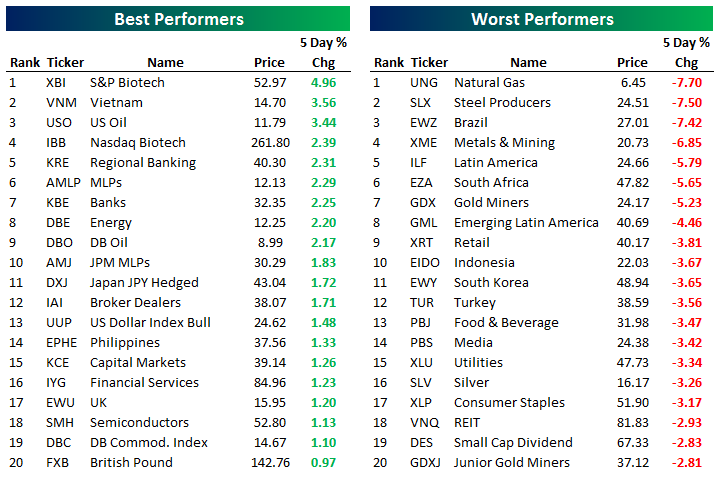
As oil prices have rallied out of the middle of the week, oil-related ETFs have shown the biggest gains among those we track. Small caps, banks, and value-oriented names have also rallied. South Africa was a major decliner on the week, driven by a huge move lower in South African rand after the country’s President fired the Finance Minister. Chinese equities and other EM were also quite weak as was were developed market currencies versus the dollar.
Bespoke provides Bespoke Premium and Bespoke Institutional members with a daily ETF Trends report that highlights proprietary trend and timing scores for more than 200 widely followed ETFs across all asset classes. If you’re an ETF investor, this daily report is perfect. Sign up below to access today’s ETF Trends report.
See Bespoke’s full daily ETF Trends report by starting a no-obligation free trial to our premium research. Click here to sign up with just your name and email address.
That’s a Wrap: Q1 Performance
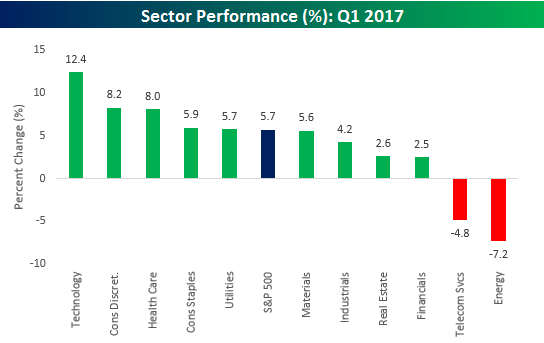
Not a bad quarter for the bulls. With Q1 now officially in the books, 2017 has gotten off to a great start with the S&P 500 rallying 5.7% through late Friday afternoon. As shown in the sector performance chart below, Technology did most of the heavy lifting this quarter with a rally of 12.4%, or more than double the S&P 500’s gains. Behind Technology, Consumer Discretionary rallied 8.2%, while Health Care gained 8%. On the downside, the only two sectors that were down on the quarter were Energy (-7.2%) and Telecom Services (-4.8%). Besides these two sectors, others that underperformed during Q1 were Financials, Real Estate, Industrials, and Materials.
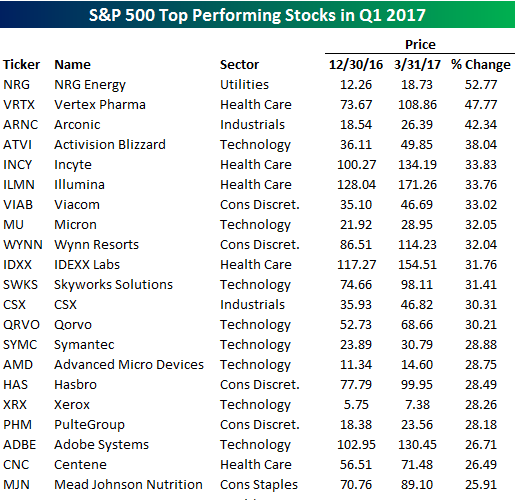
The tables below list the best and worst performing stocks during the quarter. Of the 21 stocks that gained more than 25%, shares of NRG Energy (NRG) rallied more than 50%, while Vertex Pharma gained 48%. With Technology leading the market higher, it shouldn’t come as too much of a surprise that eight of the top performing stocks in the index were from that sector, led by Activision Blizzard (ATVI) and Micron (MU) which both added more than 30%. How good a year has 2017 been for equities and Tech in general? Even Xerox (XRX) is up over 25%!
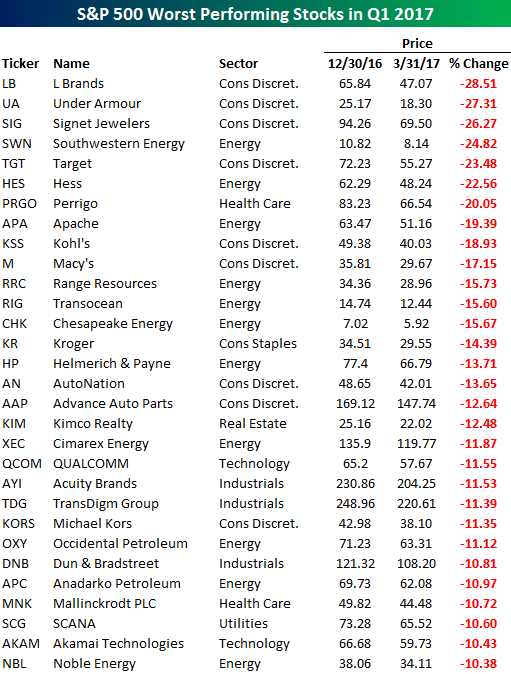
To the downside, the table below lists the 30 stocks in the S&P 500 that traded down more than 10% this quarter. Leading the way lower, L Brands (LB), Under Armour (UA), and Signet (SIG) all lost more than a quarter of their market value during Q1. Along with those three names, another six stocks from the Consumer Discretionary sector made the list. The only sector with more stocks on the list of losers was Energy. Given that it was the worst performing sector during the quarter, Energy makes sense, but Consumer Discretionary was the second best performing sector. The reason Consumer Discretionary fared so well even with so many stocks in the sector declining sharply is due in large part to Amazon.com (AMZN). With a gain of 18% and a market cap of around $425 billion, AMZN was responsible for one-third of the Consumer Discretionary sector’s gain in Q1.
B.I.G. Tips – April 2017 Seasonality
Up 5% Heading into Quarter End
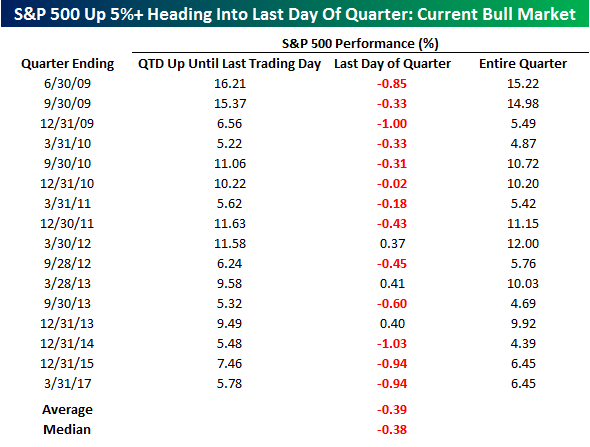
With a gain of 5.78% so far in the quarter and just one trading day left in it, the S&P 500 is on pace for a pretty solid Q1. Given the gains we have seen, it’s ironic that all quarter long investors have been bombarded on a near daily basis with headlines proclaiming an end to the rally. A 5%+ gain is a 5% gain. Looking ahead to the final day of the quarter, we wondered how the market tends to close out the quarter following a strong run. Do investors keep buying or do they take profits?
To shed some light on that question, we looked at every quarter during the current bull market where the S&P 500 was up 5% or more heading into the last trading day to see how the S&P performed on the final day. Even though we only looked at the current bull market, we found plenty of quarters that met the criteria. During the 32 quarters so far in this bull market, the S&P 500 was up over 5% QTD heading into the last day of the quarter half of the time (16 quarters). Looking at the results, there’s a pretty convincing case to be made that traders don’t continue piling into the market. Of the fifteen prior quarters we looked at, the S&P 500 was down on the final trading day of the quarter 12 times for an average decline of 0.39%. Perhaps it’s due to investors re-balancing out of some of their winning asset classes and into losing asset classes, but during the current bull market at least, there hasn’t been a lot of buying to be found on the last day of a quarter where the S&P 500 was already up 5%.
The Closer — Productivity Puzzling — 3/30/17
Log-in here if you’re a member with access to the Closer.
Looking for deeper insight on global markets and economics? In tonight’s Closer sent to Bespoke Institutional clients, we update charts on multifactor productivity using BLS data updated today. We also discuss the low investment problem those charts reveal and take a look at some EM currency charts.
The Closer is one of our most popular reports, and you can sign up for a free trial below to see it!
The Closer is one of our most popular reports, and you can see it and everything else Bespoke publishes by starting a no-obligation 14-day free trial to our research!
Guess The Chart: Election Edition
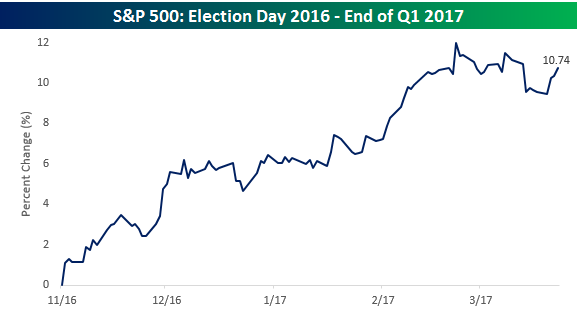
With Q1 winding down in the next two days, we thought it would be a good time to review the performance of the S&P 500 since Donald Trump was elected last November and play a quick game of “Guess the Chart.” As shown in the chart below, the S&P 500 rallied hard following the election, traded sideways for several weeks, and then rallied into early March before backing off the rest of the month. Even after the pullback, though, the S&P 500 is still up just under 11% and not far from its bull market highs.
The next chart also shows performance from Election Day through the end of Q1. This mystery chart has seen a similar but much more volatile pattern than the one of the S&P 500 above. Like the S&P 500, it rallied following the election, traded sideways for several weeks, and then spiked higher into early March before backing off its highs towards the end of March. Can you guess the chart?

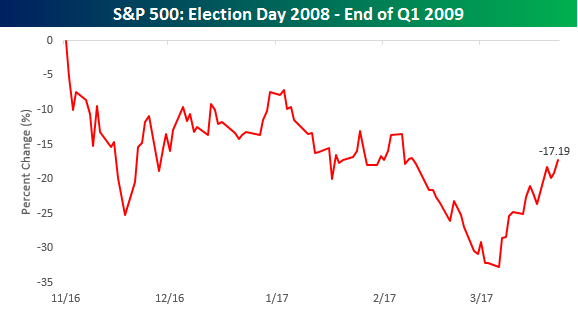
Give up yet? The “Mystery Chart” above isn’t from Election Day 2016 through now, but instead from Election Day 2008 through the end of Q1 2009. We also forgot to mention that it is upside down. Can you guess it now? It’s actually the inverse of the S&P 500. It’s not a surprise that the market has seen such different reactions between late 2008/early 2009 and now. Circumstances couldn’t have been more different on just about every measure, but if you are a bull, going forward you have to hope that the differences in performance end here. Below is the real (non-inverse) version of the S&P from Election Day 2008 through Q1 2009.