
The Best of the Blue Chips (and the Worst)
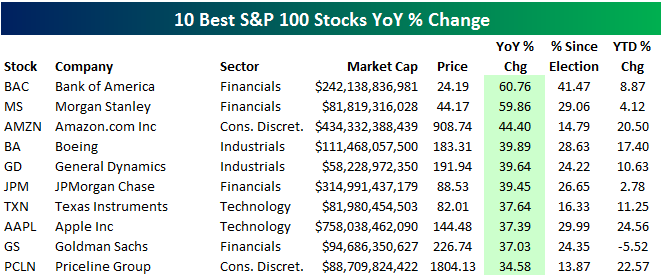
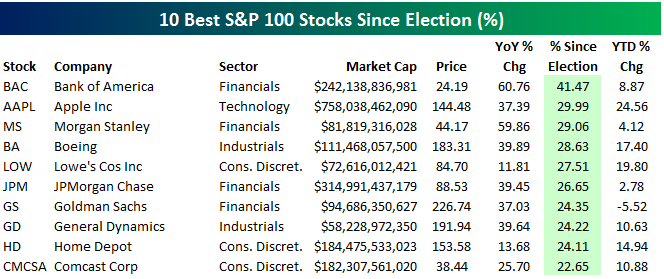
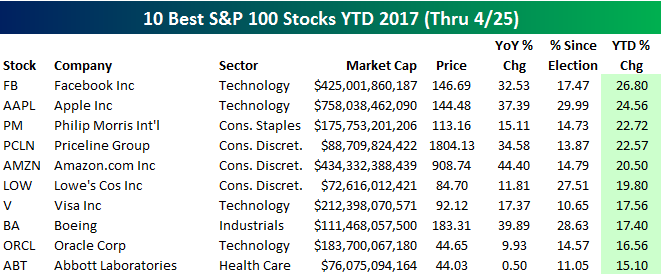
Below we provide tables highlighting the 10 best performing stocks in the S&P 100 (100 largest stocks in the S&P) over three different time periods — year-over-year, since the 11/8/16 election, and year-to-date.
As shown, Bank of America (BAC) and Morgan Stanley (MS) top the list of winners over the last year with gains of 60%. Amazon.com (AMZN) ranks third with a gain of 44.4%, followed by Boeing (BA) and General Dynamics (GD). Apple (AAPL) ranks 8th best with a YoY gain of 37.39%.
With a gain of 41.47%, Bank of America (BAC) also tops the list of biggest winners since last November’s election. Tech-behemoth Apple (AAPL) ranks second best with a gain of 29.99%. Even though it’s the biggest company in the world, Apple has quietly posted huge returns over the last 6-12 months.
Facebook (FB) has also quietly posted big gains recently. The stock is currently the top performer in the S&P 100 in 2017 with a gain of 26.80%. Apple (AAPL) ranks second with a gain of 24.56%, while Philip Morris International (PM) is up the third most at +22.72%.
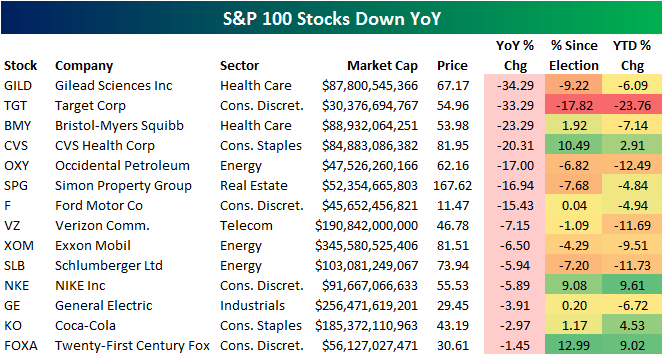
Of course not every stock is up. In the S&P 100, there are 14 stocks that are down over the last year, and we highlight them in the table below. Gilead (GILD) and Target (TGT) are down the most with declines of more than 33%. Bristol-Myers (BMY) and CVS Health (CVS) are the two remaining names that are down 20%+. Other notables on the list of YoY losers include Ford (F), Verizon (VZ), Exxon Mobil (XOM), Nike (NKE), General Electric (GE), and Coca-Cola (KO).
All or Nothing Days All About Nothing
“Internationals” Crushing “Domestics” in 2017
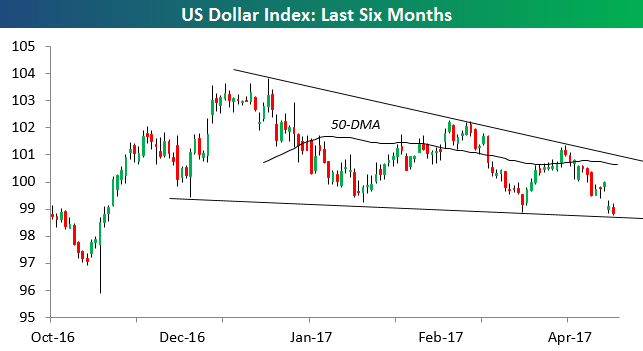
With “rest of world” outperforming US equity markets so far in 2017, and the US Dollar index fading since it peaked on 12/28/16, it should come as no surprise that US companies that generate a large portion of their revenues outside of the US are outperforming their domestic counterparts.
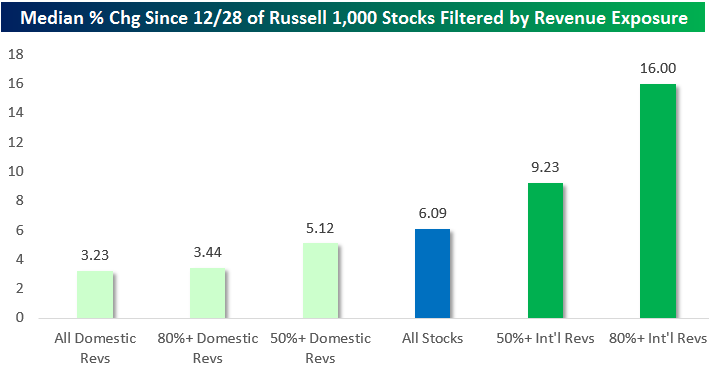
Using our Interactive International Revenues Database, which allows subscribers to pull up the international and domestic revenue exposure for any stock in the Russell 1,000 or S&P 500, we calculated the median performance of stocks based on revenue exposure levels since the US Dollar’s peak on 12/28. The results are shown in the chart below.
The median % change for all stocks in the Russell 1,000 since 12/28 is +6.09%. But stocks that generate more than 80% of their revenues internationally (outside of the US) have seen a median gain of 16%. On the flip side, stocks that generate 80%+ of their revenues domestically are up just 3.44%. That’s a huge difference in performance versus the benchmark. One group has outperformed by more than 10 percentage points (the “Internationals”), while the other group has underperformed by half.
Start a no-obligation 14-day free trial to Bespoke Institutional to use our International Revenues Database now.
Bespoke Stock Scores: 4/25/17
ETF Trends: Hedge – 4/25/17
The top five performers in our ETF universe over the last five days are all European equity funds, with returns ranging from 6.3 to 7.6%. Turkey and steel producers are the only ETFs in the top ten not related to European stocks. Banks, Transports, and some EM names round out the top 20. Coffee is the worst performer in our bottom 20, again, while gold miners, oil, energy, and broad commodities data are all weak as well.
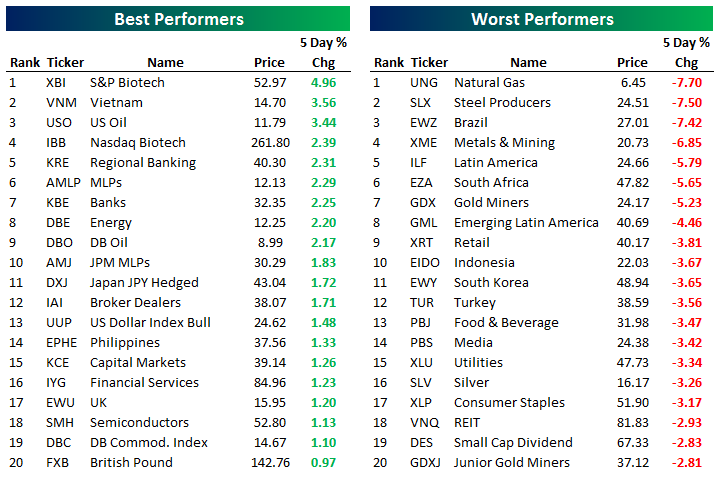
Bespoke provides Bespoke Premium and Bespoke Institutional members with a daily ETF Trends report that highlights proprietary trend and timing scores for more than 200 widely followed ETFs across all asset classes. If you’re an ETF investor, this daily report is perfect. Sign up below to access today’s ETF Trends report.
See Bespoke’s full daily ETF Trends report by starting a no-obligation free trial to our premium research. Click here to sign up with just your name and email address.
Dow 30 Trading Range Screen — 4/25/17
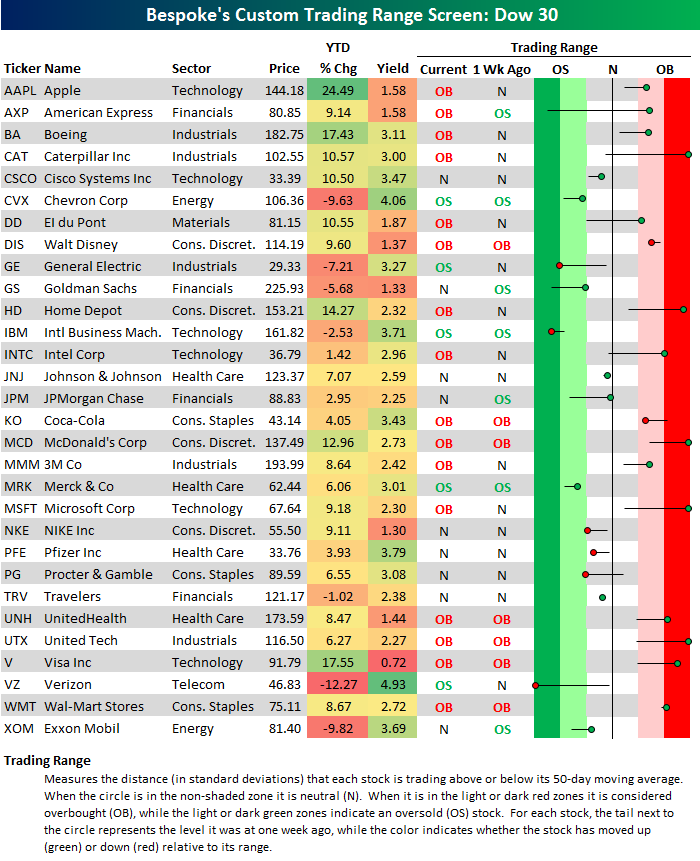
Two days of big gains for the market plus positive reactions to earnings reports has pushed a number of Dow 30 stocks into extreme overbought territory. Below is our trading range screen for the 30 Dow stocks which highlights overbought/oversold levels. As shown, Caterpillar (CAT), Home Depot (HD), McDonald’s (MCD), Microsoft (MSFT), United Tech (UTX), and Visa (V) are all trading at extreme overbought levels, which means they’re more than two standard deviations above their 50-day moving averages. CAT, MCD, MSFT, and UTX are trading three standard deviations above their 50-days. Three standard deviations is quite extended for a mega-cap blue-chip name.
On the flip side, there are five Dow stocks that are currently oversold. Verizon (VZ) is at the most extreme level, trading 3 standard deviations below its 50-day.
The Closer — 20 Percent Of Anything Is A Lot! — 4/24/17
Log-in here if you’re a member with access to the Closer.
Looking for deeper insight on global markets and economics? In tonight’s Closer sent to Bespoke Institutional clients, we take a look at what a cut in the corporate tax rate would mean in practice relative to the size of the economy and the current deficit. We also take a look back at the impact the last government shutdown had on economic data.
The Closer is one of our most popular reports, and you can sign up for a free trial below to see it!
The Closer is one of our most popular reports, and you can see it and everything else Bespoke publishes by starting a no-obligation 14-day free trial to our research!
Nasdaq Closes in on a Milestone
Start a 14-day free trial to see Bespoke’s best and most actionable research.
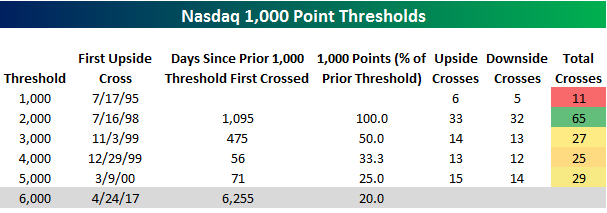
The Nasdaq Composite index is quickly closing in on a major milestone, the likes of which it hasn’t seen in over 15 years. At a level of 5,985 this afternoon, the index is just fifteen points from a first-time crossing of a 1,000 point threshold. The table below lists each prior thousand point level that the Nasdaq has crossed over time, along with how many times it crossed each level (on a closing basis) to both the upside and downside. After first crossing above 5,000 back in March 2000, the Nasdaq has gone more than seventeen years without crossing another 1,000 point milestone. What makes this drought even crazier is that the amount of time it took the Nasdaq to first cross 1K, 2K, 3K, 4K, and 5K (1,697 calendar days) was less than a third of the 6,255 days that have transpired since that first close above 5K. In other words, from July 1995 through March 2000, the Nasdaq quintupled in less than a third of the amount of time that it has since taken to advance 20%!
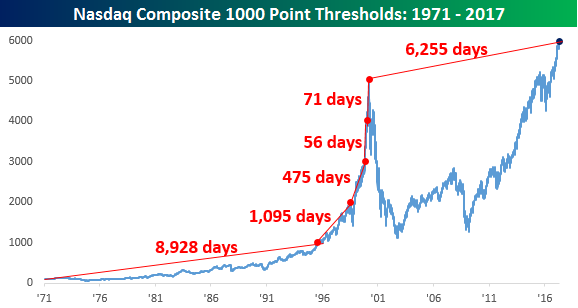
The chart below shows each of the dates that the Nasdaq first crossed every 1,000 point level from 1,000 through 5,000. As shown, some of these milestones came and went quickly. Back in late 1999, the Nasdaq rallied 33% from 3,000 to 4,000 in the span of less than two months. Then, as an encore, it spiked another 25% in just over two months. What’s even more amazing about these huge moves in such short periods of time is that, at the time, people actually thought it was perfectly normal!
Start a 14-day free trial to Bespoke’s research for more stock market analysis.
France, Germany Test Multi-Year Highs
Start a 14-day free trial to see Bespoke’s best and most actionable research.
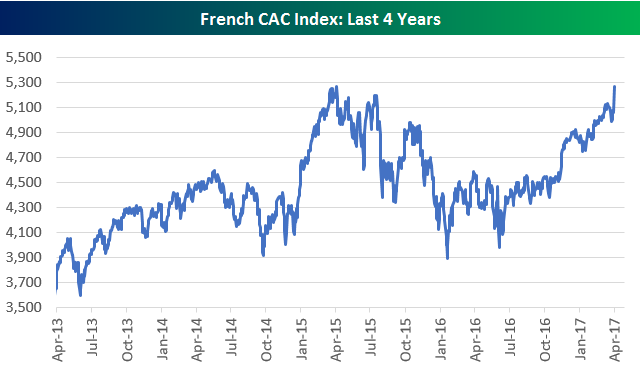
France’s CAC 40 (it’s most widely followed equity index) gained 4.14% today (in local currency), which was its biggest one-day gain since August 2015. Below is a chart of the CAC 40 over the last four years. While the index was set to close at a new 4-year high today when we got into the office early this morning, it actually closed the day at 5,268.86, which is just 0.05 points below its closing high of 5,268.91 reached on April 27th, 2015! French investors will have to wait at least one more day for a new closing high.
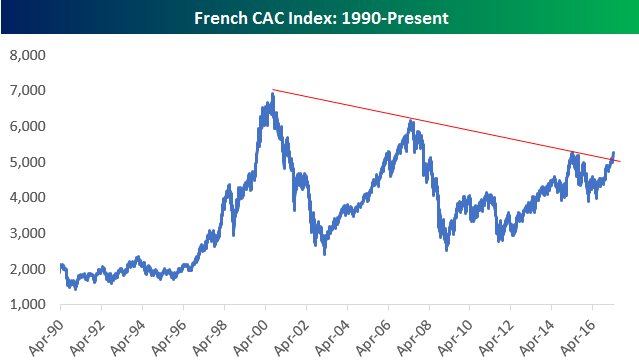
While the French equity market is just a hair off four-year highs, it’s still well below its high seen during the last two bull markets. Below is a chart of the CAC 40 going back to 1990. The all-time high for France was back in 2000, and its second highest point came at the end of the mid-oughts bull market just before the Global Financial Crisis.
One thing that the current rally has done is break a series of “lower highs” that the CAC had been stuck in. We’ve drawn a trend-line in the chart below so you can see the break, which is a positive if you follow market technicals.
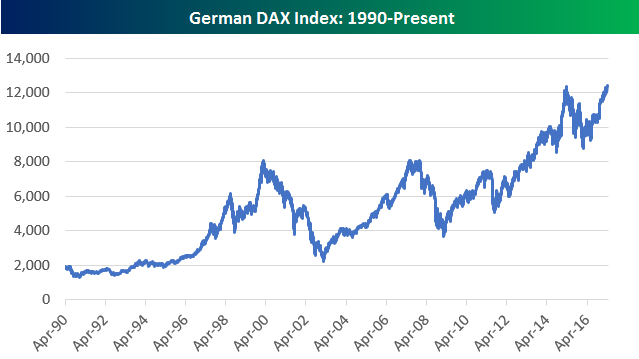
Ironically, while France’s equity market didn’t quite close at a new multi-year high today, Germany’s market did. In fact, it was a new all-time high for the DAX, which rallied 3.37% on the day, and provides another ilustration of how Germany has been the biggest beneficiary of the single-currency union. Below is a chart of the DAX going back to 1990. While France is still 23% below its all-time high from the year 2000, Germany is up 54% since that same point in time.
Start a 14-day free trial to Bespoke’s research platform to see more of our global equity market analysis.
Bespoke’s Asset Class Performance Matrix — 4/24/17
Start a 14-day free trial to see Bespoke’s best and most actionable financial markets research.
European equity markets surged today on the back of the first round of the French elections on Sunday, April 23rd. Below is a look at Bespoke’s Asset Class Performance Matrix. The matrix shows the total return performance of various ETFs across financial markets over three time periods. In this matrix, our time periods of reference are today (4/24), since President Trump’s Inauguration on January 20th, and year-to-date for 2017.
The left side of the matrix contains mostly US equity ETFs, while the right side contains international equity markets, commodities, and fixed income ETFs. As you can see, European equity markets like France (EWQ), Germany (EWG), Italy (EWI), and Spain (EWP) have exploded higher today by more than 4%. Notably, though, the China equity market ETF (ASHR) is in the red as regulators crack down on speculative trading.
Year-to-date, Spain’s equity market (EWP) is up more than any other ETF in our matrix. It’s also the only ETF up more than 20% YTD.
In the US, the Financial sector (XLF) is the clear outperformer today, but it’s still one of the weaker sectors year-to-date. Technology (XLK) remains in the top spot YTD with a gain of 11.40%, while Energy (XLE) is the biggest loser with a drop of 9.12%.
Commodities are in the red across the board today. Year-to-date, the broad commodities ETF (DBC) is down 5.81%, but it would be down much more if it weren’t for the precious metals, which are up 10%+.
Finally, fixed income ETFs are pulling back a bit today as investors shift into riskier assets. Even still, though, they all remain in the black year-to-date.
Start a 14-day free trial for additional asset class performance analysis.
