
Forget About F.A.N.G. – It’s All About the “Failing” Times
It seems not a day goes by where we don’t hear about the performance of the F.A.N.G. stocks and how they do nothing but go up. Even with Amazon’s (AMZN) current decline of nearly 10% from its intraday all-time high last week, the F.A.N.G. stocks are up an average of over 30% since the election. While no one is going to quibble with a 30% gain, the return of the F.A.N.G. stocks look nothing more than utilitarian when compared to the performance of the New York Times (NYT) during this same period. Helped in part by strong earnings this quarter, the Times has put up practically “all the returns that are fit to print” with a not so failing rally of 70% since the election!

Chart of the Day – S&P 500 Returns Relative to History
Best and Worst Performing Stocks on Earnings
Through last Friday, the average one-day change of the roughly 1,000 stocks that have reported earnings this season is -0.78%. This means investors are doing more selling than buying immediately following earnings reports this season. But of course…we’ve seen our fair share of winners this season. Below is a list of the stocks that have reported EPS that have gained more than 8% on their earnings reaction days.
As shown, Scientific Games (SGMS) ranks first with a one-day gain of 27.19% on July 24th. Arkansas Best (ARCB) ranks second with a gain of 25.35%, followed by iRobot (IRBT), Sarepta Therapeutics (SRPT), and Lemaitre Vascular (LMAT). Other notables on the list of big winners this season include Boston Beer (SAM), Netflix (NFLX), Align Tech (ALGN), Boeing (BA), Baidu (BIDU), First Solar (FSLR), and the New York Times (NYT).

On the downside, MicroStrategy (MSTR) has been the biggest loser with a one-day decline of 26% on 7/28 (it reported after the close on 7/27). Tile Shop (TTS) ranks 2nd at -25.93%, followed by MarineMax (HZO), PCM (PCMI), Echo Global (ECHO), and Triumph Group (TGI). Other notables on the list of losers that fell 10%+ on their earnings reaction days include Seagate (STX), Akamai (AKAM), Twitter (TWTR), and Buffalo Wild Wings (BWLD).
Start a 14-day free trial to Bespoke’s premium research platform for more in-depth earnings season trend analysis.

B.I.G. Tips – August 2017 Seasonality
Bespoke Stock Seasonality: 7/31/17
ETF Trends: Hedge – 7/31/17
US Oil leads the charge this week in our weekly ETF Trends Report, up over 6% on a 5 day rolling basis. Coffee and Energy have also been fixtures on the left side of this chart as of late, especially the past 2 weeks. Other notable outperformers include Retail and Gold Miners, both up over 3%. Biotech and Health Care providers have seen relatively significant losses as of late, most likely a reaction to the stalemate surrounding the Senate health care bill. Other recurring undeperformers are Transports and Natural Gas, down 2% and just above 1%, respectively.

Bespoke provides Bespoke Premium and Bespoke Institutional members with a daily ETF Trends report that highlights proprietary trend and timing scores for more than 200 widely followed ETFs across all asset classes. If you’re an ETF investor, this daily report is perfect. Sign up below to access today’s ETF Trends report.
See Bespoke’s full daily ETF Trends report by starting a no-obligation free trial to our premium research. Click here to sign up with just your name and email address.
Nasdaq Number of New Highs By Year
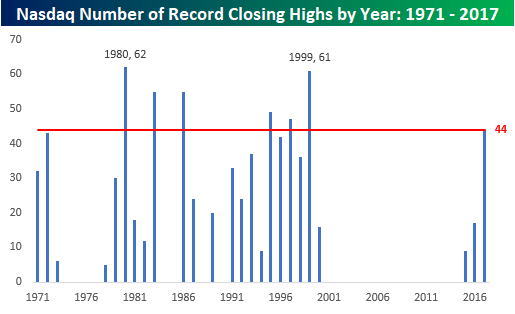
While there are still another five months left to go in the year, the Nasdaq has already seen 44 record closing highs in 2017, which ranks as the seventh most for any year since the index’s inception in 1971. So how many more record closing highs do we need to see in order to crack the number one spot? As shown in the chart below, we would need to see just 18 more record closing highs to tie the peak level of 62 back in 1980, and just 17 to tie the peak annual reading during the tech bubble in 1999.
While that seems very doable with five months to go in the year, the most important thing you would need to see in order for 2017 to break the record would be a continuation of the low volatility environment that has been in place all year. Even a pullback in the high single-digit percentage range, which is typical for most years, would stop the steady drumbeat of new highs dead in its tracks.
Perspective is Everything
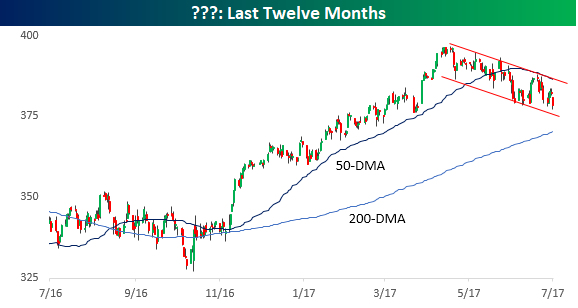
Here’s a quick question. Take a look at the chart below. From a purely technical perspective, what do you think? It doesn’t look very good, does it? After reaching a peak in May, whatever this chart is has done nothing but drift lower, putting in a series of lower highs and lower lows, and it has now erased all of its gains from its April break out.
Now, look at the next chart. This one looks a lot healthier, doesn’t it? This chart just recently hit a new high after a two-month consolidation period and remains right near its highs. Looking at both charts, most technicians would say the chart below is the more attractive of the two.

So, what are the two securities shown in the charts above? Believe it or not, they are actually both charts of the STOXX 600, which is an index comprised of large, mid and small cap stocks spread across 17 countries of the European region. The only difference is that the top one shows the STOXX 600 denominated in euros, while the second chart shows the STOXX 600 denominated in US dollars. Because of the decline in the dollar this year, the difference in performance between the two indices is close to 12 percentage points (STOXX 600 YTD return in local currency = 4.7%, STOXX 600 YTD return in USD = 16.5%). It just goes to show that when looking at returns, perspective (especially in currency terms) is everything. So far this year, US investors who are long Europe are feeling a lot more flush than their European counterparts.
Bespoke Brunch Reads: 7/30/17
Welcome to Bespoke Brunch Reads — a linkfest of the favorite things we read over the past week. The links are mostly market related, but there are some other interesting subjects covered as well. We hope you enjoy the food for thought as a supplement to the research we provide you during the week.
See this week’s just-published Bespoke Report newsletter by starting a no-obligation two-week free trial to our premium research platform.
Macro Long Reads
Clearing up some misconceptions about how the stock market works by Matthew C Klein (FTAV)
Contrary to popular opinion, companies don’t use the stock market to raise capital, and households are net equity sellers relative to market value. [Link; registration required]
Quantitative Easing and Long‐Term Yields in Small Open Economies by Antonio Diez de los Rios and Maral Shamloo (Bank of Canada Staff Working Papers)
This quantitative analysis of 4 central bank QE programs (Fed, BoE, Riksbank, and SNB) suggests that QE from smaller central banks does not have an impact on global risk premiums and therefore have a limited impact on domestic financial markets. [Link; 46 page PDF]
Corporate News
GE’s Jeffrey Immelt Is on Uber’s CEO Shortlist by Eric Newcomer (Bloomberg)
Immelt is departing from GE, but he’s reportedly high on the very short list of people the ride hailing company’s targets for the CEO job. [Link; auto-playing video]
Researchers have a new theory for why companies are sitting on ungodly piles of cash by Max Ehrenfreund (WaPo)
Two professors at NYU argue that the reason corporate cash is piling up is that a few dominant companies don’t need to invest to stay ahead, accruing huge profits that don’t go anywhere. [Link; soft paywall]
Investing
Trend Is Not Your Only Friend By Dr Ewan Kirk and Dr Chris Longworth (Cantab Capital)
A step-by-step walk through of the construction of a portfolio of assets which exhibit both trend and carry, creating larger risk-adjusted returns. [Link]
Would You Invest with Steven Cohen? by Julie Segal (Institutional Investor)
With the former head of SAC Capital Advisors soon to emerge from an industry ban following insider trading accusations, Steve Cohen is planning the launch of a hedge fund controlling $20bn of capital. [Link]
The Death of Equity Research Hasn’t Been Greatly Exaggerated by James Valentine (Integrity Research Associates)
A review of the challenges facing equity research, which are legion. That said, the author identifies areas where equity research can deliver value. [Link]
Communication
Why I tweet by Beatrice Cherrier (The Undercover Historian)
A long, sprawling essay on the value that Twitter can add for knowledge workers, through the prism of an economic historian. [Link]
What The Enron E-mails Say About Us by Nathan Heller (NYer)
An opportunity to review linguistics and data science in the context of a massive archive of digital communication, specifically the Enron email archives released as part of the investigation into that company’s collapse. [Link]
Are influencers turning away from Snapchat? by Eileen Brown (ZDNet)
A new survey of widely-followed “influencers” on social media suggest that Snapchat is on the way out, especially when coupled with a 22 percent drop in downloads over the last couple of months. [Link]
People
Origins by Blair Reeves
A very helpful review of recent data, research, and discovery into the origin of the human species over the last several hundred thousand years. [Link]
First Human Embryos Edited in U.S. by Steve Connor (MIT Technology Review)
Following similar efforts in other countries, US researchers have successfully edited human embryo genes in a lab. [Link]
110 N.F.L. Brains by Joe Ward, Josh Williams, and Sam Manchester (NYT)
A new study of donated brains from football players reveal pervasive chronic traumatic encephalopathy, a degenerative disease that attacks brain tissue and is tied to concussions and other head trauma. [Link; soft paywall]
Places
Grave Concerns by Jennifer Crossley Howard (Bitter Southerner)
A history of the Southern tradition of visiting the dead, eating a family meal and visiting the resting places of the dearly departed. [Link]
we’re still here by Anne Helen Petersen (Tinyletter)
A review of the very interesting question “Why does Montana have so few people and so many counties”? [Link]
I trained an A.I. to generate British placenames by Dan Hon (Medium)
A hilarious application of machine learning gives some amusing results. Some of our favorites: Brotters Common, Topswick End, Boll of Binclestead, Farton Green Pear End, Capton Briins Forehouint Eftte Green, Crocken-on’s Clow, Prrighstock Tabergate, and Stote S’ster. [Link]
Policy
Bannon Calls for 44% Tax on Incomes Above $5 Million by Margaret Telev (Bloomberg)
Standing in stark contrast to the Republican Congress, which has advocated the opposite sort of policy, White House Chief Strategist Steve Bannon wants a more populist bent. [Link]
Foxconn could get up to $200 million in cash a year from state residents for up to 15 years by Jason Stein and Patrick Marley (Journal Sentinel)
Foxconn (a major supplier of Apple’s iPhone value chain) is opening a new manufacturing facility in Wisconsin. While this is good news for Wisconsin manufacturing workers, it’s going to cost the state’s taxpayers dearly. [Link]
France nationalises shipyard to thwart Italian majority, angering Rome by Leigh Thomas and Crispian Balmer (Reuters)
While newly-elected President Macron has liberal, pro-market credentials, France is still France and will nationalize a shipyard instead of letting an Italian company take control of it. [Link]
EU explores account freezes to prevent runs at failing banks by Francesco Guarascio (Reuters)
In a remarkable pivot, EU policymakers are considering measures that would prevent depositors from withdrawing their cash if a bank is facing funding challenges. [Link]
Video Gaming
A video game you’ve never heard of has turned three teens into multimillionaires — and it’s just getting started by Matt Weinberger (Business Insider)
A review of the ecosystem that Roblox has built around its simplistic but extremely popular platform, where young coders can see huge revenue sharing numbers. [Link]
Education
A teacher’s solution to buy school supplies for her classroom: Panhandling by Amy B Wang and Emma Brown (WaPo)
A tragic comment on how we choose to fund schools: an Oklahoma woman was reduced to panhandling to provide basic school supplies for her class. [Link; soft paywall]
Miscellaneous
‘Phelps vs. Shark,’ Reviewed by a Shark by Fred the Shark (WSJ)
An important coda to the widely televised shark race earlier this week. [Link; paywall]
WWII pilots used North Carolina waters for target practice. Now their bombs are washing ashore. By Thomas Gibbons-Neff (WaPo)
70 year old munitions are emerging from the sea on the shores of North Carolina. [Link; soft paywall]
Have a great Sunday!