
The Closer — Cross Asset Correlations & Leading Indicators — 10/19/17
Log-in here if you’re a member with access to the Closer.
Looking for deeper insight on global markets and economics? In tonight’s Closer sent to Bespoke Institutional clients, we review recent cross-asset correlations and discuss leading indicators at both the state and national level.
The Closer is one of our most popular reports, and you can sign up for a free trial below to see it!
See today’s post-market Closer and everything else Bespoke publishes by starting a 14-day free trial to Bespoke Institutional today!
Bespoke’s Sector Snapshot — 10/19/17
We’ve just released our weekly Sector Snapshot report (see a sample here) for Bespoke Premium and Bespoke Institutional members. Please log-in here to view the report if you’re already a member. If you’re not yet a subscriber and would like to see the report, please start a two-week free trial to Bespoke Premium now.
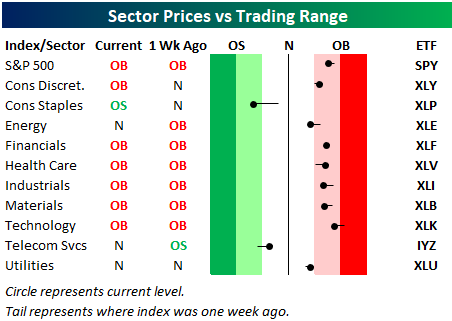
Below is one of the many charts included in this week’s Sector Snapshot, which is our trading range chart for S&P 500 sectors. The black vertical “N” line represents each sector’s 50-day moving average, and as shown, 8 of 10 sectors are currently above their 50-days. Consumer Staples remains below its 50-day and has moved into oversold territory, while Telecom has moved back into neutral territory.
To see our full Sector Snapshot with additional commentary plus six pages of charts that include analysis of valuations, breadth, technicals, and relative strength, start a two-week free trial to our Bespoke Premium package now. Here’s a breakdown of the products you’ll receive.
Investor Sentiment Dips in Yale Confidence Surveys
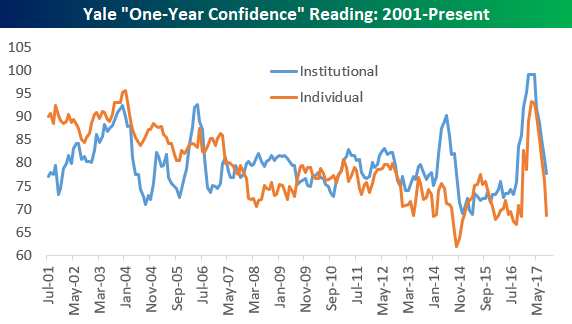
The Yale School of Management runs a monthly sentiment survey on both individual and institutional investors. Four questions are asked of investors, and below we provide charts showing the historical results through September 2017. The first chart shows the results for Yale’s “One-Year Confidence” reading which asked respondents how confident they are that the stock market will be higher a year from now.
As you can see, this reading amazingly spiked to nearly 100% in mid-2017 for institutional investors, and it got above 90% for individual investors. Over the last few months, however, bullish sentiment towards the stock market has dropped dramatically, and at this point investors surveyed are less optimistic towards stocks than they were just prior to last November’s Presidential Election.
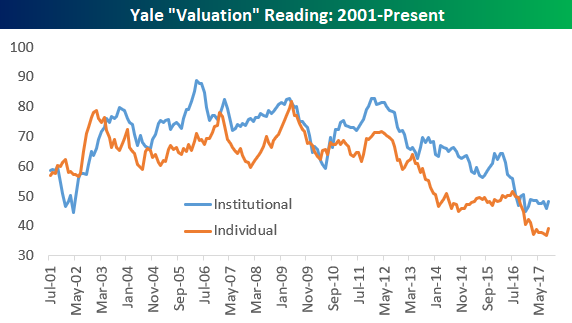
The second question covers investor confidence in the valuation of the stock market. High readings mean investors like the valuation of the market, and vice versa for low readings. As shown, both institutional and individual investors think valuations are as unattractive as they’ve been in the history of the survey dating back to 2001.
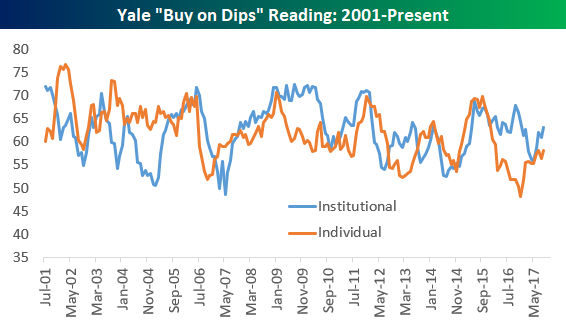
The “Buy on Dips” question asks investors how eager they are to buy stocks after the market experiences a big decline. This reading is in the middle of its historical range right now for both individual and institutional investors, but it has picked up a bit in recent months.
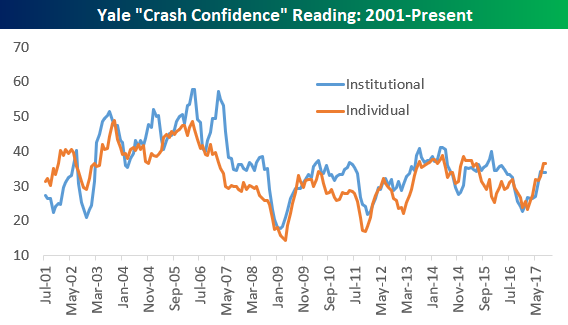
The last question asks investors how confident they are that there WILL NOT be a stock market crash in the next six months. A high reading means investors aren’t worried about a crash, which would be indicative of excess complacency in the market. While this sentiment measure has been rising slowly over the last year, it’s not elevated compared to historical readings by any means.
Earlier this week we published a more in-depth analysis of Yale’s sentiment survey including an update to our “Irrational Exuberance” indicator. Start a free trial to one of our membership levels to see the report.
ETF Trends: Hedge – 10/19/17
B.I.G. Tips – 2017 Sector and Asset Class Correlations
Housing Starts and Home Builder Stocks Diverge
Throughout the bust and the ensuing recovery in residential housing, the performance of homebuilder stocks has closely tracked the trend in Housing Starts and Building Permits. Below, we highlight this relationship by comparing the iShares Home Construction ETF (ITB) to the three-month moving average of Housing Starts and Building Permits. The relationship between the two is so strong that the correlation coefficient between monthly Housing Starts and the closing prices of ITB is 0.89, while the correlation of ITB with Building Permits is even stronger at 0.91. For the sake of reference, a perfect correlation would be a reading of +1.
While the historical relationship between the two has been strong, we would note that in the last year both Starts and Permits have been drifting lower even as homebuilder stocks have surged. In 2015, we saw a divergence in the opposite direction where Starts and Permits outpaced the gains in homebuilder stocks. In that period, the homebuilder stocks eventually caught up, so perhaps we are just seeing the opposite pattern now. The two haven’t always tracked each other step for step, but the fact that the builders have rallied so much this year even as Starts and Permits have declined should be monitored for any signs of that weakness finding its way into the homebuilder stocks.
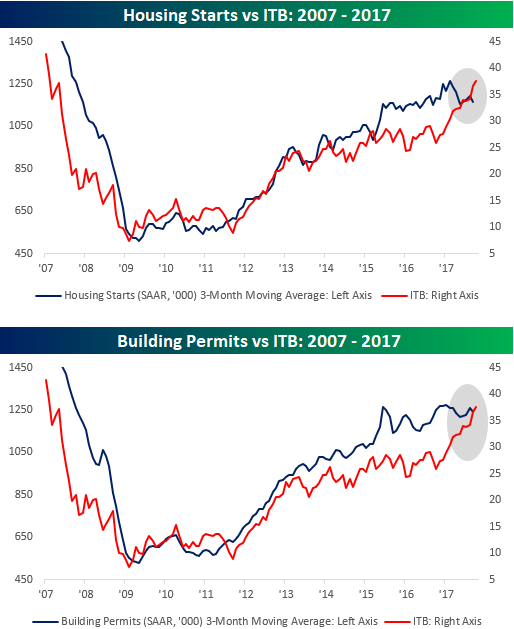
Chart of the Day: Capex Turning Up? Consider MYR Group (MYRG)
Philly Fed Positive For 15th Straight Month
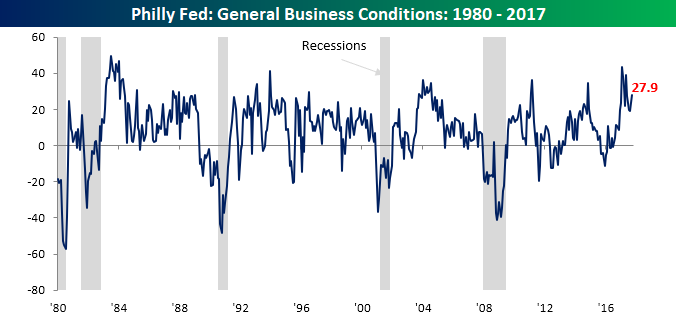
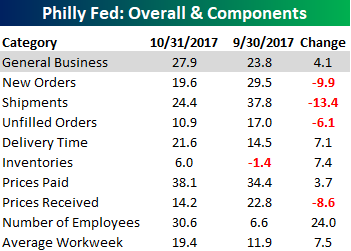
Manufacturing activity in the Philadelphia region continues to chug along as the Philadelphia Fed’s survey of manufacturing activity came in higher than expected for October rising to 27.9 compared to forecasts for a reading of 20. October’s reading represents the 15th straight month that manufacturing activity showed growth and is the strongest monthly reading since May. Looking at the chart below, the current period of consistent strength that we have seen has not been too common throughout the history’s survey.
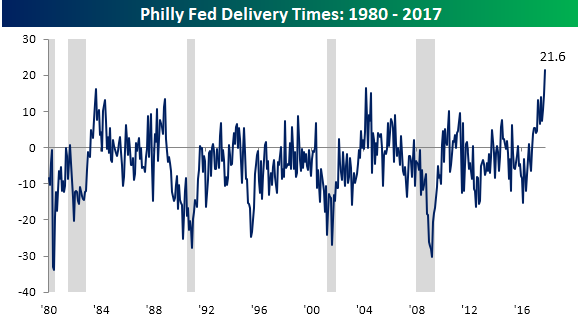
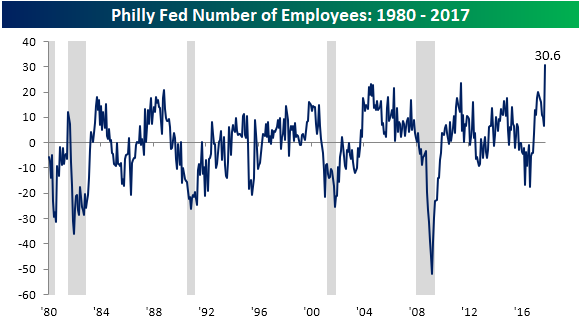
The table below breaks down this month’s report by each of its subcomponents and the results were mixed. While New Orders, Shipments, Unfilled Orders, and Prices Received all declined, we saw monumental increases in Delivery Time and Number of Employees. Both of these components are currently at record high levels in the history of the survey dating back to 1980 (see charts below).
the Bespoke 50 — 10/19/17
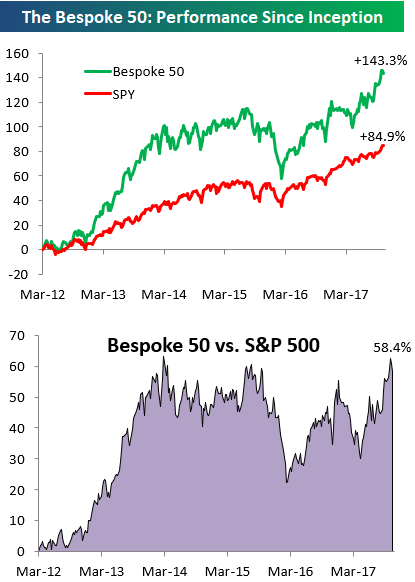
Every Thursday, Bespoke publishes its “Bespoke 50” list of top growth stocks in the Russell 3,000. Our “Bespoke 50” portfolio is made up of the 50 stocks that fit a proprietary growth screen that we created a number of years ago. Since inception in early 2012, the “Bespoke 50” has beaten the S&P 500 by 58.4 percentage points. Through today, the “Bespoke 50” is up 143.3% since inception versus the S&P 500’s gain of 84.9%. Always remember, though, that past performance is no guarantee of future returns.
To view our “Bespoke 50” list of top growth stocks, click the button below and start a trial to either Bespoke Premium or Bespoke Institutional.
New Lows For Jobless Claims
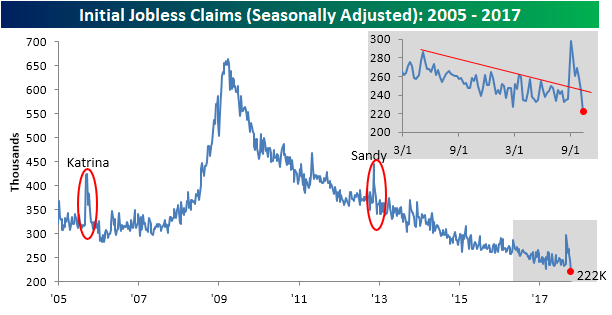
While there is still a ton of rebuilding and cleanup left in the aftermath of this Summer’s hurricanes, jobless claims have already put the impact of those storms in the rearview mirror. In this week’s report, first-time claims fell to an incredibly low level of 222K compared to expectations for a level of 240K. The last time claims were this low was all the way back in 1973! While the speed with which claims have already reverted back to their pre-hurricane trend seems quick, we would note that following hurricanes Katrina in 2005 and Sandy in 2012, claims saw similar (although larger) spikes, but quickly reverted back to their pre-storm levels as well.
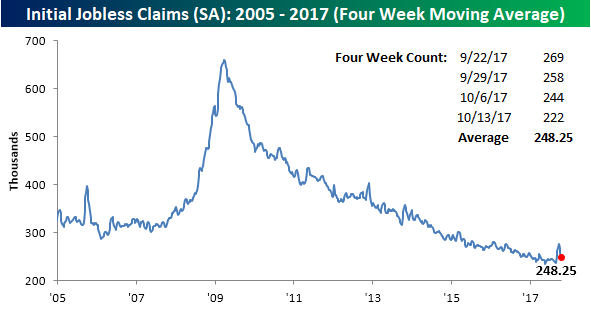
While weekly claims are at new multi-decade lows, the four-week moving average has naturally been slower to respond. In this week’s report, the four-week moving average dropped from 257.75K down to 248.25K. That’s still more than 10K above the cycle low back in May, but with a reading of 269K dropping off next week and then 258K falling off after that, the four-week moving average is set to sink like a stone.
On a non-seasonally adjusted (NSA) basis, claims fell this week down to 204.8K from 229.3K. That’s more than 120K below the average for the current week of the year dating back to 2000, and you have to go back to 1973 to find a week where NSA claims were lower at this time of year.
