
B.I.G. Tips — Fed Days January 2018
S&P 500 Performance Following State of the Union Speeches
A number of people have asked, so we wanted to provide a quick summary of how the S&P 500 has historically performed following State of the Union speeches by US Presidents since 2001. Given that the speeches take different tones depending on the President and where each one was at in their term, not to mention the state of the economy, it’s hard to say that this speech has any real direct impact on the overall market. Therefore, we would take the performance numbers with a grain of salt.
With that caveat, the one-week period stands out for its overall weakness, while the one-month period has been relatively strong. In the week that has followed SOTU speeches, the S&P 500 saw an average decline of 1.0% with gains in just 6 of the last 17 years. Regardless of who the President was, the S&P 500 has been down more often than it has been up. While one-week returns have generally been negative, one-month returns have been much more positive. Since 2001, the S&P 500 has seen an average gain of 0.74% (median: 1.16%) in the month after a SOTU speech with positive returns in all but four years. Under President Obama, the gains were even stronger with the S&P 500 having a median gain of 3.16% and only one year where it was down a month later. Thanks Obama!

Chart of the Day – Record Bullishness on US Stocks
Bespoke Stock Scores — 1/30/18
Streaks Are Made to Be Broken
With yesterday’s 0.67% decline for the S&P 500, the index ended a streak of 99 trading days without a decline of just 0.60% or more. As shown in the chart below, that’s the longest streak on record! If you needed further evidence that this market has been unbelievable lately, there you have it.

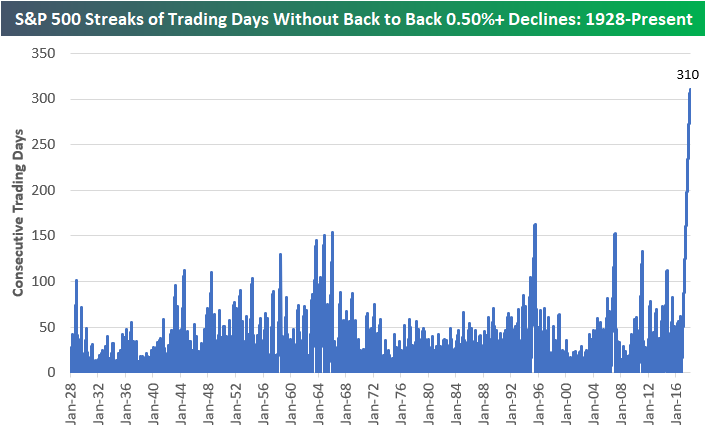
Another streak that’s just as — if not more — unbelievable is that the S&P 500 has now gone 310 trading days without experiencing back-to-back declines of 0.50%+. Think about that — it has been 310 trading days dating back more than a year to November 2nd, 2016 (just before the election) since we had two days in a row of declines of just half a percent.
As shown below, the current streak of 310 trading days — which may actually be broken today — is double the length of the 2nd longest streak without back-to-back declines of 0.50%+.
We’ve been saying it for the last few weeks now, but we’ll say it again — when the market does finally experience a pullback, it’s going to feel exponentially more painful for investors because of the simple fact that we haven’t experienced any kind of meaningful pullback in so long. And when emotions run higher than normal, it makes investors more eager to push the sell button. This in turn can cause even bigger declines, and the feedback loop begins.
The Closer — Capexpectations Surge, EM Performance, Savings Low — 1/29/18
Log-in here if you’re a member with access to the Closer.
Looking for deeper insight on markets? In tonight’s Closer sent to Bespoke Institutional clients, we review capex plans from US manufacturers, the benefits of the lower dollar for EM asset performance, and a review of the declining US household savings rate.
See today’s post-market Closer and everything else Bespoke publishes by starting a 14-day free trial to Bespoke Institutional today!
Earnings Deluge — 26%+ of S&P 500’s Market Cap Reports on Wednesday and Thursday
We’re already a couple of weeks into earnings season, but if you think it has been busy so far, you haven’t seen anything yet. Using our popular Earnings Report Calendar, we screened the S&P 500 for companies scheduled to report earnings by date. With just over 1% of companies in the S&P 500 scheduled to report earnings today, it’s a quiet start to the week. That slow pace won’t last long, though, as close to 6% of companies are scheduled to report earnings on Tuesday, and then even more companies are on the calendar for Wednesday and Thursday. In fact, with 7.2% of companies in the S&P 500 scheduled to report on Wednesday, it is tied with next Thursday for the busiest day of the entire earnings season.
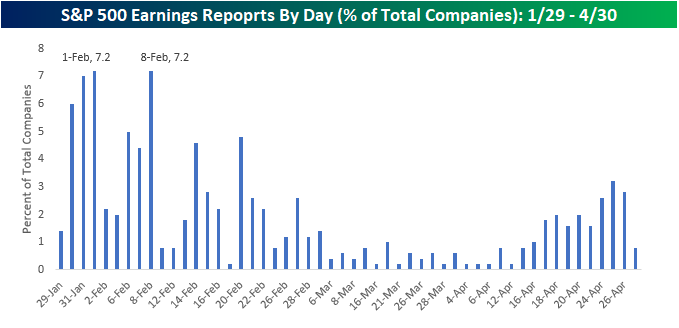
Not only are this Wednesday and Thursday notable for the number of companies reporting earnings, many of the S&P 500’s largest companies are reporting those days as well. On Wednesday, both Microsoft (MSFT) and Facebook (FB) – two of the five largest companies in the S&P 500 – report earnings after the close, and then on Thursday after the close we’ll hear from Apple (AAPL), Alphabet (GOOGL), and Amazon.com (AMZN) – the 1st, 2nd, and 4th largest companies in the index based on market cap. In total, on Wednesday we’ll hear quarterly results from companies representing 10.7% of the S&P 500’s market cap, and then on Thursday, we’ll hear from companies comprising 16% of the index’s market cap. Needless to say, the results we get on those two days will go a long way in deciding the direction that equities take this week. Rest up!

S&P 500 Stock Seasonality – 1/29/18
While we don’t ever suggest that investors should base their trading solely on the calendar, there is evidence that the market and many stocks do indeed follow seasonal patterns. This makes our S&P 500 Stock Seasonality report a useful addition to every investor’s toolbox. Using the last ten years worth of price data, our Stock Seasonality report looks at the average returns for the S&P 500, its eleven sectors, and its 500 individual stocks. In the report, we highlight the five stocks in each sector that have historically been the best and worst performers over the next two weeks. For each stock, we also include information such as average returns, the percent of time each stock or sector is positive/outperforms the S&P 500, and its historical performance over the next two weeks for each of the last ten years. The Stock Seasonality report is published on a weekly basis on Mondays, and it is available to all Bespoke Premium and Bespoke Institutional subscribers.
One stock that we wanted to highlight this week is Cooper Companies (COO). While COO is by no means one of the most well-known stocks or among the top performing S&P 500 stocks during the upcoming two-week period, it has been remarkably consistent. As shown in the chart below, the stock has seen positive returns during the upcoming two-week period in each of the last ten years for an average gain of 5.3% (median: +3.6%). Besides COO, only two other stocks in the S&P 500 have managed positive returns during the upcoming two-week period in each of the last ten years.
What’s even more amazing about EA’s performance in the upcoming two-week period is that it has historically been only the third-best performing stock in the S&P 500 during this period!

For active traders, our Stock Seasonality report is an excellent tool to help keep track of the best and worst times of year for the overall market, sectors, and individual stocks. To see the report and which two stocks have performed even better than EA in the upcoming two-week period, sign up for a monthly Bespoke Premium membership now!